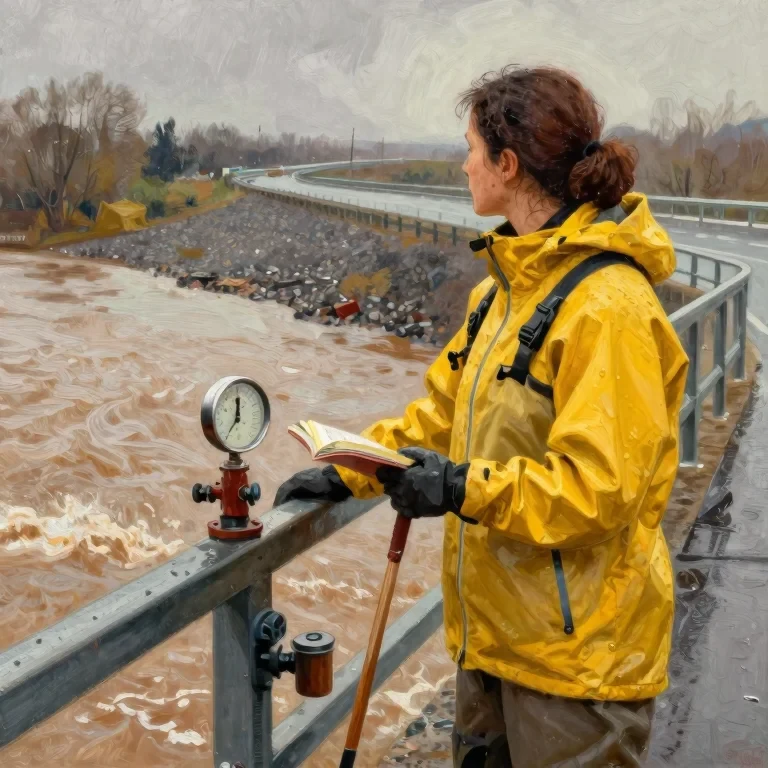
It was twenty past six on a Tuesday in August and the Manawatū at Aokautere was as low as it gets in an average year. The channel was slack and grey-green and the gravel bar in the middle of it stood a hand's width clear of the water. Mere Tipene, forty-four, gauging officer for the Manawatū River Authority, stood on the road bridge in her waders and her deep-yellow storm jacket with one hand flat on the rail, looking down at the staff gauge bolted to the abutment. She read it the way she reads everything, from the bottom up, twice, and then once more from the top down. 1.284 metres above gauge zero. In the field book it went in as 1.28, because a millimetre read off a painted board in flat morning light is a millimetre of optimism.
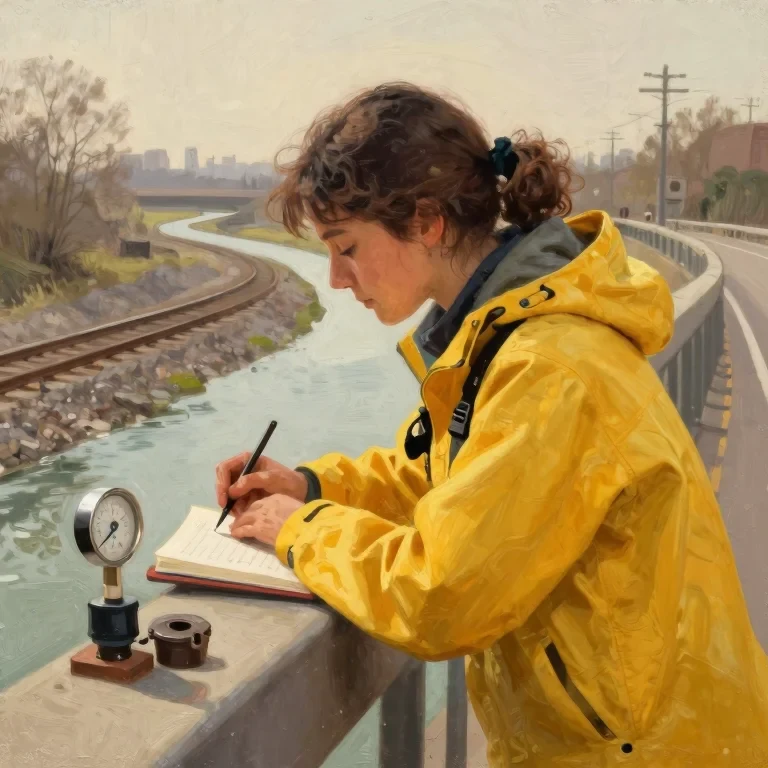
Her phone buzzed. The automatic gauge had photographed the same board thirty seconds earlier and sent the number it had calculated to the council's duty officer, and there it was on her screen in a neat little box. 34 cubic metres a second. Thirty-four thousand litres a second. She stood on the bridge and did the arithmetic she did every morning of her working life. A cubic metre of water weighs a tonne, so thirty-four cubic metres a second is thirty-four tonnes a second going past her boots, and 2,900 tonnes an hour, and 69,600 tonnes a day, which is thirty-four cars a minute going past in single file, all week, all year. That was the weight of the river. That was the job. Not the depth and not the width, the weight, and it was the only number anybody in the building ever wanted from her.
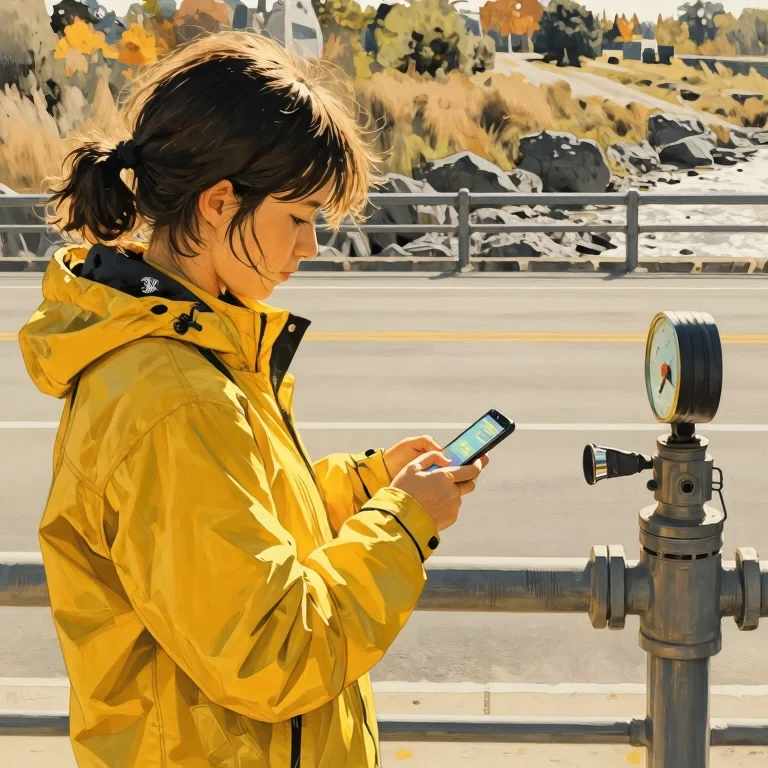
The depth and the width were free. Any fool could stand on a bridge in August and see how deep the river was. The weight was the hard part, because the board does not tell you the weight. The board tells you one thing only, which is how high the water is standing, and to turn height into volume you need a curve, and the curve is the whole of her trade. Hers went back to 1998. It is a sheet of paper with height up the side and volume along the bottom, twenty-nine measurements plotted on it, and a line drawn through the middle of the cloud of points. To get from the board to the box on her phone, Mere takes the height off the board and reads the volume off the line.
The trouble is that the line is not a fact about the river. It is a fact about the river on the day somebody drew it, and the river does not consult anybody about it. The 2013 line was fitted by hand with a straightedge through whatever points were available, because that was how the job had been done since the sheet was printed. Above 1.2 metres the straightedge had almost nothing to fit, so it guessed, and it guessed low. Mere had known that for four years and had never been able to prove it, because proving it means standing in the river with a current meter at a flow that nobody thinks is worth travelling to see.
Then the forecast came through. Heavy rain for Wednesday afternoon, forty millimetres in six hours over the catchment above the hydro station's intake, and a colder front behind it. The council's job on Wednesday is to decide, by two o'clock in the afternoon, whether to close the river road, pull the campers off the terrace below the Aokautere camping ground, and ring the farms on both banks of the bend. That decision is made by taking the flow the model gives for the river and asking the curve what height that flow stands at. There was one curve. She did not trust it, and there were going to be forty people in tents below it.

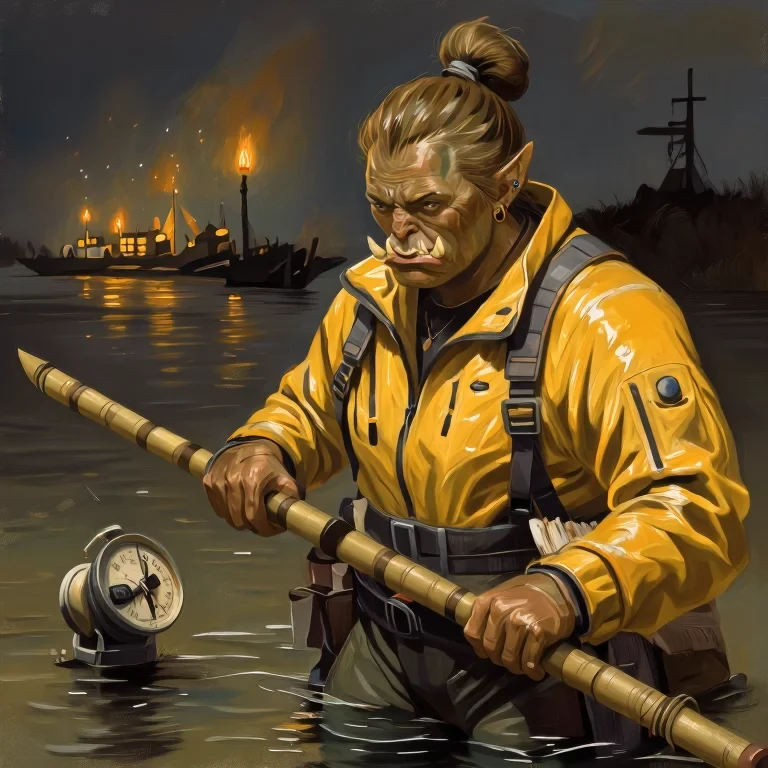
She went out onto the bar at half past seven with a wading rod, a current meter and a field book in a waterproof pouch. The rod is a metre and a half of aluminium tube with graduations painted on it every hundredth of a metre and a blunt steel shoe at the bottom, so you can put it down until the shoe touches the bed and read the water off it without looking away and losing your footing. The meter is a small propeller in a rubber boot on a separate wand, and its reading means nothing at all until you tell it how deep the water is where it stands. She set it at four hundred millimetres above the bed, which is the standard place, and it is six tenths of the way down in shallow water, because water moves fastest near the surface and slowest in the corner where the bed drags on it, and the truth about moving water is somewhere in between. She wrote the level on the rod itself in grease pencil and wiped it off with her thumb, waded eight metres downstream, and did it again.
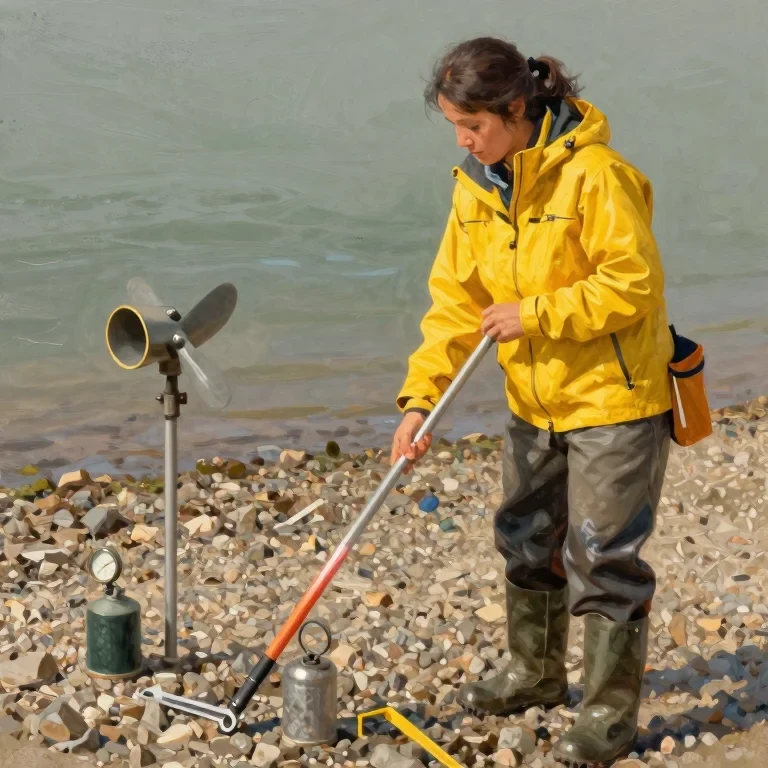
This is how a river is weighed. You cut it up into pieces with a line of poles. You measure how deep each piece is and how fast the water in it is going, and you multiply, because depth times speed times width is volume a second. Add up the pieces and you have the river. The multiplication is easy. The deciding is not. A gauger is told that no one panel may carry more than a twentieth of the total, because a panel that carries a great deal is a panel whose average speed is the average of nothing much, and a panel that straddles a change in the bed puts its error on one side of that change and keeps it there.
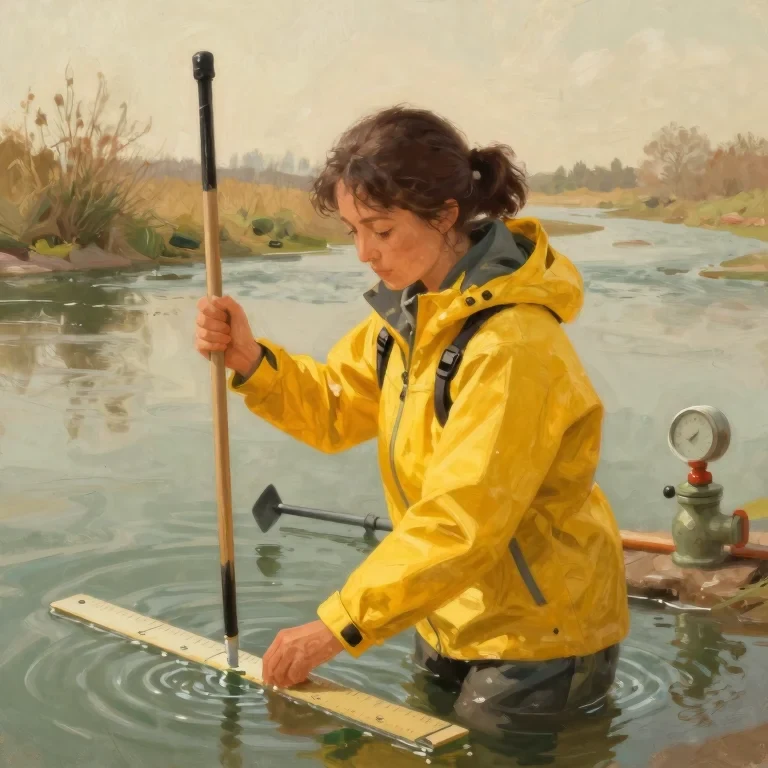
She ran the section on the standard spacing first, because that is what the old field notes use and because she wanted to see the river the way the people who drew the curve had seen it. Eleven verticals, ten panels. The deep water ran from the eighth metre to the thirty-sixth, deepest at 1.38 metres and going at 1.29 metres a second in the middle. One panel of it came to 5.4 square metres of water moving at an average of 1.265, which is 6.8 cubic metres a second. The next panel came to 6.75 and the one after that to 6.8, and the total at the bottom of the page was 39.1. So the three panels in the middle of the river were each carrying a sixth of the water, and the rule said a twentieth.
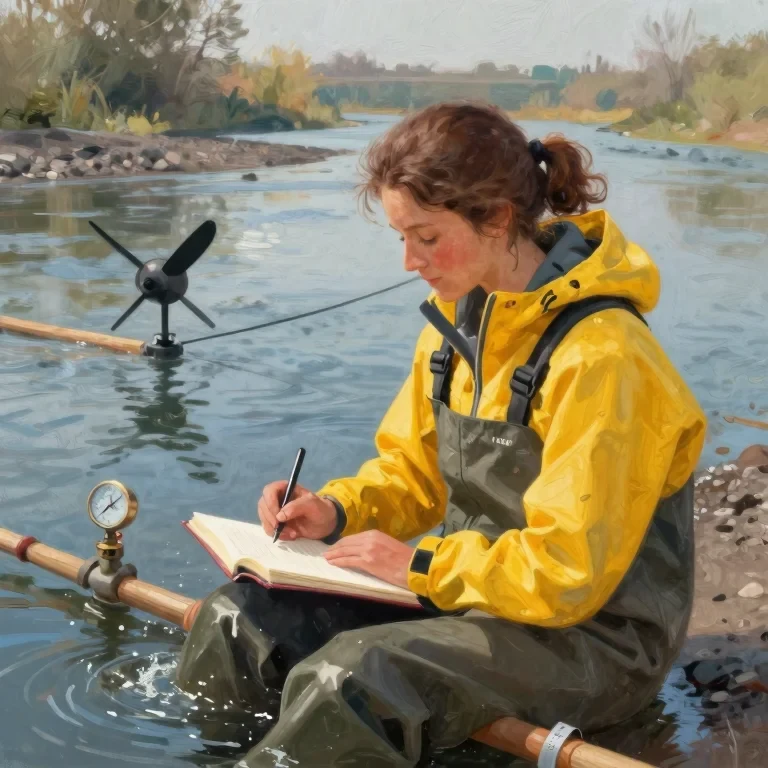
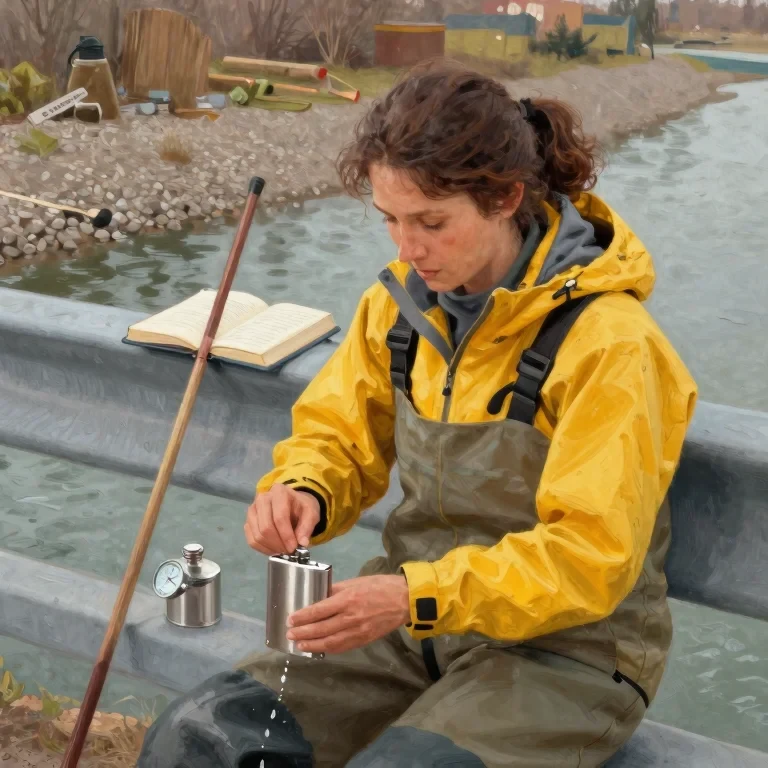
So she waded back up to the road, sat on the guardrail with a flask of coffee and thought about it, because this is the part of the job nobody outside it knows about. Four panels, four metres wide each, a sixth of the river apiece. The speed across a panel like that is not flat. It climbs to the middle of the river and falls away again, so the heart of each panel is doing more than its share and the edges are doing less, and the average of the two edges and the heart is an average of the wrong things. The fix is not arithmetic. The fix is more work, more poles and more readings in the one part of the river where the work matters. She went back in after the level had dropped a little and did the whole section again with the verticals closed to a metre in the deep water and opened out to three metres on the shoulders, thirty-three panels in all. That run came to 39.9. She did it again in the afternoon because one run cannot tell you whether you read the meter the same way twice, and the second came to 39.6. She averaged them to 39.7, which is seven sixths of 34 to the nearest tenth.
At ten past ten she walked the bar from end to end with the rod, because a bar is not a single height, it is a shape, and the shape is the argument. Its lowest point was 1.06 metres above gauge zero, and above 1.06 the bar has water on it, and where there is water on a gravel bar there is water going over the top of it and not through the section underneath.
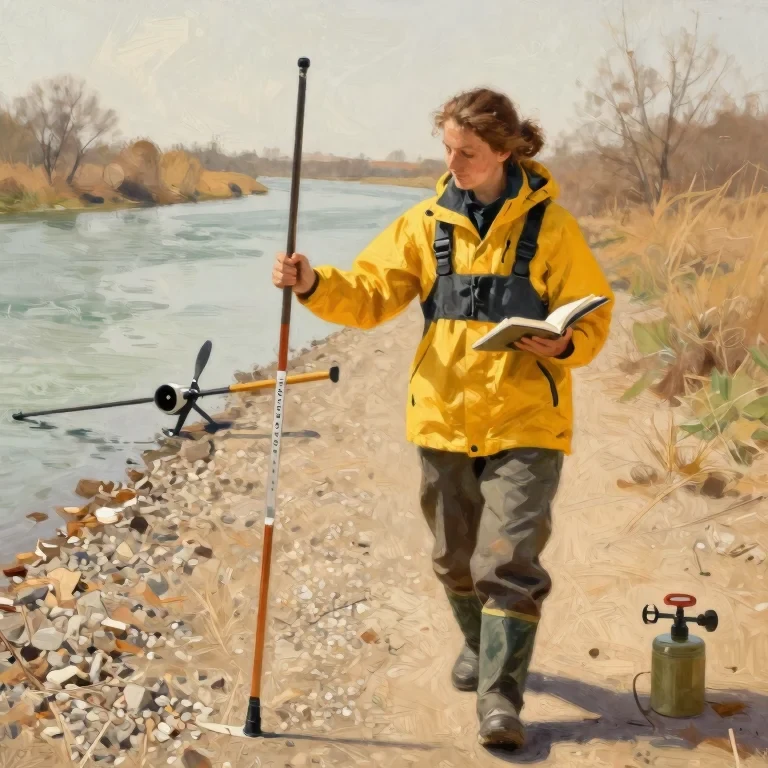
Then she telephoned Kieran Mahon, who drew the 2013 curve, who is fifty-eight, who has a degree in civil engineering and a way of listening that makes a phone call feel like a deposition. She gave him the two numbers before she gave him the story, 34 and 39.7, and the board reading they both came from, and the eleven verticals, and the thirty-three panels, and the two runs. It took her nine minutes and he did not interrupt once. When she had finished he said, “That is one part in six,” and she said, “It is five and a half cubic metres a second and the river is not sorry about any of it,” and he said, “Right. Do you know why?”
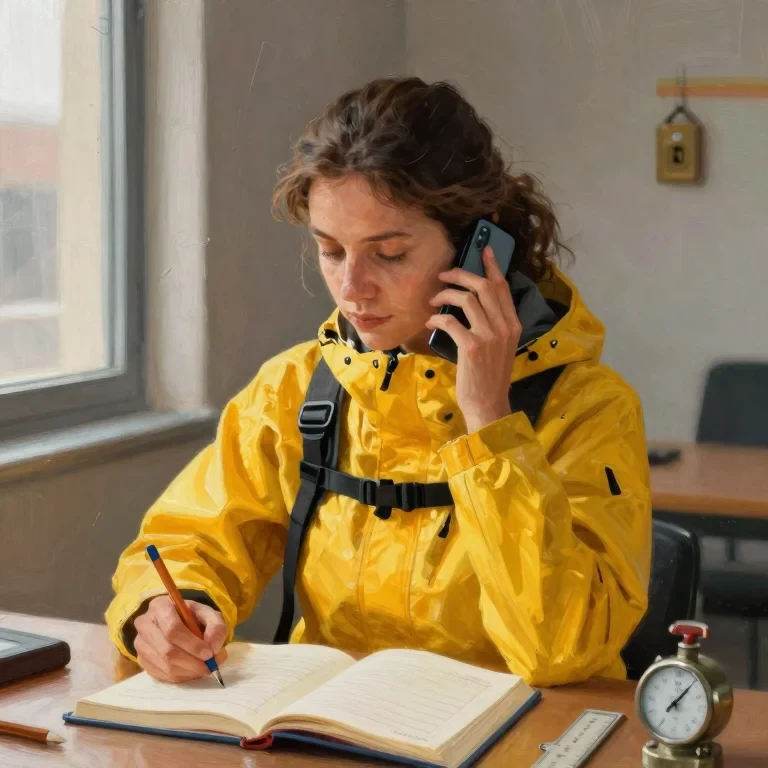
She knew why she suspected it. She did not yet know why it was true, and she told him so. The first explanation was the obvious one. A metre and a half of scour out of the bed since 2013 would do it, and worse, and she would have seen it with her own eyes, because a wading rod does not hide a hole a metre deep. The bed was where the 2013 survey put it, within a finger's width. The second explanation was the bar, and she had measured the crest of the bar and knew that the whole of the error was above it. She checked that against the one low-flow comparison she had, her own notebook from a Tuesday in 2021 when she had gauged at 0.60 metres and got 5.1 where the curve said 5.2, two per cent low where a scoured bed would have wanted twenty. Not scour. The bar.
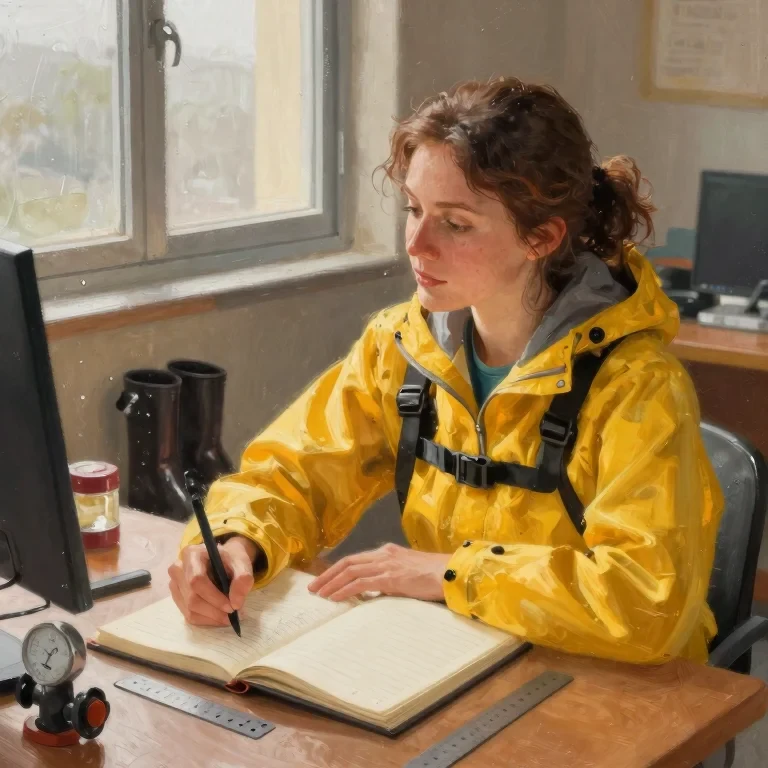
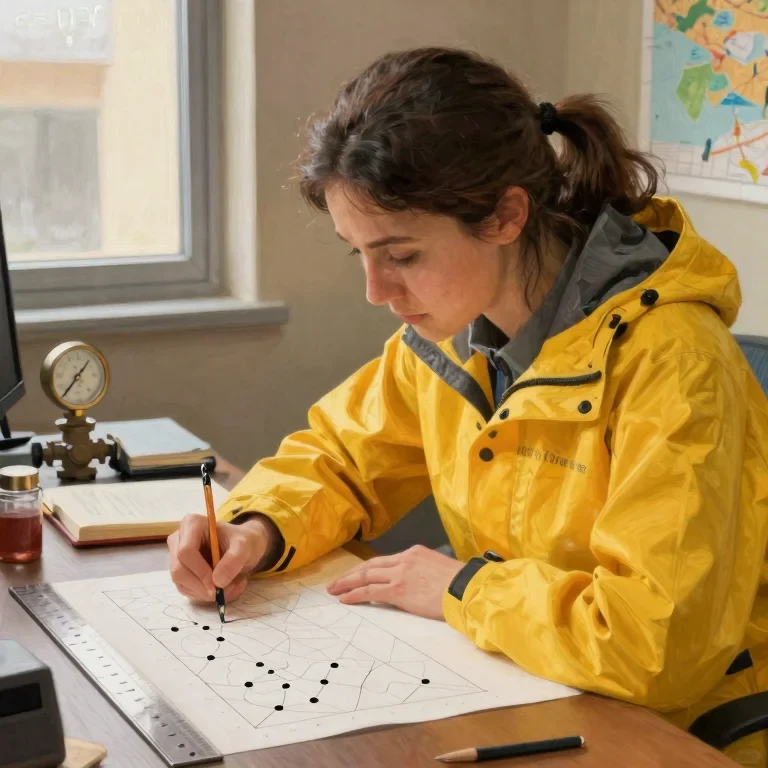
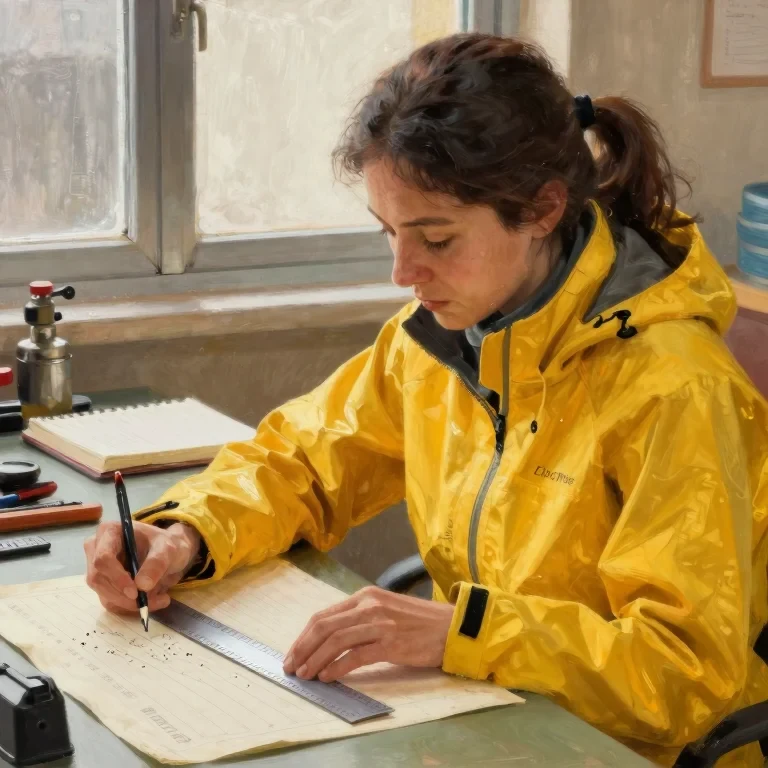
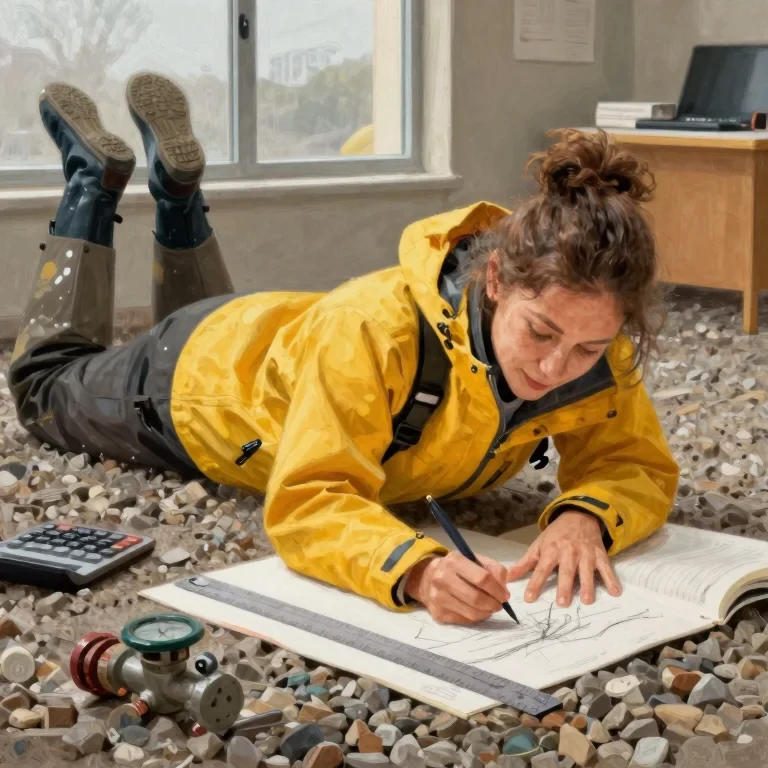
Then the third thing, the thing she had not expected and the reason she rang him back twice. If the bar is the answer then the error is not a feeling, it is a quantity, and a quantity can be calculated from the shape of the gravel and the depth of the water over it. So between one o'clock and four she did it at her desk with a ruler, a calculator and her boots still wet. Below 1.06 metres the bar is not there and the curve is right. Between 1.06 and about 1.2 the error climbs as the bar drowns out. Above 1.2 it is flat, and flat at one part in six, because a drowned bar takes its share out of the depth and keeps holding onto it. At 2.40 metres the old line said 135 cubic metres a second. Her gravel said seven sixths of that, which is 157.
The rain arrived on Wednesday a little after three in the afternoon, hard, off the west, exactly where it had been forecast to come from, and it stopped again at half past seven. The model put the peak at 160 cubic metres a second at ten past six in the evening. On the 2013 line that was a stage of 2.60 metres. On the line she had calculated from the gravel it was 2.42. The river road is embanked to 2.40 above gauge zero. So one curve said there were two hundred millimetres of road left and the other said there would be water on it, and the difference between those two statements was a gravel bar.
There was no way to get a second point on the curve in nine hours, and she had been on the receiving end of that fact for twenty-six years. Twenty-nine measurements spread over twenty-six years, spread deliberately from the pools of a dry summer fortnight to the flood of a lifetime, because a curve has to be pinned down all the way up and down its length and there is one chance at each flow per year at best. She had one new point at 1.28 metres. She could not invent the other twenty-eight, and everybody wanted a height for tonight.
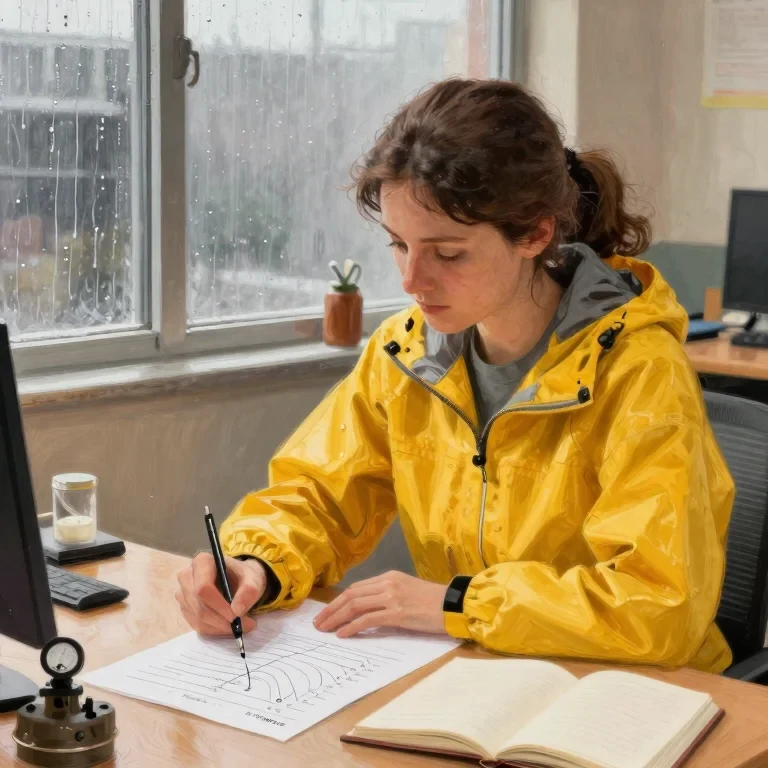
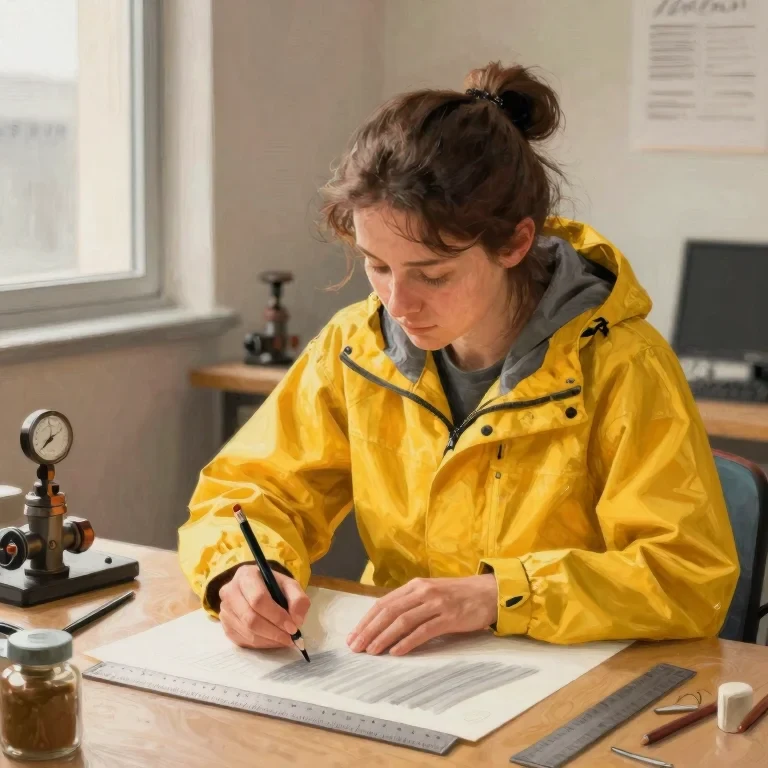
So she did the only honest thing left, which was to draw a band. She drew the 2013 line and she drew the line her own gravel forced, and she shaded the space between them, and she wrote three thresholds on the front of the sheet in the plainest words she could find. Close the road. Get them off the terrace. Leave them alone. She wrote them as heights and not as flows, because a height is the one thing a duty officer can read off a board in the dark at two in the morning, and because her two lines did not agree about what flow drowned the road at all. Kieran signed it, and then telephoned the duty officer himself and said the same three sentences he had said to her, which are that the Authority is not certain, that the number is a range, and that he would rather be the man who closed a dry road than the man who did not close a wet one. They closed it at six o'clock. The campers were moved to the school hall at eight by two volunteer brigades and a woman with a clipboard. The river crested at twenty past one in the morning at 2.44 metres.
Forty millimetres of the Manawatū covered the river road between twenty past one and half past one for eleven minutes, under the sodium lights of the hydro station, and then it came off the tarmac one dark stripe at a time from the crown down. Nobody's house was flooded. A man who farms forty hectares on the left bank lost a paddock of swede to a drain that could not cope, which is a cost and not a catastrophe and is the ordinary size of these things.
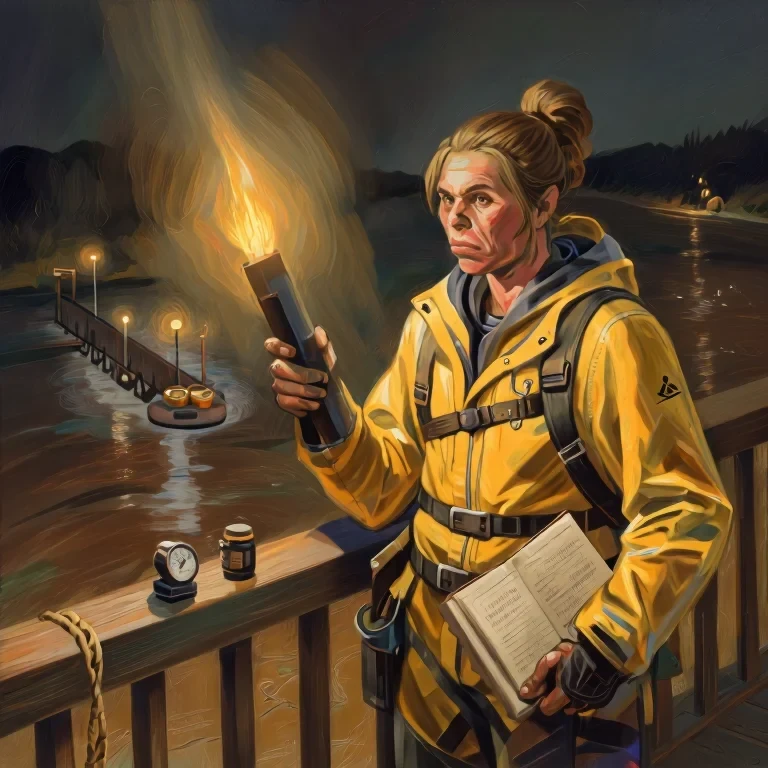
Mere was on the bridge from nine o'clock with a torch and the polarising glasses she uses for reading a board in reflected light, and she gauged the section on the way up at half past midnight because a flood is the only time you get to measure the top of your own curve. It was 1.9 metres deep in the middle and the panels were four times the size she had ever used, and her hands were not steady, and it came to 174 cubic metres a second. She did it again at two o'clock on the way down and it came to 161. Sixteen metres cubed a second apart, eight per cent, at the identical height, on the identical board, on the same night. The bed of a gravel river scours on the way up and fills on the way down and the slope of the water surface changes with it, so a rating curve is not a line. It is a loop, a narrow loop that opens as the flood gets bigger, and every flood forecast ever built on a single line has been quietly guessing which side of that loop to stand on.
Her gravel line had said 157 at 2.40 metres, which is 162 at 2.44. The loop said the river was somewhere between 161 and 174 at that height, so the desk and the boot had agreed with each other to inside a percent and had both of them sitting at the bottom of the loop, which told her the thing she already suspected about gravel, which is that a gravel knows nothing about slopes. On Friday she sat in the office and pinned the loop to the wall with two drawing pins and drew a soft pencil line through the middle of it, because a duty officer at two in the morning needs one number and not two. She wrote the uncertainty underneath in the same hand she had used in the field. Plus or minus five per cent, worse than that in a flood, and not to be used below the crest of the bar.
Then she came to fill in the log, which is the only part of the whole affair anybody else ever reads, and which has one row for Wednesday night and one row for Thursday morning because a log has one row for a night. The river had two answers. She wrote 174 on the rising side and 161 on the falling side, and she could not put both in the box, so she put 168 in the box and drew a line through it and wrote the other two in the margin, and the sheet went up on the wall carrying three numbers and no way to say which of them was the river.
There was also the other thing she had never once managed to measure. Forty tonnes a second of water is forty tonnes a second only if there is nothing in the water but water. There is fine gravel in it, and on the rising limb there is a great deal more fine gravel in it, and every kilo of that is a kilo her number does not count. A part in a hundred on a bad night, near enough, and she cannot put a figure on it, and everybody who uses her numbers is weighing a river that is very slightly heavier than the one she can stand in and measure. She closed the book. Out in the window the bar was showing again, a hand's width clear of the water, and the board at the abutment was at 1.19 and falling, and tomorrow she would go down and put her boots in it again.