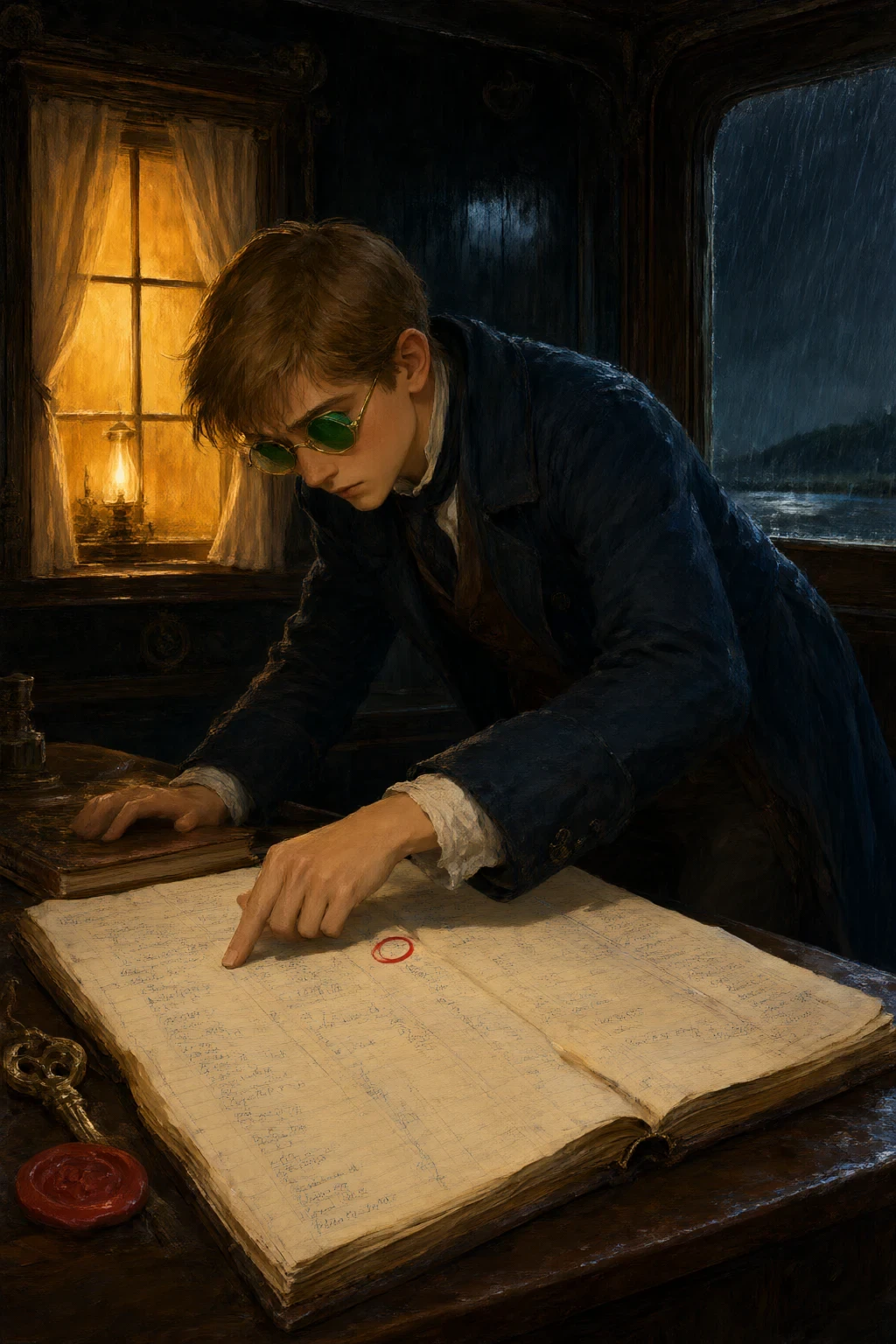
The Paper Caravan stood on four jacks in a chalk field with the rain driving in sideways off the drainage ditches. It had been raining two days. A mile back down the Salt Line the tent was a lit hill going away into the dark, and the road smelled of wet chalk, trodden sawdust and the low sulphur of the gas. Amos Small was seventeen, and he had been under-clerk of the Contract Ledger for six weeks, which meant he was the one who did the copying while Halloran Quill did the columns, and the reading, and the thirty years. That evening Quill put a card in front of him and said, in the voice of a man laying down a pen he was glad to be rid of, “Fair copy for the ringmaster. To-morrow. Renewals.” “To-morrow, then.”
“Twelve names. Eleven renewals and one new hand.” Quill pushed his spectacles up. The glass on the right was shell, and it laid a faint amber blur over that side of the room, so that half the card was the colour of tea. “Mr Vane reads from the card. Not from the book. The card, Small.” “It will be correct off the card.” Quill turned his green eyeshade down like a man going under water. “That is not the same thing, and I would argue the difference with anybody who has the leisure.” Amos copied. The card was in a fair hand that was not Quill’s. The ninth clause ran: the Company may renew this Agreement for a further term; the Signer’s body shall advance toward the animal named in the Schedule by the set measure stated there, or by such greater measure as the Signer shall by the Schedule agree; the Keepsake shall remain lodged with the Bookkeeper; and the term begins at the close of the current show.
“Greater measure,” Amos said. “What is the greater measure?” “It is in the Schedule.” “It isn’t. The Schedule says one-twentieth. The greater measure isn’t in the Schedule anywhere.” “Then the greater measure is what the Schedule provides for,” said Quill, “and the Schedule is not a document you are copying from. You are copying from the card.”
It was half past eleven when Amos turned the card over, and a quarter of an hour after that before he understood the thing on the back was not part of to-morrow’s work. The Ledger was ruled in three columns. Name, Particulars, Consideration. Eleven hundred volumes of it in cedar cases along the wagon, every page ruled by machine by a firm in Leeds that shut nineteen years ago, so the circus kept a jar of the ruling ink and never ruled a fresh page. Under the card there was a separate leaf, unruled. On it, Amos found a fourth column. Not ruled. Drawn. One line down the left margin in blue ink, made with a straight-edge and a mapping pen, and beside it, in a careful small hand he had been looking at for six weeks without seeing, thirty years of entries.
The first one he could read: “Winter of the fever year. Miss H. Dorrance, Pettifer Bridge. Lent me one shilling at the door of the carriage wash. Repaid in goods, spring. Never forgiven.” He read it four times. The next: “Forgiveness asked of me: no. Asked of me by me: no.” Then: “M. Brill. Asked three times what the greater measure is in figures, and to have it in writing. Ninety-one. Ninety-four. Ninety-six. Tray.” There were one hundred and sixty-one entries, and the leaf was not full.
He got the volume they were renewing out of and laid it open beside the leaf. The third column was Consideration. It said, for Mateo Brill: bed, board, wages at the Schedule rate, the bill, the Keepsake held safe, and the measure given in figures and in writing. That last had been in the contract since the year the man signed. And in the fourth column, in Quill’s own hand, three dates and three lines and no answer. Amos went down the column. Every name in it was a name in the Ledger. He checked eleven before he stopped, because it held nothing the third column did not, and because these were not the entries of a man keeping a private account of what he was owed. They were the entries of a man keeping track of what the circus was owed, and to whom, and by whom.
It was a second set of books. It had run beside the real ones for thirty years and nobody had ever been told it existed. Then he came to the bottom of the leaf, where the ink was blackest and the pen had been pressed hard enough to emboss the paper from behind, and there were three lines in red. “Thursday. Renewals read. M. B. declined. Continued.” “Thursday. Renewals read. O. V. declined. Continued.” “Thursday. Renewals read. J. S. not asked. Continued.” Continued. Not renewed. The same word twice, and then once, and then all three the same. Amos went back to the card on the desk. Twelve names. Eleven had a small mark in the left margin meaning read and hold. The twelfth had a mark meaning continued.
He did not sleep. At six in the morning, with the rain still going, he asked Halloran Quill whether a memorandum could be broken. “Say again?” “Whether a memorandum could be broken. A record of what people are owed. Not a contract. A memorandum.” Quill set down his pen. He took a while over it, and the taking of the while was the most like a man Amos had seen him be. “Strictly speaking,” he said, “a memorandum is not a contract. A contract requires two parties, a signature and a witness, and a memorandum has none of the three. It cannot be broken, because there is nothing there to break. It is ink.” “But it’s in the book.” “It is on a leaf of the book.” “That’s the book.” “That is a leaf of the book,” said Quill, “and whether a leaf is the book is a question I have declined to answer for thirty years, and been paid a small salary not to answer.”
Amos said, “If it’s a memorandum, it can be argued with. You told me that about pencil. And if one paying person in the room hears the argument, the rule is satisfied, the same as any contract.” Quill took off his spectacles, cleaned them on a cloth that was not clean, and put the shell lens back last, so that the room went briefly clear and then amber. “Do you know the words, Small, for what happens when a clause of this company is broken?” “The transformation goes faster. And it takes the nearest one, the same night, one degree off.”
“Yes. So a boy must be quite certain what he is reading, and to whom, and in front of how many people, before he opens his mouth about a leaf of paper in a wagon on a wet night.” He put the spectacles on. “And I will say this. I have not entered three names in a renewal column for three years running because I believe they should be there. I entered them because I was told they should be there. That is the whole of my thirty years, and I have never said it out loud, and you have made me say it.”
August Vane came into the Paper Caravan at ten past six with his hat in his hand, which he only ever did in the shed, and set it on the desk, which nobody did. “Small. I am told you have a card.” “I have a card, Mr Vane.” “August can hold a room. August has read the ninth for eight years without a stumble. My aunt says a ringmaster who cannot be trusted with the ninth is only shouting.” He said it to the wagon. “So. What.” “The ninth on the card is not the ninth in the book.” That is not a thing you say to a man at half past six in the morning. Amos said it anyway, and counted under his breath, one, two, three, four, five, and stopped at eleven, which is where he stopped counting most things. August Vane put both hands flat on the desk. “Read me the difference.”
“Three names on the card are marked continued. Mr Brill declined the last three renewals. Miss Vrain declined last year’s. Miss Sparrow was not asked, because the terms were not read to her when she signed, and there is a date and an hour in the book where somebody was meant to write that they had been.” “They did not decline. They are company. Decline is not a thing you do. You decline at the butcher’s.” “Mr Vane.” “They do not decline,” said August, “and I have read that ninth out of that card for eight years, and the ninth is the Company may renew, and the Company has renewed, and my aunt is the Company. If you have a thing to say about that, say it to her at a quarter to nine tonight, in front of the paying public, where a rule can hear it.” And he went out.
Amos looked at the card for a while. Then he opened the second drawer of the desk, which in six weeks he had never had cause to open. Inside it was a tin tray, and in the tray was paper. Not much paper. It had not been emptied in three years, because a tray in that wagon is emptied when the Director says so, and she had not said so. Amos counted: forty-one. Three in his own hand, thirty-eight in other hands. He read them all, because nobody had ever read them, and because in this company the things nobody had read were the things that ran it. “A lamp for the horse, three nights, had from the Lantern Works. H. Quill.” “That the safety be examined before the flying act.” “That somebody tell my wife what I do here.” And the oldest, folded twice and soft as cloth: “that I be told the name of the thing I signed.”
At a quarter to nine that evening, with four hundred and six people in the seats of the Ivory Tent and the corona up and one jet on it sooted dark so that a guttering shadow walked a slow circle around the ring as the pressure dropped, Halloran Quill stood at the ring edge and read the terms of renewal in a voice that eleven hundred contracts had been written for. Amos had put the book into the ringmaster’s hand and taken the card away. August Vane had looked at the book, and then at the card, and then out at four hundred and six people, and said, off the microphone, “Well. The card is a summary,” which is a thing a ringmaster says. Then he opened the book. He read it well. That is the thing about August Vane: whatever is put in his hand, he reads.
And at the third name he stopped, because the third name was Mateo Brill, and Mateo Brill was standing in the ring with his tail through the back of his belt, and the page said declined, and the page said continued, and a man thirty per cent lion can do a great many things with his face and cannot do a lying one. “No,” said Mateo Brill. Behind Amos, in the front row, somebody made a small noise, and it went round the building like a wave off a stone, and it was neither a bad noise nor a good one. Four hundred and six people who had paid to see a lion. “No, sir,” said August, and he read the next line, which was the consideration, and the line that said the measure should be given in figures and in writing, and he read that one twice.
“Mateo. I have read that clause eight years and never had cause to.” He had stopped being the third person now, and nobody in four hundred and six seats noticed except Amos. “Is it not there?” “It is there,” said Mateo. “It has been there since the year I signed. I asked three times for the figure in writing, and I asked for it in the tray, and the tray was not emptied.” He said it evenly. He had said it to himself a great many times, in the dark, in the Widow’s Pew. “I have not declined out of temper. A term of the consideration has not been performed, and a performer whose consideration has failed may set the failure against the renewal and take what is owed instead of what is asked. That is not mine. That is on your card, on the front, in the fourth line, and Mr Quill has read it to me in this tent more than once and called it a formality.” “You have read me the fourth line,” said Mateo. “Then it is the law of this ring tonight, and I set it against my renewal, and I decline. I should be obliged if August would read the third column before he reads anything else.”
The third name was ten years old, and it took longer. It took longer because Junie Sparrow stood in the ring and said, in a small voice the corona carried perfectly, “Can I ask something? Just one, and then I’ll do it how you say.” “Ask it,” said August. “Was it read to me?” said Junie. “When I signed. Is there somewhere it says somebody had to read it to me?”
The Director stood up in the front row on the second sentence. She was a small woman in a plain grey coat who had arranged, over some decades, to look like a person you would not look at twice. Nobody in the circus had ever seen her sit through a show. “Mr Small is correct,” she said. Her voice was not loud. It did not need to be; the tent was a bad place for a voice and a good place for a silence. “The fourth line is the law of this ring. I have read it out twice a season for eleven years and called it a formality, and I was wrong to call it a formality, and Mr Brill is right to set it off, and I will not argue with him in front of you.” “Madam,” said Mateo.
“But I should like to say the other half, since you are all being given the law of this ring and you did not pay for half of it.” She did not sit down. “If Mr Brill’s consideration has failed, then Mr Brill has no wages, no bed, no bill and no teeth this winter, and he is thirty per cent lion, and there is no work in this country for a man who is thirty per cent lion. I say that in a full tent because it is true, and because some of you have been buying tickets since Tuesday.” Amos counted nineteen, twenty, twenty-one. “You have taken three contracts off this company tonight,” said the Director, “and I have let you, because I would rather be robbed in public than rob in private. The winter bill at Harrow’s Landing is short three acts. Some of you will be able to tell me what that means by March.”
And then she sat down, and folded her hands, and August Vane stood in the middle of his ring with a book open in both hands and no idea at all what to do with the rest of his evening. That is how the Gilded Menagerie discovered, in public, with four hundred and six people in the seats, that the fourth line had always been the law.
The show went on for an hour and ten minutes and it was over an hour early, because there is no lion without Mateo, and no lion means no gate, and the gate was the middle of the bill. The money went back at the door. A man in a brown suit stood in the mud behind the ticket wagon with a cash box, giving it back to people who did not want it, and one woman stood there until he closed her fingers on it. Nell Ferrule took her nine days in the Widow’s Pew on the Sunday, alone, in the dark, and they did not come back in order. One of them was a Thursday in October three seasons back, in the ticket booth, warm, the roll open on the counter and the day’s takings ruled off in a strong slanting hand she had not seen in three years. It came back all at once, and it was not hers to enter.
Junie Sparrow was the only one of the three who was happy. The terms had not been read to her on the day she signed, and the contract said they should be, and that was a condition of the consideration, and a condition never performed was a condition never begun, and so the whole of it came down at once and left her owing nobody anything. She came to the Paper Caravan and asked Halloran Quill for the cedar box, and he opened it without a word. Twenty-six Keepsakes in twenty-six paper twists, and Junie found hers by the description, because it was the smallest: a hairpin, steel, bent double. She held it in both hands for a while. “Is it fine?” she said. “Is it fine? Is it fine?” Nobody could tell her what it was about. She put the hairpin in her hair, where it did not stay.
Amos Small emptied the request tray on the Tuesday. Forty-one pieces of paper on the long desk, under the single window with the green curtain drawn back, and the Bookkeeper reading each one out loud in a voice nobody had ever heard him use that way, twice, and putting it in a pile. Then he said, “Mr Quill. There is no request from Miss Ferrule in the tray.” “There would not be.” “She has a claim.” “She has a claim,” said Quill, “and she has had one for three years, and it will not go in the tray, because a girl of thirteen does not put a claim in a tray, and every year she has not put one there it gets a little heavier, and by the time she is old enough she will have taught herself that she does not put things in trays. That is not a fact about her. That is a fact about the tray.”
Amos said, “Then I shall have to go and ask her to say it out loud.” “Yes,” said Halloran Quill. “And when she has said it, bring it back to me.” He wrote it in the fourth column, in the margin, with the straight-edge, in ink, under the name of Nell Ferrule: booth money, three years, every Saturday, one thousand and thirty-eight entries, and the days, asked for, said out loud, heard. “Will you countersign it, Mr Quill?” Quill looked at the entry for a long while. “I have never in thirty years written down anything I was not told to write down.” “Not tonight,” said Amos Small. “Sit down,” said Halloran Quill, and signed it.