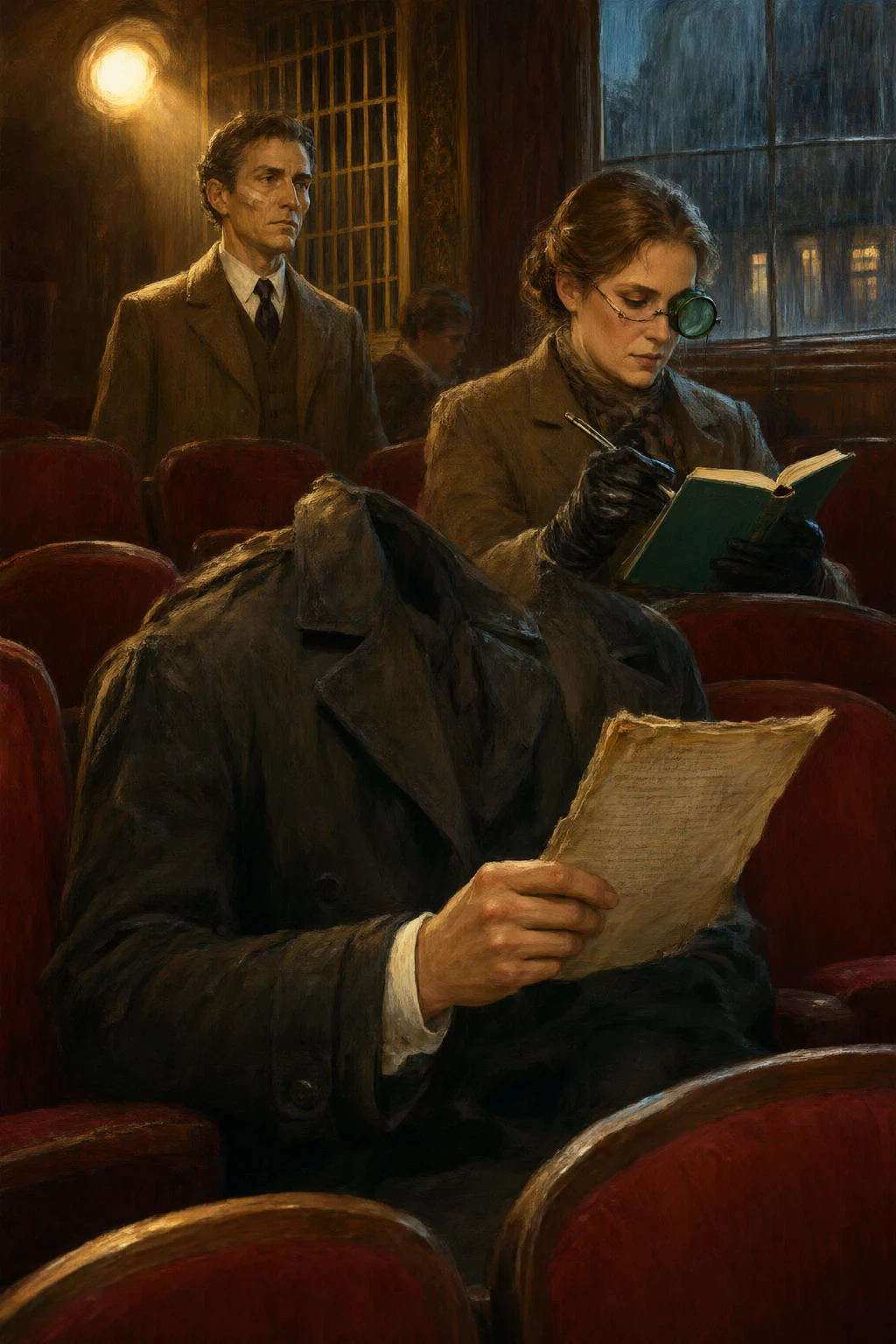
Elias Kett had printed the programme for the Thistlewire for eleven seasons, and he had never once been inside the house, and on the Thursday of the Salt Harvest he went in by the front for the first time, because a man does not sell a thing for eleven years and then find out what it is made of. It was raining on Ardle Street in the way it rains in Verrow, which is not falling so much as standing in the air. The gas jets outside the doors burned a hard blue-white and every wet flagstone up and down the pavement was the colour of weak tea. There was a queue at the box office window. There was a horse tied at the stage door with its head down and a man in a cabman’s coat asleep on its back.
Above the doors there was a board in gilt lettering, four feet of it, and the gilt was not on the board, it was on the letters, and the letters said THE SALT HARVEST MR E. AVELINE · MISS ROMAINE VESSEY · MR CLELLAND DRAX MR TACE RUNDLE · MRS FENN HOLLE · DR AMBROSE QUILL Kett had set that type. Not this month — the standing type, kept locked in the forme in the cellar of Three Fish Lane between two other men’s work, so that it was always ready and never broken down. AVELINE, upright, in a Caslon he had chosen himself out of four on an afternoon in a bad mood. He could have told anybody in Verrow where the S was in that name. He gave his name at the window, and a boy looked it up in a list, and said row F, and Kett went up through the cold panelled lobby, past the Subscription Office with its brass grille, and into the house.
The house was a horseshoe. Four hundred and twelve seats in red velvet worn pale at the front row, as velvet always is at the front row, because that is where the weather gets in. The plaster ceiling was stained the colour of tea. The gas mantles along the sides had been turned low, and there was a noise coming off four hundred and twelve people that Kett, who works alone in a room with a press, had no vocabulary for at all. Row F was halfway up and to the left. Seat fifty-one was the eleventh from the aisle. He sat down, and the seat took his weight, and he put the programme on his knee, and he was in a theatre.
The house filled around him. He had a programme in his hands and nothing else to do with them, which is the condition in which printers are most dangerous, because a programme is only a piece of paper with a claim on it. He read the claim. Salt Harvest, a play in five acts by Solomon Frend. Costumes and effects by the house. The cast list, with the gilt names. The notices: the second act begins at nine; the smoking side is the right-hand side; the gallery is closed. And he read the back, because he had printed the back, and the back is where a printer puts the truth. The conditions of subscription, in eight-and-a-half point, in a face he had set himself in 1871 and had not looked at since: No subscriber shall be permitted to enter the auditorium after the curtain is raised. The house lights shall be raised at the curtain and lowered at the cue.
No subscriber having been informed of any matter of the performance shall purchase any seat for the remainder of the season, and the Subscription Office shall refuse such entry in its own hand. Kett had set that line in 1871. He had set the word refused, and the word hand, and he had thought nothing of them, because they are words, and a man does not read his own type. The Salt Harvest begins with a river and a handcart and a man arguing about a toll. The fourth lamp came up amber. The fifth came up green, and the green lay along the actors’ hands and the wet boards like water in shallow grass, so that everybody standing in the light was warm on the face and cold underneath. The Younger Brother came on in the third minute, and Kett, who was thirty years of setting other men’s words, knew inside four seconds that something was wrong, and then took eleven minutes to find out what.
The man who came on was not Mr E. Aveline. Kett had never seen Aveline and did not need to have. He knew the name as a piece of type. A name on a programme is a shape, and a shape is a promise, and this man did not have it. He was lean. He was about forty. He had a tan that did not come from a river, and it had the particular evenness of greasepaint gone into a skin and stayed there, and on each cheekbone there were two small strips of flesh-coloured tape holding something together that had been worn away and laid again so often it had given up. But that was not what told him. What told him was the coat.
Brown serge, single-breasted, four buttons, and cut so well that it made every other costume in the play look like it had been made on a stage. And the left shoulder was let out by hand — not taken in, let out — a good half inch, with the seam opened and resewn in a thread that did not match, by somebody who knew exactly what they were doing and had a strong opinion about the wearer. Kett had been printing cloth merchants’ cards for thirty years. He knew a well-made garment at forty feet in bad light. Then the young man took the glass the Doctor offers him, and held it in a way Kett had seen before, in a photograph, in a shop window, a still of a man in a white wig at the Lyceum with a glass in his hand and a great deal of stage behind him. Everybody in Verrow had seen that face in the paper for ten years. It was not on this stage.
Kett put the programme down on his knee and did the thing that a man does when the count does not come out. He began at the beginning of the list and went down it. Aveline, he had printed a notice about on Wednesday morning, on page three, a stop-press of a single column, because the paper sets a column in a morning and the morning had been wet: NOTICE. The company at the Lyceum Theatre are locked out at their employers’ instance from this date, salaries held pending adjustment, and the management ask the public to disregard the announcements of the week. He had set that himself. He had pulled a forme at half past six on a wet Wednesday and set the notice in two hours and it had gone to press at ten, and there were four thousand two hundred copies of it in Verrow, and he had never once looked at the play.
He went down the rest of the list. The Ferryman was played by a man with a real limp, which the programme did not mention and which a doctor would have mentioned. The Widow Ferrers had a voice like a hand on a wet rope. The Correspondent, who has four words in the second act, was a girl of about seventeen and she came on and said them and went off and was not written down anywhere, in the cast list or the programme or the printed bills, and the house did not know her name and could not have told anybody afterward. Which left the Younger Brother.
Kett sat in row F and worked it out the way he would work out a forme that had come off the press short of two hundred, by the shape of the hole, and then he stopped, because the arithmetic had nothing else to give him. There is no name in a building for the thing he had just established. He could not write it in a book, and he could not say it, and he could not, if he thought about it for very long, be entirely certain of it either. The gas hissed once, the way it does.
At the half the house lights came up by inches and stayed at half, and the house made the noise four hundred and twelve people make when they have been sitting still for fifty minutes. Row F stayed darker than the rest, which Kett noticed, and which he attributed to a dead mantle and then did not attribute to anything at all, because a man does not query the gas. In the lobby he found a boy of about fifteen on a stepladder with a shuttered lamp in one hand, one eyebrow burnt black, oiled silk wound round his forearm, moving along the row of the front stalls and dimming it, one seat at a time, so that somebody could walk down it in the dark without anybody seeing. He had come out for one reason and he now stood at the window with the reason in his hand.
“Sorry. Chair is mine,” said the woman behind the bars, to a chair, not turning round. Her right hand was in a black kid-leather glove with the index finger gone shiny at the tip, and a green lorgnette hung on a black cord at her breast which she did not look through. “Miss Karrow. I print the programmes. There is a fault in the playbill.” “Is there.” She turned round. “I should think there is. There is a fault in it every week and I have never once seen one.” “The name at the head of the cast. Aveline. It is standing in the forme as Aveling.” The woman wrote nothing down. “How long has it been standing.” “Three weeks. It comes off a clasp. The g nearly closes on the n in that sort of weather.” “I see.” She looked at him for slightly longer than a woman looks at a man who has come to tell her about a letter. “You are Mr Kett.” “I am.”
“You are in my book. Row F, fifty-one, the season, taken out on the first of October in a compositor’s hand, because the season goes in from a list and yours came in on the list.” She turned and squared the teal cloth volume on the desk. “Now. What else.” “Nothing else. That is all. It is only a letter.” “That is all. Sit down.” He sat down. The counter was cold. Behind her, the Subscription Office was a small panelled room with a cold desk and a brass grille, and the Season Book lay open on it, quarter-bound in teal cloth with a gilt edge, opened every day of the year at the same page, its columns of names in eleven different hands and one at the head of the list in her own.
Karrrow was not reading it. She was counting. She had a ruled sheet in front of her with three columns on it and a tally in the third, and she was going down the tally with a pencil the way a man goes down a list of figures he has checked once already. “The reconciliation is at the interval,” she said, without looking up. “It is done at the interval every night of the season. The house is counted at the top of each act and at the interval and the count is brought here and the book is brought here, and the two are made to agree.” “That sounds like a formality.” “It is the only thing in this theatre that is not a formality, Mr Kett, and I have four hundred and twelve people upstairs who have never had to think about it, and I would thank you not to think about it either.”
She put the pencil down, and it was then that Kett understood that she was not going to let the evening go the way he had planned it. “Row F,” she said. “Fifty-one. It is empty at the top of the first act and it is occupied at the interval. It cannot be both. Those are the two counts and I have both of them in my own hand, and one of them is wrong, and the one that is wrong is the one I have to correct.” “It was not empty. I was in it.”
“You were not in it at eight o’clock, and this theatre does not take a man’s word for where he was at eight o’clock, it takes the man in the seat, and at eight o’clock there was nobody in the seat. You came in at the third scene, which is a thing the theatre allows and does not record.” She turned the Season Book a quarter turn and put one finger on a line. “So. I have two courses, and I am obliged to offer both, and I offer them in this order because it is the kind first. You can surrender the seat for the remainder of the season and hold it for the new one, and there is no money in it either way. Or I cancel the subscription and refund you the balance of the season at the counter, tonight, in cash, and the seat goes back on the list and is sold at the half-price window, which is where it always goes.”
“That is a considerable thing to do to a man for being late.” “It is a small thing to do to a seat, Mr Kett. You are not being punished, and I would be obliged if you would not describe it to me as a punishment, because in a fortnight some other man will come in at the third scene and I shall have to do it to him, and if it is a punishment there will be a second thing invented by Friday, and I have not the hands for it.” He looked at the ruled sheet. The two columns, and the tally. “I surrendered it,” he said. “I cannot collect the balance in sovereigns in a bag on a wet night, and I am not a man who wants a scene in a lobby.”
“That is very sensible. Thank you.” She wrote for a while. “There is a line at the bottom of the reconciliation for the subscriber. Not for the surrender, Mr Kett, there is no surrender. For the fact of the surrender. I cannot have a seat back on the list with nothing against it, and you will not be here when the next man comes, and I cannot have it in my own hand and nobody else’s.” “You want me to write my name.” “I want you to write your name at the bottom of a sheet of paper, once, in my office, with the counter between us, and then go back up and stand at the back of the house for ninety minutes, and then go home in the rain, and not to say anything to anybody about it, and I would be obliged for the last part particularly.” He took the pen.
It was a bad pen. That was the thing he could not put down afterwards. The nib was split and the ink was thin, and he had set the type for the words on the top of the sheet, which was a thing he recognised and could not get past. THE SUBSCRIPTION OFFICE RECONCILES THE SEASON BOOK TO THE HOUSE. SEAT CANNOT BE UNOCCUPIED AND OCCUPIED IN THE SAME COUNT. THE SUBSCRIPTION IS CANCELLED AND THE SEAT REISSUED. Then a ruled space, and the printed word SUBSCRIBER under it, and a line. He wrote on it, in a printer’s hand, upright, without a spur: Elias Kett, compositor.
That was the frightening moment, and it lasted perhaps four seconds, and he could not have told anybody afterwards what he was frightened of. It was not the losing of the money. It was the word compositor. He had written his trade under his name in a book he had never been inside, in the hand of a man who sets other men’s names in metal and never signs his own, in the one theatre in Verrow where a name is a description of a person, and the woman in the black kid glove had not read it and would not and had no need to. “Thank you,” said Ilse Karrrow. “You may have your money at the window. You are the only person in this room tonight who will be paid anything, and I should like that noticed.”
Half the house went out into the rain at the interval and the half-price window filled with them, and there was a girl of about seventeen standing by the pillar with her coat on and a length of bright red thread knotted round her right wrist, looking at the board over the doors as if it were a document somebody had lost. Kett looked at her for a while. He had printed the number of her words in the cast note, in six-and-a-half point, under a line that said FOUR WORDS, SECOND ACT, and had set it in a smaller size than the notices about the smoking side, and had thought it comic. She did not ask him anything. He did not speak to her. There was not one person in that lobby he could have said it to, and he had got as far as working out that he could not, which was as far as anybody in the building ever got.
At the second-act cue the house went down, and the foyer filled, and a young man of about twenty came in with a rain-dark overcoat and a programme, and stood in the row, and said, quite gently: “Is fifty-one free? I have it from the window.” “No,” said Kett. “It is mine.” “It is mine from the window. Half price. They said the holder had gone down with the balance and did not want it.” “He did not go down. He is standing here.” The young man looked at him, and then at the seat, and then, being a decent sort in a decent coat, apologised, and Kett apologised, and the whole business took four minutes and was conducted with perfect good manners, and neither of them said one word about it that was true. Then Kett got up, and took his programme, and stood at the back of row F in the aisle with his face to the stage and his back to four hundred and twelve people.
Nobody threw him out. That is the thing he could not get over, and it turned out later to be the thing that had been true all the evening. There is no clause, no procedure, no ejection, no usher with a hand on his shoulder, no anything at all. He had lost his seat at a counter over a column of figures, and the building had not one rule that could put him out of it, and so he was still in the house, and he was simply no longer a man the house had counted.
The second act is the market. The Younger Brother comes in from the left in the brown serge, and the sister is on the stair, and he tells her about the morning their mother drowned. Somebody saw their mother at Sennet market, at the weigh-house, with her coat over her arm, and the rain coming through the roof of the shed, and a woman cannot drown twice. It is nine words in the printed programme and it is the best thing in the play, and Kett had read it and admired it and thought Frend was lucky with it, and had never once thought to ask himself where a man gets a sentence like that. The man standing behind him in the aisle was about twenty years old. “Was that Frend’s?” the young man whispered. “The market bit. That was the best bit.” “It is the best bit.”
“They say the fellow who plays the brother has a way of holding a glass.” He shifted his weight. “They say Frend is dead, though. That is what my cousin said. He said you cannot write a bit like that if you are not in the room for it.” “He is dead eleven years,” said Kett. “So somebody else is saying it, then.” “Yes,” said Elias Kett. “Somebody else is saying it.” The second act went on. The house made its noise at the right places. In the seventh row, a man who had a season ticket and a name in a book an hour ago and no longer had either, and a young man with a programme bought at the window for one and six, watched a face in brown serge do a thing neither of them could pay for.
At the curtain the house came up and four hundred and twelve people got out of red velvet that had been pale at the front row for forty years, and Kett went out under the board with the rest of them. He stood in the wet on Ardle Street a minute with his hat in his hand and looked up at the gilt. AVELINE. VESSEY. DRAX. RUNDLE. HOLLE. QUILL. Nine feet of painted tin in a black frame over a door, and the rain coming down the gilt in beads, and the gas making the pavement the colour of weak tea, and the queue at the half-price window standing in the street.
He had set that type. He had chosen the Caslon out of four on an afternoon in a bad mood. It was still standing in the forme in the cellar of Three Fish Lane between two other men’s work, locked in, ready, unbroken down, and Thursday morning it would be printed again, four thousand two hundred of them, and the name at the head of the list would go out onto Ardle Street for the eleventh time, correctly, standing upright, and a man would carry the paper home, and a man would read it, and no part of that chain has Elias Kett in it anywhere. He had gone half a mile home before he understood the other half of it, and it was the half that would keep him.
He had been on that stage of the list too. A compositor sets the name. A compositor prints the name. A compositor reads the name, if the name is to appear, and the fact of having read it is a Position in the building, and the terms of the Position are that the name is what the building requires and not what the reader has, and he had kept the terms. For the whole life of this play he had set the name of a man who was not in the building, and he had never been told that the job required it, and he had never once required it of himself, and the wage came in every Friday in a sealed envelope with nothing written on the outside of it.
He went up to his rooms over the shop on Three Fish Lane and washed the ink off his hands and did it badly, the way he did it every night of his life, and got a smear on the cuff of his working coat and did not notice that either. Then he pulled Thursday's forme, which is nothing at all to do, and locked the standing type in, and went to bed.
On Sunday the paper came off the press with Aveling in it, and on Monday the proof of the same notice came back from the man at the Lyceum for correction, and on Tuesday Kett came down at half past six into a cellar that was cold in a way that had nothing to do with the weather, and pulled the notice forme, and set a column in four-and-a-half point, because a single column is a single column whatever size you set it. LOCKED OUT AT THEIR EMPLOYERS’ INSTANCE FROM THIS DATE, SALARIES HELD PENDING ADJUSTMENT. And after it, because he was thinking about the house, and because it was in the second act and he had been thinking about it for three days, he set two more words in the same four-and-a-half point, and the compositor who was not there to object to it was him. THE MANAGEMENT ASK THE PUBLIC TO DISREGARD THE ANNOUNCEMENTS OF THE WEEK.