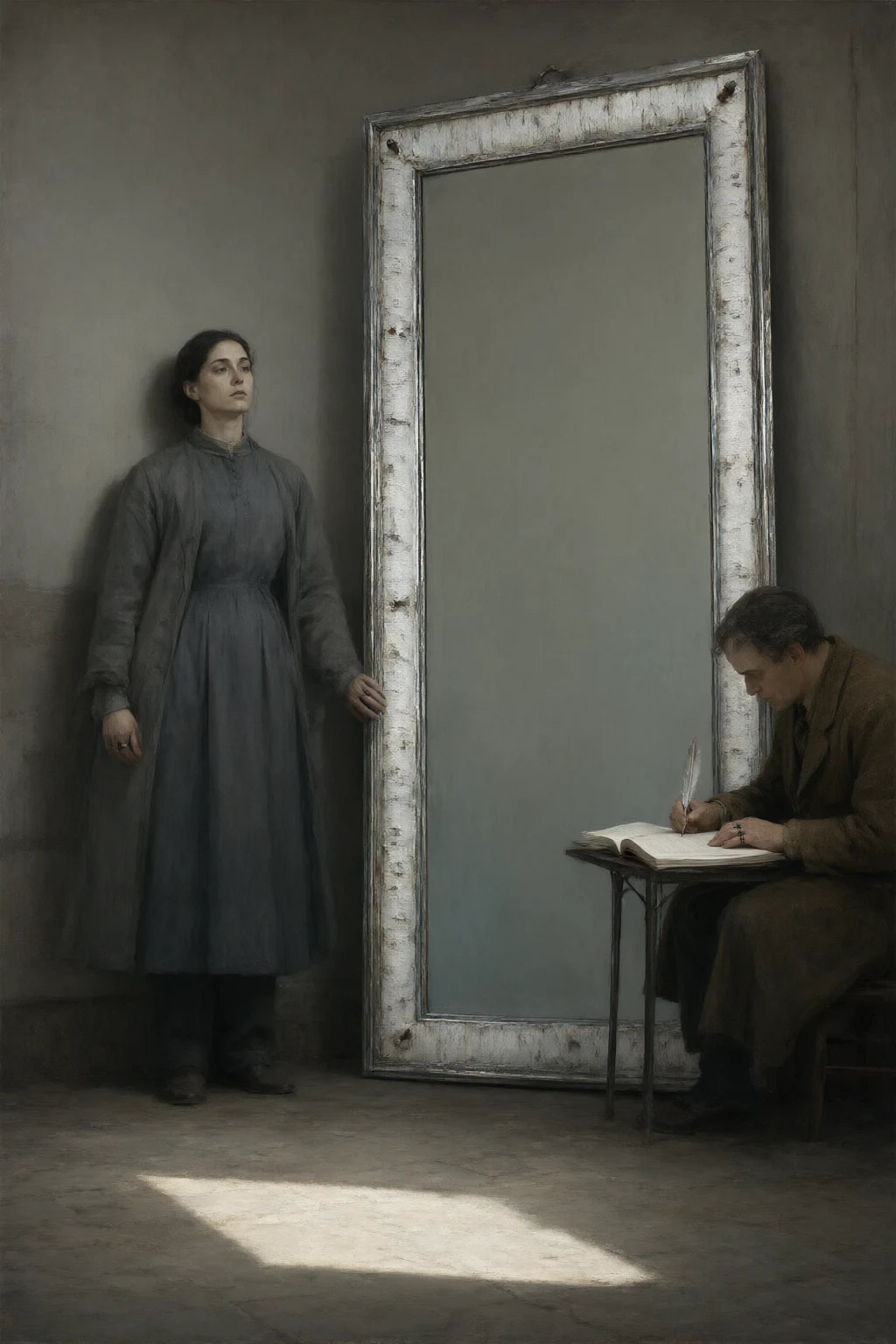
The mirror had served the crown for a hundred and nine years, and in all that time it had answered eleven thousand times a day, and it had never once been asked the right question. It stood eleven feet high in the Hall of Reflections, black glass leaded into a frame of white birch and forged silver, angled four degrees so that whoever stood before it found themselves slightly taller than they were. The court called this flattering. The mirror's showing was also the one document from which there was no appeal, and every queen in the line had understood without being told that this was a privilege and not a mechanism, because being told would have required saying something. On the morning the Queen came to consult it, the hall was cold and smelled of tin and old beeswax, and the mirror was doing what it always did.
It was not vain. Vanity wants to be looked at. The mirror did not care who looked. It stood in a dark hall on a floor cut with a channel three feet deep, and gave itself entirely to the thing that was put into it, which was never a face at all. "Your Majesty," said Hesther Ollivant, "it is customary to say the formula. I have kept my reflection in the empty space beside your shoulder for forty-four years, so that we look at the hall and not at each other." "I have said the formula every day for three years," said the Queen. "I would like, once, to say something else." "There is no other. There has never been any other." "Then let us find out what the glass believes, if anything believes it at all." "The glass does not do what it is told," said Hesther. "It does what it was cast to do."
The Queen took a breath. She was thirty-one, found in a wood as an infant, raised in a cottage at the edge of the ash forest, and brought to this hall at twenty-eight and crowned because the mirror had shown her face, after which the council said nothing for a full minute, which was the closest thing to an acclamation any of them could manage. She said: "I have been thinking about the beard." Nothing happened. The glass held her reflection with perfect, insulting clarity. "That is not what I meant," she said, "and I would like it recorded that I did not mean it." The mirror made a sound. It was not a voice. It came from high up in the lead, from the joint where two panes met, and it had the quality of a bell heard through a chimney. Hesther went down on both knees and said, "No, no, no, it is not permitted, in a hundred and nine years it has not—" "It spoke," the Queen said. "It said break me."
The council refused that afternoon, and refused with an elegance the Queen admired for the rest of her life. Lord Vansca, chancellor, laid it out with the care of a man laying a table for guests who are leaving. The mirror is the proof of succession. The proof is what the seven provinces pay their levy upon. Break the glass and the queen is a woman in a chair; the provinces will know it inside a month, and inside a year they will be sending men. And that is not conjecture. It is what happened in the fourth of Ovelle, when a pretender could not produce a showing, and a very tidy war followed for two years. "You are telling me," said the Queen, "that you would rather risk a war than break a piece of glass." "I am telling you that I have never heard a piece of glass ask to be broken, and that a thing which asks to be broken is not thereby made harmless. Ask the kiln-masters what the black plate does with pressure."
So she asked the kiln-masters. The seventh of them, Mace Audry, seventy-nine, came down from the upper works with her hands stiff from the cold and sat near the furnace and regarded the Queen with the flat courtesy of a tradesman consulted free of charge. "It vents," she said. "Where?" "Down." Audry moved one gnarled finger at the floor. "The channel goes into the bedrock at the founding. Things come up through the roots of the ash wood and go down into the cottage at the wood's edge, and the woman there has been burning them since before I was born. Unsaid things. There is a cellar of jars. Nine hundred of them, my father said, and one on the top shelf heavier than the shelf." "And the venting has increased." "Threefold since the spring. The pressure goes somewhere. Where would you like it to go, madam? Through the plate, into the hall, over all of us? Or down into the wood?"
The place was as she remembered it and not as she remembered it, and the difference was in the bark. The last half mile of ash stood with its bark lifted into long horizontal folds like a stack of paper left in a damp room, and the folds were warm, and when she laid her palm on one it gave, faintly, like the flank of a sleeping animal. Where the stream came down over the stones it made a noise she had heard every childhood summer, and it stopped the instant she stopped moving. The old woman was called Nen, and was styled in council correspondence as the old woman at the wood's edge, an address that had outlasted three monarchs. She was eighty-four and not glad to see the Queen and did not pretend otherwise. "You were told you were found," said Nen. "I was. I would like to know who found me."
"He brought you in a basket," said Nen. "The man with the wood. He set you on my step and went back up the hill, and that is the whole of what I have ever known, and I have been asked by better than you and have not improved on it." "Why didn't you ask?" "Child." Nen filled the kettle. "I asked."
The mirror did not choose. It had never chosen. It showed — and what it showed was the largest thing being held unspoken anywhere within the realm at that hour. It was a function, like a sundial, not a judgement. The court believed it was asking a vain question, and the glass went on answering a different one. And the kingdom fed it, because to ask the glass the vain question is to hand it whatever you were withholding in making it: the lie to a child about where the money went, the name not spoken at a grave. A state is largely a machine for holding things that are not said.
Then there was the machinery. There was a court, a very old one, called the Reliquary of Said Things, staffed by four clerks, existing to receive and witness anything a subject might choose to discharge aloud. It had been founded in the year of the mirror, in anticipation of exactly this day. It had received nine declarations in a century. The last had been from a bishop in 1102, ran to four pages, and the fourth page was about a horse. The Reliquary could receive. Nothing could be discharged into it. A declaration was a thing that had been said, and a thing that had been said could not be unsaid, so a declaration was of no use to anybody. The procedure had been drafted wrong: it recorded the speaking and left the holding entirely intact. Every word in the Reliquary was a word that had already been free. The whole institution was a machine for confirming that people had managed to talk.
The Queen had governed three years and knew what to do with a procedure drafted wrong, and did it in nine days, and it was the least impressive thing she ever did, and it is the only reason any of the rest of this happened. The instrument was the Relief of Held Things. Any person in the realm might appear before the mirror and speak aloud the thing they were holding; the Reliquary would witness, the glass would take it, and the declarer would be discharged. Clause four stated that a declaration under this instrument is the payment, and that the matter declared ceases to be held, whether or not the declarer believes it to have been taken. Clause nine provided that no office, honour, land or title shall attach to the content of a declaration, and that nothing so declared shall be admissible in any court or assembly. She wrote that clause herself, at night, because she had watched a country try to hang a man for a poem. The first declaration was made on a Tuesday in the ninth month, by an under-cook named Bib Ostrow, who wished to record that she had told a customer in 1108 that the fish was fresh.
They came for four months. Not a mob. The court had made provisions, and the provisions were good, and the Queen had spent a week being the chancellor in miniature; so the emptying happened the way everything in a well-run state happens, slowly, in rooms, in shifts, a hundred and forty a day. They came from the four cities first, and then from the guilds of the second city, who fought over the schedule for a season and then declared a joint holding, which was not permitted and which the Reliquary allowed anyway.
In the middle it became funny. The hall filled with people holding small dull things, and the small dull things are most of a life. A woman wished to record that she had told her sister for thirty years that their mother's house was sold and not given away. Two brothers came separately, each holding that neither of them had ever wanted the mill — and both were telling the truth, and the whole arrangement had been maintained for a generation by a single unsaid sentence on each side of one kitchen table. The hall was quiet except for the reading voice, and the noise of it was a sort of rain.
And the mirror thinned. Hesther reported it the way a man reports a tide: it went from showing a room to showing a hall, from a hall to a doorway, from a doorway to a stretch of wall. What remained were the things buried deepest, the unsaid of the founders and the first seven provinces. The Queen stood in the middle of the hall and understood that she was not running a kindness. She was running a clearance.
The four months ended and the hall was empty, and the mirror was not empty. She had hoped for enough, and it was not enough. After every subject of the realm had spoken, once, in the Hall of Reflections, the glass was still full, and it showed nothing but a single figure standing in a very large room. It was still her. Vansca came down from his rooms in his night robe over his coat and stood a long time in the doorway. "Well," he said. "Go to bed, my lord chancellor." "Madam." He was fifty-four and had a cough. "I have been chancellor two years and I have never seen it show the same face twice. In two days it has shown the same face four hundred times. It is showing you. It has been showing you since before you were crowned. I had assumed it was showing the sovereign. It is not doing that. It is showing you the thing you are holding."
She went down in the spring, the long way, and was gone four days, and no one in the capital marked the day. The cottage had a corpse in it, and had for two days, because the old woman had no family. She had died in the chair by the stove with a book open on her knee. The Queen sat with her a while, and was not sorry in any way that anybody would have found useful to observe. The cellar was as Audry had described and considerably worse. The labels were in Nen's small square hand, and the labels were proper: dates, contents, counts. Some were two hundred years old. Some said, in Nen's writing, may be discharged by any person who has the name — and the Queen stood in front of the middle shelf a long time reading eleven jars labelled with the same name.
The huntsman was alive. He was ninety-one and lived in a lean-to at the wood's edge and had not been inside the cottage in fifty years, and when the Queen came down the path he was sitting outside in the last of the light with a stick across his knees. "You have grown." "Coll. I am going to ask you a question, and it is the only one, and I have thought about it for nine months." She crouched in the path so he would not have to look down. "Did my mother send you?" "No," said the huntsman. "Then who sent you?" "I never asked her either," he said, "and I have had a lifetime to enjoy that, so you will forgive me if I do not seem to be upset."
Here is what the mirror had been holding, given that it held nothing else. The Queen had known — not guessed, known, the way a person knows a name they have been given once and mislaid — that she was the old queen's daughter. She had known it since she was nine, in the cottage, when Nen had put a cup down too hard and said your mother would have called you Sorrel, and then had gone out into the rain and come back and said, in a different voice entirely, you were found, child, that is the whole of it.
For twenty-two years the Queen had carried it, and the mirror had carried it with her, because that is what the glass was for, and a thing that is held is a thing that is not said. The mirror had made itself a room for it and had built itself up around that one enormous silence the way a tree builds itself up around a stone, and had overflowed, and had vented a century of pressure into a wood where it grew paper in the bark and made the stream talk. And the load-bearing part, the thing she could not have told anyone, was this. On the day the council had said nothing for a full minute, she had looked at the showing, at her own face in the glass, and had thought, quite clearly, in words: then it is settled. And had been glad.
She was not going to be forgiven. She did not think forgiveness was the relevant instrument. But it was being held, and it was hers, and it was dischargeable in the Hall of Reflections before four clerks, on the record, and it would have to come out of her mouth in front of a clerk with a fair hand. She walked back up the hill in the dark.
She declared on the fourth day, in the middle of the afternoon, because that was the hour the Hall had least traffic and because she did not think the law allowed her an audience. She stood where the light came in from the western screens, at four degrees off the angle, so that she was a little taller than she was, which had been the vanity of it, and was now simply where the light was. The four clerks sat at their tables. Hesther stood at the wall, because a man of his age had no business sitting down for this. "My name is Sorrel," said the Queen. "I am the daughter of Alaine the Second, who sat in this chair, and I have known it since I was nine years old, and I have not said it once in twenty-two years." The fourth clerk wrote. His hand was fair and completely unremarkable and did not shake, which she was grateful for in a way she had not expected.
"The mirror showed me at my coronation," she went on, "and the council said nothing for a minute, and I looked at the showing and I thought: then it is settled. And I was glad. I have held that for three years. I declare it now. I set it down here, in this room, and it does not go to anyone, and it is not forgiven, and it is not a matter for this court." She stopped. The hall was very quiet. Outside, in the city, four hundred people were going about an afternoon that had nothing remarkable in it. "There is nothing else," she said. "That is the whole of it. I have been the largest thing in this kingdom since I was nine years old, and there is no second part."
The glass took it the way a still pool takes a stone, without any of the surface disturbance people expect, and then the light went all the way through. It went through the pane, and through the lead, and through the silver at the corners, and what was behind the glass was not blackness but the ordinary back wall of the Hall: limewash, a scuff at shoulder height, an old nail, a pale rectangle where something had hung for a century and been taken down. You could see the four rusted nails that had held the showing-bolt, in a square. Nobody said anything for a while. Then Hesther, who had stood at that wall for forty-four years and had never once seen what was behind it, said, "Well," and sat down on the floor.
The succession, when the clerks laid the instruments out, turned out to be two hours' work and four hundred years of accumulated panic. There was no proof of succession now, no showing to appeal to. Vansca drafted a statute creating a standing council of five, rotating, whose composition was minuted, published and fixed for seven years, which would execute the Standing Orders of the crown until a sovereign was established by a procedure that did not involve a sheet of glass. The glass had been a convenience everyone had been afraid of, and the weight of the arrangement had been sustained by nobody knowing what it would be like without it. They asked the Queen what to write in the field marked MIRROR, the one column that was a single square inch on the form. She considered the empty frame, the four rusted nails, the pale rectangle in the dust. "None," she said. The clerk wrote: None.
The kettle was not the worst of it. But Nen had taught her that one winter, without comment, by way of an argument about tea, and the Queen had gone on boiling the water in the first year of her reign because a dead woman had not explained herself, and she noticed it now on the anniversary, over a pot, and said nothing, and carried on. She is no longer the sovereign. The council meets on Thursdays and takes minutes and has, on the whole, done respectably. The Standing Orders cannot be touched, because there is no one to touch them, and so the kingdom continues to be administered by a dead woman's marginal notes, which is a phrase the fourth clerk has put into a report and which has been quoted in three provincial gazettes, generally with the observation that it sounds like a joke.
The last of the standing matter is the ash wood. It must be thinned and burned and replanted within the year. The cost is not voted, because there is no sovereign to ask for one, and so it stands, the way a great many things now stand: correct, undated, and waiting. She has not gone back up the hill. There is nothing there but a cottage, a cold furnace, a book left open, and a woman who said your mother would have called you Sorrel and came back and said something else entirely, and kept saying it for thirty years, and was not a liar, and cannot now be asked.
On the third of Marrowfall she went down with the cart. The furnace still stood where it had stood, with a bird's nest in the flue, and Nen had kept it so for fifty years with the fixativeness of a woman who was not going to be thanked. So it was only the jars. There were, by the fourth clerk's count, nine thousand one hundred and six, and they had needed two carts, and the first cracked a wheel on the stony mile.
The labels went into the wood with the clay, unopened, because the Reliquary had ruled in the spring that a label which has stood in a sealed jar for a hundred and nine years is a declaration, and is therefore the payment, and therefore may be discharged by any person who has the name. There were eleven labels in Nen's hand that carried a name, and nine thousand one hundred and six that did not, and eleven was not enough to empty a cellar, and they were not going to be the ones who broke them. Not ever. Not for tidiness.
Then the water came. It came the way Nen had kept it coming, by not stopping it: the last of the channel's pressure going out through the bed of the wood and up through the roots of the four ash trees and into the trunk, where the paper-bark was folded back and wet and the grain stood open and black for a foot above the standing height. The water rose through the trunk and out along the branches in four thin cold sheets, and fell in a steady rain over the bare ground, and it was not much, and it was entirely new, and the coal in the tray was wet through on the underside and gave off a thin grey smoke that went straight up in the still air.
The fourth clerk held the book open against the door frame, and the Queen, who had no business in a cellar and had been in a cellar, kept the mirror of the entry, and they wrote down nine thousand one hundred and six dispositions in the correct hand while the rain came down through the wood and the water went back into the ground, because the ground takes everything eventually and the book needed to be dry. The last of the dispositions, the one they wrote last, in the same fair hand, and it is the only line in the entry that is not a disposition of a jar: Ash, north of the weir. The channel is in the bed of the wood and it is a city work, and the bank is going. Tell the Five. The Five will not act without a showing and there is no showing. They will act without a showing when the bank goes. Get the engineer. Do not wait for me. N. The rain came down through the wood, four thin cold sheets from four ash trees, and a grey rain in the still air, and the smoke went straight up.