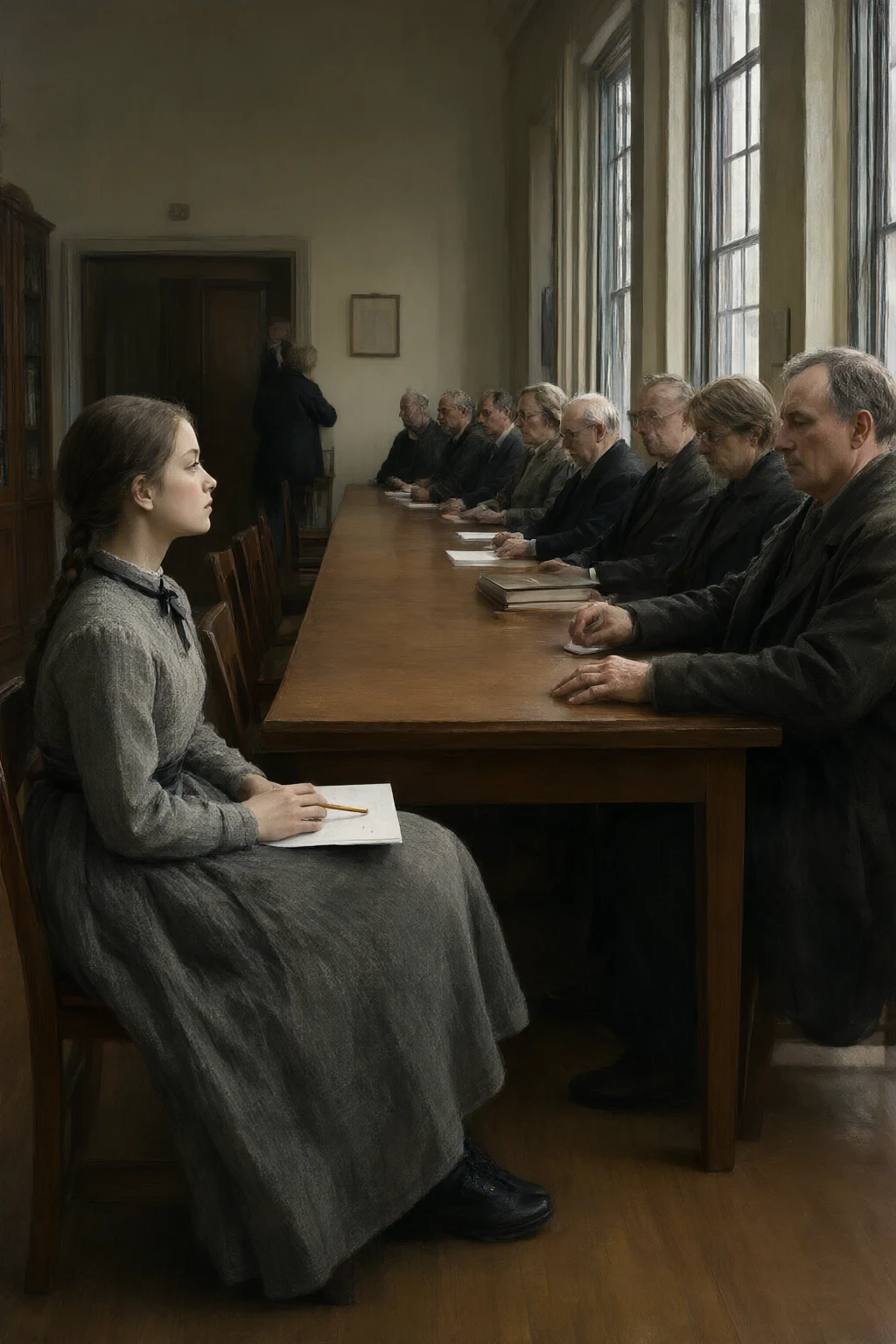
The petition went to the Board in the last week of September and it was four lines long and it was signed by four examiners and it asked for one thing. It asked that the standard of the Bureau be inquired into. That is the whole of it. Nobody in Featherstone has ever petitioned the Board for anything about a bed. The trade petitions about prices, about the towpath, about the hours the girls work the tearing machine, and about the county survey, and the petitions are all about money in one direction or the other. Nobody has ever petitioned about a pea in a drawer, and the reason nobody had is that there is no one to petition about. You can petition about a thing somebody is doing to you. A standard is a thing agreed to be itself. Nobody is doing anything to anybody. That is the entire subject of the petition and it is why the Board took nine days to answer it. The minute of the Board is on the page opposite the sewing of the November returns and reads: RESOLVED: that a Committee of Inquiry into the Standard of this Bureau be appointed, consisting of nine persons not in the employment of the Bureau, to sit in the Reading Room on the Tuesdays between the first of October and the last of March, and to inquire into the keeping of the standard, the comparing of other things against it, and the practice of the Bureau in relation to it, and to report whether that practice should be continued, amended, or ended. Amended. Not used.
The nine were appointed on the fourth of October and they were appointed in a way that the Board was quietly proud of, and the pride is in the minute and the minute says only that they were persons of good character not in the employment of the Bureau. Edmund Carrawe of the town, a magistrate of forty-one years’ standing, was chairman, and had put his name down first, and had done so because his grandfather had sat on a similar committee in 1840 and had told him, once, in a way that made it memorable, that a body which cannot be asked whether it is right is not a body. A mattress maker of fifty-two from Ketch, who had a shop, a floor, eleven hands, and a returned-bed book going back nineteen years. A shopkeeper from Auld Sluice who sold beds and had never sold one he had not slept in. A physician of the town. A surveyor. A schoolmistress, who was the one who had been at the back of the Reading Room in October and had said afterwards that it did not matter. A clergyman. A landowner. And a woman of about sixty who kept a registry of wills in the county town and had said no to the seat and had taken it.
Nine. Fourteen Tuesdays. A minute taken by a clerk from the Board. The room was the Reading Room because the room where a thing is read is the room where a thing may be said to be public, and the door was propped, and anybody in Featherstone might sit at the back, and the clerk recorded the number of persons at the back on each day, because somebody thought of it in the first week and it turned out to be the most useful column in the report. Nobody who worked in the Bureau sat on that committee. That was the rule and it was the right rule and it produced the only serious defect in the inquiry, which was that the nine spent a winter learning the trade from people who had been given the trade to learn, and one of those people could not stop, and one of them could not begin, and one of them had four names and no photographs and would not say the four names until the eleventh Tuesday. The case for the standard was opened on the first Tuesday of October by Mr Halliday, a lawyer of the county town, appointed by the Board and not a member of the committee, and the committee allowed him to sit with them and question and be questioned, and he was allowed because a committee of nine is not a court and the Bureau had wanted an inquiry and not a trial and had got one. Halliday made the case in nine days. He was not a good speaker. He had a heavy voice and he read his notes, and he read them well, and everything he said is in the report in full because the chairman ruled that both cases go into the report entire. His first proposition was arithmetic and it went into the report as Proposition 1.
There are one hundred and forty-one thousand certified beds in the four counties. He had the figure from the returns and the figure was exact, because returns have been kept since 1802 and have never been in dispute, since a return is a figure and a figure is not a thing anybody wants to argue about. Every one of those one hundred and forty-one thousand beds carries a figure on its foot, in pencil, in a testing hand, and every one of those figures means the same thing, and the only reason any of them means anything is that there is a fixed point in a cellar in this building that has not moved since the year the Duke of Cumberland’s reign was young. If the point moved, Halliday said, the whole of the one hundred and forty-one thousand went out of tolerance in a single afternoon, and not by being bad. By being different. And the trade has one remedy for a bed that is out of tolerance, and the trade has had that remedy since 1802, and the remedy is that the bed is returned, opened at the seam, emptied, burnt, and re-stuffed, and the cost falls on the shop that sold it. One hundred and forty-one thousand beds, in one afternoon, in a county with one kiln.
His second proposition was the one the report calls the distinction, and it is the shortest and it is the load-bearing one. A standard is never used. A pea that has been under a mattress is a proof, not a standard. That is not a rule of the Bureau. It is the definition, and the Bureau did not invent the definition, it found it, in 1802, in a house, and has kept it for two hundred years, and the whole of the Bureau’s authority rests on the distinction and on the fact that nobody has ever been careless enough to break it. If the standard in the cellar were put under a mattress tomorrow, Halliday said, it would cease to be a standard before the second hour was out of it. It would be a proof. And then there would be no standard in Featherstone at all, because the only standard there has ever been is a thing that has not been used, and a thing that has been used cannot be un-used, and there is no other pea. There is no other pea in the county, and there is no other pea in the four counties, and there has never been a second one, and the making of a standard out of a proof is a founding act and it has been done once.
The report puts it this way, at paragraph 6, and it is the paragraph the Board read twice: That the case in the strongroom is the only standard of the Bureau, and that the finding of 1802 was made upon a proof, and that the case was made from the proof, and that if the case be used the register of two hundred years becomes a register of comparisons with a document. His third proposition was the one nobody had thought of asking him for, which he had prepared in a fortnight, and it is the proposition that carried the case for the rest of the winter and is the reason the report is as it is. The Bureau does not claim that the pea measures anything. He said it four times in three sittings and wrote it out at paragraph 9. The Bureau does not hold that a dried pea has a property, and it does not hold that a pea is a measure of anything, and anybody who says that the Bureau believes the pea can feel is a fool and has not read the working papers. What the Bureau holds is that everything else in four counties is measured against the same thing. That is the claim. It is either true or it is false, and the register is two hundred years of somebody keeping it true, and if it is true then one hundred and forty-one thousand beds can be compared with one another, and if it is false then the Bureau is a fraud, and it has been checked in the only way available, by two hundred years of not being wrong in a way that anybody could point to.
Aldis Prome was the first witness and he was on the floor for two of the sittings and he gave four hours of evidence and he was the only man in the winter who everybody believed, and the committee believed him because he would not discuss a bed he had not personally slept in and he had personally slept in, over twenty-two years, somewhere over three hundred beds, and he could be checked on any of them, and nobody checked him. He was asked, first, about the pea. “I cannot describe it,” Prome said. “That is the answer and it is the whole answer and the committee will not like it. I cannot describe the pea. I have been under it four hundred times and I have never once known it was there on the first pass, and I have never once known it was not there on the first pass, and if you put me in that room tomorrow with a bed and forty of them, I would give you the same answer in every case, and you would not be able to check the answer, and I have always said that the answer is not checkable and I have never once been asked until the fourth of October.” He was asked, then, what a standard is for.
“To be the same on Tuesday as it was in 1802,” Prome said. “That is all. Not to be right. To be the same. If you want a thing to be right you want a rule and a rule can be read by anybody and I have read a rule. If you want a thing to be the same on Tuesday as it was in 1802 then you cannot read it and you cannot argue with it and you have to be the kind of person who can hold still, and there are eleven of us in this building and four of the ones before us could not hold still, and their names are in the pension book and there are no photographs of any of them anywhere in this county, and that is what a standard costs, and it costs it in people, and there is no other currency.” The maker from Ketch asked him, in a plain way, whether he thought the pea was the same.
“I have never been able to touch it,” Prome said, “and the man who made it touched it once, and the man who made it signed a card, and there is a line in the working papers that says the case is not to be opened except for the removal and re-setting of a standard, and that line is the only thing standing between that pea and a hand, and it has stood for two hundred years, and I have wanted to be in that room about nine thousand times and I have not asked.” “Why not,” said Mr Halliday. “Because I would be the man who asked,” Prome said, “and then it would be a question, and then it would be a proposal, and then it would be a rule, and then in a hundred years there would be a paragraph about Aldis Prome in the working papers and the paragraph would say he was right, or it would say he was wrong, and either way the pea would have been used, and I would have done it for a reason, and reasons are what this Bureau is careful about.”
The case against the standard was opened on the second Tuesday of November by Miss Harrow, of the county town, appointed by the Board on the same day as Halliday and to the same terms, and she had been given six weeks to prepare and had prepared by reading two hundred years of returns, which is not what lawyers do, and which is why her case was the better one. The report calls her first proposition the unchecked standard, and it is four sentences long, and it is the sentence the whole of the case against the Bureau is standing on. Nobody has ever shown that the pea is the same as the pea. That is not a suspicion. It is the state of the evidence. The standard has never been compared with anything, and it cannot be compared with anything, because comparing is a use. Its entire authority is that it has not moved, and it has not moved because nobody has looked at it, and there is a difference between those two things which the Bureau has never had to explain because in two hundred years nobody has ever asked. Nobody in this room, she said, has any evidence that the case in the cellar is entire.
The register does not say. The register says what was found, in a house, on a day, by a man, and the register is very good and I have read all of it that I am allowed to read, and the register is a record of verdicts, and not one verdict in two hundred years is a measurement of the standard. Every verdict is a comparison of a person with a pea. The pea is the unmeasured quantity. In every measurement that has been made in the four counties in two hundred years, the one thing that has never been measured is the thing at the end of the ruler. The surveyor asked her the obvious objection, which is that a thing which is checked every day by a trained man for forty years has been checked. Then it has been checked by a man, said Miss Harrow, and the man is a person, and a person declines, and there are four of them in this county who declined, and the certificate that produced them is in the register, and I have read the certificate, and the certificate provides that a child shall be exhibited to the standard until the figure of the child shall have declined to within two hundredths of an ounce of the declared sensitivity of the household, and not further.
And there it was. The committee had not had the certificate. It had a copy of the certificate in Exhibit 14, which is a form, and the form was read into the record as a form, in October, by a clerk, and nobody had read the fourth paragraph aloud because the fourth paragraph does not apply to anybody at the front of the room. Harrow did not produce it as a document. She produced it as a sentence and she made the room say it back, and the maker from Ketch said it back, badly, twice, and the schoolmistress said it back correctly, and the woman who kept the wills said it back correctly and faster than the schoolmistress and then sat down. That is the moment the inquiry turns, and the report says so at paragraph 14, in one line, without any comment: on the second Tuesday of November the committee had before it the arithmetic of the exposure of an instrument, and it is recorded here that the arithmetic was not disputed by any member. Miss Harrow’s second proposition is the one the report calls the sheltered figure, and the committee did not like it and could not answer it, and it is the shortest of her three and it is the one that has been quoted since.
The assurance of the Bureau covers the people who buy good beds. That is not a criticism of the Bureau. That is what a tolerance is for. A tolerance is a promise about how wrong a thing may be, and the promise is made to a person who intends to buy the thing, and a person who does not intend to buy the thing has not been promised anything, and this is the correct arrangement, and the trade would not have it any other way, because the making of a promise to four hundred households who cannot use it is a maker’s waste of ticking. And the four hundred households are on the terrace, and their people are dull, and dull is stated in Featherstone as a compliment, and the trade states it as a compliment, and the word is in the shop, and the word is said with a certain warmth, and the warmth has been there for as long as anybody can remember and nobody has ever asked who taught it to them.
They are not tested. A person who cannot feel the pea cannot be certified sharp, and a person who cannot be certified sharp is certified dull, and the certification of dullness is a single line and takes six minutes and is done on the first Tuesday of the month. There are no cards in the register for the dull, and there are no photographs, because a dull household does not get a finding, and the finding is the thing the register is for. The report is careful here, and the care is the point: the committee does not say that the four hundred are worse served. The committee says that of the two kinds of house in Featherstone, the one that can feel the pea and the one that cannot, the first is under an apparatus that spends it and the second is under no apparatus at all, and that the word for the second is a compliment, and that the word for the first has meant sharp in four counties for two hundred years and has meant a child of nine since October. Miss Harrow put it in one sentence and the report puts it in the same sentence: the standard protects the people it reaches, and the people it reaches are the people it finds.
Cobb Tarn was called on the fourth Tuesday of November and he took four hours and he had the hundred days, and the hundred days went into the report entire, and it is the longest single document in the history of the Bureau and the only one anybody has ever wanted to read. He was the registrar. He was not a member of the committee and was not a witness on behalf of the Bureau and was, on the record, a person with a hundred days of leave from the Board and a finding in the register against the household of the Bureau of Featherstone, which is the twenty-fourth card in drawer one and which the Board had read and had thanked him for and had recommended no action upon. He was allowed to read the hundred days because the hundred days were his and the register was his and the finding was his. He read it in the flat voice, from a sheet, without stopping, which is the only time anybody in the winter saw him do that.
Twenty-one cards. A column of forty-one figures on the back of each, in a hundredths place, in a testing hand. A decline of one hundredth at every presentation without a single exception. A clearance of two hundredths, in the same hand, on every card, and the clearance in words: the household is not to be reported until the figure is not less than 0.02 above the declared sensitivity of the household. Two exceptions, and both exceptions explained, one by a fever and one by a flood on the towpath, and both honest. And the fourth paragraph of the certificate of certification, printed, and printed identically since 1802, and the two hundredths in it. He finished by saying that he had wanted for eleven years to be told that he was wrong, and that no member of the committee had told him, and that the arithmetic was in two hands, his own and Aldis Prome’s, and that Prome had put the figures there in the expectation that some day a registrar would be allowed to look and would be the sort of man who looked. The maker from Ketch asked him the question the whole of the inquiry had been building to, and asked it in the plainest words anybody used all winter. “Forty-one times,” he said. “Every time. A child, forty-one times, and then it is over, whatever the child is.”
“Whatever the child is,” Cobb Tarn said. “Whatever the year, and the county, and the house, and the weather on the day, and the state of the child on the day. The clause is a clearance for the tester and it is the most careful sentence in the working papers of this Bureau, and it was written in 1802 by men who had watched four examiners be ruined by verdicts and wanted a way to stop that, and it stops it perfectly, and there is no mention of the child in it anywhere.” “Is there a form for that?” “There is no form for that,” Cobb Tarn said. “I have tried eleven lines of one.” The committee adjourned at half past four and did not sit again for nine days, which was longer than any other adjournment in the winter, and the minute for the adjournment is in the clerk’s hand and gives the reason as: the committee requires time.
Nell Crumm was called on the second Tuesday of December and it is the shortest evidence in the report and the only one the report declines to reproduce entire, and the reason it gives is that the chair and the committee found that the whole of it could not be got onto a page without the page becoming an argument, and the clerk was directed to enter a summary. She is sixty-two. She has a hip that has been out of alignment since 1979 and she sits on one buttock on a bench, and she was given the bench at the end of the table because it was the only one with a back at the right height, and she noticed that and said so, and the maker from Ketch moved the bench. She was asked what a house is like to sleep in. “I have slept in about nine hundred,” said Nell Crumm. “Not a house. A bed. Everybody always asks the house, and the house is a building, and a building does not sleep. I have slept in nine hundred beds, and the ones that are good are good in one way, and there is only one way, and it is not that it is soft.” She was asked to describe the way.
“He is not turned over,” said Nell Crumm. “That is all. In a good bed a man is not turned over in the night. He goes down and he stays where he put himself. In a bad bed he is turned, and he does not know it, and he wakes up tired, and he has been at work eleven hours and he has been turned over forty times, and he will tell you he sleeps soundly.” “Does the Bureau’s tolerance describe that.” “No,” said Nell Crumm. “Could it.” “No,” said Nell Crumm. “And I will tell you why, and then you can write it down or you can leave it out, and it makes no difference to me either. I have stuffed to a figure for forty years. Forty years. And I can do it blind, backwards, and I have never once in forty years stuffed to what a person wanted, and the reason is that I do not know what a person wants until I have watched him lie down in it, and I cannot watch him lie down in it and stuff it at the same time, and the figure comes at one o’clock and the wanting comes at three in the morning.” She was asked whether the Bureau should be reformed.
“Yes,” said Nell Crumm. “I have said so for forty years and nobody has ever asked me, and you have asked me, and I am going to tell you what the reform is and you are not going to be able to use it. The reform is that somebody has to lie in the bed before it is sold. Not a tester. Not a boy. A person who has to lie in it and be paid nothing and come back the next morning. That is the reform. It is not a figure and there is no line for it and I have said it to nobody in authority, and I am saying it now, and you can put the bench in the report.” The report does not contain the bench. Miss Harrow asked her, at the end, one more question, and it is the only question in the winter that appears in the report as a question rather than as an instruction. “Madame Crumm. If a bed is in tolerance and a person does not sleep, what is the Bureau to do.” “A person is not a bed,” said Nell Crumm.
The schoolmistress was called on the fourth Tuesday of December and her evidence is four lines in the report, and the four lines are the reason a boy of nine from the terrace is in this story at all. He had been found at a school inspection in the spring. He was sharp. He was certified, and a finding was made against his household, and the household is on the terrace, and a finding against a household on the terrace makes the household’s name a word, and his family’s name has been a word in that street for four months, and the boy has a caliper-shaped bruise on his own forearm from practicing on himself, and stands with his back to a door, and asks what a thing is for before he lets anybody do it. She was asked, by the chairman, in the plainest voice used all winter, whether the finding was correct. “It was correct when it was made,” she said. “He could feel it in the spring. He cannot feel it now. He did it to himself, in a shed, with a thing he made out of wire, and he did it because he had worked out that he was important, and being important is what he was told.” The maker from Ketch sat back in his chair for a while. “Fourteen Tuesdays,” he said afterwards, to nobody in particular, and the clerk recorded it because the clerk recorded everything in the room, and it is the only sentence in the report that is not addressed to anybody.
The obvious answer came on the third Thursday in January, and it was not a Thursday sitting, and it is in the report at paragraph 31, and it is the shortest paragraph in the report and the only one that the report says it cannot reproduce. There were nineteen at the back of the Reading Room that day, which was the largest attendance of the winter, and the nineteenth was a girl of fifteen who had come with her father, who was a junior clerk of the Bureau and had a board under his arm, and who had not been admitted to the table and had not asked to be. The girl is Marguerite Fenn. She can feel the pea. She is the only person in Featherstone who has felt the reference pea and been able to say so, outside the strongroom, and she felt it once, on her thirteenth birthday, under supervision, in the strongroom, in a case held by two people, and she has two small red marks on either side of her fourth finger from holding the case, and she has never been formally tested, and she has asked to be, more than once, and the answer she has been given both times is that she will be tested at sixteen.
She had a sheet of paper on her knee. She had been taking down the numbers, and she was the only person in the winter who took down numbers who was not on the committee, and the numbers she took down are in the appendix, in a child’s hand, and they are correct. At four o’clock, when the evidence for the day was closed, the chairman asked whether any person at the back wished to say anything, which he had done four times in the winter and which nobody had ever done, and he had done it on the fourth because the girl had been writing for fifty minutes and he could see that she was not writing about anything that was on the table. She said it in nine sentences, and the report at paragraph 31 says that the substance of them was as follows, and the substance is this. You have spent a winter finding out that nobody has ever shown that the pea is the same as the pea. Then find out. You cannot find out by leaving it alone. Every way of finding out that is not a lie involves a person lying on it, and there is one person in this room who can feel it, and it is me, and I am fifteen, and I have been waiting three years to be allowed to be the one.
And then, when the chair asked her, in the middle of it, what she understood to be the consequence, she said it, and she said it as a fact and not as an argument, and she said: “If it is used then it is a proof, and then the register is a register of comparisons with a document, and every bed in four counties is out of tolerance at once, and one hundred and forty-one thousand beds go to the kiln in a fortnight.” The report records that the maker from Ketch did not look up. The report records that the woman who kept the wills wrote something on her pad and did not read it back. The report records that the chairman asked the girl a further question, which was whether she considered that a reason not to do it, and that the girl said: no, and that it was Mr Halliday’s figure and not hers, and that she had written it down because it was a good figure. The report records that Aldis Prome was not in the room. The report records, at paragraph 31, in the whole of its nine words, the following: The committee took no evidence on this matter and gave no ruling.
It stayed on the table for eleven weeks. Everybody who could have touched it had a reason, and the reasons were good, and not one of the reasons was money, and every one of the reasons had been made well in advance by somebody who knew what it was for. The registrar had it in his hand first. Cobb Tarn had wanted for eleven years to be told that he was wrong, and had never been told, and in November he had entered the only finding he has ever entered and had been thanked for it and had had no action recommended, and the hundred days is the only proof of anything he has ever done, and if the standard is used the hundred days is a count of opinions about a dried vegetable. A registrar may reopen and recount. A registrar may not propose. There is no line on the form for a proposal and there is no line on the form for anything. He could have said it in a corridor to a member of the committee, and the corridor is a room, and a thing said in a room in this building is a thing the building has said.
The chief tester had it. His reason is on the record and it is that the accuracy of twenty-two years is a claim about a man, and a man is the only thing in the inquiry that can be checked, and if the pea is used then the accuracy of twenty-two years either agrees with the pea or does not, and if it does not then the eleven testers he trained are a mistake and six years of his not saying anything is a matter of record, and he is forty-seven and wants to be replaced while he is still accurate, and a man who is being replaced on the evidence of a comparison with the thing he has spent his life against is not being replaced on the evidence of his accuracy. He said so to Mr Halliday on the last Tuesday in February and Halliday put it in his note and it is in the report, and it is the only evidence in the winter given by a man who was not asked. The girl had it. She had said it, in a room, out loud, and had been asked by the chairman for her view on the consequence and had given the consequence correctly, from the other side’s own figure, and had then said no, it was not a reason. And she was fifteen and not a member and not a witness, and the committee was not permitted to take the evidence of a person who is neither a member nor a sworn, and by the time the charter was examined, in the fourth week of February, the whole of the winter had established that nobody in Featherstone can be made to act outside a procedure, and the girl had no procedure, and the one thing she wanted, which was to be tested formally and to fail, is a thing the Bureau does not have a form for, and she was told again in March that she will be tested at sixteen.
The chair had it. Edmund Carrawe was asked by Miss Harrow, privately, in the corridor, and in the report at paragraph 33, and his answer is the whole of the fourth section of the report and the reason the report is what it is. He said: it is not a question before this committee. The terms of reference are the keeping of the standard, the comparing of other things against it, and the practice. The practice may be continued, amended, or ended. Use is not a practice. Use is the opposite of a practice, and if this committee reports on use then the Board will enlarge the terms, and the Board will enlarge the terms because the Board would like to be a body that could, and a body that could enlarge its own terms at the request of a schoolgirl is not a body that anybody in this room would be content to be a member of. And the Board. The Board was written to on the eleventh of February and the answer came back on the nineteenth and it is one line and it is in the report: the Board declines to enlarge the terms of reference. Which is correct, and fair, and is the answer of five people and a table who were doing the only thing they know how to do, which is to decide by the end of the year what is going to be true, and what was going to be true by the end of the year was that the practice is continued.
The report went in on the last Tuesday in March and it is four hundred and eleven pages and the clerk’s minute of the delivery is one line. It is in two parts. The report says at the head of the second part that the two parts are of equal length by direction of the committee, and that the direction was given on the first Tuesday of October before either case was opened, on the ground that an inquiry into a standard ought to show the standard’s case at the same length as the case against it, and that if the parts were of unequal length the reader would be able to tell from the length which way the committee went before he had read either. And then, at the head of the recommendations: THAT the standard continue to be kept in the strongroom in its case, unopened, and that the case be not opened except for the removal and re-setting of a standard, and that a further exception be added, namely, that the case may be opened once in twenty years, in the presence of two persons not in the employment of the Bureau, who shall be appointed by the Board for that purpose, and who shall satisfy themselves that the case is entire, and shall enter their finding in the strongroom book, and shall have no other duty.
THAT no tolerance be re-declared, and that all tolerances declared before and after this report continue to bind at the figures at which they were declared. THAT the fourth paragraph of the certificate of certification be amended, in the second year of every certificate, to require that the household be informed in writing of the number of presentations to which the instrument is subject, being a number which is not less than forty-one. THAT the Bureau make no alteration in the practice of comparing beds against the standard, and that the committee express no opinion upon the question whether the standard should at any time be used, that question not being before the committee. And then, as a heading, with nothing under it: THE USE OF THE STANDARD And under that heading, in the clerk’s hand, at the foot of the page, the following, which is the last thing in the report: The committee did not consider this question. The reasons are at paragraphs 3, 8, 11, 15 and 19, and are given. The report is delivered in the Reading Room on a Tuesday, publicly, and Cobb Tarn entered it in the register on the Wednesday, and the entry is the ordinary entry, and the finding of the committee of inquiry is the household of the Bureau of Featherstone, and it is the twenty-fourth card in drawer one, and drawer one has twenty-four cards in it, and the twenty-fourth is the only one that is not about a house. He wrote the number of the card at the foot in his small hand and he wrote the date, and the date is the last Tuesday in March, and under the date he wrote the number of persons at the back of the Reading Room on the day of delivery, which was thirty-one, which was the largest attendance of the winter and which the clerk had been keeping a column of since the first week of October for no reason he had ever been able to give.
In the cellar there is a low vaulted room with one north window and a wall of numbered drawers, and in drawer one, on a shelf of bare stone, there is a glass case the size of a fist with a single dried pea in it, on a card, and on the card there is a date and a signature, and the date is two days after the finding of 1802, because the finding was made with a pea that had been under a mattress, and the standard was made out of it afterwards by a man who has no name in anything. The door was shut when Cobb Tarn went down, and it was shut when he came up, and he is the registrar and he has a key and he did not use it, because there is nothing in that room that a registrar may do, which is the definition of a standard, and is the reason a standard is not a bed, and not a form, and not a person, and not a sentence in the fourth paragraph of a certificate. The recommendation was agreed in the last week of March. Nobody in Featherstone has the least expectation of carrying it out. It is in the working papers on a page of its own, under the four recommendations, and the page before it is blank, and the page after it is the return for the quarter, and the clerk ruled both.