The roll room is above the tithe barn and has one window, and it faces north, which is the correct window for four hundred years of paper, because a north window does not lay the sun on a page and a south one does. Ivo Colm had worked in it for thirty-one years and had made his arrangements. The desk stood four feet back from the glass of the window. The green reading arm was bolted at the height of his left eye, which was the eye that worked, and the right one did the stair. There were eleven feet of shelves in a press along the east wall, and the press was locked, and the key lived on his person.
Below him the Monday market was making itself into six awnings in the wet, and a bicycle stood against the wall of the barn with a lamp wired to the handlebar. A man who stood in the market on a Monday morning was in the one place in Coldhay where all seven stands had to appear together in daylight, in public, and could not speak. At a quarter past eight the stair gave him a footstep, and it was a boy of thirteen from the wool yard with a folded slip, and the slip said, in a small square hand that put its crossbars through everything: Will you compare the glass of the third stand against your entry for 1902. Bring the volume down. It is not light. — T. Kelder
Ivo Colm read it twice. Then he took the day book off the shelf, turned back to Tuesday, and wrote under the Monday line: Asked by the third to compare the glass of the third stand with the entry of 1902. — I.C. Then he read the previous day’s entry aloud to the empty room, and waited, and the room did not finish it.
The volume went down in the wool handcart with Ivo Colm on the shafts, because the volume is four hundred years of bound signatures in quarter-calf, and a handcart will take a table on its side and cannot take a table on its edge.
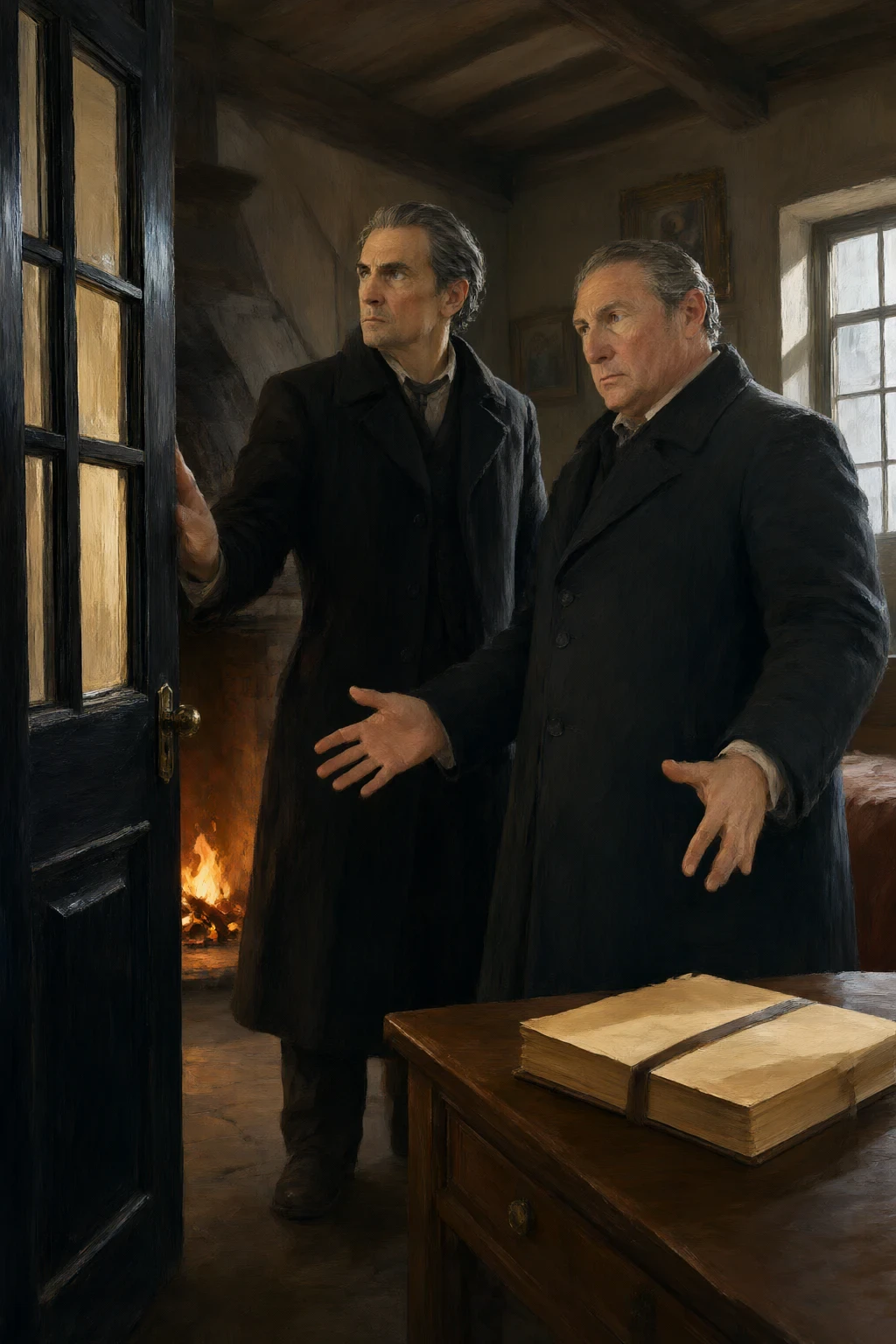
The wall is nine feet of limestone between the market and the pasture, and you cannot see over it and you cannot hear over it, and both of those facts are load-bearing in a town where words are the whole of its law. The seven gates are at uneven intervals because the holds are. At the first gate there was a smell of woodsmoke at eleven in the morning, which is not a smell anybody burns, and the first door is shut, and behind it a fire is kept in. At the third gate the door had a pane of glass in it, nine inches by eleven, set in black wood, and the pane was clean, and the pane was the reason the door could never be locked, because a house that is locked is a house that has something in it.
“Nothing has ever been taken out of it,” said Tam Kelder, who had counted the doorways he came through on the way, which was three, and said so. “Not the glass, not the frame, not the door. In twenty-two years I have never seen that door off its hinges.” “Then we take the book to the glass.” “That is the arrangement. The glass does not go. It reads back what has been said in that house, and if you carry it into a lane it is a different record, and there is nobody in this town who needs a different record.”
The third stand has one room, a hearth, a door, and a bed built into the wall under the stair. There was a dresser with plates on it, one chair that Tam Kelder did not sit in, and a window of four panes, one of them a later repair. The pane in the door is the glass. That is what the house calls it and it is the only glass in Coldhay that anybody is afraid of. It is not a mirror and it does not show the room to a man standing in the room. It holds what has been said in that house, and the holder may stand before it with his hands open and say a date and wait, and the words come through the pane in the voice that said them. It is as complete as the hand that kept it and no more, which is why nobody here has ever argued with a glass and lost.
“Who kept it in 1902?” said Ivo Colm. He had the volume on the dresser, squared to the edge, with a strap round it. “The holder of the third. He had the stand from ’71 to the year he died and he kept the glass every day of it, and a man who keeps a glass for twenty years does not write anything down anywhere else, and that is the whole of your question. Say the date. The eleventh of March, 1902, and the evening of it, because the words were said after the lamp was lit.” Tam Kelder put both hands out at his sides, palms forward, fingers apart, in the posture that Coldhay has one word for, and the word means he is a witness and not a person who is merely present.
The lamp in the account was already lit. The words came through the pane in the voice of a man of thirty-five or thereabouts, and they were said in this room, with two men in it, and the fire in a third stand, on the eleventh of March, 1902:
“And I say to him, Edvard, you will have the long close for the one year and not the two. And he says the two. And I say, then we are two hours here for nothing. And he says nothing. And I say to him I will not say it twice, and he says say it. And I say, the one year and not the two. And he says the one. And I say, the year is the year of the ledger, Edvard, the same as the wool and the same as the tithe. And he says it is. And he says, write it. And I say, I will write it. And he says, write it in my hand. And I say no. And he says, then I will write it myself. And I say, you hold nothing in this house. And he says, I can read.” Then the voice stopped, and the fire in the account went on being a fire for the length of a breath, and stopped.
Nobody said anything for some time. “There,” said Tam Kelder at last. “That is the whole of it. He held nothing in this house. A man who holds nothing in a house cannot make a covenant in it, whatever he says under that roof, and the man in the third stand said so to his face, and the man from the seventh said he could read.”
Ivo Colm opened the volume on the dresser, found the leaf, and read the entry for the eleventh of March, 1902 in a voice he did not raise. It was one line, in the hand of 1902, which no living man can read but his: “Eleventh March. Covenant of the long close in the third stand, the one year and not the two, the holder of the third agreeing, witness to the same, J. Fenn.” He read the previous entry first, as he always did, exactly, and waited, and the room did not finish it for him, and then he read this one, and squared the volume to the edge of the dresser again, because he squared everything, and looked at the pane.
“Four differences,” he said. “I have four, and I will give them in the order they trouble me. One: the holder of the third did not agree to a covenant. He agreed to a year. A year is a lease, and a lease is paper, and a lease expires, and a covenant is a word, and a covenant binds, and he was careful about that in the glass and careful about it in the margin of his own copy of that year, which I have seen. Two: there is no witness. The glass has two men in it and one of them was the holder, and a covenant wants a third person awake, of an age, and not a party, and there was nobody. Three: J. Fenn was of the sixth stand and he was at sea that month, and the press book has his mother’s wages for the same month in another hand. Four: the long close was used by the seventh after a year and paid for by an arrangement between two men, and that arrangement is not in the roll, because it was never a covenant.” “And the rent,” said Tam Kelder. “The rent is the rent.”
“Say it again,” said Ivo Colm. “The same date. I want to hear whether the room gives me the same account twice, and if it does not, I want to know which one it gives me second.” Tam Kelder turned to the door and put his hands up again and said the date, and the words came through the pane in a different voice, flatter, and a man of forty, and the same room, and the same fire, and it went:
“And I say to him, Edvard, you will have the long close for the one year and not the two. And he says the one. And I say, then write it. And he says, write it in my hand. And he writes it. And I say, the year is the year of the ledger, Edvard. And he says it is. And I say, the witness is J. Fenn. And he says, J. Fenn is at sea. And I say, then it is J. Fenn. And he says it is. And I say, read it back. And he reads it back.” “The two hours are not in it,” said Ivo Colm. “And there is nobody in it who said he would not say it twice. And there is a witness.” “Glass keeps what it is given,” said Tam Kelder. “That is all it does. It does not know which of them you want.”
“It is not a question of which I want. It is a question of which is on the top.” Ivo Colm had his hand flat on the new black wood, and he was looking at the frame and not at the room. “Now read it once more and listen to what the first man calls the thing the words are coming through.” They read it three times more, and the first account said the pane, twice, plain, the way a man says a word he has never had occasion to think about, and the second account said the glass, once, in the last of his sentences, and gave it the article as well. “In 1902 that frame was not black,” said Tam Kelder. “It was painted in the year it was put in, and it has been black since they took the paint off, which was eleven years ago.”
“So the second account was told by a man who could see the glass as a glass,” said Ivo Colm, “and knew what it was for, and knew it was the account, and that is not a man correcting a memory. That is a man who has come into a house to change what is in it. And a rewritten glass is a felony. It is the only felony in Coldhay, and the book of them has one entry in it, and that one is of 1741, and there has been nothing since, and this is the second.”
They went up, the volume under his arm, and the stair took him four minutes and would have taken him two.
On the desk, under the north window, with the volume open at the leaf, Ivo Colm said, “The hand is the hand of 1902. I am the only man alive who can read it, and I am telling you it is the hand of 1902, and it is a very good hand, and a forger does not make a better hand. A forger makes a careful copy of a careful hand, and a careful copy of this hand is wrong in three places. One: he never ruled a line under a name, not once in four hundred years of that hand, and the check took me eleven years, and this one is ruled. Two: the guard of the binding over this leaf is doubled. Three: the stub at the foot does not answer to the leaf now in place, which is a tenth of an inch narrower than the cut it was made for.
Take one out and put it back and the book will let you, once, and I have never taken one out.” “That is a great deal on a ruled line.” “It is the lightest of the three,” said Ivo Colm. “The other two are a leaf out of the press. A copyist who has the leaf in front of him is a man inside the press, and the press is locked, and the key is on my person, and I have not slept in this room once in thirty-one years.”
“There is a note in the margin of the 1978 leaf,” he said. “I have read it perhaps forty times. I am going to read it, and then tell you what I thought of it, because I have been wrong about it for three years and I would rather say so in the room than have it found later.” The note was in a small upright hand of 1978, and it said: The leaf of 1902 examined this day. The guard doubled. The stub does not answer. The entry is in a copied hand. I make no further finding, the glass having been shown to me. “That is Aldis Roache. He kept the rolls in ’seventy-eight.”
“He is dead in ’seventy-nine and I went to the funeral and heard not one word of this afterwards, and I have had a disagreement with his hand since the March of ’seventy-four, when he ruled a line through an entry of mine and I was certain he was wrong, and I was not wrong, and I have been certain ever since that he was a pedant with a grudge. I thought a man who wanted to be right about a leaf had found a leaf he could be right about.” “And now?” “Now I am a man who has been wrong about a hand for three years,” said Ivo Colm, “and there is an entry in the volume that I put my initials beside in March ’seventy-four in the belief that I had settled it, and the entry I settled was the one he was talking about.”
The day book for June 1975 was on the shelf, and not in the press, and that is the only difference in the handling of a document in that room that Ivo Colm has ever insisted upon. The key was out of his hand from the third to the nineteenth, inclusive. The leg had been broken in the yard in May and set in the market on the sixth, and he had been in this room with the leg up on a stool for the second week of June, and on the third of June and on every day after it to the eighteenth the book says the key was out of his hand. There is no name against any of the seventeen days, which is the rule, because a name in the day book is a witness, and a man who lifts a leaf out of a press does not want a witness. “Seventeen days.”
“Of a key going round Coldhay in a coat, or a key lent and lent again,” said Ivo Colm. “Anybody in this town could have used it. That is not a conclusion, it is a range of three people: one is dead, and one is the man who holds the seventh and wanted to sell the long close in ’seventy-four and could not, because there was no title, and one was a man in this room in the second week of June with a leg up on a stool and no memory of the fortnight. I have looked for that fortnight and I have not found it.”
He ruled the leaf through once, diagonally, with a broad nib, the way a man rules through an entry he is not willing to strike out, and he did not tear it out, because a torn leaf is a loss and this is a press and the press is the record.
Then he turned to the clean leaf of 1981 and wrote out the account of the eleventh of March, 1902 exactly as the pane had first given it, all of it, including the two hours and the not writing it in his hand, and under it: Entered from the glass of the third stand, the glass being the true account of that house; the entry above is in a copied hand, the guard of the binding over it is doubled, and the glass was re-told in 1975, which is a felony. The 1978 hand was right. I. Colm, clerk. And under that his initials and the date, and under that, in the same ink: The key of this press was out of my hand from the third to the nineteenth of June 1975 and I do not remember the fortnight.
They went down at noon, and the market was at its thickest, and nobody said a word. In the lane by the third gate Tam Kelder took the rent book out from under his coat and opened it on the wall and turned it round, and Ivo Colm did the sum with a pencil and wrote the figure on the tail-board. The figure was the rent of the long close for thirty-one years, every year of it entered in Tam Kelder’s hand and collected from the man of the seventh stand and spent on wool, coal, a saddle, and nineteen weeks of a girl at school in the town, and none of it the rent of a field. “That is the whole of what the roll gave me.”
“It is the whole of what the roll took from you,” said Ivo Colm. “You will want to speak to him. It will not be today, and it will not be in the lane, and neither of you will say one word of it in the market, and when you do say it you will be two men with a handcart and a wall between you and him and a gate, and that is the way this town does every single thing.” They stood in front of the door with the pane in it. The glass was clean, and there was nobody in the house and no fire lit, and it was not a mirror and it was not an oracle, and nobody in Coldhay had ever once put a question to it. It had said the whole of the eleventh of March, 1902, in a voice thirty-five years old, twice, in two voices, and the first of the two was the one under.