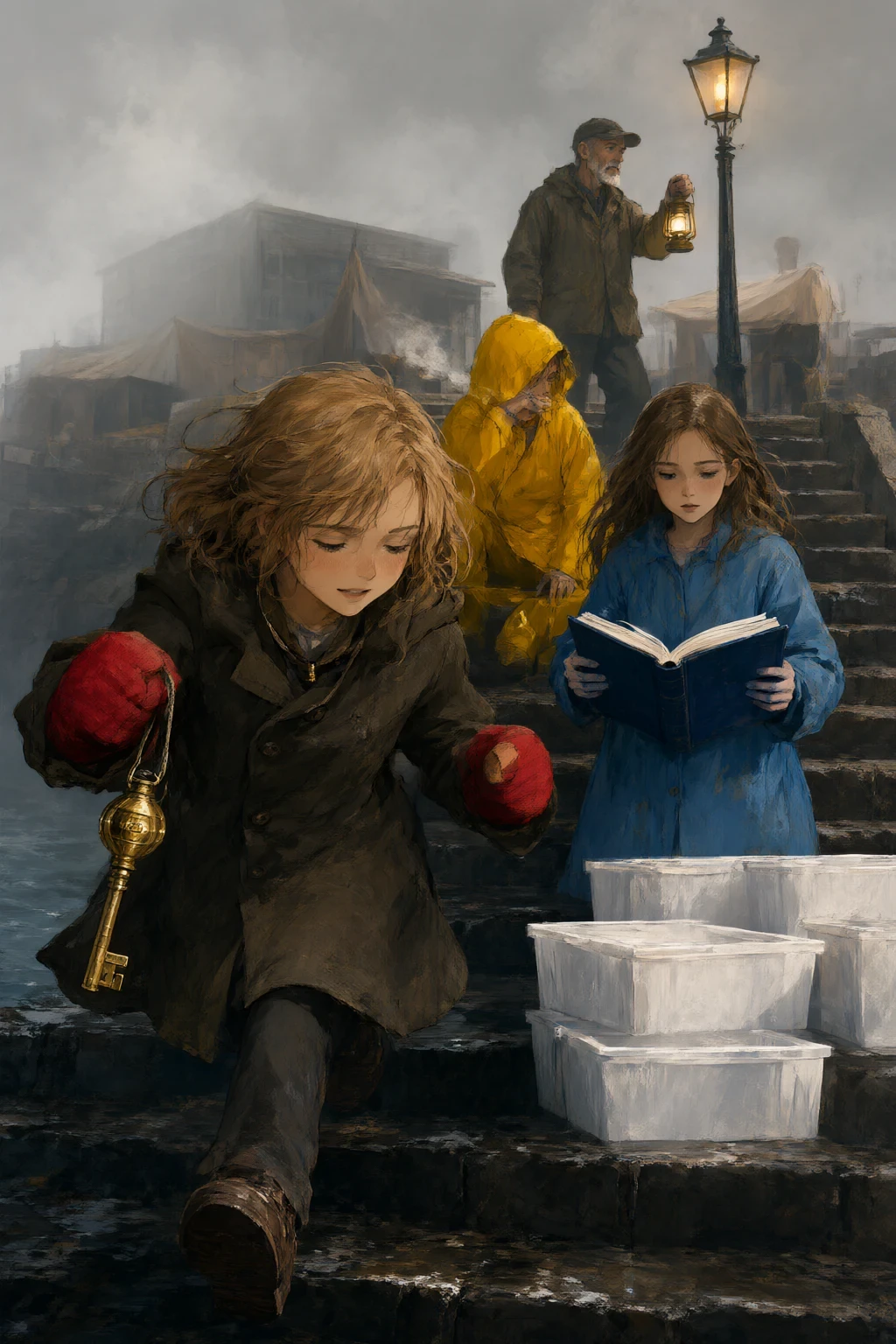
The first thing Pim heard was the ice. That was wrong. Ice in a hard frost does not crackle. It settles, and whispers, and goes soft on top, the way snow goes soft. But this was a sharp bright sound, like a plate set down hard on a table, and Pim looked up from the crate she had been sent to stand beside and saw the harbour post at the end of the weigh shed go yellow, then orange, then dark. Then the second one did it. Then the third.
The frost had come in on Monday and the fog came up off the water at half past three, the way it always did in the last week of October, and the lamps were due at four, and by the time Pim had her hand round the rail the landing had gone out like a snuffed candle. A hundred crates of ice stood going white in the dark. Somebody dropped a basket of mussels and swore in the old words. A horse that had been standing quietly since dawn made a noise Pim did not have a name for. “Listen -” said Neel Ferrin, arriving out of the fog at a run in her yellow slicker with the hood up, which was the only thing about her that was ordinary. “Listen - I smell it.” “Sweet,” said Neel, before Pim could stop her. “Like the plug the trimmer sells off his arm. Only burnt.”
Pim’s mouth filled up. The smell was coming off the three dead posts in a slow grey thread, sweet, kind, a cooking-house smell, and it did not belong on a harbour at all. Pim was eight. She knew four things about lamps, and this was the first: the harbour posts are the low lamps, the low lamps are the First Lantern’s neighbours, and the First Lantern is the one that holds the chain. She knew it because the walking song says it out loud every dusk, and she had been made to sing it since before she could sit up. Second: a runner does not carry light. That is the whole of the rule, and the rule exists because of her, because of what she did at six with a jar of eiderdown oil off a shelf, and because after that Hadren Vole made one more rule up on the spot, and it has never been written down. A runner carries a key. Third: you do not go up the dark. The fourth was new, and she did not know it yet, so it did not count.
The auction bell went while Pim was still counting the dead posts. Three strokes, rung by hand by old Kett, who rang it that way at a fire or a wreck and at nothing else, and who now stood in the fog ringing it over and over. “All hands to the low lamps,” somebody shouted. “All hands to hell,” said another. Pim was already running. The first wick had guttered at ten past four, the second at quarter past, the third at half past. Same post, same trimmer, same oil, three running. Which meant the oil was bad. Bad oil smokes and spits and smells of nothing much, and this had smelled of a sweet shop. Wren Adry was sitting on an upturned fish box with the Great Oweing Book open on her knees, a stoppered inkwell held in her teeth, not writing. She had been at the landing since two, because the Book is opened before the lamps or not at all.
“Forty-one at fourpence half,” said the ice-man, arriving at a run. “Eleven pounds two and six,” said Wren Adry, without looking up. “And at fivepence you have told me seventeen pounds one, and one of those two is a lie, and I would rather you went and found out which before I do.” Then Wren Adry looked up, and saw the three dark posts, and saw Pim, and was on her feet so fast the book hit the wet stone and the ink came out of the page in a long blue tear. “My key,” she said.
The runners’ key is brass and shaped like a lantern and it lives on Pim’s throat on a cord, in bed, in the sea, everywhere. The Council’s key is a different animal: cold iron, a foot long, stamped with a letter, so worn you could not tell which one. “It is the oldest key on the coast,” said Hadren Vole, at the key board. “Council made it. Council boards the low housings, so Council opens them, so the Chief’s men do not carry a key they can lose. Cheaper that way.” The white stubble on his jaw had gone the pale green of sea foam in the lamp light, and there was a thumbprint of lamp-black in the crease of his right thumb that had been there since Pim was five.
“Runner. You open the housings. That is all. You do not light. You do not touch a wick. You do not put a finger in a lamp for any reason at all, and if the glass is warm you step back, and you count to ten, and you tell me.” “I am not going to light anything.” “Cheaper if you say it and mean it.” Neel Ferrin came in with her hands red to the wrist, and Teo Ivers was out on the line ahead of the Chief with the second pole, and Ansel Quance was not there at all, being four miles further on than that with the list, and everybody knew it and nobody said it. Of the two runners in Brinehold, one was past the head and one was here, and both of them had already been sent, which is why the key went to the fish box. “Listen - I can go up with her,” said Neel.
“Forty-nine steps from this door to the first post,” said Hadren Vole, laying out bricks. “Then three hundred and fifty-one more. That is four hundred wet, at four in the afternoon, with the fog down. Pim. The Council key is heavier than your arm at the top. Take it in two goes or do not take it at all.” “I will take it in one.” “Wren Adry.” Wren Adry held the key out. Her fingertips were blue to the second knuckle. “Two things,” she said. “One. The housings are numbered two, three and four from the seaward end, and the number is cut into the sill, and it is on the underside, so you will have to get your cheek down on the step to read it.” “Two?”
“Do not stop up there. People stop up there. The light goes off the walk at the third post, and the third post is a hundred and forty feet of nothing, and if you stop up there you will be the only light on the coast, and you will be eight.” She put the key in Pim’s hand and folded Pim’s fingers over it. “Bring it back. That is the job. Bring the key back.” Ansel’s red mitten was on the board, where he had left it by the stove, and its thumb was darned with a strip of sailcloth. Pim took that too, and told nobody whose it was.
Pim went up fast for thirty steps and then had to slow, because the steps were wet and the Council key was so heavy she had to swing it at her side like a dead fish to get it round the corners of the turns. “One, the housings, under the sill,” she said, because Ansel did lists, and doing an Ansel thing in the dark was company. “Two, read the plaques so Hadren knows the doors are open. Three, the mitten goes back on the board. Four,” she said, and waited, because he always said four. “Four, and,” she said, for him. “And don’t stop up there.” The fog did something then. It did not lift. It only stopped being one kind of grey and became another, and she worked out after a while that she was above most of it, that the cloud sat down in the hollow of the town like milk in a bowl and she was standing on the rim with her hand in it.
Below her the landing was a small grey plate. She could see the breakwater, the black teeth of the Outer Stacks, and eight lamps burning along the Ridge Line between here and Cormorant Head, eight small orange sparks in a line, and at the harbour end of that line three gaps where three sparks ought to be. One, two, three, and. Eight lit, and one to go, and one more. Then she stopped, because there was a voice.
It was coming off the water, out past the breakwater, down in the lanes where the water goes near-black, and it was a man’s voice, low, and it was saying a word. Not calling. Calling has a shape. This was flat: a man putting a word into the water over and over, the way you hold a door open for somebody who is not coming back through it. “Mm,” said the voice. “Mar.” Pim’s whole body went cold in a place that had nothing to do with the fog. She got down on one knee and looked over the edge, three hundred feet of nothing, and there was nothing to see but water, and a long way out one small boat lying to at the edge of the Stacks with a lamp in her bow. A lantern in a boat does not mean salvage. A lantern in a boat means a man has decided something is down there. “Mm,” said the voice again. “Mar.” Two syllables. The second one went on at the end. Instead she said, “I’m here. I’m on the steps.” The water did not answer. She had time to be pleased with herself for that. Then something under the fog, a long way out, at the edge of the Stacks, said, “Pim.”
Two, three and four from the seaward end, the numbers cut into the sills, under the sills, so she had to get her cheek down on the wet step and feel for them with her fingers inside Ansel’s red mitten while the fog came down past her head. The doors were stiff with salt and she hit each one with the heel of her hand until it gave. The glass inside the first one was not cold. That was wrong. She had seen a hundred lantern glasses cold in the morning, and this one felt like a cheek.
Inside the second housing the wick lay over sideways in a black slick, and the black slick smelled sweet, and there was a fine green bloom up the inside of the glass like the inside of a bottle that had held something bad. The number under the third sill was worn nearly smooth, and she had to get her cheek right down on the step and read it by feel, and it took her a long time. Then she stood up on the Ridge Line with the Council key in her fist and the whole bay underneath her going black from the middle outward, and she thought about stopping up there, because Wren Adry had told her not to, and there was nothing up there. A rail, a bolt, four feet of wet iron, the eight small sparks, the fog, the water.
She went back down. It took much longer than the going up had, and the key knocked her shin twice, and at the two hundredth step she sat down in the dark and cried for a while in the manner of a person who has decided this is a hill and not a person, and then she got up and went on. Wren Adry was at the bottom of the four hundred steps with the Book open and the pencil ready, and Neel Ferrin beside her, and the ice-man, and old Kett, and eleven people Pim did not know, and half the landing. “You are early,” said Wren Adry. “The housings are open.” “All three?”
“All three. Two, three and four from the seaward end. The number under the sill is nearly rubbed out on four, I read it by feel, it is four, it is the same shape as the others.” Pim put the Council key down on the fish box, which put it on top of the page. “And I did not light anything.” Then Wren Adry said, in a voice that made every head turn, “Two, three and four open. That is two, three and four.” Pim looked up. “Five lamps at the harbour end of the line, then, and not three. The First and the four above it.” She was already writing, which she had never in her life done before finishing a sentence. “And I want somebody to go and tell Hadren Vole that right now, in a voice a person can hear across a landing.” “Neel,” said old Kett.
“I will go,” said Neel Ferrin, and did not move, and after a moment Pim understood why, and Neel said it out loud, which Pim would think about for a long time afterwards. “Listen - I do not go up the dark,” said Neel Ferrin. “That is not the fog. That is any dark. I have never gone up the dark in my life. You go and tell him. I will hold the Book.” Wren Adry wrote until the Book was under her hand, and then stopped, and did not put the pencil down so much as hold it a little way off the page. “Say the second thing again,” she said. “Exactly as you said it to me.” Pim’s mouth was dry. She had said a great many things on that staircase, and the only one she had not been asked for was the one being asked for.
“A man on the water. Down in the lanes, off the Stacks. A boat with a lamp in the bow. He was saying a word. Two syllables, and the second one went on at the end.” “Was it a name?” “Yes.” “Was it anyone’s?” “I don’t know. I don’t know anybody’s. I know sounders. I don’t know names.” She put her hands flat on the fish box. “And he said Mar-something. And then I said I was here, because I was. And then something said my name.” The landing got very quiet. The water was so still that the reflection of the four hundred unlit steps lay on it in one long unbroken stripe. Wren Adry wrote something. It took a long time for four words. “He can light one on the way back,” said old Kett, “and he always does, and it is always the wrong one, and that is why it is always the wrong one that is dark.”
“Hadren Vole,” said Wren Adry, “is going to light four lamps on a staircase at eight o’clock at night, alone, and he is sixty-one, and every hour of it comes off the back of his own life, and he will not put it in the Book as five. He will put it in as one, because that is the arithmetic he has always done.” She looked up. Her blue fingers were trembling slightly. “Write it as five,” she said. “It is what was owed and it is what it cost, and we will know both, even if it is only tonight, even if somebody has to say it out loud on a landing for us to have written it down once.”
They got the First Lantern at half past four. Hadren Vole climbed the four hundred steps with a pole in his right hand and did not use the rail, because Hadren Vole has never in his life used anything a person could hold. He took the glass down, and it came off its seat with a sound like a nail dropped down a well, and the inside of it was the same green bloom Pim had found on four, furred up the whole height of the chimney in a soft rotten velvet.
He lit the First Lantern with his own light, standing with his hand flat on the brass plaque and saying the name on it out loud, which is the only signature the sea will take. The plaque was cold when he began, and when the flame came up the engraved letters filled with light one after another, the way a wet street fills, and the name was a name Pim had known all her life, and it was also a person, somewhere below, warm, being kept. Then he went up to the four above it and lit them too, and the light ran back down the Ridge Line in a line of nine with four gaps in it, and the amber came over the lip of the cliff and turned the whole of Brinehold Row the colour of a lit window.
Pim was at the bottom of the four hundred steps with the Council key on her knees and Ansel’s red mitten on top of it, and she was not going up the dark for anybody in the world. Neel Ferrin sat down beside her. “They will be four hours behind all night. Four lamps, four hours, and the Chief will not say so, and the Book says one, and the Book is what the town argues with.” “The Book says five tonight,” said Pim. “The Book says five tonight,” said Neel Ferrin, and pulled her hood further forward, and after a moment said, “Listen - I am glad you came back down. That is the true one. The rest of them I said to make it sound like I had been thinking. Listen - it is not only the dark. It is the dark under the line, where the water is.” “Yes,” said Pim. “Yes,” said Neel.
Above them the fog kept coming in from the west, and the four gaps in the line were not going to close tonight, and would be chalked on nine tide boards all over Brinehold Row in the morning, one stroke apiece, in a hand that had been getting worse for fifty-five years. Pim put the Council key in her coat, next to somebody else’s mitten, and thought that she had thought a runner carried a key. She had thought that because it was true, and because nobody had told her the rest of it: that a key is a name, and a name is a person in the water who is warm, and that the only reason Pim had been sent up four hundred steps in the dark was so that somebody who is sixty-one could be met at the top of them and given a little less of his own life than he would otherwise have had to give alone.
She had carried a name up the cliff. She had brought it back down. That was the whole of the job, and she would hold the brass little key against her chest all night, and it was the shape of a lantern, and it was a name, and the fog would not get it. She hummed the walking song all the way down the four hundred steps, all nine, and the low lamps, and a light, she sang, and a key.