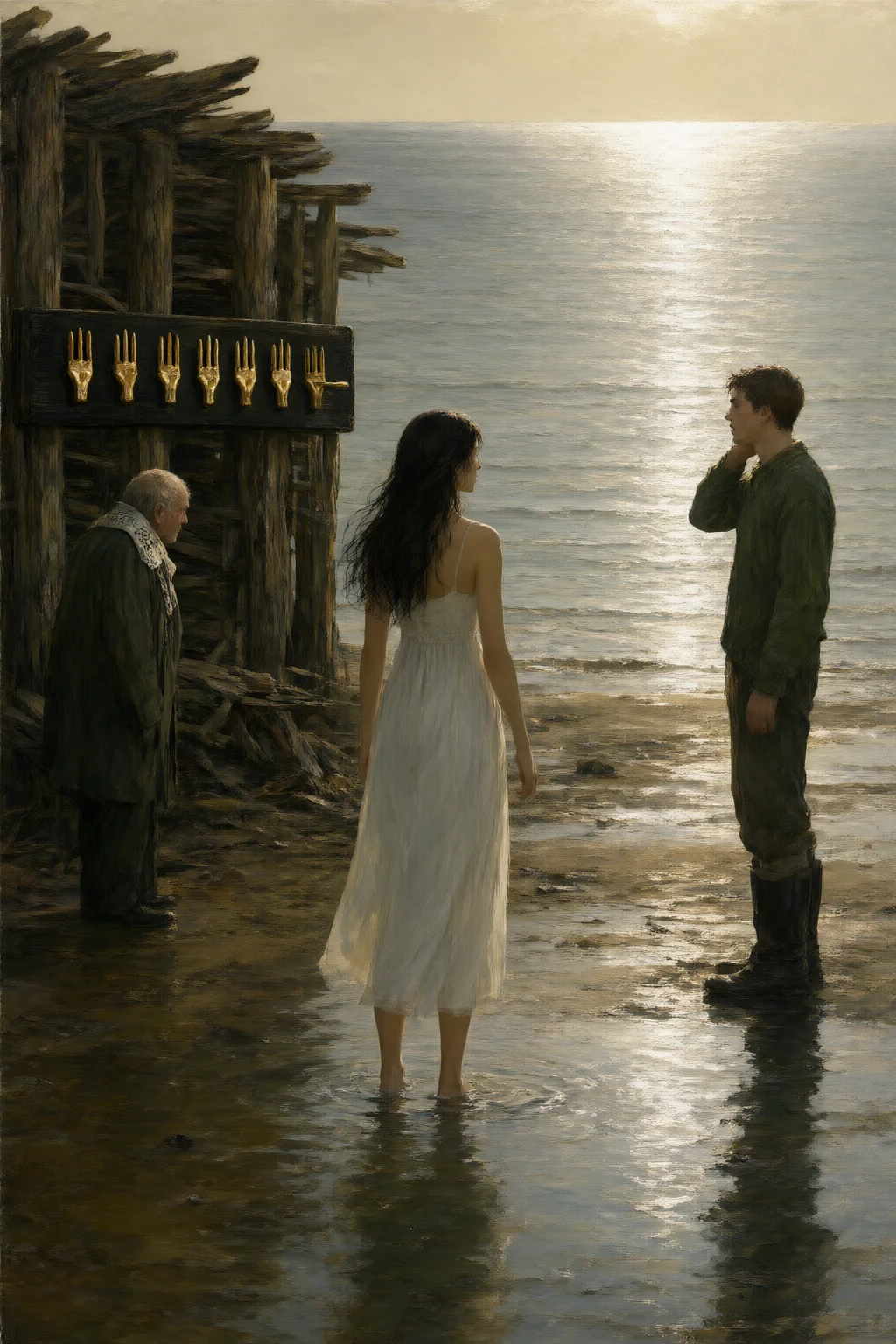
At Dunmarrow the sea keeps the register, and the sea is a very old clerk with a very good memory and no interest whatever in anybody's opinion of it. A person born on land is given a name on land, and the name is a lease, and the lease is renewed every year at the Court of the Seventh Hour, for a fee the ward sets and the sea does not. A person born of the water carries a sound, which is given to them by whoever finds them, and a sound is not a name, and a sound cannot be entered, and cannot be spoken of in a court, and cannot be signed at a harbour office, and cannot be written in a log. Halla Ossick was sixteen, and she had a sound, and she had no name.
Her father was the keeper of the light at Salt Head, a stone tower on the north side of the strait called the Skarr, and her mother had come up out of the water in a bad year and had not gone back, and had died of a cold in Halla's ninth year, and had never held a lease, and so there had been nothing for Halla to have when she died. There was, in the log book at Salt Head, a column for the keeper, a column for the assistants, a column for the supplies, and a column headed, in a hand that was not her father's, unregistered.
The Court of the Seventh Hour is a long low building of driftwood and old lime on the strand at the west end of Dunmarrow, and it has no windows that you can see out of, and the door is low, because the tide comes up under the floor twice a day and they built for it. Along the inside wall is the Tide Table: seven brass hands on a bar of black wood, one for each day, and behind them a rack of catches. Every day at the seventh hour of the ebb, when the water is lowest and the sea is nearest, the hands are checked against the water, and what the difference is between what the sea has taken and what the table says it took is entered, and a person is made whole for a year. People from Dunmarrow said the Table counted the fish. It counted the names. It was the amount of naming the town had done and had not paid for, and the number on the seventh hand had not been still in thirty years.
Halla had been down to the Court twice before. The first time she had eleven marks, which she had from her father's wages of two summers, and the clerk had taken it, and looked at the bar, and given it back. "The sea is not paid in coin." "Then what is it paid in?"
"A name lent," said Anselm Kroft, Clerk of the Seventh Hour, who was sixty and had a printed collar and a wet coat and no interest in her whatever. "A name of a living holder, on the tide side, given freely by the person it belongs to, lent for a term, and returned at the end of the term. That is the whole of it. The Court does not take a child. The Court does not take a corpse. The Court takes a name, from somebody who is alive and willing and has two names to spare, and if there is no such person, the Court takes nothing and you go home."
The second time she had come with the harbour money she had earned, forty-one weeks of painting the light-room window in the winter, and the clerk had taken that too and given it back, and had said the sentence that the Court says to people who come twice. "A name is not a money. Wages are not a money. There is no hour of any work in this parish that buys a name, because a name is not a thing you can do instead of paying."
Jerrik Sarn had come down to renew his own lease on the same evening. He was seventeen and he was the pilot's boy and the diver, and he went out at night in any weather to check the line on the light, and he was the fastest in the water on that coast, and everybody knew his name, which was not what made him fast. He also had a mother of the water, which is a thing that is not said on the coast, and so his name mattered to him in a way that nobody had ever asked him about, and he was aware of the shape of the town and could have told you that a lease was the difference between being somebody and being a young man of the district. He had a name to spare, or nearly, and the arithmetic of it was not complicated. Halla saw him waiting under the low door with his fee in a purse, and she heard the clerk say his term, and she heard the clerk say the ninth of the month following, which was eleven days off, and Jerrik said, "Then we can have it now."
"What?" "The ninth is the eleventh day. If I give the lease to you today, I have nothing to pay on the eleventh, because there is nothing of mine left to pay with, and on the ninth of next year it comes back to me and I renew it as if nothing had happened." He said it the way you say a thing you have thought about for a while and have not slept much for. "You are not taking anything off me. You are taking it off the sea. The sea does not mind. The sea never had it. It is a lease. I have had it since I was four years old." "Give it a term and you are dumb for a year."
"Give it a term and there is a person on this coast who can say your name out loud in the customs house, and sign for her wages, and be entered in the pilot's book, and be drowned in the record if she is drowned." Jerrik shifted the purse. "I can dive in the dark either way. I cannot be anything else either way."
The rule about a freely given name is the oldest thing in the Court, and it is tested in one way only, and the test is that the Court must ask, in front of the clerk, and the person must say it in front of the clerk, and if the person says anything other than the name, the Court does not hear it and the thing is void. Anselm Kroft asked him twice. Jerrik Sarn said it both times.
And the Court heard it, and the seventh hand of the Tide Table went round a notch as it went, which is how the Court marks a lease, and Halla Ossick had a name for one year, and it was somebody else's, and the clerk entered her in the register under a line that said by lease, from Sarn, Jerrik, to the ninth of the month following, and gave her a slip with the term and the date on it, and told her to keep it dry, and did not look at her, because the clerk of the seventh hour sees about forty of these a year and has never once been in a hurry.
She had wanted it for seven years and it took eleven days to learn what it was. In the first month she was almost sick with it, in the ordinary way, and she said the sound out loud on the headland where nobody could hear, and it was Jerrik's name in her mouth, and the shape of it fit, and she could feel that it fit, in the place where a name goes when it is properly yours, and that was the whole of the sensation and there was nothing wrong with it and nothing right with it either.
In the second month she was in the customs house, and the customs clerk looked at the slip, and at her, and then wrote her name at the top of a page and asked her to sign underneath, and she could not sign, because she had never learned to write the name and had eleven days in which to learn and did not have paper, and had a week in which to learn and did. The name was in the book. She was in the world. The signature was the only thing missing, and she laughed about it for a month, and then she stopped laughing about it in the spring, because the man at the post office was the third person to say I can read it, you know, I just can't be sure. The name is a name only when other people can hand it back to you.
Halla tried to pay it back in the fourth month, and went down to the Court at the seventh hour with the slip in a fold of oilcloth and an account in her head. "I want to take it off him early." "You cannot." Anselm Kroft did not look up. "A lease is for its term. It is not breakable and it is not a bill and it is not a kindness. If it were breakable, nobody on this coast would ever be named, because half of them would be named and given back inside a month to see whether it could be done." "Then take the year. And take the ninth, when it falls due. I will pay the ninth. It is only a year. I have the harbour money and I will have more."
"You will pay nothing," said the clerk, "and I am sorry to be exact about it, because I can see what you have come to say. The payer must be a named person. A person who is not entered cannot pay, because a person who is not entered cannot be received, and the tide takes payment at the third bell of the ebb or not at all." He turned the page. "You are the only named person in this transaction and you are wearing his name. If you set it down, you are nothing on my paper, and the ninth will fall on a man who cannot be named to anybody and cannot answer for it." "So the sea takes him."
"The sea does not take him. The sea does not do anything. A person whose lease falls due and is not renewed is not owed a body; he is a person who has no name, and there is no form for that, and the water takes the form for it, at the first tide, and the water is not a court and does not hold an inquest." He closed the book. "He has eleven months. Bring me his money on the ninth and I will renew it, and you can have your name back the day after, and that is the only door and I am not going to pretend there is another."
Jerrik did not go into the water for five weeks, which nobody on the coast could understand, since he was the boy who went in for a coin, and the reason was very simple and he told nobody it. Without a name he could not be paid. He could be given money, and he could not be entered for it, and at the end of a season a pilot's boy who cannot be entered for his work is a boy who has not worked. He could not be signed for in the boat's book, so he could not go out in a hired boat. He could not be entered in the harbour book, so the harbour book had a hole in it where the diver was, and a boat that goes out with a hole in it does not go out.
He washed nets. He hauled a seine for a man who did not like him. He sat on the wall at Salt Head in the evenings and he did not talk, and there was a thing he had wanted to say to a person about a rope for a long time, and he had no name to say it out loud with, because a name is what you say out loud with, and saying things to people is a thing you do with a name. Halla watched him do all of it, and it was worse than drowning, and she could do nothing about it, and both of those things were her own arithmetic.
On the ninth of the month following, in a rising gale, the light at Salt Head failed. Halla was on the rock with her father when the tower went out, and there was a boat ashore with three men in it and no one to take a line out, because the harbour pilot was drunk and the second assistant was nineteen and the diver they had all been using for nine years was a young man sitting on the wall at the north end of the town with nothing to enter him for. He went out. He went out at the tower and he got the line and got it hooked and held it in a sea that was taking the light-house itself, and he came back at the fourth bell blue to the lips and alive.
And he could not be entered, because his lease had fallen due at the seventh hour of the ebb on the previous day, and Anselm Kroft had struck the line at the seventh hand and closed the book, and there was no name in Dunmarrow to enter him under, and so the boat's book has a gap in it on the ninth of that month, with a wet line written in the margin beside it and no name at all.
At the lowest water of the year, eleven days later, Halla Ossick went down to the Court of the Seventh Hour and asked for the form. There is one release in a life. It is the oldest thing in the Court, it is not in the Assay, and it is not advertised. You may set down a name, once, in front of the clerk, and at the third bell of the ebb the sea takes the lease back, and you are not left with the fee and you are not left with the name. You are left with a sound, which the sea has no claim on, because the sea deals in names and sounds are not names and cannot be entered and cannot be claimed and cannot be sold. "You understand what you are doing."
"I have understood it since the fourth month," said Halla. "I have been the only named person in this for eleven months and I have watched the whole of it. Write it out. Put down the term and put down the release and put the date on it, because you are a clerk and a clerk wants a date." Anselm Kroft wrote it out, because it is in the rules, and the rules are the only thing he has ever been fond of. He read the release back to her twice and made her say the name once at the seventh hour and once at the third bell, and the second time she said it and then did not answer to it, which is the whole of what a release is, and the seventh hand of the Tide Table went back one notch.
"Jerrik Sarn's lease is restored as of this bell," the clerk said, "and he will be entered again in the harbour book in the morning, and he is owed five months of his wages, which I will see are paid. After that you are not on my paper." "I know what I am after that," said Halla.
She went down at the ebb, from the slip at the end of the west point, and the water took her at the knees and then at the shoulders and she did not have to swim, and that is the difference, and there is no shame in it anywhere in the water. Jerrik Sarn walked out onto the flat at the lowest hour of the lowest tide of the year, over the mud that is sand once in nine years, and stood on the strand in his boots with the wind coming round the point, and he was a person again, and he had a name, and it was in his mouth, and it had been for eleven months that nothing in the world was in his mouth but air.
He said it to the water. He said the sound, the way her father had taught it to her, which is not a word and is not a cry and is a thing a person can make once and then knows. The water did not take it, because the sea deals in names. Halla answered.