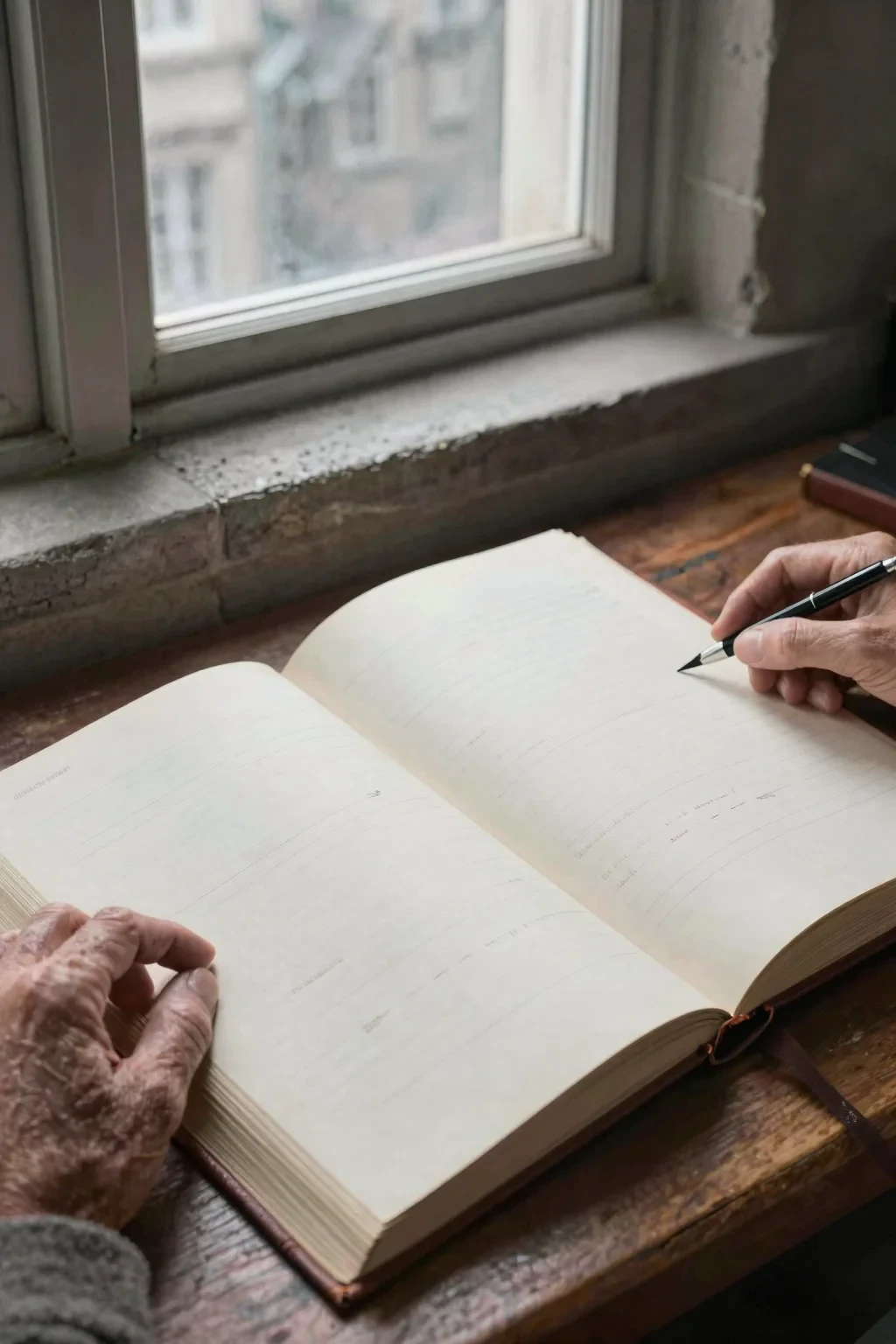
The office was cold until eleven and colder again after two, and Bronwen Vasey had spent the winter of 1929 in it with a lamp on a chain and a ruled notebook and a tin tube, and the thing in front of her was not a question of weight. It was a number of clerks. The Harbour Board wanted a schedule. Not of the line — the line had been scheduled in 1919 and re-scheduled every November since, and that was a different document — but of the paper. The consent book was public in the only sense that mattered, which was that anybody might stand at the desk and read the open page, and the Board wanted to know, for a form, how many people had ever kept it, and from when, and whether the volume was complete.
The wage book answered the second of those. Wages at the winding house were paid at the mill on a Friday in coin and entered in a hand that had not changed since 1889, because it was not a hand. It was a clerk of the mill counting heads in a column, and the column said Jonas Kearn from the twenty-ninth of June 1889, and then a name, and then another, and that column was the arithmetic of the whole town, because a clerk of the winding house was paid eleven shillings a week and eleven shillings was a great deal of money in a house whose trade had been dying for thirty years. Bronwen wrote the eleven names into her own notebook on the first day and put a bracket beside the column. Eleven names, and eleven clerkships, and the wage book gave the dates exactly, because a man who stops being paid stops being a clerk, and the mill counted to the penny. It was the hand count that would not come out. She began the way she began everything, which was to put the thing down and go and look at it in daylight with a rule against it, and on the second morning of February the sun came over the harbour wall at about ten and lay a bar of it across the office table, and she put the open book down into it and looked.
A ruled page has two kinds of line in it and only two. A line drawn by hand is a line of ink, standing proud or sitting in a groove, and it takes the light on the top of itself and casts a shadow along its length. A line made by a machine is not a line. It is a bruise. The wire presses the paper into itself and the fibre takes the impression and there is no ink on it at all, and it catches the light on one side only, the way the edge of a thumb does, and it cannot be written on because there is nothing there to write on. That was the whole of her method for the first week and she was ashamed of how long she took to think of it.
The first thirty-one pages of the consent book were hand-ruled. Kearn had ruled them himself, at a desk by the north window, and he had ruled them badly in the way that only a careful man rules badly: the horizontals dead straight, because a man lays the edge of the page along the table and draws to it, and the verticals wobbling, because a man draws a straight line at forty-five degrees from the eye and not from the shoulder. On page nine the wobble was a hair’s breadth out by the foot of the page. On page twenty-eight it was a quarter of an inch, and by page thirty-one the third column had walked off towards the gutter and Kearn had pinched it back by eye. From the fortieth page the paper was machine-ruled, and the chain lines ran a shade wider, and there was a mark in the corner of the lower left that was the trade of a paper mill she had never heard of and could not date. Kearn had bought the first ream himself. The office bought a ream at a time, and every ream that was bought is a boundary in the book, and Bronwen found the boundaries the way a woman counts fences, and there were eleven of them between 1889 and 1929, and two sat within a year of each other because in 1916 nobody could get paper at any price and the office used the last of an old stock and made it do. The line was, she wrote in the notebook, on the whole a continuous record. There was no gap in it that she could find. That was the good news and she did not believe it.
Ivo Trant came down at half past two most days and stood in the office doorway with his left hand in the red mitten and his right hand out of it, and he gave the wind before he gave anything else. “West-south-west, twenty-six, gusting thirty-four at the mast. She’ll hold to forty and she’ll be ugly at it.” Then he would stand there, because there was a chair by the stove that was not his. “The Board’s asking me how many clerks there’ve been,” he said. “They’re not asking you. You don’t keep the book.” “No.” He shifted his weight. “But they’ll ask me, because I’m the one that answers for the house, and I’ve been on the drum since ninety-seven, and I can tell you what I heard.” “And what did you hear?” “That it was always a lad.” He said it without weight, and then he added, which was the part he had come down for: “Ivo Trant, it was never always a lad, and the day somebody asks me that I’m going to say so, and I’d rather it came out of that book than out of my mouth.” Bronwen pushed the book towards the lamp. “Then let it come out of the book.” That was the whole of the conversation. He counted something under his breath going out, in fours, and the door was shut, and she went back to the page.
What he had said was useful, and she wrote it down, because a grip-man of thirty-one years had heard every clerk in his working life describe himself or be described, and a man who says a thing was always a lad is making a claim about a hand. She began to count hands. It is not a difficult thing to do and it is not a quick one. Two entries are the same hand when the thick stroke and the thin stroke fall in the same places on the same letters and the letters lean the same way over the ruled line and the loops close at the same size, and it is a thing you can only see with the page flat and the light raking across it from the side, because a page seen face-on will make a bad hand look like a good one and two bad hands look like one good hand, and the whole of her trade was the habit of saying that a thing was a thing to within a margin rather than a thing exactly.
The first entry on the first page is Jonas Kearn, in a heavy upright hand with the ink spread where the pen had sat, and the date beside it, and the line, and nothing else, because there was nothing else. A name, a date, a line. That is the whole of what the law requires, and the law is in the book whether or not anybody reads it, because a name that is in the book and was not spoken is a forgery and the cable knows about it before the clerk has put the pen down. So the cable was the auditor. Not the clerk, not the mill, not the Board. The cable, which had no opinion about any of them, and which could not be entered in any of their books, and which weighed four hundred people standing in iron pans against the weight of a car of walkers and passengers, and stopped when the arithmetic stopped being true. Bronwen had always found that a comfort and had never examined why.
She had audited the line eleven times in nine years: the ballast, the span weights, the water in the tanks, the deck and the tare of each car, and the margin, which was two stone on a car and which she could never once state as exact because the deck of a car is a wet iron thing and a wet iron thing weighs different at eleven o’clock than at three. Eleven audits, and every one of them cleared it. An audit is a thing done by a person and not by a number, and she had known that for some years, and she had not been able to do anything about it because a person is a person and a number is a number and the Board’s form wanted a number.
She got to the fourth column on the ninth of February and it took her the better part of two days to be certain of it, and the certainty, when it came, was not a surprise at all, which was the strange part. The page was the first page of the rota year. The rota came in from Mr Rownt in the November before, on paper, in his own hand, with the lines ruled and the names filled in and the hours in a fourth column, and it was a good document. Two hundred and ninety-one names for the year against two thousand four hundred souls, which is the arithmetic of the Grip: every person may hold once, and only once, and only for the line they live on, and so the town must be able to find two hundred and ninety-one people who live on the right line and are willing to give two hours of a morning they will not spend riding. She had audited eleven times against three columns and had never once stopped to ask why a book with an hour in it kept no record of the hour. The fourth column was on page two hundred and six.
It was ruled by hand, in ink, with a straightedge, in a broad nib, and it was the wrong side of the page. She measured it twice with her own ruled brass rule, once in the office and once in the daylight off the harbour, because she was Bronwen Vasey and she could not state a figure as exact, and both times it came out the same. It was a sixteenth of an inch out. It sat a sixteenth of an inch in from the outer margin instead of sitting on it, and it did not stop at the foot of the page. It ran through the last line of the ruling and out past it, into the margin, and there it faded, because the pen had run out of ink at the last inch and had been dipped and the second pull was lighter than the first, and a man who has ruled four inches of column and run out of ink at the end of it does not go back and start again. He finishes.
And at every place where the fourth column crossed one of the horizontals the ink was heavier, and the paper under it was faintly cockled, which meant it had been ruled on a damp evening with the book standing open on a desk and the window shut, and the damp had gone into the sheet and the sheet had taken the ink deeper at the crossings than between them. That was the whole of it. A column ruled in a hurry, in a damp room, by lamplight, on the wrong side of the page, by a person who had two hundred and ninety-one names to enter and an office to keep and a rule that a name in the book and not spoken is a forgery, and who had therefore ruled a fourth column and gone to bed. Bronwen sat with her hands flat on the book for some time. Nobody had ruled it out. She had expected that. Ruling cannot be unruled. You cannot take a line out of a page of a book without leaving a line in it, and this was the sentence she had been carrying round Wyver Hold since she was twenty-two years old and had never once had a place to set down.
Nell Cardew was on the shallow pan that morning with the rota slate and a stick of chalk, and she came in with the slate against her chest and the tan line across her forehead white with dust. “Fourteen until two,” she said. “And I’ve done the eleven o’clock column twice because you’ve had the book open on the office table since Friday and I can’t chalk a slate off a memory.” “You could not have chalked a slate off a memory at any age,” said Bronwen. “How many on the slate now?” “Twenty-six.” Nell looked at the page in the sun. “And that’s not four, miss. That’s three and a bit over on the right, and you’ve had me counting columns all winter and I never once said.” “A sixteenth of an inch is not a column.” “It’s a column if you’ve got to write in it,” Nell said. “That’s all a column is. It’s a place somebody decided about.”
The hand count came out at eight and she did it twice from opposite ends of the book, in case her eye had made friends with a hand that had no business there, and it came out at eight both times. The wage book gave eleven names. That was the whole of the arithmetic and it was very clean, which was how she knew it was wrong, because a thing that has been true for forty years is never clean. She set it out in the notebook as eleven lines, three of which carried a second name, and there was a fourth thing that was not in the wage book at all, and she went through the four one at a time in the order she found them, and every one of them turned out to have a perfectly ordinary explanation, and not one of the four was a lie. Rowland Caws had it in the fourth clerk’s hand for twenty-two months.
He came into the office in May 1912 at nineteen, having left the quarry, and Gwilym Pryce had held the book since 1909 and had no reason to hand it over to a boy, and Caws wrote his first entries in Pryce’s hand because Pryce told him to write them in his hand, and said, without any particular emphasis, that a book that changed its hand every time a new lad came in was not a book but a magazine. Twenty-two months is a long time to write like a man in order to please him, and it is not a short time either, and the entries on the pages from May 1912 to February 1914 are Pryce’s hand in every particular: the same lean, the same closed loops, the same way of letting the descender of a g run out past the rule and stop dead in the margin. In March 1914 Caws was given a good pen for his birthday and the hand went, all at once, into a rounder upright thing with an enormous M, and never came back, and he kept the book until January 1917 and then went to the millpond and was never in the office again. Megan Orrell and her brother Emrys wrote the same hand.
They were thirty-one and twenty-nine and they were in and out of the office for two years between 1924 and 1927 because there was nobody else to do it, and if you asked the town to describe the clerk of 1925 they would have said Orrell, and there were two of them, and the mill paid a woman who did the office work on a Saturday a different rate, and their two entries sit a half-inch apart on the page for nineteen months. You can tell them apart. It is not the letters. It is the nine. Emrys closed the loop of the nine and turned the tail inward and Megan threw the tail out to the right and came back under, and there are thirty-one nines between them and you can find every one of them. And Merren Skelly came back.
This was the one that took two months, and the reason it took two months was that it cannot be true and she could not make it true by wanting it to be true. Merren Skelly had held the book from January 1902 to June 1909. Seven years, four hundred and ten days, and the wage book gives it to a fortnight because the mill counts in fortnights and there was a strike at the mill in the March of 1908 in which the office was not paid and she was not paid and the entries in the book in that fortnight are in a hand that is slightly larger and slightly worse than the rest of her, which is a thing a person does at the end of a fortnight of not being paid. The hand is a small square hand with the t crossed high and the e written with a very short middle stroke, and it runs from page ninety-one to page one hundred and forty-one. And then, at page three hundred and nine, with a machine-ruled page of the 1923 paper in front of her and a fourth column ruled a sixteenth of an inch out, the hand was there again.
It was the same hand. She put the two pages side by side under the raking light and let the sun do it and there was no room for doubt: the t crossed high, the short e, the way the n leaned a degree into the column and came back, the same habit of breaking the ruling on the descender of a g and stopping in the margin as though the margin were a shelf and not a place to write. And the wage book said that Merren Skelly, sixty-eight years old, had been clerk of the winding house from the ninth of September 1923 to the second of March 1924. Six months. And then a name in the wage book that Bronwen did not know, and a hand that was not one of the eight, and the run of Skelly’s hand broke and did not resume. The first thing that saved her from writing something silly was the paper.
She had been dating the pages by the paper all along, because the office bought a ream at a time and a ream came from a mill with a mark in the corner and the marks changed when the mill changed, and eleven reams had been bought in forty years. The page at three hundred and nine was not 1902. It was not merely the shape of 1902. It was a sheet out of the ream bought in the spring of 1923, and its chain lines were a shade wider than those of the sheet at page ninety-one, and its ruling was a bruise and not a line. She had spent nine days learning to tell a line from a bruise and it turned out to be the whole of the job. That was the moment the book stopped being a book of names and became a book of ruling. Every date in forty years could be taken off the paper. Every hand could be taken off the ink. And where a hand had changed and changed back, the paper would still have said which of the two was the earlier, and would say it without anybody’s opinion being involved.
She took it to Gwilym Ore on a Tuesday because he was the only man in Wyver Hold who kept a second set of records for reasons of his own and she wanted a witness who was not interested. He came down out of the winding room with the horseshoe burn on the front of his apron and a pencil behind his ear that had been there since 1911. “The drum log,” he said, before she had said anything. “You’ve come about the drum log.” “No.” “Then you’ve come about something you think the drum log will help with.” He had kept it because he was a mechanic and mechanics kept logs. Every journey of the Grip since 1888: hour, weather, wind at the mast, weight out, weight back, and the stops. Bronwen put the book down open at page three hundred and nine and told him she had eight hands where the wage book had eleven clerkships, and he corrected her before she had finished. “Eleven clerkships is not wrong.” “It isn’t the same thing.”
“It is the same thing if a hand is a man.” He turned the page over with the side of his thumb and did not look at it, because he does not look at paper, he looks at what is on it. “Kearn, Prothero, Skelly, Pryce, Caws, Tole, Veale, Orrell, Orrell, Skelly, Prothero. Nine men and women. Eleven wages. You’ve miscounted the men, not the clerkships.” “Nesta Prothero has the book now. She had it in 1895 and she has it again.” “Then Prothero’s hand is in it twice, and she is sixty-six, and it is not remarkable that it is in it twice.” “It’s not remarkable that she is in it twice. It is remarkable that the town has been paying eleven.” She turned the page round so that the light from the window came across the t’s and the e’s. “That is nine people, Mr Ore. Eleven wages.” He looked at it then, for perhaps four seconds, and then he said the thing he had come out of the winding room to say, in the tone of a man who has been keeping a thing for eighteen years and has had nobody to hand it to. “Page two hundred and eleven,” he said. “Half past two, the fourteenth of March 1920. Cable stopped and held. Twenty-six minutes. I have never known the stopping time of that day and I have wanted to know it every year since.” Bronwen sat very still.
The margin of page two hundred and eleven is where she found it, and it is four words long. 2.51 p.m. The entry beneath it is struck through. One stroke, and the stroke is not a line across the name, it is a line from the top rule of the row to the bottom rule of the row, through the name and the date and the line, in a hand that is not the hand of the column and is very much the hand of the man at a desk at the end of a long afternoon, because it is the same hand as the entry above it and the entry below it and it is only the size that is different. It is smaller. It is the size a hand gets when it is writing small on purpose. The rule is that a name removed from the book stops holding at the moment of removal, wherever the person is. The rule is also that no holding may be given or taken while the cable is moving, and that a name crossed out mid-journey stops at the next brake, and that the grip-man pulls the brake rather than trust anybody’s timing.
Rhys Trellan had spoken his sentence at the pan at a quarter past two on the fourteenth of March 1920 and had stood in it, and the car had gone up, and the cable had been running nine minutes when he put his head over the rail of the shallow pan and said the other thing a person can say at a pan, which is that he would not do it after all, and there was one clerk in the office and it fell to him, and he went out with a pen and did the only thing the book allows, which is to take the name out. He struck the row out at 2.51 and the brake went on at 2.53 and the town stopped for twenty-six minutes with a car on the upper span and four walkers in it, and rule ten held, because a balance broken mid-journey is not a fall. It is a stop. It has happened eleven times in thirty-one years and nobody has ever been hurt. And then, because there was no column for it and because the office had one clerk and the office was at the bottom of the hill and the clock on the wall is the drum clock, he wrote down the time. Not the reason. Not the man’s name again. The time. The ink stands above the ruled area in the space the binder leaves, in the same hand and the same nib, and it is one of two such entries in four hundred pages, and the other one is on page one hundred and eighty-four and is in another decade.
Aldith Marner came in on the last Friday of the month and stood in the office with chalk on the cuffs of a jacket that was too good, and asked whether it was true that no person had ever refused to hold in forty years. “It is true that no person has ever been recorded as refusing to hold in forty years.” “That is not the same as it being true.” “No,” Bronwen said. “It is the same as it not having anywhere to go.” The book was ruled for a name, a date and a line. A person who stands on the pan and speaks and holds has filled the three. A person who stands on the pan and says no has filled nothing, and there is nowhere on the page to write down that they came and stood there and said it, and there has been no refusal in the volume in forty years, and Aldith Marner wanted one of her two hundred and six children to refuse in public on purpose so that the rest of them would know it could be refused, and the book had been refusing on their behalf the whole time by having no place to put it. “The margin,” said Aldith Marner. “The margin is where the time went.” “Then the margin is where the refusal went.” “Yes,” said Bronwen Vasey. “And that is the whole of what a margin is. It is where a book admits that it has a body.”
Page one hundred and eighty-four is the twentieth of November 1911 and the hand in it is Gwilym Pryce’s, and the margin entry is long, and it is the only long thing in the margins of four hundred pages. It is not a name and it is not a date and it is not a line, and that is the point of it, and the clerk appears to have known it while he was writing, because he wrote it across two lines of the margin and then stopped short of the third. Evan Trelawney says he is Evan Trelawney and he holds for the up. Idris Vaughan says the same and holds for the same. Neither is Wm. Vaughan. I wrote the wrong name and it was my ear and not my ink. Twenty-two minutes of the cable and the drum held and no man spoke. G. P.
Ivo Trant had it before she had finished reading it out. “The twentieth of November,” he said. “And it was the morning, and it was the day the upper span went in, and I have had a crew of strangers on that line with an inch of slack in it and a drum I could not trust, and I said to the man that if anything was going to happen it would happen that day.” “It was the morning, and the wind off it.” He put the white hand flat on the desk, which he does when he is being exact. “Gusting thirty-one, twenty-two at the mast, sea fret up the cutting. I had the brake on and my hand on the lever and she would not have moved an inch, and I counted to a hundred and eighty by fours waiting for somebody to come and tell me why, and nobody came, because nobody knew, because the office was full of men stripping a cable. Twenty-two minutes. Then she went up.” “Then you remember a thing nobody has written down.” “I remember a thing a clerk could not say out loud in a room with strangers in it.” He took the mitten off his left hand and put it in his pocket, which he does at the end of a thing. “That is the hand of the man I was talking to. Pryce had the book.” “The book has a name in it that was not spoken,” she said, “and he is not in the book at all. The cable would not move an inch. And then your Vaughan and my Trelawney said it to you themselves, and Pryce struck a line out with a pen.” “Then the book was wrong for twenty-two minutes.” “The book was wrong for the length of one sentence.”
Gwilym Ore read page one hundred and eighty-four in the office on a Friday and did not put it down for a while, and she watched him read it twice, and she understood that the thing he had wanted for eighteen years had not been why the span was changed but the other half of it, which was that he had been asked nothing, and that a thing you are not told is not the same as a thing nobody knows. “Nineteen hundred and eleven,” he said at last. “The twentieth of November. Cable up on the twenty-third, or the twenty-fourth. I was at the mill at Salford and I was not told.” “You were not asked. It was not in the log.” “No.” He closed the book, and then he opened it again, which she had not seen him do. “Two names spoken and one name written, and the machine refused, and the reason is on the page in the margin in a hand smaller than the rest of it.” “It is the same hand.” “It is the same hand and it is the smaller one. That is what I have been trying to say for eighteen years. Somebody in that office knew they were writing outside the book while they wrote it, and made the writing small, and the smallness is the whole of the record.”
There were two such entries in four hundred pages and eleven clerkships, and Bronwen Vasey set them down side by side in her own notebook on the Sunday, because it mattered that they be side by side and not one after the other. A time. And a pair of sentences. Both were written outside the ruling. Both were written in the hand of the clerk who was doing the entry, at the size that a hand takes when it knows it is writing in the margin. Both were made at the moment when the office had one clerk and a rule that could not be entered and no column to enter it in, and both were made by a person who had stopped to make the record rather than go on making the book. Neither of them balances anything. That is what she kept coming back to, and it is why the Harbour Board had no difficulty at all when she told them, on the eleventh of March, that the consent book had been kept by nine people in eleven clerkships, and that eight of those nine had kept it in a way anybody could see.
The ninth name on the schedule was a matter of arithmetic and not of hands: Jonas Kearn, Nesta Prothero, Merren Skelly, Gwilym Pryce, Rowland Caws, Evan Tole, Catrin Veale, Emrys Orrell, Megan Orrell, Merren Skelly again, Nesta Prothero again. Nine people. Eleven wages. The town had been paying eleven and had been counting eleven, and had been wrong by two for as long as the ninth of September 1923. And the eight hands were a matter of nothing anybody needed, and she said so in the schedule, in one line, and the line is the only sentence in eleven years of her audits that she was not able to give as a tolerance.
She wrote in the margin on the last Friday of the month, which is a Friday, because the office was shut and the office had been shut since one o’clock since the war. She wrote it in ink. That was the decision and she made it in about a second and then sat with it for an hour. Ink because pencil can be rubbed out, and a book that has been the law of a town since 1889 is not a thing that ought to contain anything anybody can rub out, and because the ruling would show an ink mark now and forever whatever she did, and a thing that shows is a thing that happened. Small. In the margin. Across two lines, stopping short of the third. The book has no column for a clerk. It has no column for a refusal, a time, a sentence, a correction, or an error, and it has had no column for any of them for forty years, and a column cannot be ruled into it because the book is the law and the shape of the law is not the clerk’s to change. So the margin it is, and the margin is not a column and is not governed, and she had understood that at the end of February and had needed the whole of March to be able to do it. When she had finished she counted the hands again, because she could not help herself, and there were nine, and there had been eight when she began, and the ninth was in the margin and it was hers, and it was in a book about how many people are allowed to say yes on behalf of a town that cannot go up the hill.
The hands she had been puzzling over since February were on the page still. Prothero’s was the second hand in the book, at the small looped entries of 1895 and 1896, and it was the hand on the open page in front of her at the bottom of page three hundred and ninety-eight, in the fourth column, and in thirty-three years it had not altered except to lean a little the way Kearn’s leaned. “A hand goes back to what it was taught,” Gwilym Ore said, when she asked him on the stair and he answered without stopping, because he does not stop for questions. She went down to the harbour after and stood on the wall in the dark, where the wind is least, and the lower station glowed across the water like a lantern, and somewhere under it a car was going up on somebody’s name. Page two hundred and six has a column in it that is a sixteenth of an inch out. Every name entered under that column holds, and has held, every year since the winter of 1919, and nobody has ever rubbed it out, because you cannot rule a line out of a page of a book without leaving a line in it. A sixteenth of an inch is the width of a thumbnail. It is the width of a mishearing, and of an hour nobody could enter, and of two hands that wrote outside the ruling and a third that joined them when they were read again. The hill went up and down all day on the strength of it.