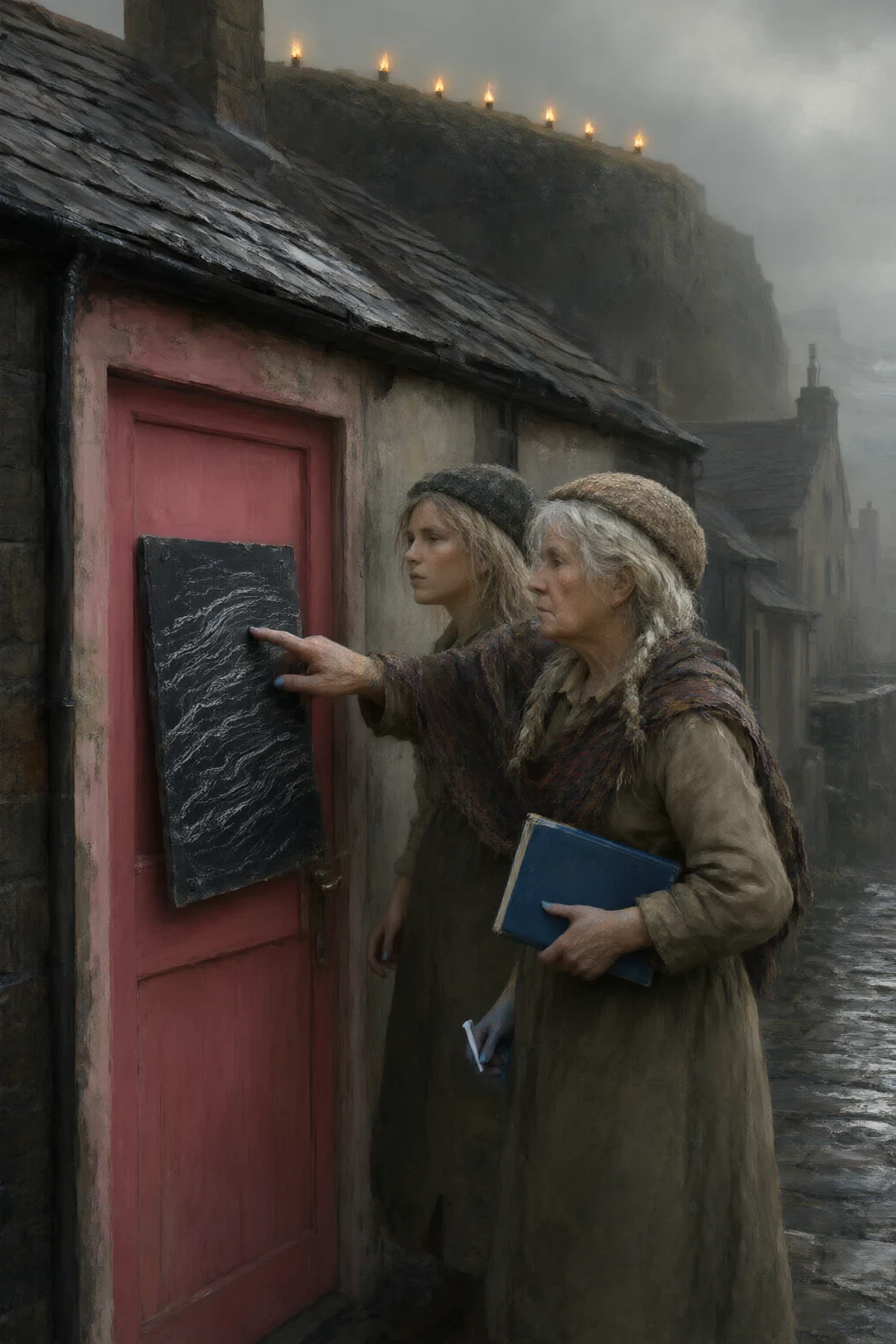
The tide boards of Brinehold Row are not boards in the sense a joiner would recognise. Each is a slab of black shale the width of a hand, hung on three nails outside as many doors as there are on the Row, which is one hundred and forty-one. Once an evening the Chief Lamplighter chalks the nine lamps on every one of them, and once in the morning somebody rubs them out, so that the whole of the town’s ritual exists at its thinnest for about six hours a day. They are not a record. That is what everybody who has ever tried to use one has discovered, and it is why the Council keeps a Great Oweing Book, and why the harbourmaster keeps a Bay Book, and why there is a tally wagon behind the weigh shed with a board nailed flat on its tail. Three kinds of record, and no two of them have ever spoken.
On the Thursday of the third week of October, 1901, Wren Adry was forty feet up a stair on Brinehold Row in front of a house that was half a wall, waiting for a man with a crowbar. She was fifteen, and her fingertips were blue with ink, and she carried the Great Oweing Book under one arm bound in tarblue cloth the way other children carry a doll, and she had a sheet of foolscap in her apron with a plan on it: METHOD — chalk against memory. WITNESSES — two. FIRST MONTH — the raising. SECOND MONTH — the cut. RULE — they do not touch. “The board is the last thing on that gable not nailed to something the men are keeping,” said the man. “That there is your board.” It was the house of Bewick, and had been since before the Winter of Lost Boats, and the man was putting a new one up for a family called Sell, and nobody on the Row had wanted the job, because you do not want to be the one who took an old Bewick board down, and Wren Adry had volunteered in writing. The old woman was already sitting on the flags of the half-demolished porch with a stick between her knees.
Tace Bewick was eighty, and had been ten in the Winter of Lost Boats, which is a thing she has said so often that people have stopped hearing the year in it. She had a knitted cap on in October, and she had come up in a cart from Black Spit in a rain not worth the sitting. “Mistress Adry,” she said. “You have chalk.” “I have chalk.” “Good girl. Do not let the man take it down till we have looked.” There is a thing about chalk that most people do not know, and it is that a chalk line is not a line. It is a layer. Chalk laid dry over a wet board goes down into the wet and the two become one thing, and then a second coat goes over that, and a third, and if you get a light down low on the left you can read a dozen coats at once. “You hold this,” Wren Adry said to Neel Ferrin, “and you do not move it, and you do not speak, and when I say look you look where I look and not where the light is brightest.” Neel Ferrin took the lamp in both hands, in a bright yellow oilskin slicker with the hood up, in October, in the rain, on the ruin of a porch, and said, “Listen — I can hold it.” They started at the top of the Row and worked down. The first six told them nothing, because the six nearest the Lamp House end had been reboarded inside living memory and their chalk went back a season and no further. The ninth was Tace Bewick’s, and the ninth was the one they wanted.
“Come round the corner of the porch,” Wren said. “The wall is sheltered, and this board has never been scrubbed in living memory, because a Bewick does not scrub a board. A Bewick chalks on top of a board and lets the weather do it.” “So it goes back how far?” said Tace. “The weather takes a coat in about nine years. So six, eight, ten coats. I can read the top two and see the edges of the rest, and I can tell you that the bottom four are not what I was looking for, and I cannot tell you what they are.” Wren Adry put her hand flat on the board. “That is where I need you.” “Something you can remember and I cannot.” “Then I shall want it on a cold morning,” said Tace Bewick, “and not now, and you may tell Mistress Skerry I said so.” And there was the rule, and Wren Adry had to explain it, and it turned out she could not explain it without going red. “Two witnesses,” she said. “You and me. You read what a memory supplies. I read what the chalk supplies. And we do not touch.” “Do not touch what.”
“Each other.” Wren looked at the flags and then at the step. “You stay down there. I stay up here. And if one of us says a figure, the other does not go looking for it, and does not nod, and does not help. Because if I have heard you say it first, then everything I find afterwards is a thing I found because you told me where to look, and it is nothing.” “You will have to be very dull,” said Tace Bewick, “and very careful, and dull for four days, and you will hate it.” “Yes,” said Wren Adry. “Then we will get on.” “In January of eighteen thirty-nine,” said Tace Bewick, “I was ten. I have been asked that so often I have had to stop saying it as though it were a sum, and you may do the sum if you want to, girl, I have watched you doing it since Thursday, and I have never once been able to make the two numbers agree, and I have decided to be eighty.” She was not a woman who told stories with a beginning put in for effect. “It was the eleventh of the month the boats went. A gale off the north-east that came in with the moon and would not go off with it, and it took the lot. Not a boat. The lot. Thirty-one, and the crews, and the women who went out to hold the mooring lines. My mother went out with them. She came in at four in the morning and she was the only one of the Row who came in, and she said the water had made an offer, and that the offer was generous, and that the whole Row was going to be sensible about it.”
“On the twelfth they buried nobody, because there was nothing to bury. On the thirteenth they sat in the cold church with the doors shut and somebody wrote the terms down, and that was Master Rask, the schoolmaster, and he did it in one night because it was a Tuesday.” “There was not one lamp lit in Brinehold that winter. The water did not want lamps. Lamps were forty years away. What the water wanted was a thing to be given at dusk, and what the Council agreed was that the coast would give it, and that the thirty-one should sleep warm at the bottom of the bay and should not rise. And it ends the way a sentence ends, and I am not going to say the end of it here on a wall in the rain.” “I want to know what it is doing now,” said Wren Adry. “That is a much better question, and it is the reason I am on this porch. Eleven houses carried that winter, and any soul in the house who could get out in the dark, and we carried without being asked and were never thanked in writing, and I would not have wanted it. And we knew one thing, and it was not a secret, and it was arithmetic nobody wanted to finish: the water had asked for a night, and the Council agreed to a lamp. Those are two different shapes, and only one of them can be given, and the water will not tell you, because the water does not keep your account.”
“There were eight days of raising,” she said, “the twenty-first to the twenty-eighth of September, eighteen forty-six, with a wind off the north-east the whole eight days. Nine sockets. Iron, socketed into the rock, not planted. Set, the way you set a cup in a hole in a wall, because a post planted in a cliff in this weather comes out in the first gale that means it.” “They went up harbour end outward, so the first to stand was the one nearest the water and the last was at Cormorant Head, and the order was settled in an afternoon, and the argument that afternoon lasted eleven years. Nine names out of thirty-one. Not ten, girl, and not thirty-one. There is no tenth. You cannot raise a tenth lantern on this coast and a seventh name cannot go on a lamp.” “The first night was Michaelmas eve, the twenty-ninth, and I carried the sixth.” “You carried the sixth.”
“Hannah So Werby. She was forty-one and had a boy of six who stood on the wet grass with his hood down in a north-easter to watch a woman light a lamp for his mother, and his mother had been dead nine years and never had a post and never could, because she was not in the water. She was found on the harbour steps. He did not speak, and afterwards he ate his supper without stopping, and his aunt said he had been odd about it his whole life, and he is the Chief Lamplighter and he is sixty-one.” Wren Adry wrote it down, and her hand was not steady, and she said nothing for a while. “And he signed the pot,” she said at last. “He cut something out of a recitation. That is a different thing, and it was thirty-one years afterwards, and I have not come to it. You are not allowed a thing that happened to me in 1871 until we have done the number.”
“There were one hundred and fifty nights in a season and that is not a thing anybody sat down and decided.” “It is not.” “It is a thing somebody counted once and wrote on the back of a hand, and the hand was Master Rask’s. The counting was done in a shed at the harbour end with the lamps in on the bench, and I was twenty-five and held the lamp for him while he counted, and he did it twice and got the same number twice and then ruled it, and I watched him rule it. Michaelmas to Candlemas. First of October to the second of February, and there is a gate in the fence at the gorse where the turning is, and to this day the Chief does not take the line up after it.” “One hundred and fifty dusks.” “One hundred and fifty dusks, and nine lamps on each, which is a lamplight apiece, and a lamplight is one hour of life given to one post. Not nine hours shared out in a pot. One hour, to one post, by the person who gives it. Thirteen hundred and fifty a season, and every child on this coast can do that in their head, and you have done it the way a person does a thing she has been told.”
Fifty-five seasons of that, shut at Candlemas of this year, is what entered the Great Oweing Book: seventy-four thousand two hundred and fifty, entered a lamplight at a time since the twenty-ninth of September of 1846, without anybody once stopping to wonder what the entries were for. “There is a second column.” “There is.” “DELIVERED.” “There is, and you will not believe how old it is. A bearer stands at a post and gives an hour, and the hour is the whole payment, and the only way anybody on this coast can tell whether it took is the plaque. If a lamp is fed properly the letters fill with light behind them and you can read every letter of the name from thirty feet in the dark. If it is not fed properly the plaque stays flat and cold and you can read the engraving and not the name. That is how DELIVERED has been counted for fifty-five years. Somebody walked the line at dusk and looked at nine plaques and wrote down how many had their names in them, and then somebody else did it again the next night.” “Then the coast has been measuring itself honestly for sixty years.” “For sixty years,” said Tace Bewick, “and the difference between the two columns has been written in a third column every season, in a hand you will know in a minute, and nobody has ever once done anything about it.”
The Harbour Council house smelled of tar, lamp oil, and wet coats. “Before we start, I am going to say the thing that will be said afterwards, so that nobody can have it afterwards. In eighteen seventy-one I signed a minute. I was thirty-six, and a man came in and told me the honest light had finished, and he was thirty-one, and he was right, and I believed him.” “You signed the minute for the pot,” said Wren Adry. “I signed the minute for the pot. A pot is a fire for three hours a night, and a fire wants a Council minute. That is all that paper is. It is permission to spend coal. And the pot was the right thing to spend coal on, and it worked, and that is the whole of my defence, and I have had thirty years to make a better one and have not managed it.” She put two fingers on the tin. “There is one more thing on that sheet. Nobody has ever read it. I have never shown it to anybody, because a rubric is a form, and nobody reads a form.” She opened the tin.
Every Council minute carries a rubric at the head, because a Council cannot act under a bargain without writing down the bargain it is acting under, and the rubric was copied at the top of the sheet every time, in the same words, for sixty years, in a small upright hand. That hand is the Adry hand, because the Adrys have kept the Council’s pen since before there was a Council. Every rubric in the tin ran the full width of the paper. The one on the ninth of November, 1871, stopped two inches short of the right margin, and its tail had been struck through with a single stroke of a flat pen, and the stroke carried on past the words into the blank paper, and it was the only struck line in sixty years of minutes. Halla Skerry came in behind Wren Adry and stopped in the doorway. She was thirty-four, and had held the Great Oweing Book since the March when her husband died of his lungs in about four minutes on a Tuesday afternoon, and she held it now with both hands and her chin up. “That is my husband’s great-grandfather’s hand,” she said. “It is,” said Osa Kilbride. “I have never seen it and I have known about it for eleven years.” The four struck words were: until the owing is paid. And Tace Bewick, standing at the back of the room, said them out loud, once, in an ordinary voice, and never said them again.
“He did it on the same afternoon,” said Tace Bewick. “Before the pot was cold he came out onto the half landing and recited the compact to the men standing there, because that is what a Chief does when he has changed the fuel — he tells the line, and they were his men and they were owed it. And he recited it from memory, in the wet, with the steam coming up the stair behind him, and it went as it had gone every Michaelmas for twenty-five years, until it did not go any further.” “Until it did not go any further,” said Wren Adry. “And he stopped, and there was nothing after the place where he stopped, and the last thing that was there was the part about the thirty-one sleeping warm. There were seven men on those steps and a girl holding a lamp at the bottom, and that girl was me, and I was the last one of the eleven.” “Did you say anything?” “No.” “You were the last one of the eleven.” “Yes, and I did not say anything, and I have had thirty years to find a way to have said something, and there is not one, and I want that written down too, because you will think of it.” “Why did you not say it?” Tace Bewick took a while. “Because if I had said it, I would have had to say the other half of it. A person can carry the first sentence for seventy years and get away with it, because the first sentence is about the water, and the water is not here. The second sentence is about me, and there is no water to put in front of it.”
The arithmetic took the best part of the second day, and it came out like this. One thousand three hundred and fifty lamplights a season, entered. Fifty-five seasons. Seventy-four thousand two hundred and fifty entered. Seventy thousand seven hundred and one delivered. And the difference, which is the only number in the book anybody ever looks at, because the Council has carried it every season since 1847, and carrying is permitted because of the four words on the tin. Three thousand five hundred and forty-nine. And only three thousand five hundred and forty-nine. “Now the two halves of it,” said Wren Adry, and stopped, because she had the pencil over the page and had written nothing for a minute. “Go on.” “It splits.” “It splits,” said Tace Bewick. “Say the two numbers aloud, and then say aloud whose hand wrote both, and then say the next thing.” Wren Adry said: “Three thousand, and five hundred and forty-nine.” “Now the hand.” “The same hand. The same small upright hand, the Adry hand, in the arrears column in both. The last of that line was the man who died of his lungs in the March, and he had been keeping the column nine years.” “Now say what three thousand is.”
“Four thousand five hundred tallow-dusks. Thirty seasons, a hundred and fifty a season, every season from eighteen seventy-one to this one. The Council does not split a season. The first tallow went into the pot on the ninth of November and the Council carried the whole of that season at tallow, and that is how you arrive at a round four thousand five hundred.” “And how much did four thousand five hundred tallow-dusks deliver.” “A third.” “And how much of it was entered?” “All of it. Every one, as a full lamplight.” “So the Council wrote down four thousand five hundred and the water was given one thousand five hundred, and the two thirds written down and never shown to anybody is three thousand.” “Three thousand,” said Tace Bewick. “The pot did not lie. Not once. It made a clean sweet flame that no one had to give an hour for, and every soul in Brinehold has slept warm in that bay every night since, and the thirty-one have not risen. The lie is not in the pot. The lie is in the book, in a warm room, with a good pen, on a line where a third of one went. The sea is never asked to read the book.” Wren Adry wrote that down in full. Then she said, “Then there are two things here, and one of them is the twenty-two.” “No,” said Tace Bewick.
“There are two. The three thousand is tallow. The five hundred and forty-nine is carried for the twenty-two that never had a post, at the rate of the nine, and that is a different grievance and it has a different—” “No, and put the pencil down, because I have watched you get a good sum in front of you and go tidying, and you are about to make it two things, and it is one thing written twice.” “It is two sums.” “It is one hand.” Tace Bewick leaned forward over the lamp. “The same line that left the tail off a Council sheet in eighteen seventy-one carried the unposted from eighteen seventy-eight onward, for the same reason: the Chief told him the compact no longer closed, and told him to carry what was left, and he carried what was left, in two lines, because the Council has two columns and not one. It is the same wrong, small, in the next column, in the same afternoon.” Wren Adry put a line under the five hundred and forty-nine and wrote UNDER THE SAME HAND, which was the first time in four days she had underlined anything.
“The five hundred and forty-nine is the one I want you to see properly,” Tace Bewick said, “and then I am never going to speak of it again, so put your face on.” “Twenty-two sleepers, carried at the rate of the nine. Which means the Council has been paying, on behalf of twenty-two people, an obligation the Council never asked the water about.” “That is it exactly. You are the first person in thirty years to say it in one sentence.” “Why were they carried at all?” “Because the Council cannot bear an unposted name to be the one thing the Row does not mention. Nine of the thirty-one have a lamp. Twenty-two have nothing — no post, no plaque, nothing to put a flower on at Candlemas. And a Council that keeps an account could not stand the account to be short twenty-two, so it carried them at the rate of the nine, out of its own head, at its own table, for sixty years, and never once put a question to the water.” Halla Skerry had been standing by the shelf with her hands behind her back. She now took a folded leaf from inside her coat and put it on the table, which nobody had asked her to do.
“This is mine,” she said. “Not the Book. It is my own keeping since the March. The unposted, taken out of the arrears and set by itself, with the twenty-two named, and a column for what each of them is carried at. I started it because the Book is a wall and I wanted a window. Every figure in it is the figure in the Book.” “It is a good piece of work,” said Wren Adry. “I know. That is what I am frightened of.” “Because I have made the twenty-two into a separate thing, and so have you, and so had the Council before either of us, and the moment you give the unposted a column of their own you have said they are owed something on their own account, and nobody has ever established that, and there is nothing in the Bay Book that says any of the twenty-two was charged by the water at all.”
The Bay Book is kept by the harbourmaster and has never once been found to contain a lie, because it is kept by a succession of harbourmasters who are all men of the same sort. It records the vessel, the hour, the place, the count, the sea’s state, and one column nobody on this coast ever reads, which is what the water took. And for six of the twenty-two, in the harbourmaster’s own hand, going back to 1840 and never altered, the column reads: NO WATER CHARGED. “Because they were not in the water,” said Tace Bewick. “Hanged in a loft. Drowned in the harbour steps at low water and never came loose. Two of them were put out of their cots on the night of the gale by a father who lost his nerve, and the harbourmaster wrote it in plain words because he would not write anything else, and there is a family on this Row that has not forgiven him for it in sixty years. And for the other four the water never had them, because the water never had anybody. It did not take those six, and no one in this town has ever gone and asked the water to say so.” “So the Council carried them anyway.”
“The Council carried them at nine apiece for sixty years,” said Tace Bewick, “against a line the water never wrote. Five hundred and forty-nine hours. It is a real hole in the Council’s account, because the Council has carried it and been given no credit, and the honest light is short by all of it. And it is a false one, because the water never asked. The Council entered men against themselves. It is the smaller line of the same lie as the three thousand, in the same hand, in the same afternoon, and it is not a second thing anybody was done to, and if I hear one more person set it up as its own injury I will walk down to the water.” Halla Skerry picked her leaf up, folded it, and put it back inside her coat, and nobody stopped her, and she did not tear it up either.
The rest of the sum came out on the Sunday in the Lamp House at nine in the morning. “Three thousand five hundred and forty-nine hours,” Wren Adry said. “At nine a dusk. How many nights.” “Three hundred and ninety-four nights and — ” She stopped. “Say it.” “Three hundred and ninety-four nights and one hour at nine a dusk. That is how the Lamp House book puts it. That is the phrase the book has used since eighteen forty-seven.” “That is not what the division gives.” “No. The division gives three hundred and ninety-four nights and three hours. There are three hours over, not one.” Tace Bewick put her hand flat on the bench. “There,” she said. “That is the whole of the work and you have not done it with a pencil. Sixty years this town has said three hundred and ninety-four nights and one hour, because that is the only shape a rota has. A rota is a list. It is nine a dusk, and there is no such thing in a rota as part of a night, and so when the sum comes out with three hours hanging off the end, the list cannot hold them, and it rounds them, and the coast calls it one hour.” “So the remainder hour —”
“The remainder hour is the whole difference between a rota and a rate,” said Tace Bewick. “A rota says nine a dusk. A rate says one hour to one post, by a person, in the dark, standing still. There is no part of a night to put three hours in. On any list in this Lamp House tonight those three hours go nowhere, and they have gone nowhere since 1847, and they are the only part of the three thousand five hundred and forty-nine that nobody has ever been made to stand still for. It is not a moral. It is a container. A list cannot hold a third of a dusk, and a person can.” “Now the other one. The arrears against the doors.” “One hundred and forty-one doors on this Row. Three thousand five hundred and forty-nine hours, shared out evenly, which nobody would do and which is the only fair way to make people understand a thing.” “How many hours to a door.” “Twenty-five hours and ten minutes.” Halla Skerry sat down on the bench, and got up again, and sat down.
“No,” said Tace Bewick. “No, that is a bad number to stop on. You divide it out on one morning and it looks like a great deal, and it is not. Spread it along the years. Fifty-five seasons, a hundred and forty-one doors. It comes to half an hour a door a year, and the better part of that is a quarter of a minute on a night at dusk.” “That is eleven seconds.” “That is eleven seconds a door on a night, which is a fifth of the time it takes to chalk the board on the outside of the door. Three thousand five hundred and forty-nine hours, and every one of them is eleven seconds, twice a week, on a wall, in the rain.” Nobody said anything for a while, and out in the bay the tide was making, and Ansel Quance came through with an armful of chimneys counting under his breath, one, two, three, and, and went out again.
“You have all been waiting for me to say that it was too much,” said Tace Bewick. “I am not going to say it, because it was not. Not once, not in sixty years, not by an hour. There was no winter here that the honest light could not have been carried. There was no hunger in it. There was no dying in it. Twenty-five hours and ten minutes is a day and an hour, and a day and an hour is nothing at all beside nine posts a dusk, and everybody who ever told you otherwise was making it sound worse on purpose. Brinehold has never once been an hour short. Not in my lifetime. Not in yours. Not one night in seventy years. “It was never too much. It was only ever too honest.”
“On the ninth of November, 1871, somebody had to make a note that the sea had never dunned this coast, and nobody had ever made it, and I am making it now, as an officer of this Council, and I would like the room to sit down, and you have all sat down.” Nobody had been standing. “There is no bill. There has never been a bill. There is no letter — the water has not written to this Council in two hundred and sixty years, and there is no word for what it would write with. There is no demand, and no dun, and no such office anywhere on this coast; the fishwives at the landing will tell you so for nothing. Three thousand five hundred and forty-nine hours has never been put in front of a living soul in Brinehold, and the only place on this coast where the figure exists is a page in a book we keep ourselves.” “For sixty years this coast has short-paid itself by two thirds of a fuel that was not accepted, and has carried a debt for twenty-two people the water never charged for, and the water has taken what it was given. It has taken what it was given, quietly, and kept the thirty-one warm. It asked once, in a cold church, and it has not once come up the Row.”
“The sea never dunned us,” said Tace Bewick. “We have been waiting sixty years for a letter. There is not going to be one. We short-paid ourselves and the water took what it was given, and we made a religion out of the silence, girl, because the silence is comfortable and it lets the Council carry things forever.” “Then it can be carried forever,” said Halla Skerry. “No, it cannot, and that is the end of the work: it cannot be carried forever, because the words that made carrying lawful were struck off a sheet of Council paper on the ninth of November, 1871, by a man of thirty-one who was the Chief Lamplighter, and who is alive, and who is sixty-one, and who lives four hundred yards from where we are sitting.”
The new board went up on the Sell house at four on the Sunday afternoon, because the gable was going under a slate at ten the next morning. It was a slab of black shale on three nails, and it was blank, and it was going to be chalked at dusk the way every board on Brinehold Row is chalked. Tace Bewick took the tin of chalk off the nails and gave it to Wren Adry, and then took it back, and made nine strokes, short and even, the hand she had been given by a Chief who was somebody else, and put the chalk in her apron. Halla Skerry stood in the road and looked at the board and at the bay and at the two of them. “There is one thing left to decide, and it is mine, because the Book is mine, and I would rather decide it than have it decided for me in a minute on a Tuesday, which is how this coast does everything.” “Go on.”
“You do not put the split on it. Three thousand five hundred and forty-nine is the coast’s figure and it is clean and it is the only one the water could ever be said to be owed. The three thousand and the five hundred and forty-nine are ours — the three thousand because we wrote it, and the five hundred and forty-nine because we invented it — and I will not have a girl of fifteen chalking them on a gable where the men of the Council walk past every morning, because in four years one of those men will have found a use for the smaller number, and it will be in a report.” “Four figures,” said Wren Adry. “Thirteen hundred and fifty a season. Seventy-four thousand two hundred and fifty entered. Seventy thousand seven hundred and one delivered. Three thousand five hundred and forty-nine short.” “And no names.” “No names. Because it is a name, and a name is a signature, and this coast knows very well what a signature is for.” Wren uncapped the pencil with her teeth. “And because I am fifteen, and my name on that wall would be the whole of what anybody remembers about this in ten years, and I would rather there was a number.”
She wrote them in a small upright hand, all four, in one column, and squared the foot of it, and the rain started again about the time she finished and did not take it off, because chalk laid on a wet board goes down into the wet and the two become one thing. Tace Bewick stood with her stick and read them from the step, at a distance, without going up. “One thousand three hundred and fifty,” she said. “Seventy-four thousand two hundred and fifty. Seventy thousand seven hundred and one. Three thousand five hundred and forty-nine.” “That is right.” “That is what I came up those four hundred steps to hear somebody else say.” “It is my hand on it,” said Wren Adry, “and you told me the numbers, and I found them in a book, and we never touched.” “No,” said Tace Bewick. “We did not.”
Neel Ferrin was on the step behind them with the lamp, in the yellow slicker, hood up, in the rain, in October, holding the light eight inches off the flags because that is where she had been told to hold it. She looked at the four figures, and at the nine strokes above them, and at the bay laid out below the Row a hundred and forty feet down, and at the nine small orange lights already going up along the cliff top as far as the eye could follow them, because the fifty-sixth season was a fortnight old and the wind was off the north-east and doing the only thing it has ever done. “Listen — ” she said. She did not finish it. She stood on the step in the rain with the lamp in both hands, and at slack water, an hour later, the bronze bell on the timber frame out on Black Spit began to swing, unhanded, and gave three slow notes across a bay quiet enough to hear the eiderdown on the water. Tace Bewick turned her head and listened to it the way other people check the time.