The reading was going to be held at the Barren Ring. That was the whole of it, and it took the village a week to say so out loud. For four hundred years the pact had been read in the Scriptorium with the doors shut. This Samstag Elder Ashdown was to read it in the open, at dusk, two miles east, at the actual line. “Out in the wind,” people said. “At the actual line,” said Oren Vall, and let his knee click, and did not finish the sentence.
The reason was on the notice-slate in Elder Ashdown’s hand. The sap was drying on the pact-board in patches. And in the last week of the frost, in daylight, the first ironwood had stepped over a boundary mark and had not been stopped, and nobody could say by how much. So the guild walked out. Every wick-watcher in Nettlefold, and their lamps, and the Warden, and Tace Aldren with a barrow of oil, onto the Ring, to stand on both sides of a line and say a document out loud where the line was.
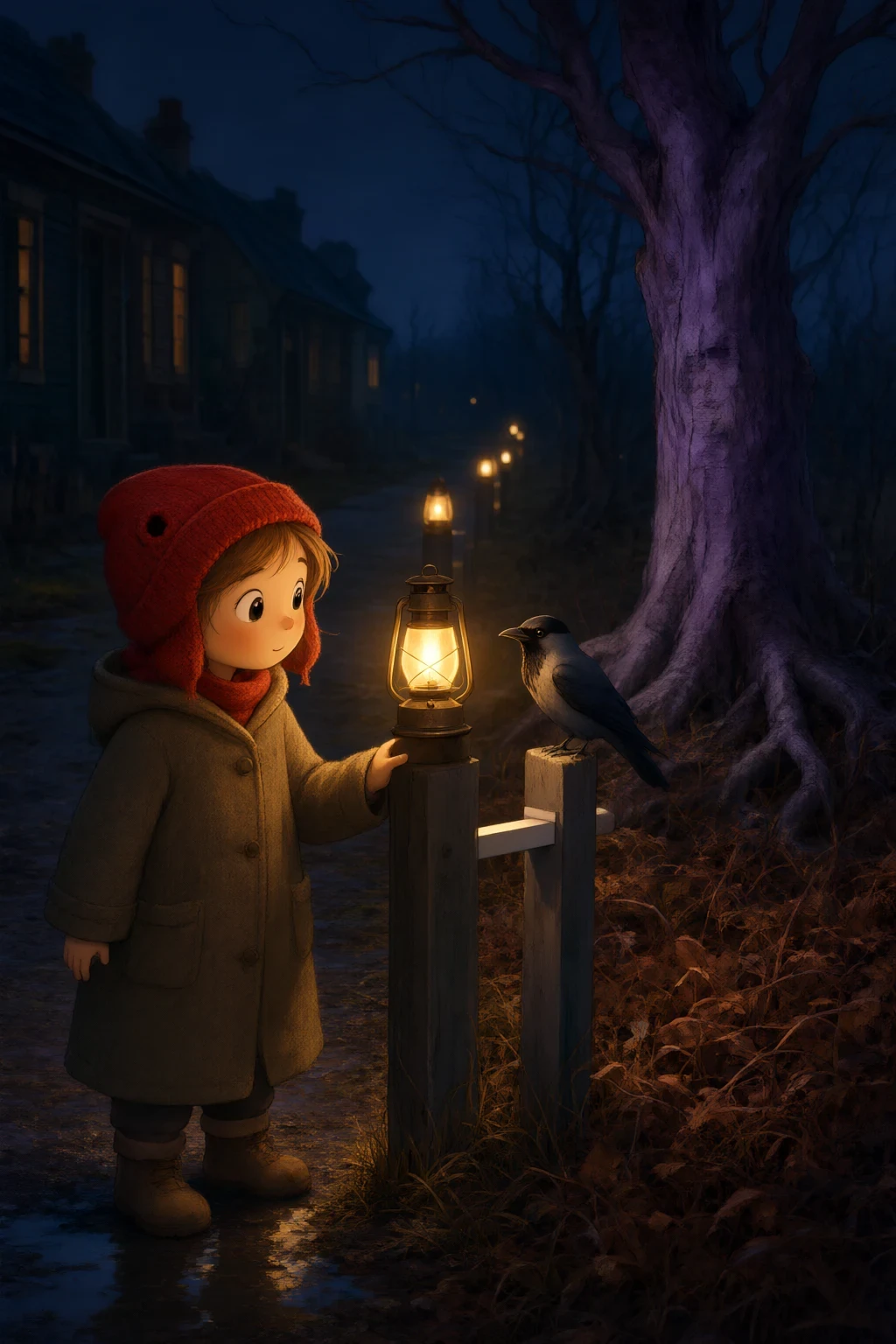
Merrin Vale was nine, and the only child in Nettlefold allowed indoors during the reading, and this year there was no indoors. She stood on the step with her red knitted cap pulled to her eyebrows, earflaps down, and the hole in the crown she had knitted closed four times. She watched forty-one lamps go past her in the dark, all down the Row, and then forty-one sets of feet after them, and then nobody. Her mother stopped. “I will not be back before the small hours.” “I know.”
“Two rules, and then I am going.” She crouched so Merrin had to look at her instead of the dark. “One lamp before me and one after me, whatever happens, and if you cannot do both then you do neither and you sit on your doorstep and shout.” “And the second rule?” “The second rule is that you do not put your hand in a lamp that is not yours.” “Is that allowed?” “No,” said her mother. “That is the whole point of it.” So Merrin did the round of the Row by herself, and it went like this.
Lamp 1. She stood at the top of the Row first, because you cannot see the round from anywhere else. From up there the lane was a string of small warm circles on the wet ground, and the dark pressing in from both sides like water. The tally slate hung on its post beside the first lamp, and Merrin took the chalk from her coat and wrote the number at the top, as she had watched a hundred times. One hundred and one lit windows, the first time through. She did not know yet she would write it twice, and then cross one out.
Lamp 2. The little hinged door sticks. You lift the brass catch with your thumb and pull, and the door comes open on a hinge that squeals, and there is the wick, sitting in the oil, black and not lit. Merrin put her hand in and lit it, the way you do, and shut the door. The number was chalked on the post above. So was the name of the lamp you had last filled, because somebody has to know whose it was.
Lamp 3. There is a house at lamp 3 with three dogs, and the dogs hear the door squeal, and light comes under the shutters and a voice says, “Is that you, watcher?” and Merrin says, “It is,” and the voice says, “Good,” and lies down again. Lamps are not for lamps. Merrin learned that at nine. Lamps are for the people who are not asleep yet. Lamp 4. Lamp 4 would not stay lit. Merrin lit it, and shut the door, and got four paces, and turned round, and it was guttering low. She went back, opened the door, and looked at it, and it was guttering low again. A lamp lit by somebody hurrying goes out. That is the whole trouble with hurrying.
So Merrin stood at lamp 4 with her hand flat on the warm iron of the post and listened to the Row, which at that hour is a hundred small noises and one enormous one: the wood out there, moving, downslope, always downslope or toward water. After a while the wick settled. The light stood up straight and stopped dancing, and made a round bright shape on the wet gravel, eleven paces across, because that is the distance between one lamp and the next. Then Merrin went on.
Lamp 5. Merrin was doing the eastern stretch only, but the tally was the whole village, a hundred and one windows, and it was her job because her mother was two miles east. She counted them going down, as she had done a hundred times. Ninety-eight at lamp 5, ninety-nine at the corner, then the east stretch, which was not hers, and which she counted anyway.
Lamp 6. The middle of the Row is the loneliest part, because the houses stop there and it is only backs of chimneys and a ten-foot wall, and behind it is the wood. A lamp lit at each side of her and nothing between but forty feet of wet gravel, and she was the only person awake in Nettlefold. And on the post at lamp 6 there was a crow. “Lights, then,” said Sixpence. Merrin stopped, because a crow on a lamp-post in the dark is not a thing anybody expects, and because this bird had a job.
“Is that allowed?” “That is the job,” said a voice behind her. It was Oren Vall, come back up from the Ring on his own, standing in the dark. “Go on, then. He is going to wait.” And Merrin said, out loud, to a crow, in the middle of an empty lane, “Lamp six. Count it.” The crow was satisfied. He turned his head with the whistle in it, flew on to lamp 7 and did the same there, and Merrin found she was not alone, and that this was a trick, and that it worked.
Lamp 7. The Cindermill side. The big shed with three chimneys and a hood of black soot, and the light inside it jumping orange under the door. “Smiths work by ear,” Nessa Brack had told her, “so they hammer to a count, and you learn to hear a count.” The forge light is the only light in Nettlefold that is not a promise to anybody. It is fire, in a shed, doing what fire does. Merrin stood at lamp 7 and let the noise go over her and thought: everything else in this village is somebody choosing to stay awake. That is the job.
Lamp 8. Past lamp 8 the houses thin out. There is a low wall with a broken place in it, and through the gap you can see bracken, and the bracken is not dark the way the wood is dark. It is a dark only standing still, and if you look at it too long you will be sure it has moved. This is where the edge of light is. Where gravel becomes bracken, and the two grounds meet in a line you can see.
Merrin stood on the edge of it with the lamp behind her, and understood the orders: fewer lamps, dimmer lamps, two lamps off the eastern stretch, a month of arguing at the Cross. Every lamp is paid for with a spoon of sap a season, and sap is the trees' living substance. Every lamp kept is a tree spent. She had never thought of a lamp as a thing that cost anything. It had just been the light. Lamp 9. Lamp 9 was out. Not guttering. Out, cold, the little door shut and the oil full to the shoulder, and a wick as black as the inside of a boot. Merrin had her own lamp in her hand. Every watcher carries a spare, and she had oil for three relightings and two fingers left.
So she took the brass catch with her thumb and pulled, and the door squealed, and she lifted the dark wick out with the tweezers off her belt into her own lamp, and lit her own, and stood with her hand in the warm iron. That took a long time. Long enough that the two dark gaps on the east stretch got darker, and long enough that she counted her own heart, and got to a hundred and forty before the wick took. Then she shut the door on her own lamp, and chalked the number on the post, and went on.
Lamp 10. The last named stretch. The brass plate here is longer than the others, with four names on it, and Merrin could read the top one in the lamplight. She looked at the four names and thought: that is the whole village. Not the lamps. The names. She had been walking on the names all night.
Lamp 11, and the dark house. Lamp 11 is the last lamp on the Row and it is not the end. Past it the gravel runs a little and then it is bracken, and at the end is a boundary mark, a post with a white bar. That is where Merrin was to put her spare lamp and stand and watch, and nobody else was. She got the slate out of her coat and read the top, because that was the habit, and the habit is the whole craft.
It said one hundred and one lit windows, twice, in her own chalk. And it was wrong. Merrin stood in the middle of the Row with the slate in both hands and did the only thing she could think of, which was to count the dark. The houses on the east stretch: lit, lit, lit, and then the tall narrow one with the blue door, dark, cold ash in the grate, because everybody in it was at the Ring.
So the tally was a hundred and one and the true number was a hundred, and one line on the slate was a lie, and she was the one who had written it. And here is the thing that she understood, standing there, nine years old, in the rain: If she went in and lit its lamp, the slate would say one hundred and one, and it would be true for the rest of the night, and at the small hours they would all look at the slate and say the round was done. It would not be done, and nobody would know.
Because that house was not hers. Its watcher’s name was on the brass plate, and a wick-watcher’s lamp is a lamp with a name on it. Put your hand in a lamp that is not yours and there is one number on the slate and nobody under it. Which is worse than no lamp at all. A dark window is honest. A dark window with somebody else’s hand in it is not.
So Merrin did the only thing her two rules allowed. She did not go into the house. She walked past it to the boundary mark, and set her lamp on the white bar’s post, in the open, where anybody could see it, at the actual edge, not in a window and not in a hall, on a boundary mark, where a light belongs. And then she stood there, and she watched, which is the job.
It was cold and it was slow, and the wood out there was forty feet of iron-barked tree on root-fists coming down the slope. It came to within a hundred yards of the white bar and stopped, the way it does when there is light on the ground in front. Merrin put her hands inside her sleeves and did not go inside. And then something happened that she has never told anybody except, eventually, in the end of this. The birdsong came up out of the bracken, and it did not stop.
For a long time Merrin had believed the birds were doing it on purpose, out of caution. She had said so to nobody, because when you are nine and say that out loud, adults wait for you to stop. But it was not caution. A bird alone out here, saying a phrase with nobody to finish it, is a phrase that never ends, and the wood is full of lonely things.
What stopped them was the document. Two miles west, out on the Ring, the whole village stood on both sides of a line in the rain, and a woman with a beard fine as lichen and three strands silver-leafed was reading the pact aloud, then saying the line again, slower. The birds finished the phrase. That was all. They finished it, started another, and finished that too, all along the edge of the bracken, and Merrin stood on a boundary mark and listened to all of it. It was the most beautiful thing that has ever happened to her.
And it lasted about nine minutes, and then the birds went back to stopping short, six nights in seven, because the seventh is the night the document gets read out loud, and the rest of the week they cut the phrase so something is left over for the reading. She has wanted it every morning since she was old enough to want anything. The arithmetic is this: you do not get it just by wanting. You get it when somebody is out in the weather saying the words out loud, and she is too small and too far down the Row ever to be that somebody.
The guild came back at the small hours, and this time the lamps came up the Row ahead of the feet, so Merrin watched forty-one small warm circles come up out of the dark, and counted them. Her mother came last up the stretch, and stopped at lamp 10, and read the slate on its post. Then she said, “Walk me.” So Merrin walked her the eleven. “Lamp one,” she said. “You count from the top, because you cannot see the round from anywhere else.” Lamp two. “The door sticks, and somebody always writes whose it was.”
Lamp three. “The dogs, and a voice that says good.” Lamp four. “It would not stay lit, so I stood there until it settled. You are not allowed to hurry a wick.” Lamp five. “Ninety-eight windows, and the ones that are not mine.” Lamp six. “There was a crow, and I answered him, and then I was not alone.” Lamp seven. “The forge is not a promise to anybody. Everything else is.” Lamp eight. “The edge of light, and the cost of a lamp, and I did not know a lamp cost anything.”
Lamp nine. “It was out with the oil full, and I changed the wick, and it took a hundred and forty counts.” Lamp ten. “Four names on a brass plate. It is not the lamps, Mother. It is the names.” And lamp eleven, which was the boundary mark, and where she stopped and had to be asked, and then said it anyway.
“The blue door is dark and everybody in it is at the Ring, and the slate says a hundred and one and the true number is a hundred. So I did not go in. I put my lamp on the boundary mark instead, and I stood there and watched, which is the job.” Her mother was quiet. Behind her, forty wick-watchers and a Warden came up the lane, and somebody’s window would be dark tonight, and everybody knew which one. “You did the round,” her mother said. “Eleven lamps,” said Merrin Vale.
“A lamp is only a promise somebody makes,” her mother said, “and a promise is only worth the person still awake to keep it. You were the person still awake.” She put her hand flat on Merrin’s wet cap, over the hole knitted closed four times. “That is the long round, love. You have been doing it since you were born.”