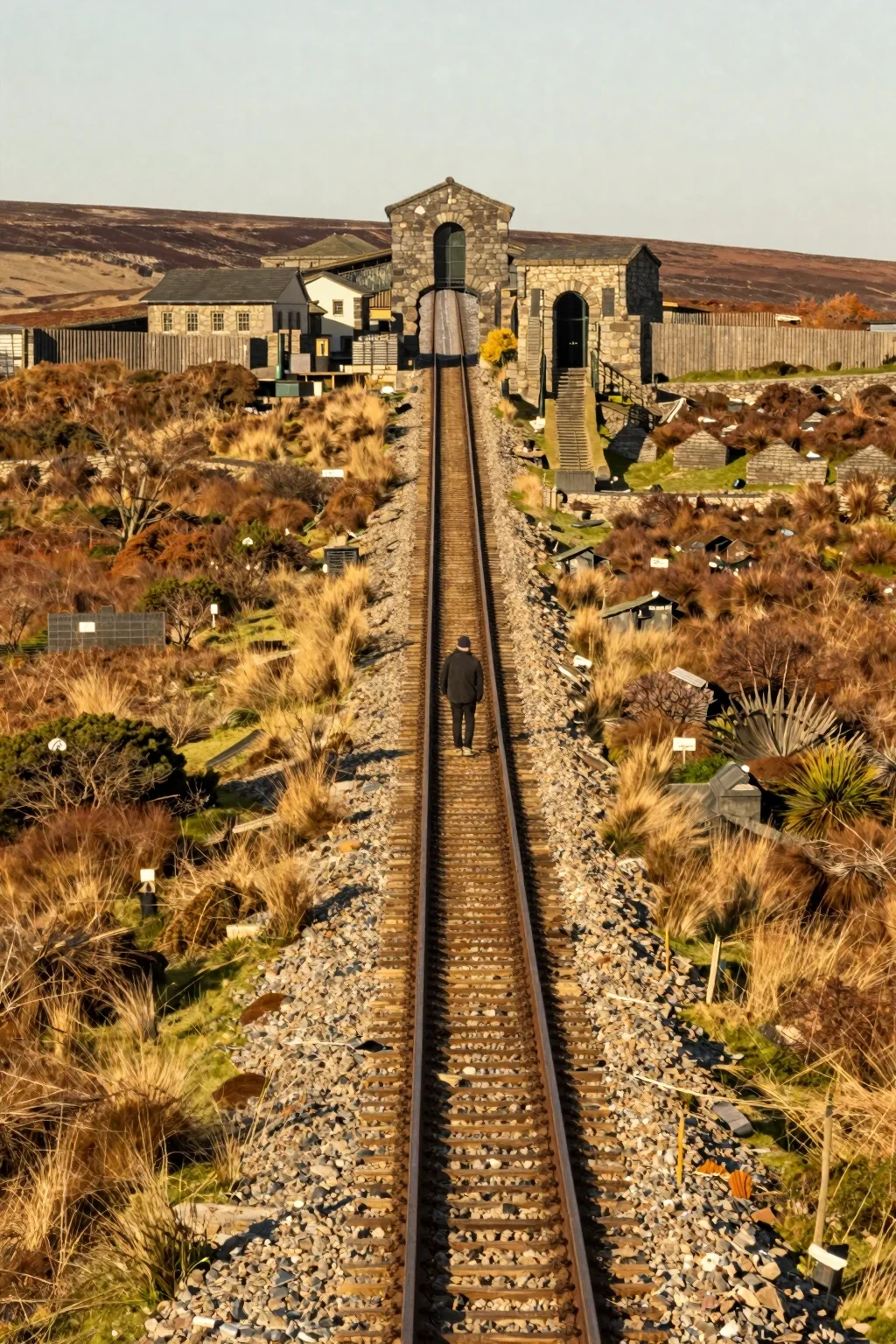
The full assembly of the holders of the lower line of the Grip sat on the first of February in the balance room of the winding house at the bottom of Wyver Hold, and it sat there for eighteen days, and the reason it was sitting there was a sentence nobody in the room could put a hand to, because it was in the custom and not in the book. The sentence is the ninth rule. The cost is the time, and the time is not recoverable. A person who holds does not ride. It was an unusual place in which to sit on a question of principle. The balance room is cold in February in a way the mess room is not, because the mess room has a stove and this room has a pit, and the pit goes down thirty feet into the granite on which the whole winding house stands, and it is open through a grating in the floor. The grating was the only place in Wyver Hold where a person could stand and see the whole of what the town was doing, and a great many people had discovered that over the years and had mostly stopped coming.
Above the assembly, three feet over their heads, hung six iron pans on their chains. Two deep and one shallow, each one cut for a person to stand in and be counted. The chains went up into the dark towards the sheave beams, and the floor beneath them was worn into a curve by eleven thousand pairs of boots, and the curve had not changed shape in fifty years because the same feet came back to it and the same boots were resoled at the same heel. Nobody in the room could stand under the shallow pan for long without looking up at it, and the shallow pan hung at the end of the room because somebody had arranged it in about 1904 and had never explained himself. Teofil Rownt called the assembly to order at ten in the morning, which was late for a man who kept a slate yard, and he called it to order with a piece of paper, and he read the terms off it in the voice of a man reading terms. “The lower line of the Grip, being the line between the lower station and Tannery Moss, one mile and one quarter, seventeen degrees, being worked under the tenth custom of this town — ” He had four hundred names in his ledger and he had the hours of all of them, and he read out the notice of the meeting and the terms of the amendment and the rule that the vote might only be given by a person whose name stood in the consent book for the line they lived on, and he read it in eleven minutes, and at the end of it he could not stop, because there was one more thing and he had costed it. “For the year, then,” he said. “If it is carried, it is for the year, and the question comes back at the end of it, and that is the offer.”
The brass token on his chain was worn through at the edge and had been worn through for about nine years, and when he said the word year he turned it over in his fingers so that the worn edge went out of sight, and Ivo Trant, who was sitting at the drum end of the room with his hands on his knees, noticed that and did not think anything about it until the eleventh day. “Gusting forty-one at the mast,” said Ivo, “she’ll hold.” It was the first thing he had said in eighteen days, and it was what he said first in every argument of his working life, and a woman near the back said, without turning round, that a man could say anything he liked about the mast. “Gusting thirty-six off the harbour wall at seven this morning and it has not shifted a point since,” said Ivo. “Twenty-two minutes up with the load and nineteen with it off. If it were not for this meeting I would have had the car on the upper span at ten.” Nobody said anything, because that was also true, and because it was the first of eighteen days and the whole of what was going to happen in the room had not yet been said by anybody.
The amendment was tabled by the grip-man, and it was eleven words long, and it was not what anybody had expected. It was this: that the ninth rule be amended to add, that a person who has given his holding for the year, and has worked out the hour in full, may ride once in that year. “That is all of it,” said Ivo Trant. “That is the whole of the motion. Nine words for the amendment and the rest is procedure.” He gave the wind at the mast again before he sat down, not because it had changed but because he gave it before anything else, and a schoolmistress of twenty-nine with chalk on the cuffs of a jacket that was much too good watched him do it and counted under her breath, one two three, before she decided what to ask. “Count the holders who rode last year,” said Aldith Marner. She said it as an imperative, in the voice she used with two hundred and six children, and then she waited, and the waiting was the entire method, and it turned out over the next eighteen days to be the most expensive instrument anybody had brought into the room.
Nobody answered her for some time. A man at the back said there had not been weather. Somebody else said the car had gone up with the surveyors on the fourteenth and the doctor on the twenty-second. Aldith Marner waited. “Eleven hundred and forty-one names in the book for last year,” said a girl of sixteen from the side of the room, “and two hundred and six of those were under twenty-five, and of those two hundred and six there were eleven who rode, and I know because I have the sheets.” She was standing up because she had been on the pans since she was twelve. She had a wicker splash of boiled leather on and her boots were mucked to the welt, and there was chalk on the fingers of her right hand from the book, and a tan line across her forehead where the sun stopped at the edge of the hat she did not wear in February. “Nell Cardew,” said Ivo. “She has the sheets,” said Teofil Rownt. “She is on the pans and she keeps the sheets, and I do not object to her keeping them, and I would object to anybody else keeping them, and that is the whole of my interest in it.” “Gwilym Ore,” said Ivo. “You have a date.”
“Two hundred and six was not the number,” said Gwilym Ore. “Two hundred and six is the roll of the school and the hospital and the mill office put together, which is Aldith Marner’s figure and not the book’s. The book has one thousand one hundred and forty-one for the line and one hundred and ninety-four of them are in the mill, the fish market and the quarry, which is where the holding is and where it has always been.” He had a leather apron on with a horseshoe burn across the front of it that could not be scrubbed out, and a pencil behind his ear that he had forgotten was there, and he corrected dates the way other men shut doors. “And the eleven who rode,” said Aldith Marner, “were they riding?” “They were riding,” said Ivo Trant. “Some of them had held earlier in the year. That is the whole of what happened and it happens every year and it is not a breach, because the hour is worked out in full and the holding for that line is done and the book is right, and a man who has held and finished his hour may go up on his own money an hour later with a different set of feet in the pans.” “Then you have already amended it.” “No,” said Ivo. “No, I have not, because a man does not go up in a car he is paying for out of the same hour he gave for the last one. He goes up in the year after, and that is a year he will not see if he is sixty. And that is not amending anything. That is the ninth rule being expensive.”
The wind came up on the fourth day and the line closed at nine in the morning, and the drum stopped, and the assembly went on sitting. The Grip closes above twenty-eight knots at the mast and stops dead in icing, and in a bad February it can be shut for a fortnight, and there is no line to run and no passenger and no balance wanted, and the holders sit in a cold room with six pans over their heads and nothing at all to do. Ivo Trant had been on the drum for thirty-one years and had not been off it for eleven consecutive days since he was twenty-one. He slept in the cabin above the winding room. On the fourth day he moved the bed down into the mess room, which was a decision he made without saying anything about it, and he made it because the cabin has one window and the window faces the drum and there is nothing to see. On the fifth day Aldith Marner asked the question that turned the argument off the man and onto the promise, and she asked it in the imperative, and she waited, and this is the question as she put it and as it was minuted on the fifth day of February: “Nobody in this room has made this promise. Every holder here made it to somebody who is not in this room.”
The room was quiet for a while. From the harbour came the noise of a winch on the loading stage, which is the sound Wyver Hold makes instead of silence. “Not to the dead,” said Aldith Marner. “Not to the ones who held before any of us and got nothing and are not here. Not to the ones who will hold in ten years and have not been born. They are a considerable majority of the parties to this promise, and there is no procedure I know of by which a room of two hundred people can make a bargain with a party who cannot answer.” “That is not the question,” said Teofil Rownt. “That is a very good piece of thinking and it is not the question. If the rule is theirs, it is theirs to amend. You would be saying that no promise could ever be changed by anybody who made it, and that is not a law, that is a stone in a road.” “I am saying something narrower than that,” said Aldith Marner. “I am saying that the rule is not only a thing the holders do. It is a thing the holders promise. Those are different, and the difference is the whole of the ninth rule, and you have spent two days costing it as a thing the holders do, and that is why it is coming out at nine words.”
The arithmetic began on the seventh day and it began because a girl with chalk on her fingers would not leave it alone. She had been in and out of that room for eighteen days with sheets of ruled paper under her arm, and on the seventh day she put a sheet on the drum housing at the end where Ivo could read it from his chair, and he read it upside down for a while and then got up and came round to it. “Two tons eight hundredweight,” she said, “is the empty grip car, weighed in the pit on the eleventh of January, in iron, with the gear in it and the tank dry. Two tons seven hundredweight and twelve pounds is the empty balance car, same day. That is eight pounds in favour of the balance end before a soul gets near it.” “Eight pounds.” “Eight pounds, over two thousand seven hundredweight of car, and every pound you put in the grip car has to be answered with more than a pound in the pans, and one adult, which the book calls eleven stone four, which is a hundred and fifty-eight pounds, has to be over at the finish.” She wrote on it with a stub of pencil and the chalk came off her fingers onto the paper.
“Six up and a hundred and eightyweight of mail and instruments is three thousand eight hundred and four pounds in the grip car. It wants three thousand nine hundred and sixty-two at the balance end. The empty balance car is two thousand seven hundred and twenty-eight. That wants one thousand two hundred and thirty-four pounds of people.” “That is eight of us.” “That is eight and a third of us, at ten stone eight, and it is nine of us, because there is no such thing as eight and a third of a person, and nine gives four thousand and sixty against three thousand eight hundred and four, which is two hundred and fifty-six over, and that is ninety-eight over the margin, and that is how the Grip has worked since 1888.” “Eight is fifty pounds short,” said Bronwen Vasey. She had a ruled notebook open and a tin tube on the table beside her and her spectacles on a cord, which she took off to look at the sheet from the far end of the room and then put back on, and she had been in the room for seven days giving tolerances.
“Eight is fifty pounds short,” she said, “and two thousand seven hundredweight and twenty-eight is two thousand seven hundredweight and twelve with a tolerance of two stone on a car, which is the margin the manufacturer gave and which has never been a margin on the drum. I have audited this line eleven times and I have never once written a figure without a tolerance and I have never once been wrong, and I would like somebody from outside this town to audit it, and it is February, and a man with a theodolite is not going to walk eleven miles in this to look at somebody’s arithmetic.” “Who does it, then,” said Ivo, “when somebody does come?” “A person,” said Bronwen Vasey. “That is the answer and it took me eleven years to arrive at it. A person looks. A number does not look. Eleven times I have sat where you are sitting and checked a line against its book, and the line was right eleven times, and there was nobody in the room on any of the eleven who could say what the numbers meant, and that is the difference between an audit and a look, and there is no clause in any book on this coast that gives a name to it.” She wrote that down in the notebook too, in the margin, in a hand much smaller than the rest.
The eleventh day was given to Gwilym Ore because Aldith Marner stood up and asked him a question, and because he had been in that room for ten days being a man who corrects weights, and because nobody had asked him anything at all. “Tell the room why the upper span was replaced in 1911,” she said, and then she waited. He got up the way a mechanic gets up, one hand on the table, and he put the pencil that had been behind his ear onto the table beside him, which he had not known he was doing. “The upper span was replaced in 1911,” he said, “because in the September of that year the car stopped four times on one journey between the ninth and the eleventh trestle, and on the fourth stop it stopped thirty feet past where it should have, and it was not the driver’s hand, because the driver had the brake on and the brake was not slipping. It was the cable.” “Stretched.”
“Stretched,” said Gwilym Ore. “Not broken. Stretched, in one place, over nine inches, on a length of three hundred yards, and it had been spliced in 1889 by a man who spliced well, and the splice was sound, and the nine inches was not in the splice. It was in the lay. The strands had gone over on one side of the drum and had taken a set in that direction, so that the span was longer on one side of the wheel than on the other, and the car came up level and then went on and hung there.” He put his thumb and forefinger about four inches apart to show how little of the whole cable it was. “They condemned the span in a fortnight and put a new one in in October. I was eleven. My father fittered it. He wrote three pages and a half about why a cable that had stopped four times in one day should be taken out when the drum had been turning true since June, and he was not in the room when the report was read, and I have wanted for fifty years for somebody to ask me what the report said, and nobody ever has, and I have never once said it out loud, and you have asked me a question that is not that question.” The room waited.
“The report said the cable was defective,” said Gwilym Ore. “Three pages and a half, and it came out at one sentence, because it was read by four men and they were all thinking about the money. And that was the whole of what was said in print, and it was true. The cable was defective, nine inches of set in the lay on the driving side, and it is not the reason the span came off.” He did not use the word because. He never used the word because. “What is the reason,” said Ivo Trant. “The reason a cable takes a set in the lay in one place and not another is that the load on that side of the drum is not the load that is written on the pan sheet for the day,” said Gwilym Ore. “A span does not go bad because it was badly made. It goes bad because it was asked to do something it was not weighed for. In the September of 1911 the upper car went up nine times with six on it and once with five, and on that one the balance end had nine in it, and there were nine on the pan sheet, and the sheet was signed, and the ninth of them had not been there at seven.”
Nell Cardew said, from the side of the room, in a voice that carried exactly as far as it had to: “The ninth of them was Elsie Trant, and she was sixteen, and she was in the mill, and she came at nine because her mother was ill, and her name was in the book at seven because her mother had told the clerk she would be there.” Nobody said anything. “That is not a thing anybody should say,” said Teofil Rownt, after a while, and he did not sound angry, and he sounded like a man pricing a difficulty. “It is a thing somebody has to say once in fifty years,” said Gwilym Ore. “It was not in my father’s three pages and a half, because he was not asked for them, he was asked for the cable. And the reason it was never printed is that if it is printed then this town rode on a book that was not true, and it did, once, in September 1911, for a car of five, and it went up because the cable was longer on one side of the drum than the other, and not because nine people were standing in the pans. I have said the cable was honest for fifty years and I am not going to stop, because it was honest. It was accurate. It was doing precisely what it was built to do with what was put in it. It was the hand that wrote the ninth of her on at seven that was not honest, and you cannot put a report on a cable for that, and so everybody agreed it was the cable, and the tenth rule was written in the winter of that year, and there you are.” He sat down. He put the pencil back behind his ear afterwards and it stayed there for the rest of the eighteen days.
What the tenth rule is, exactly, is that a balance which goes wrong is not a fall. If the cable is wrong the cable stops, in whatever weather, on whatever trestle, and holds there until it is right. Nobody has ever been hurt, because nobody has ever been let go, because there is nothing to be let go from. It has happened eleven times in thirty-one years, one time every two years and ten months, and all eleven were in Ivo Trant’s hand on the brake. He gave the list to the assembly on the eleventh day without being asked, one year at a time, in a flat voice, and Nell Cardew wrote all eleven in the margin of her sheet and did not know why she was writing them until the seventeenth day. “You have never ridden,” said Aldith Marner, on the twelfth morning. She had not asked it. She had come in from the schoolroom with the snow still on the shoulders of the jacket, and Ivo Trant understood that it had been planned, because she had come at the hour when he had nothing to do and the whole assembly was in the room. “I have made four thousand journeys,” he said. “I would have thought of it.”
“You have made four thousand journeys and you have stood under six pans for every hour of them,” said Aldith Marner, “and your name is in the book every year of your life on the first of January, in your own hand, on the line you live on, and that is the only requirement there is, and you have never once missed it. That is not a coincidence and it is not modesty. It is a habit, and it goes back further than this meeting.” The room was quiet. “Yes,” said Ivo Trant. “Then why is this amendment yours?” He gave the wind at the mast. It was twenty-two and steady off the quarter and falling, and he gave it before he could stop himself, and about eleven people in that room had by now heard him do it a hundred times and had stopped hearing it and four had not.
“Because I have a daughter at the top of this hill,” he said, “and she is twenty-four, and she is at the hospital at Tannery Moss, and I have never been in that hospital, and I have seen her eleven minutes twice a year since she was thirteen at the foot of this drum with the car standing, and she has counted them, and she does not tell me that she counts them, and she leaves the tea on the sill because I take it strong and there is no tea on the top that I have ever been asked to drink.” He turned the right hand over on his knee and looked at it. It was white to the second joint and had been white since 1901 and it did not hurt and it did not close all the way, and the red mitten was on the left hand and had been on the left hand for nineteen winters. “That is the reason it is mine,” he said. “It is not a good reason. It is a reason with a hill at the end of it, and there are four hundred men in this town with a hill at the end of it and not one of them has ever stood up and said so in a room, and if I say it here then this amendment is about me, and it will be carried or refused on whether the town wants me to see the view.” “Then do not say it again,” said Teofil Rownt. “No,” said Ivo Trant. “No, I will not. I have said it once and it is minuted and there is a clerk who will read it out to anybody who asks, and now it cannot be taken back, and that is the whole of what I have to say about it.”
The rota came up on the fourteenth day, and it came up because Teofil Rownt offered it, and it came up finished. He had twenty-six sheets in a ledger behind him, one for each fortnight of the year, and every name in the book for the lower line was on one of them except four hundred and ninety-one who had asked not to be, and there was a column for the hour of the pan turn and a column for the second pan and a column for the third, and the whole of the work of the year was in it. “One thousand one hundred and forty-one names,” he said. “Three thousand and sixty-nine turnings, because a journey takes nine, and there are three hundred and forty-one journeys in a good year, and a turning runs forty-six minutes on the average, and that is two thousand three hundred and fifty-three hours of holding on this line in twelve months. The working year is two thousand four hundred hours. So the entire holding of the lower line is one man’s working year, spread across two thousand four hundred people, and it comes to fifty-eight minutes each, and that is why nobody has ever noticed it.” He turned the brass token over.
“And it is in my hands that nobody notices, and I have known that for nine years and have not said it, because a rule nobody feels is a rule that will not survive its first bad winter, and this rule has had one, and it stopped on the ninth of January for six hours with a car at the sixth trestle, and nobody was hurt, and I did not know until the eleventh o’clock that night that my own rota had a hole in it. Two hundred and sixty names carry forty-six per cent of the hours. They carry it because they cannot get away from the mill or the fish market or the quarry. One thousand and forty-one hours out of two thousand three hundred and fifty-three, in the hands of a hundred and ninety-four people, and if the amendment is carried every one of those hours grows by one more turning for every journey somebody upstairs wants to take.” He stopped. He had a sentence and could not finish it. “For the — ” he began. “For the year, then,” said Ivo Trant. Rownt looked at him and did not finish it, and put the ledger on the table, and did not open it.
The amendment was given its wording on the fifteenth day, because for fourteen days the assembly had been arguing about a promise and had not once agreed what the words were, and Aldith Marner put her hand flat on the drum housing and said: “Say it out loud and let us find out what it costs.” It cost one person. “Six up and the mail is three thousand eight hundred and four,” said Nell Cardew. “Mr Trant is twelve stone six. That is a hundred and seventy-four pounds, and he has been in the balance end of this thing every journey of his life, so I have weighed him on the pan scale myself and I am not going to be told about it. If he goes up in the car then the car is three thousand nine hundred and seventy-eight, and it wants four thousand one hundred and thirty-six at the balance end, and nine of us gives four thousand and sixty.” “That is seventy-six pounds short.”
“Seventy-six pounds short. Ten of us gives four thousand two hundred and eight, which is seventy-two over, which is a hundred and forty-eight more than the margin requires. There is nothing between nine and ten. You can have nine and you can have ten and there is no such thing as nine and a bit, and the ninth rule says there is no tolerance, and Mr Vasey has told us eleven times that there is a tolerance of two stone on a car and that no drum has ever known it.” She wrote it on the sheet and turned the sheet round, and nobody in that room could see the sheet because the room was full, and she turned it round anyway, for somebody at the back. “So the amendment costs the line one more man in the pans for every journey a holder takes, and the man cannot be asked for, and he cannot be found out of the rota, because the rota has been full since 1919, and the only place left is the four hundred and ninety-one who asked not to be on it, and they asked not to be on it.” “That is the whole of the arithmetic and it took us a fortnight to arrive at it,” said Teofil Rownt. “For the year, then — ” “For the year, then,” said Ivo Trant, and Rownt looked at him, because it was the first time in eighteen days that a sentence had been finished for him by somebody else, and the thing the sentence meant was that the amendment was sound, and that soundness was the problem, and that neither of them was going to say so.
Aldith Marner made her last argument on the sixteenth day and it was the best one anybody made, and it failed by four votes. “A promise is made to somebody,” she said. “That is the whole of what a promise is. Ours is made with the grip-man hearing it, and that is the third rule, and there is not a consent in this book that does not have a witness standing in a winding room. The witness is not a bystander. He is the person the promise is made to. He is the man with his hand on the brake who is going to decide whether the words were said, and a holder who rides takes himself out of the part of the promise he was making. A man who holds and rides has not kept two promises. He has kept one of them and gone off to enjoy the other.” She waited. She waited for the length of a count of forty, which she had never in her life done in front of two hundred and six children and did now.
“And the people in the cars,” she said. “Four hundred thousand people a year come up this hill to stand in the rain and look at a view. None of them are in this room. They are not holders. They have no vote on this and they never will have, and every one of them is relying on a thing they were never told about, and they are relying on it this morning, and they will be relying on it in a week, and you are going to change what it is in the middle of a February with the doors open and the town standing on the wall to listen.” “Two hundred and sixty-one to one hundred and four,” said the clerk. “Thank you,” said Aldith Marner, and wrote the count down, and did not ask for the division list because there was no division list, there was a book and a clerk and a show of hands. An old woman from the fish market stood up on the seventeenth morning and said that she would like to ride once, and then sat down, and then stood up again and said that she was not asking, and that she wanted it minuted that she was not asking, and that if anybody in the room wrote her name down anywhere she would like it written beside the words she had not asked.
The clerk wrote it beside the words she had not asked. She was seventy-nine. She had held on the fish market line for fifty-four years and had ridden twice in that time, both times in 1919 in a car going up with a load that was wrongly counted, and she had been in the car and not in the pans on both occasions and had not said so, and she said so now, on the seventeenth of February, and it took nine minutes, and nobody interrupted her. The thing that turned the eighteenth day was not an argument. It was a sentence from the drum end of the room, said by the man who had tabled the motion, and it took nine words and it was not in anybody’s notes until the clerk wrote it out afterwards. “This does not touch the hours already given,” said Ivo Trant. “I want that said before the vote and I want it written. Every hour given on this line since 1888 has been given at the ninth rule, and the ninth rule says the time is not recoverable, and this amendment says the time may be set against a journey. If that is set against a journey then it was never a cost. It was a price on a ticket. And then eleven thousand people have paid it for something they were told they were not allowed to have, and this amendment cannot give it back to them, because they are dead. We have not fixed it. We have decided that from the first of March a person may ride once, and the rest of it stays exactly where it was.” He gave the wind at the mast. It was thirty-four and it was gusting and he said she would hold, and everybody in the room knew he was not talking about the weather.
Nell Cardew wrote the eleven years in the margin of her sheet, one against the other, the eleven times the cable had stopped in thirty-one years and the eleven audits Bronwen Vasey had signed off, and she put a line under both and wrote what time it was, because she had not been asked and because she did not know what else to do with her hands. The vote was taken on the eighteenth day at four in the afternoon. Only holders for the lower line and only for the line they lived on, and every name read out from the book before the hand went up, and one name one hand, and two hundred and fourteen in the room. One hundred and thirty-seven for. Sixty-one against. Sixteen gave no answer, and the clerk did not count them, because a name is in the book or it is not, and there is no third place, and nobody argued about it. The amendment was carried. And then, in the four minutes after it, the room discovered what it had done.
“The ninth rule stands for the grip-man,” said Teofil Rownt, from the ledger. “A man on the drum cannot hold for a line. Rule eight says no holding is given or taken while the cable is moving, and the grip-man has to be there when the consent is spoken, and there is one grip-man in Wyver Hold and he is sitting in that chair.” “And how long is a second one?” said Bronwen Vasey. “Nine months,” said Gwilym Ore. “Nine months with somebody who can be given an order. Not nine months learning the drum. Nine months learning to be told.” Nobody said anything for a while, and the wind came at the sheave beams, and the six pans hung over the heads of two hundred and fourteen people and did not move. “Then it is carried,” said Ivo Trant, “and it is not usable for nine months, and the book says it takes effect on the day it is carried, and I am the grip-man, and I am the only one, and so the amendment stands and the journey does not, and that is the price of it, and I put it on the table myself.”
It took nine months and two weeks. He handed the drum over on a Tuesday in the September to a man of twenty-six out of the quarry office who had been three years on the line and who had never once been asked what he thought about anything, and who was chosen out of eleven because he was the only one of the eleven who answered. That was the whole of what Ivo Trant had to give away, and he gave it in an order, out loud, in the voice of a man who had never given one before, and it came out at once and it was obeyed. The first journey the new man ran alone was on the twenty-first of September. It went up at eight in the morning with six on it and the mail, and the wind was twenty-two at the mast and steady, and there were nine in the pans, and there were ten in the pans, and the tenth was in the shallow one because there was nowhere else to put him that was not in somebody’s way.
Nobody asked Teofil Rownt to get in. He had been in the balance room at seven for the rota and he was still there, and he wrote his sentence on the board in the office with the date and the line, and then he took the book to the pan and said it out loud to the drum, one spoken sentence, with his own name in it, because that is the whole of the form and there is no other form and there never has been. And then Ivo Trant, who had been on that drum for thirty-one years and had never once been on the other end of the thing in his life, went up in the car, at nine minutes past eight, on the twenty-first of September, with the mill parcels and a schoolmistress’s basket and one dog. The schoolmistress did not come up that day. She has never ridden the upper section. She describes the view to two hundred and six children on a Friday and she will go on describing it, and there is nobody in Tannery Moss to tell her whether she got it right. The journey takes twenty-two minutes. He counted it. He counted everything in fours, as he did, and he got to eighty-eight and the car came over the top and stopped and he did not get out at once.
The terminus at Tannery Moss is a stone building with a wooden floor worn into grooves by thirty-one years of feet that had all come up and none of which had ever stayed, and there is a stove in it and a bench and a window that faces the moor, and it is the end of the line and the top of the town and the view people come from three counties to stand in the rain for. Ivo Trant did not look at the view. He had been describing it to nobody for thirty-one years from the middle of a drum room, in his own head, in fours, and it had never once been the thing he had wanted. He wanted the other thing. He wanted to stand above it and see how a man looks from four hundred and ten feet, and how small the winding house is from up here, and whether the cable runs dead level from the top, because it does not, because the drum is at the bottom and the span sags in between, and he had spent thirty-one years feeling that sag through the palm of his left hand and could not tell anybody a single thing about how it looked. He stood in the doorway with the wind coming off the moor at his back and took the red woollen mitten off his left hand, because the door was open and because after thirty-one years the left hand had been the only one that had ever been warm. The right hand was white to the second joint and it hung at his side and it did not close. He put the mitten back on, one hand only, and looked down the hill he had run for thirty-one years, and the cable ran away from him dead level to the ninth trestle and then began, almost imperceptibly, to take up the weight of the car on it.