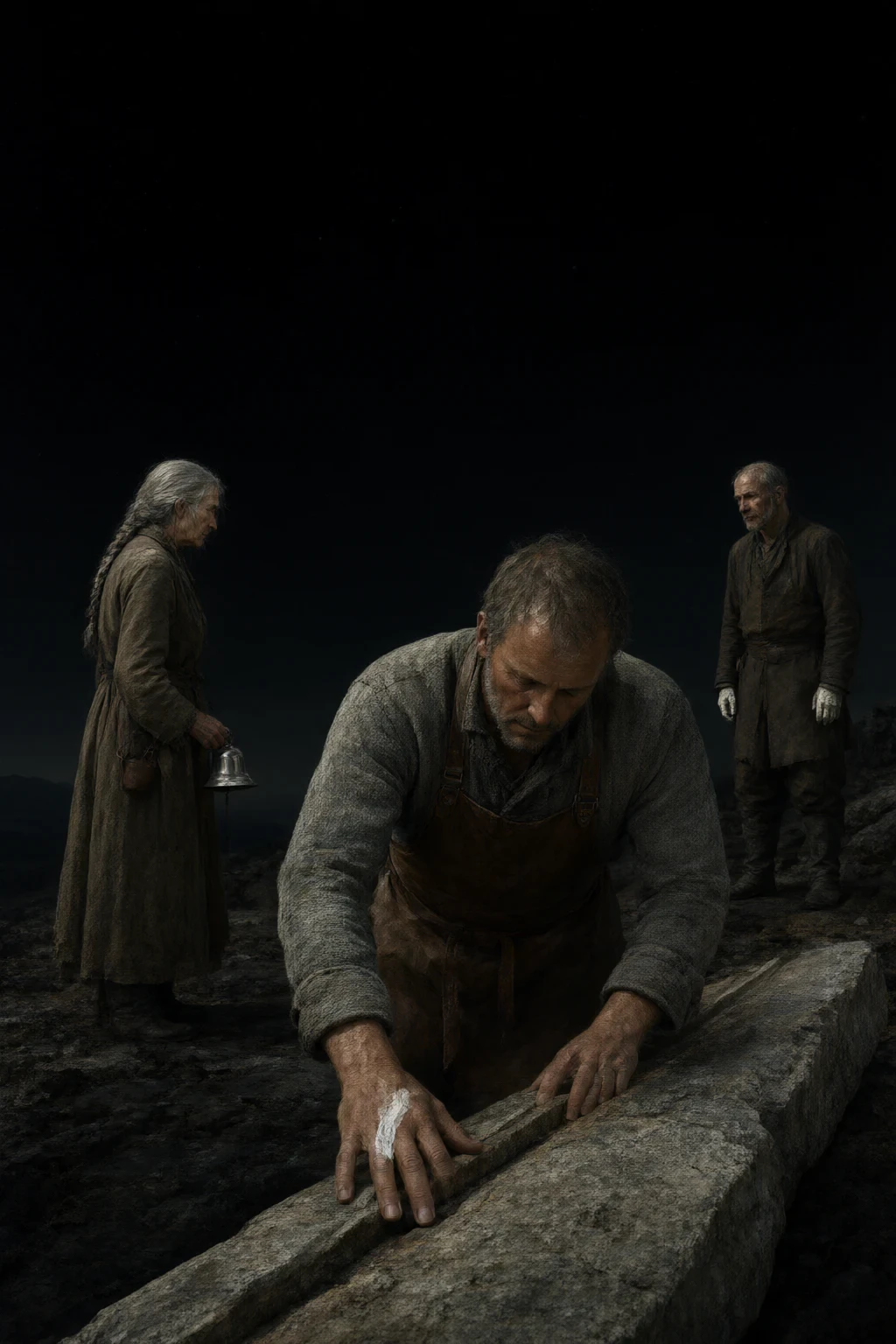
By the fifth month of the long night the sourness had become the weather, and the way Sef Anhalt described it, which he did to anyone who stood still long enough, was that a wall is only a wall while you can tell the difference between it and the thing it is holding up. He could not tune it. That was the whole of his report, and he made it every ninth night for four months, in the flat voice he used for facts. The third horn was in tune against the fifth below it, which is the test, and there is no test for the other thing. The chord was wrong and every note in it was right, and he had never in eleven years been in that situation, and the situation has no name in six hundred years of record, and he had begun, in the last month, to leave off the tuning slide altogether, which was the single most alarming thing anybody on that mountain had ever seen him do. They were thin. All four of them. Grey. Their breath stood in the green light the way breath does over a river. And below them, three thousand feet down and eleven hundred hours of cut stone away, Sillvane had begun to hum.
Not sing. The singing had stopped in the second month of the previous winter and had never come back, and now the weather in the valley had changed the way it changes on a shoulder, and the two hundred people of the Windward valley went about their days with a note in them that they could not put down. It came out while people were doing things with their hands. A woman cut bread in a turf-roofed house and the knife went on the board in a rhythm. Two men loading a sledge found themselves stepping in time and neither of them noticed for a quarter of an hour. Children at play in the still cold did not stop to rest, and the reason was not energy. They were holding the ninth part of a chord they had never consented to, three thousand feet below the place where the chord was actually being played, and the only people who knew this were four on a slab of black rock and one going down a stair.
The Foundation is cut into the sill of the ninth segment, where the oldest masons worked, and Pell Underhay went to it in the fourth month with a lamp because she had stopped sleeping and the lamp was better than nothing, and she took Wend Cassock's roll and a scrap of paper and a stub of pencil, and she did the thing that a sixteen-year-old who has kept a ledger for three years is actually able to do, which is to check the arithmetic of an institution. Seven of the nine lines in the Foundation carry the name of an instrument. Horn of the west. Horn of the north. Horn of the east. Great bell. Small bell. Bass. Drum. That is seven, and the drum is out of service, and the ring has been short by one player since the split, and everyone in Sillvane has understood the ring to be nine horns and bells and a bass and a drum and has understood, wrongly and forgivably, that nine was a number of players.
The eighth line is a gap. It is not a name. The masons cut a space in the stone the width of a hand and they cut it deeper than the rest, and the depth is deliberate, and every collector in six hundred years has written it up as a mason's error or a repair that was never finished, and both of those are records, and a record is a thing that can be true and still be wrong. The ninth line is not a gap. The ninth line is a line. A single stroke cut the length of a forearm, unbroken, at the same depth as the eighth, and when Pell put her thumb in it in the dark the stone was warm the way the sill was warm, and she took her thumb out and put her hand in her coat and sat on the step of the ninth segment for a long time with the lamp going on the wall in green. “Collector,” she said, up the ring, in the voice she used when she had a number. “What is the number of places on the Shoulder?” “Two hundred and forty steps,” said Wend Cassock, “and nine segments, and nine gaps, and nine places.” “What is the number of the places that make the chord?” “Nine.” “And how many of them are instruments?” “Seven.” “Two,” said Pell Underhay. “There are two of the nine that are not instruments, and one of them is a hole, and one of them is a line, and you have been reading the roll over a line for six hundred years, and the line does not have a place in it because it was never a place for a person. It is a place for a sound.”
Wend Cassock had five of them by the fourth month and she kept them properly, in the ordinary way, the way the valley already kept a thousand other worn-out people: without ceremony, with total indifference, and by putting them to the work they were still good for. Turi Roke, sixty-two, cut peat and could not lift a full block, and said so at the cutting, and the foreman put her on the drying rack, which is the warm end of the shed. Gunnar Veil, seventy-one, mended harness in a shed with one wall that took the light, badly, and was the only man in the valley under seventy-five who could put a stitch in a reindeer harness that would hold a loaded animal over rough ground. Bendik Rask, sixty-seven, dug at the peat bank with a spade two feet shorter than his arms had been built for, and could not be got to stop. Elda Mork, seventy, whose chest had been bad since the melt, sat by her own fire, and was the only one of the five the valley treated differently, because she could not get up out of a chair. Annick Stow, fifty-nine, still looked like herself, and was the only one of the five anybody asked how she was.
Wend had a note on each of them in the survey book and the note was the same in every case and she wrote it five times and hated it five times, and the note was this: the arrangement has not cost this person anything the valley can see, and the valley is the only instrument that measures, and there is no year in the valley. There is only before and after. And the before and the after of all five of these people are so close together that a person would have to be the collector to notice at all, and the collector has noticed, and is therefore the only person in the Vellmark valley obliged to say so, and does not, because saying so would be a thing a person in a valley does not do to a neighbour in a peat shed in the fourth month. That is the finding of the fourth month, and it is in the book, and it is the reason the five were not the five when it mattered, which is that the mountain had never asked the valley a question the valley could hear the answer to.
Ysolde Vant went into the ninth segment on the ninth of the fifth month and stayed there until the fourth hour, and nobody went in after her, and what happened in there is in the record because Wend Cassock wrote it down, and what Wend Cassock wrote down is four sentences, and the four sentences took her nine days to write, which for Wend Cassock is a rate of about one sentence per two and a quarter days, which is a rate no collector has ever worked at for anything. The ninth place is a silence that has been held open for six hundred years. It is not a rest. A rest is a thing you get between two notes. This is underneath the two notes. It is the thing that the eight are standing on, and the reason eight notes can hang in the sky in a wind that never drops is that there is a floor under them, and the floor has never made a sound, and everybody in six hundred years has assumed that a thing which makes no sound is not being played.
She went in and she did not play anything. She put her hand in the line and she sat down on the sill with her back against the stone and she let the chord go over the top of her, eight parts of it, hour after hour, and she did not try to be anywhere in it. And the mountain taught her the pitch. It taught it the way it had been trying to teach it to her for six years, in the shape of a thing that was not there, and the thing that was not there had a room in it. Ysolde Vant heard the pitch of the ninth place the way a person standing in a doorway hears a conversation in a room they are not in. Then the mountain gave her the condition, and Ysolde Vant came out of the ninth segment at the fourth hour and stood in the green light with her hands in the sleeves of her coat and said it out loud, in her cadence, without stopping, the whole of it, the way a person reads a charge.
“Chimerunner. Small-bell. Horn-line. The ninth place is a note and the note is a sound and the sound is the ending of the winter, and I have it, and I have had it for a long time, and I am not going to be the one to play it, and I will tell you why in the plainest words the ring has ever heard, and then I will not say anything else. The mountain will not give this note to a person who wants the night to end. It will give it to a person who is prepared to have the wall gone as well. I have wanted the winter to end every hour of every day for forty years. I want it ended so that I can lie down on this rock. That is not the wanting the mountain is asking about and I know it is not, because the mountain said no to me in the third hour in a language I could hear, and what it said was that I am holding on to the wall, and I am, I am holding it with both hands like a woman holding a door against a flood, and I do not want the flood and I do want the door.” She stopped there, which was the first time in seventeen years that Ysolde Vant had stopped.
“It is a year,” said Maran Ostler. “It is a year,” said Ysolde Vant. “Given freely, of the player's own life, not by proxy, and not paid for by the mountain. That has not changed since the Foundation was cut. And I will not be the one, because the year has to be one that I can lose, and I have not got one left that the ring has not already had. The mountain is not being cruel. It is being exact. There is no difference between a gift you have chosen and a gift that has been taken, and I have known that for six years, and I would have liked somebody else to be in the room when I found out.” Pell Underhay had the scrap of paper out. She had had it out since the ninth of the fifth month, and she had been writing in it with the pauses of somebody doing sums on a wall. “What is the number for that,” she said. “For the year.” “It is a year.” “That is not a number, Keeper, that is the size of the box.” Pell's pencil did not move. “It is a sixth of what you have left. It is a fifteenth of what I have. It is a nineteenth of what the horn-line has, and she is sixty-two and she is the one holding the chord together, and if she loses a year out of nineteen then she loses nineteen hours for every hour that you lose, and that is just arithmetic, and I have done it, and it took me two nights, and the answer is that the year is cheapest at the top of the range and dearest at the bottom, and the mountain will take it anywhere it likes, and the only reason it has not taken it yet is that nobody has offered.”
“That is exactly right,” said Sef Anhalt. “Small-bell. That is exactly right, and I have been trying to say it for four months, and I could not get the sentence out because I could not make the sentence and the arithmetic agree.” He did not sit down. “The mountain will not take a cheap gift. A year off a woman of sixty-two is a year she will not miss. A year off a woman of seventy-three is a year she has been spending on the ring already. A year off the Small-bell is a seventh of a childhood. There is not one of those that is free, and not one the ring should be allowed to accept, because a person who can give a year without feeling it has not given a year. She has made change.” Wend Cassock went down the Gallows Stair on the tenth of the fifth month with the roll in a satchel and a lamp she did not need, because there was more light in the valley in the fifth month than there had ever been, the curtain being what it was, standing sour and unblinking over two hundred roofs. She came back up two days later, having taken the two hundred and forty steps in one push, which she had not done in nineteen years, and the four of them were at the top of it. She said, in the third person, which is what she did when the thing she was reporting was too large to be the first person.
“The collector went to Sillvane and the collector told eleven people what the collector had done. The collector read the roll aloud in the bell tower with the woman who keeps the key standing in the stair, and the woman did not come up, and the collector read the second page as well, the page that says the collector did this. The five names were read: Turi Roke, sixty-two. Gunnar Veil, seventy-one. Annick Stow, fifty-nine. Bendik Rask, sixty-seven. Elda Mork, seventy, whose chest is bad, and who came up the stair in the second month to be looked at and would not be helped. They were told what had been taken, and that it cannot be given back, and that the ring is held in thirteen hands, and that five of the hands are in the valley.” Silence on the slab. The wind with its whistle in it. “And they said no,” said Wend. “They said what,” said Sef.
“They said no, all five of them, in five houses, over two days, and they gave the same reason and it was not pride.” Wend put the satchel down on the stone. “Annick Stow said: I have had two winters of this and I am warmer than I was, and the ache in my knees went in the fourth month, and I have not been able to get up that stair since the second month of the year before last, and I am not giving it back now. Gunnar Veil said his hands had come back enough in the spring to hold a cup and a chisel, and that his hands had not held a chisel since he was sixty, and he would like to keep them. Elda Mork said that the note in her is the only thing in her house that is not hers, and that she is seventy years old, and that she is not going to sit in a cold room being a person again.” “They were happy,” said Wend Cassock. “That is the finding. Five people, offered a full release by a collector with the authority of the roll in her satchel, and five people refused, and it was not fear and it was not the ring. The collector reports that the five found the arrangement better than the alternative, and the collector also reports that the five had not been asked what the alternative was.”
The argument went on for two days, and it went on the way arguments go on between people who are all right: without heat, without a resolution, and with everybody in the room slightly more accurate than the last person who spoke. It turned on the sky. Nobody on the Shoulder of Nine Notes had seen an ordinary sky. Not the players, not the collector, not the six hundred years of collectors' books, not a word of the Founding Hours, which were a sound and not a record of anything anybody had seen. The oldest thing anyone knew was that the sky had been a different job before the first chord, and no one alive had been in it, and the whole of the world's understanding of the word sky was a green ceiling. “Then we are deciding about a thing none of us has seen,” said Pell Underhay, “on the evidence of a sentence cut into a sill by a mason who is dead, and the arithmetic on that is that we are not. Every column in this book is a number somebody paid, and this is a number nobody has paid, and that is why it will not go in, and it is the only number in the history of this mountain that has ever been free.”
“It is not free,” said Maran Ostler. “It costs a year. Every figure in this argument about a year is true, and one of us is going to have to be the one, and I have known for two years which one it has to be, and I have been not-saying it in the way I have not-said everything for forty-two years, which is by arranging the room so that somebody else says it first. The fifth. The fifth is not being played and the fifth is not available and the drum is a piece of rotten heartwood with a hide band on it. The ring is going to be eight parts and a silence, which is what it has been since before the Foundation, and I have been pretending for two years that that is a shortage.” “It is a shortage,” said Ysolde Vant, “and you have made it into something else, and I will say what something else it is, in one sentence, and then I will stop, because I am seventy-three and this is my last winter standing up. The ring is not short of a player. The ring is carrying more than it ever has and it is being carried from underneath by people in a peat shed, and the ninth place is empty, and the empty place is the only honest thing left on this mountain.”
Sef Anhalt did not say anything in the first day of the argument. He sat at the bass and listened to the three women, who were all correct, and on the second morning he asked the small-bell to help him with a measurement, which was a thing he had been doing for eleven years and had never told anybody he did, which was to count. He counted the chord. Not the notes: the hours. He had been keeping a count since his second year, of the hours since the ring had last been nine, because a tuner knows when a chord is a chord and when a chord is four players apologising for a chord, and he had a figure and he gave it to Pell and she wrote it down. “Six thousand two hundred hours,” he said. “Small-bell, that is the number of hours the ninth place has been empty. At ninety seconds an hour, which is the rate the collector tested herself at and which is a figure I am not proposing, I am just reporting it, that is nine hundred and thirty hours a year for a player on the slab, and I have been on the slab for twelve years, and I would like somebody to put those two numbers next to each other in the ledger and look at them, and then I would like everybody in the ring to stop talking about the cheapest year.” Nobody put the two numbers next to each other for a while. Then Pell Underhay did, and then she closed the book, and said, in a small voice that was not steady, “It is not a year, then. It is about nine hundred and thirty hours. It is about two of the four of us. What is the number for that.” Ysolde Vant answered her, and did not interrupt herself, and did not say it twice.
Kell Ostler came up on the twelfth with the last load of the season, two hundred and forty steps and a sledge, at fifty-nine years of age, in a hide apron, with a badly mended left glove whose thumb-lining showed all the way through, and stood at the eighth segment in the wind where he had stood every ninth night for thirty years, and did not come into the ring, and did not ask to. What he said, when Maran Ostler came over to the gap in the wall to look at the step, was, “Sorry. I am taking up the air. Finish your sentence.” “There is no sentence,” said Maran. “Then I will stand here and be quiet, which I am good at, and you will tell me the thing you have been not-telling me, because I am the only one of the six of you who is not bound to that wall, and it is going to take somebody who is not bound to hold the other end of this, and I would rather it was me than a stranger from three valleys over.” “He is a fair man,” said Maran Ostler to the wall, and then, to her brother, “it is a year and the night ends and the wall ends with it and the sky becomes the sky that was there before the first chord, and one of us has to say yes to both halves, and I have known since the second month of the year before last that I am the one who will have to, and I have not said it, because a person who says it out loud on this ring is a person who has agreed, and I have not agreed, I have merely been the one holding the door.” The eleven words went across the slab and did not stop the wind this time. There was nothing left to stop. “If you say it,” said Kell Ostler, “I will carry you down.” “Sef will say it,” said Maran.
The small-bell asked the question that ended the argument, and she asked it in her own hand, with the notebook open on the sill of the ninth segment, and the lamp beside it, and the line under the lamp with its unbroken stroke. “What is the number for that,” she said. “For the four of us giving a quarter of a year each. All four of us, together, at the ninth place, at the same hour. It is not by proxy, because we are all standing in it. Chimerunner, the Foundation says a year and it does not say one player. It says a player. There are four of us. I have been up here two nights working out whether that is a different sentence and I cannot make it a different sentence, and I want somebody to tell me I am allowed.” They tried it at the ninth place, at the fourth hour, all four of them, and it is not in any record, and Wend Cassock entered it afterwards anyway, under the heading of things that were done, which is a heading she had never had cause to use in nineteen years.
Maran Ostler, Sef Anhalt, Ysolde Vant and Pell Underhay said it out loud together, in their own notes, in the same cadence, at the same moment, and the mountain heard it, and the mountain heard it the way the ring hears a player who has lied to it and cannot tell the difference between a lie and a wrong note. The ninth place did not sound. The eighth place did something instead, which was to open about a finger's width, on the shoulder side, with a sound like a held note being drawn away from itself very slowly, and the curtain in the east, which had been shut and had been holding shut for a year and a half, came apart along its whole length in one piece, like a thing unzipped, and stood open from the ninth segment to the third, and there was no green behind it at all. Pell Underhay had been in a room like that once, two winters before, and she knew the sound of one, and she was the only one of the four who did not move. Then it closed. The line came back. The chord came back. Everything came back except the sourness, which was thinner by about a ninth, and had not been that thin since before the roll was written on.
“That was a hole,” said Sef Anhalt. “A quarter of a year is a hole. The ring will not be given a fraction, and it will not be given a share, and it has just told us so in the loudest way it has, and I would like it noted that I said it would be a hole in the first week and I was laughed at by a bass player who does not know I can hear him.” “It will take a year,” said Ysolde Vant. “From one of us. Whole. And it will not take the cheapest one, and I have said that and I am not going to say it again, and the reason I will not say it again is that I have said it and the two of you heard it and one of you has been waiting four months for somebody else to say it, and the waiting is over, and the next hour is going to be very short.”
They spent the afternoon in the places, which is a thing players do without ever being told it is a thing players do. Sef Anhalt went round the bass and put his palm on the lead pipe at the knee, the shoulder and the top, and the lead was cold in three places and not cold in two, and the two that were not cold were the places he had touched in his second year, and he said, “It will not be a machine in the morning, then,” and went to get his coat. Ysolde Vant hung the clapper on the yoke and put her two hands flat on the hide rope and stood there for the length of a count, and then she said, in her cadence, without stopping, “I walked to this shoulder at fifty-five with frost in my lungs and I have been on it seventeen winters and I have never once wanted a different rock, and I have wanted this rock to still be there in the morning, and I want to say that out loud one time before we do this, because it is the only sentence I have that is mine, and I am not going to pretend to have said it kindly.”
Pell Underhay sat on the step of the ninth segment with the small bell above her, eight feet of silver wire going up out of sight, and did not play it, and stayed there a long time. Maran Ostler walked the whole nine segments of the wall and put her white left hand, out of the mitten with the thumb cut off, on every one of the nine joins in turn, and did not speak at all, and at the third join she stopped for a while, and Kell Ostler stood at the gap in the eighth and did not watch her do it, because his brother had a right to one thing done without an audience, and had been giving him the other things for thirty years. At dusk the four of them stood in the ring and the wind came over the slab with its whistle in it and went through the nine gaps and out again, and it did not drop, and it had never dropped, and in the morning it would be a wind on a rock.
The roll was struck at the change of the watch, and it was struck by the only person on the mountain who was permitted to strike it, which is a collector, and there was exactly one of those. Wend Cassock took the sheet off the board. She did not tear it. She took a knife and cut the nine lines off below the last name, because a torn sheet is a destroyed sheet and a collector is not permitted to destroy the roll, and a cut one is a discharged one, and the Foundation provides for it. “You are going to read it,” said Maran Ostler, “before you cut it, and I am going to hear it, and I want to hear it read properly, because you are the only person on this mountain who has ever written down a true thing by accident and I am not going to let you do it in a hurry.” Wend Cassock read the standing of the ring for the last time. “First place, horn of the west, had by Maran Ostler. Second place, horn of the north, vacant. Third place, horn of the east, had by Maran Ostler, who holds two. Fourth place, great bell, had by Ysolde Vant. Fifth place, small bell, had by Pell Underhay. Sixth place, bass, had by Sef Anhalt. Seventh place, drum, out of service. Eighth place, vacant. Ninth place, vacant. And the roll as enlarged in the second month of the deep night, by the collector, without authority, was: Turi Roke. Gunnar Veil. Annick Stow. Bendik Rask. Elda Mork. Annick Stow, refused. Collector, ninety seconds, in the ring. And the standing of the ring is four, and the Foundation is nine, and the collector is the only person who can write a name, and the collector has written thirteen.” She cut the nine lines off below the last name and handed the sheet to Sef Anhalt. Then she stood in the eighth segment in the wind and did the thing she had come up the mountain to do.
At the fourth hour the eighth place was open, the way it had been built to be, with the sound moving through it and not coming back, and the eight parts of the chord were being let go all at once by three players and one piece of cut heartwood, and Sef Anhalt put his hand on the ninth place. He was thirty-five years old. He had come up the Gallows Stair on a six-month labour term when he was twenty-three and had been there twelve years, and in all twelve years the ring had taken a year out of him every year without asking, the way a mill takes flour, and he had never been asked, and nobody had ever told him, and he had worked it out on his own in the fourth month of the long night by adding up his own life and finding that it did not add up. “I want to say the terms,” he said, “because I have been in a room with four people who are going to pay for my leaving and I am not going to be allowed to do it badly.” There was a silence with nine edges to it.
“I give one year of my own life to the ring, given freely, of my own body, not by proxy, and not paid for by the mountain. I have given eleven already. I have not been asked for them and I cannot get them and I have not been able to say for twelve years that I would have declined, and that is the true state of it, and it is the true state of it for all five of you as well, and the ring has known that for six hundred years and has never once asked any of us, and I would like that written down by somebody, and there is only one person here who writes things down, and she is at the eighth place with her lantern, and I would like her to write it down now while I am saying it.” Wend Cassock wrote it down. Sef Anhalt put his hand in the line in the ninth segment, and the note that had never been played was played, and it was not loud.
It went through the eight open places and out past the wall and it did not stop at the wall, and the wall was nine segments of mortared granite nine metres high and it was still there, and then it was not. It went down. Not all at once. It came out of the joints first, the way mortar goes out of a joint, in a long dry grinding that took eleven seconds and that everybody on the slab and everybody in the valley heard as a noise in their teeth, and the nine segments stood for the length of a held note, and then the top course of the fourth went off the wall sideways and the rest followed it down onto the black rock, and where the wall had been for six hundred years there was a single straight line of fallen stone and a great deal of moving green light. The aurora went up out of the ring like a held breath let go. The Standing Chord did not stop. It thinned, the way a voice thins when the person is far off, and it thinned through nine places, and the eight places that had been sounding stopped sounding one after another as the players let them go, and the ninth place went on by itself, alone, under everything, for a count of about four. And then it stopped too, and there was no chord anywhere in the Vellmark range. The sky over the Shoulder of Nine Notes was black and full of ordinary stars.
Nobody moved for a while, and the four of them were standing in an open round room nine metres high with the sky where the missing floor had been, and it was extremely quiet, in a way that none of them had ever been, because a chord is not silence and a chord had been the only sound any of them had ever lived inside. Sef Anhalt took his hand out of the line. He was shaking, and he was warm, for the first time in twelve years, in a way that could be felt from four feet away, and he stood there in the middle of the ring and put both hands over his face and wept without a sound for about a minute, and then stopped, and wiped his face on his sleeve, and said, “Bass. I am going to go and sit down now and I would like nobody to follow me, and I would like somebody to tell me what the sky looks like, because I have never seen it.” Dawn came at the ninth hour, and it came in about four minutes, because there is no curtain to hold the colour back and a curtain is what makes a long night long, and the whole of the six hundred years of the Longest Night was the curtain, and the curtain was the wall, and the wall was the sky.
The sky over Sillvane was enormous. It was black and then it was grey and it had about four times as many stars in it as any of them had ever seen, and the stars were not green, and there was a piece of it in the west where the light came up that had no colour in it that any of them could name, and the three thousand feet of dark pine below lay in an ordinary early light, and there was no sound coming out of it at all. Maran Ostler stood at the place where the third horn was and put her hand on it and opened her mouth to say which note she was going to take, and nothing came, and she stood there for a while with the cold ash settling on her eyebrows, in a ring that was only a ring, on a rock that was only a rock, under a sky that had no wall in it anywhere. Pell Underhay wrote in the fourth column, under the heading, in pencil, in a small firm hand, and then she put the notebook inside her coat against the broken spine and closed it, and did not open it again that day.
Wend Cassock sat down on the fallen stone of the fourth segment with her lantern in her lap, and took out the second book, and turned to the last clean page, and read what she had written in the second month of the deep night, before any of it had happened, in the flat hand, in the tone of a survey of a wall she had already measured. The night ends. The wall ends with it. What the Year was before the first chord becomes the Year. She wrote one line under it, and the line was the only line in six hundred years of record that was in the second person, and it was a collector's line, and it said: I was wrong about one word. It said: the Year. Then she put the book away, and stood up, and went down the Gallows Stair for the first time in nineteen years, at fifty-nine metres of stair a minute in a wind that still had its whistle in it, two hundred and forty steps worn into shallow bowls in the middle of each tread, and she was the first collector in six hundred years to reach the bottom of it while there was a note still sounding anywhere in the valley.
At the bottom, in the sheltered fold, the peat smoke was going straight up in the still cold, and the bell in the tower of Sillvane stood in its frame with a bell that nobody in six hundred years had been able to tune, and there is no aurora-player in the world now to listen to it, and it could be tuned by anybody, badly, this morning, with a knife and a file and an ordinary ear. The woman who kept the tower key came out into the yard to ask whether it was over, and the collector said that it was over, and then, because she was a collector and it was the last entry she would ever make in that book, that it had cost a year out of a man of thirty-five and a year out of five people in this valley who had not been asked, and that those years could not be given back, and that this was the finding, and that it was the only finding she had ever been glad to make. The woman looked at her for a while. “Wind's dropped,” she said. “First time I can remember. There's no hum in the houses this morning. I thought I'd got the room wrong.” She looked up at the tower. “I can tune that now, can't I. There's nobody to listen to but me.” The collector wrote the finding down in the book, and the finding was that nothing could be given back, and the woman read it over her shoulder and said it was a hard thing to write on such a morning, and the collector said that it was the first easy thing she had written in nine years of collecting, and that the two of them would have to learn to be careful about which of them was glad.