The court of the Amber Hall kept a custom that Onni's cook found interesting and everyone else found obvious: song could be bought. There was an office for it. The Under-Marshal of the Sound held a room with a good ceiling and a bad chair, and his clerks weighed the gold on a small balance, and the weight decided how many nights the song would last. Nobody in the Amber Hall thought this was strange, because in the Amber Hall a thing you had paid for was yours, and a bird is a thing that makes things.
The bird lived in a cage. The cage was gilt, and its bars were silver, and it had a domed top with a crown worked into it, and it stood on a table in the Hall of Silence so that the court could look at what it had bought. There was a nightingale in it. It had come out of the north in a cart, three years ago, and it had sung at two weddings and eleven banquets and a funeral, and it had never once been asked anything.
Onni was ten, and he was the kitchen's boy, and he carried bread and peeled turnips and swept, and he had a cat called Bister and a habit of talking to both of them.
Hedda the cook noticed things. She noticed that the bird was fed on honey and water and nothing else, and that the bird was thin under the gold feathers, and that the bird turned its head away from the honey. "Nightingles eat beetles," she said. "Under-Marshal Gorse says it eats what it is given." "Nightingles eat beetles," said Hedda, "and if a bird is fed on honey and water it sings for a while and then it has nothing left to sing with. That is not a mystery. That is arithmetic."
She began to smuggle things up to the Hall of Silence in a covered dish. Crumbs with beetles in them. A mealworm, which was a special occasion. Once, in a bad week, a piece of her own bread. "What are you doing," said Onni. "I am feeding a bird that I do not own," said Hedda, "and you are helping me, and if the Under-Marshal asks, we are taking a dish back."
It was Onni who asked the question, and he asked it in the wrong room, which was how it got answered at all. The feast of Midwinter was the longest sitting of the year. The Under-Marshal had commissioned a machine for it: a small wind organ, brass, that ran on a hand-crank and could be made to hold one note for a very long time, so that the court could be given their song without troubling a living creature. It was beautiful. It worked perfectly. It sounded like a bird remembering, from a distance, what a bird was.
The court loved it, and gave the Under-Marshal a standing ovation, and then asked, quite reasonably, for the real one. The cage was carried in. The bird sang. Onni, standing by the door with his hands behind him, watched it sing, and it was the same bird and it was not the same bird. The note came and came and came out of it, thin and bright and strained, the way a thin bright thing strains when it is being asked to hold. It stopped.
It stopped in the middle, the way a spinning wheel stops when the driving band slips off, and the silence that followed was so complete that somebody at the high table laughed, because a room full of two hundred people will fill any hole at once. "Where is the bird?" said the King. "It sang," said the Under-Marshal. "It stopped. It is a bird; birds stop."
"It has not stopped," said Mistress Vale, who was the physician and had been eating her dinner in the corner, and who was a woman nobody argued with in matters of bodies. "It has a heart rate of one hundred and forty and a weight that I would not repeat in this room, and it has been fed on honey and water for three years, and it is going to die of a performance." The room became extremely interested in the tablecloth.
Then the Under-Marshal said the sentence that changed the winter. He said it to the bird, in front of everyone, as if it were a figure in a ledger: "It is ours. It was bought. The song is ours, and the bird is the instrument that carries it." "Somebody bought me," Onni said, from the door. Nobody had noticed him, which was the last useful thing that happened to him that night.
The cook was called to account in the morning, and the Under-Marshal was in a temper, and the whole of the palace waited to see what happened to a woman who had been caught feeding another person's bird. Hedda came in wiping her hands. She was seventy-one and had buried a husband and two kings' cooks, and had never in her life been impressed by a room. "Ask the bird," she said. "It has been here three years. Ask it what it is." "I am asking you."
"Then I am telling you what I know, which is that it eats beetles and beetles are not on your list, and that the money for the song is paid quarterly to a man in the north who sends you a bird in a cage and takes your coin. It has never been outside that cage. Ask yourself why you would send it out." "Because it would not come back," said the Under-Marshal, before he had meant to. "Yes," said Hedda. "Now you know it as a person. That is the whole trouble and it took three years."
Onni was made to stand there too, because he had been seen, and because he had been carrying the dish. He said which dish. He said about the beetles. He said he had known it was theft and gone on doing it for four months because he liked the bird and liked the walk. "You will be kept off the Hall," said the Under-Marshal. "That is correct," said Hedda.
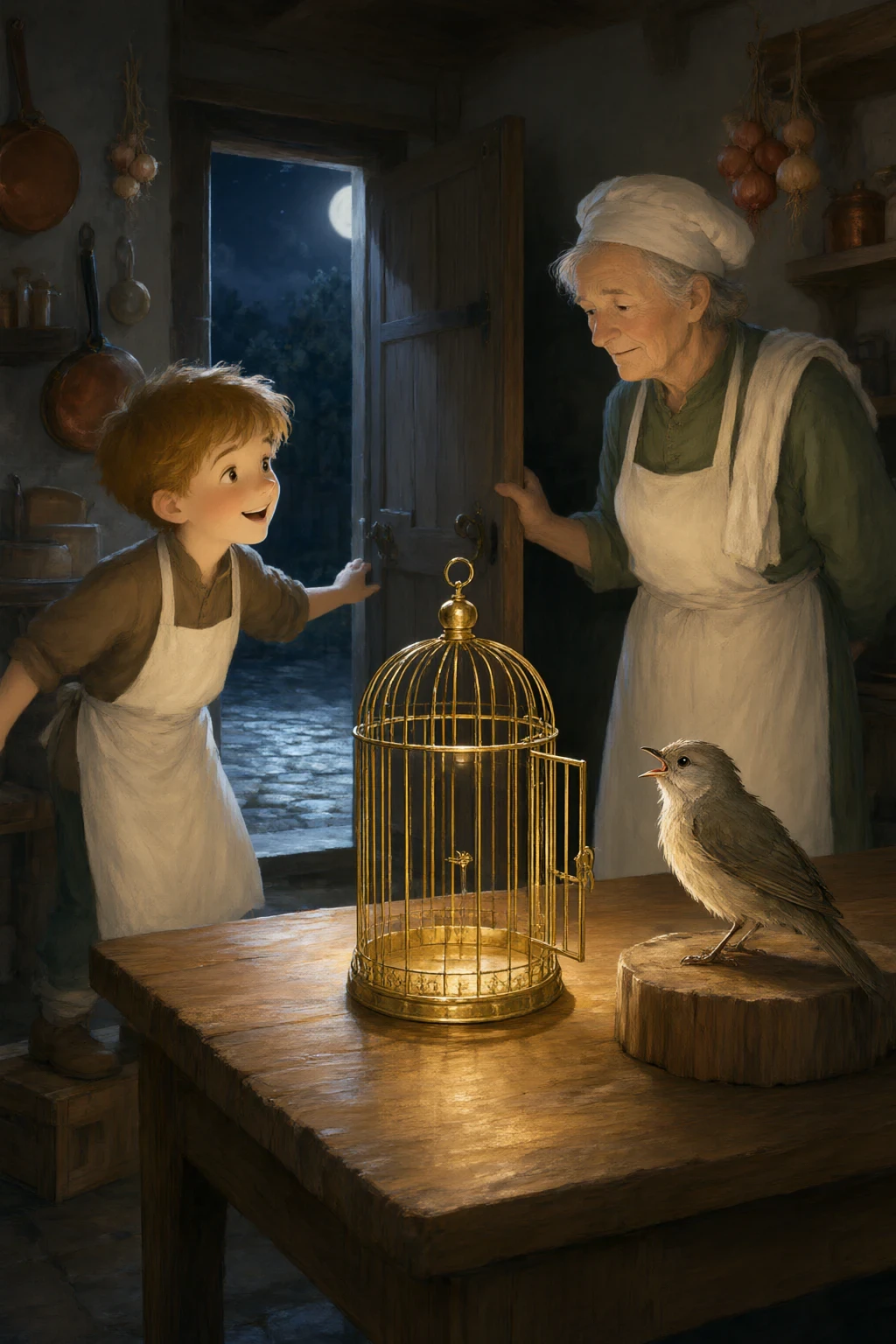
They did it in the scullery at two in the morning, with the scullery door open to the yard, because Onni had pointed out that a bird flown into a lit room will not leave a lit room, and had been told off for knowing it. The pin on the cage door was a long way down. The bird did not struggle. It came out onto Hedda's chopping block, and stood there, and breathed, faster than a bird should breathe, and then it sang four notes and stopped and sang four notes and stopped, like someone counting.
Then Hedda put the cage on the yard step and walked back inside, and the bird sat on the block until she was out of sight, and then it flew.
They found it in the plum tree inside the walled kitchen garden the next morning, and the morning after that, and every morning after that, singing at first light from the branch over the vegetable beds. It was thinner than it had been at court. It ate beetles out of the plum tree like anything else, and it sang for anybody who stood under the branch: the scullery boy, the King, and the Under-Marshal, who came twice and stood a long time with his hat in his hands and said nothing at all, because there was nothing to say.
The Hall of Silence was shut up, and the machine was sold to a theatre in the capital. The court of the Amber Hall, deprived of its property, had the worst summer in its history and also, in the end, the best one, and the reason was boring: the singer's list was rewritten. Singers were hired by name, on a wage, and paid in coin on Fridays by a clerk who wrote the amount in a book.
The list was nailed to the passage wall by the kitchen, which was the only wall the court walked past, so that for the first time in a hundred years the people whose voices the court bought could stand where the court could read what it paid them. The kitchen got a second stove and a bigger one, and the first breakfast moved out into the yard in the May, and Onni was allowed to cook the second course, which is eggs and broth and a great deal of doing things in the right order, and which he is still extremely proud of.
Hedda's only visible spoil was the cage. It was far too grand to throw away and far too gilded to stand in a kitchen, so it hung by the scullery door, holding onions in a net and a pot lid on a hook. In the spring somebody cut a plum slip from the yard tree and set it in the bottom of the cage, in wet moss, because the cage had a saucer and a saucer is a pot.
By August it was a plum tree two feet high, and the bird sang from the open window of the Hall of Silence, which had no doors on it any more, and nobody in the Amber Hall ever worked out how the bird had learned which window was the one the kitchen was under.