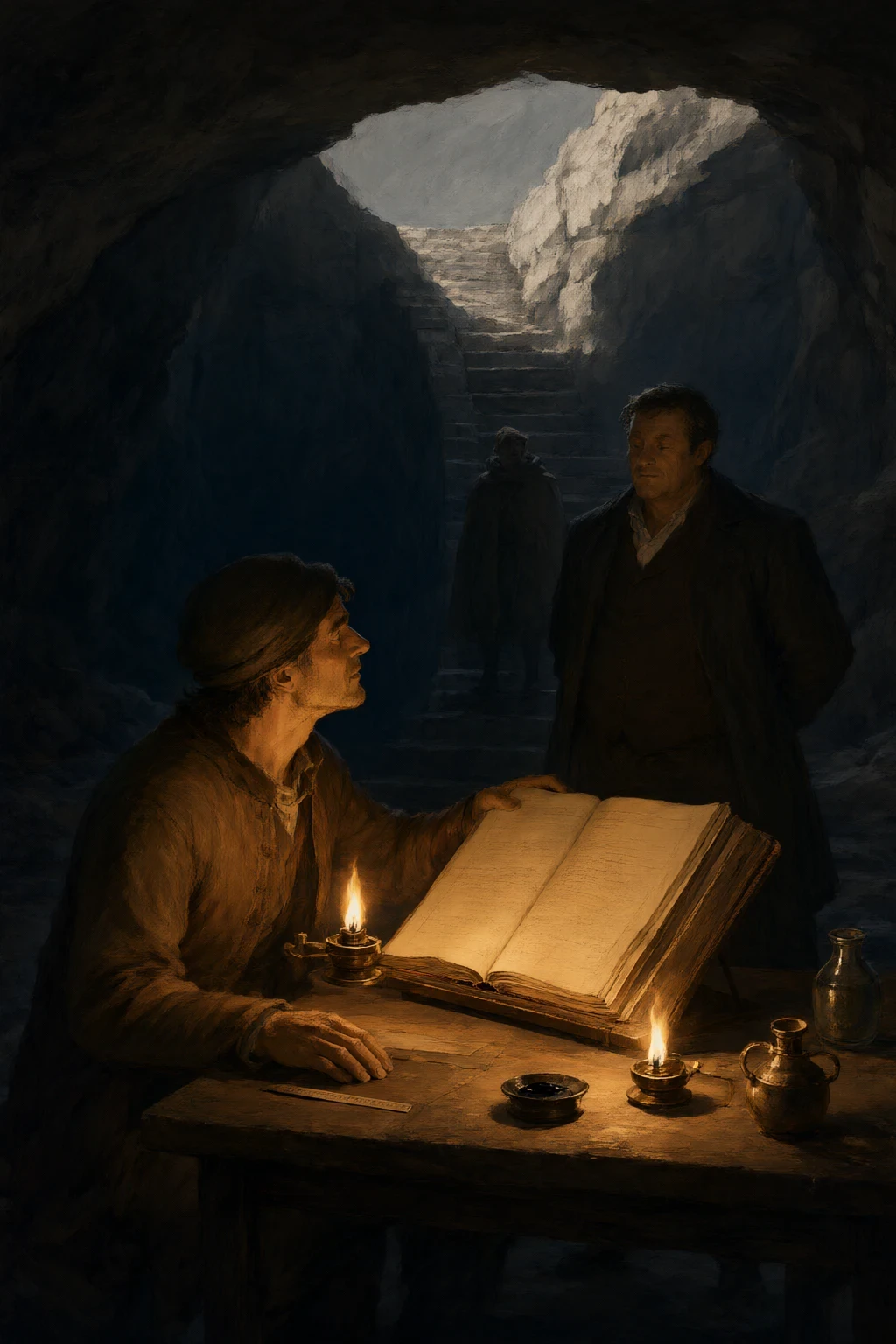
There is a storyteller who sits in the north-east corner of the caravanserai at Rashtan, and he tells the story of the cave on the odd evenings, and it is always about four men and not forty, because a crowd in a story is cheap and four men in a story is a job. I will give you the version he tells now, and then I will tell you the part he leaves out, because the part he leaves out is the only part of it that ever happened to anybody.
"You have heard it a hundred times," he says. "Two beggars, a slave and a boy, a woodcutter who cuts too much wood, a mountain that opens, a treasure, and a man called Kafour who is let in on a word and let out on a worse one. Nobody in this caravanserai is eleven years old. What people want to know is whether it is run well." He leans in. The lamp is trimmed low for the room and for the season, because the room is cold in the eleventh month and because he is sixty-one and does not like being asked to hold a lamp higher.
"They ask me, is it run well. And I say: it is better run than this caravanserai. It is better run than this town. And they laugh, because a man in a warm corner saying that about a cave is a joke, and then they stop laughing, because I say it in a particular way, and the particular way is the answer."
I was the second clerk of the market at Rashtan, which means I kept the market book, and for eleven years that book had a column at the foot of the last page headed, in my own hand, wheel and water, villages. The qanat comes out of the hill above the town and goes down under it and comes up in four places, and the four places are the four public troughs. Somebody is responsible for the wheel at the head of it. That somebody is the market, the market pays that man two hundred dirhams a year, and the market recovers it from the villages below the town on every load that passes through.
The sum is called the wheel-money. Everybody knows it. It is the oldest tax in the valley and the only one nobody has ever tried to abolish, because abolishing it would require somebody to say out loud that the wheel is eighty years old and half of it is ditch. I collected it for eleven years. I collected it in person, once a year, in the ninth month, with a boy and a basket and a leather bag.
The wheel was fine. The part of the work the wheel-money was raised for, the cleaning of the open channel above the troughs and the mending of the two broken arch-hollows, was done properly, by two men, in the second and third years. It cost four hundred and six dirhams. The wheel-money came in at between one thousand eight hundred and two thousand two hundred a year, because I collected it at a rate set by a predecessor of mine in the time of my grandfather, when there was a toll on the bridge. The rest went somewhere. I know where it went. It went into a chest in my house, and the chest was not stolen, and that is the entire confession. I did not put it on anybody. I added to it, and the adding was the habit and not the motive, and that is worse. For nine years I also collected a smaller sum from the same four villages for a thing that does not exist.
The granary of Rashtan lost grain in the seventh year, and then in the eighth, and then in the ninth. The granary is the town's. The mill at the bottom of the qanat makes the flour, and the granary is meant to hold a thousand loads against a bad year. It lost, over three years, a little under two hundred loads, and nobody loses two hundred loads by accident, and the town appointed a committee of four in the ninth month of the ninth year. The committee's first act was to list every official in Rashtan who touched a key, a seal, a book, or a bag of money.
I was on the list. I was the only man in the town who went out into the villages once a year with a basket and a boy, and I was, in the phrase the committee used, the man with the yearly door. I went to the committee on the second day and I said, before anybody asked me anything, that I would produce my eleven years of receipts in the market's own hand, and that anybody who liked could add them up, and that I had added them up myself a great many times. They let me go. That was the last conversation I had with that committee.
The district had exactly one set of books that anybody trusted, and it was not the town's, and it was not the muhtasib's, and it was not the temple's. It was in a limestone ridge above the juniper wood, four miles north, and it belonged to what the road calls the Forty. I had told that story in this corner for nine years. I had never been up there. Nobody in Rashtan is invited. I went up on the eleventh day of the ninth month, in daylight, with my receipts in a satchel, and I did not have a plan, and I want that on the record, because a man who says he had a plan is describing the story he has told himself since.
The mouth of it is not dramatic. It is a fissure in the limestone about as wide as your two hands, and a floor of flat stone inside, and four paces in the floor changes and there is a stair going down, cut, and squared, and worn in the middle of the tread where forty men's right feet have gone down it. There is no magic in the opening. There is no word. There is a term of the partnership, it is a question, and the answer is the same sentence every time, and the sentence means: what goes in is written in, and what comes out is written out.
The chamber below is about as long as this hall is wide, and it is cold, and it is lit by two lamps that are always lit. The walls are bare rock. There are no goods on the floor and no goods on any shelf, and no bench, and no bed, and no treasure, and a man who goes down that stair expecting treasure has made an error about the kind of place he is in. What is in the chamber is: a table, two chairs, a bench, eleven jars of water, a stack of felt, and a book on a reading stand.
The book is four hundred leaves in a plain sewn binding and it is the reason I went up there, and the description of it is the whole of what I have to say about forty men. There is a page for every transaction in the history of the venture. Not a summary. A page. Date on the left, item in the middle, weight in the middle, names on the right, and a line at the foot for what came off it. There are four hands in the book and the fourth has been in it for fifty-one years and is a man of eighty-one who still does the third watch on Fridays.
There is a rota. Six names to a night, forty men, so a man comes round every six nights and stands the first watch and the last, and the rota is a grid on the inside cover, and the grid has never had a dispute in it, because a disputed man is not asked to keep the grid. There is a fund. Every load that goes in puts one part in forty-two into the widows' and old men's fund, the fund has been paid out eleven times in thirty years, and one of those payments, in the nineteenth year, is a leg.
There is a seed advance. In the seventh year, when the rains failed, they put out four hundred measures of barley to four families in the villages below Rashtan at no interest, on the security of the harvest, and the four hundred measures came back in the fourteenth month of the eighth year. And there is a page for the disputes, and there are nine in thirty years, and every one is set out on both sides in the words of the two men, and in eight of the nine the decision is against the man who brought it.
I sat down in one of the two chairs, which I understand is a thing you may do, and I said: I am the second clerk of the market at Rashtan, and I have been the man with the yearly door for eleven years, and I am going to read your book. The man at the table was about fifty and had a face like a good saddle. He said, "You are going to read it and then tell us what you find, and you are going to be careful in what you find, because everybody who has read it has found something." "I am an auditor," I said, "and if I find something I will say so in the room, with a date, in a voice that does not enjoy it, and that is the only kind of finding worth having." He looked at me for a while. Then he pushed the book across the table, which was not what I expected, and which is in fact the most alarming thing that has ever happened to me.
I read it for six days. I slept at the top of the ridge in a shepherd's hut, and on the second night a man of about sixty sat on the floor by the stair and told me the history of the founding of the venture, which took four hours and which I have since been telling in this corner for the last two years. Here is the finding. I will put it as the town would have wanted it, and then as the audit would have put it, and the second is the true one. The town would have wanted: the Forty have had grain from the Rashtan granary.
The audit says: the Forty have not taken a grain of Rashtan granary in thirty years, and the reason is on the third leaf, a standing order made in the first year and never amended: no goods from the town's stores, on any account, in any month, whether by night, by day, in fire, in flood, or on any claim of custom. And under it, in the same first hand, the reason for the order: a venture that eats its own market dies in a bad year, and the market is what makes a bad year survivable.
That is not honesty. It is arithmetic, and the man who wrote it was not a good man, he understood that a bad year arrives about every nine years and that a village eaten by its own thieves is a village with no flour in the ninth year. It is the coldest sentence in the book and it is the one I have never been able to stop saying.
There was a second finding, and I made it on the fourth day, and I have thought about it every day since. On the sixth leaf of the seventh year's accounts, in the ordinary hand, in a column of the ordinary page, with the date and the weight and the names, is an item of ninety dirhams. Wheel and water, villages of Rashtan, collected, being the surplus of the said tax over the cost of the work. It is entered as a receipt, dated the fourth month of the seventh year, in the same book, in the same hand, under the same rule as a load of pepper or a bolt of cloth. And against it, in the second column, is the payee: Ibram son of Yusuf, thirty-eight years, of Rashtan. They did not take it off me. They wrote it down.
I asked the man at the table about it, and he said, "We were asked for it." "By whom?" "By the market," he said. "Not by you. Your clerk, in the sixth year, wrote to us and asked whether we would hold a sum. He said it was money that had come in and did not need to go out. We said: is it honestly come in. He wrote back and said it was, and he said what it was, and he did not say what it was for, and we took it because we are a bank, and a bank does not ask what a man intends, because a bank that asks is a confessor, and confessors are cheaper than bankers and worse."
I was removed from the market on the sixth of the eleventh month of the ninth year, by a letter, on the grounds that the wheel-money could not be collected by a man the town was investigating, which was a true sentence and a coward's sentence, and I accepted it in one line, and the committee wrote in the town book that my accounts had been found in order, which they were. I have never found out who wrote the letter. It is true that the wheel-money has never been collected since, and that in the fourteenth year the town put the troughs on a rate, openly, at a quarter of what I was collecting, and the qanat is still running and nobody has been hungry in the villages below Rashtan in twenty-two years.
So I sit in this corner, and I tell it with four men instead of forty, because a crowd in a story is cheap. The only difference anybody ever notices is the name. I do not say Kafour any more. I say the boy, and I say his name was Rahim, and I say he was a runner for a brass merchant, which is the trade I came up in, and that when he was let into the cave he did not go mad and did not go home rich, and that he sat down with a clerk and read a book for four days. The only part I leave out is the nine years.
Because here is the thing, and I have turned it over and there is no better way to say it: for nine years, the most disciplined men in this district held a sum of money that was stolen from four poor villages, entered it in a book, made a man put his name against it, and did not spend a dirham of it. And they did not stop the theft, and did not report it, and did not return it, and every year they wrote the interest of doing the right thing on a page while the man doing the wrong thing added to his chest at home.
I have never decided whether that was complicity. I have decided that it was not my business, which is what they said, and I have noticed, over twenty-two years, that it is the single most popular sentence in this valley, and that it is the exact reason the wheel-money was collected at twice the rate for eleven years.
"Then how do we know what it is like in there, if you never went in?" "I went in." "Then how do we know you are telling it right?" And I tell them the truth, which is that I do not know that I am telling it right, and that I have told it eleven hundred times, and that the eleven hundredth time somebody in this room will go home and repeat two sentences of it to somebody who was not here, and by next year the hill will have a door in it and a man in front of it, and that this is the ordinary end of every story told in this corner.
Then I take the lamp down, because the eleventh month is cold and the hour is late, and go out into the yard and unhook the board that hangs by the inner door of this caravanserai. It is the market's old notice board, and it is mine by a custom nobody can explain, which is that the man who was last removed from a post in this town hangs the board outside until somebody else does. On the front of it, in eleven years of my own hand, are the receipts. Every one. Nine hundred and eleven entries, with dates and villages and sums, in a column, because a column is the only honest shape for a thing that was one lie.
On the back of the board, which nobody reads, I have pinned one more sheet. It is the first receipt I have issued in this town since the letter of the sixth of the eleventh month, it is made out to myself, it is for one night's lodging at this caravanserai, and it is for one dirham less than the posted price.