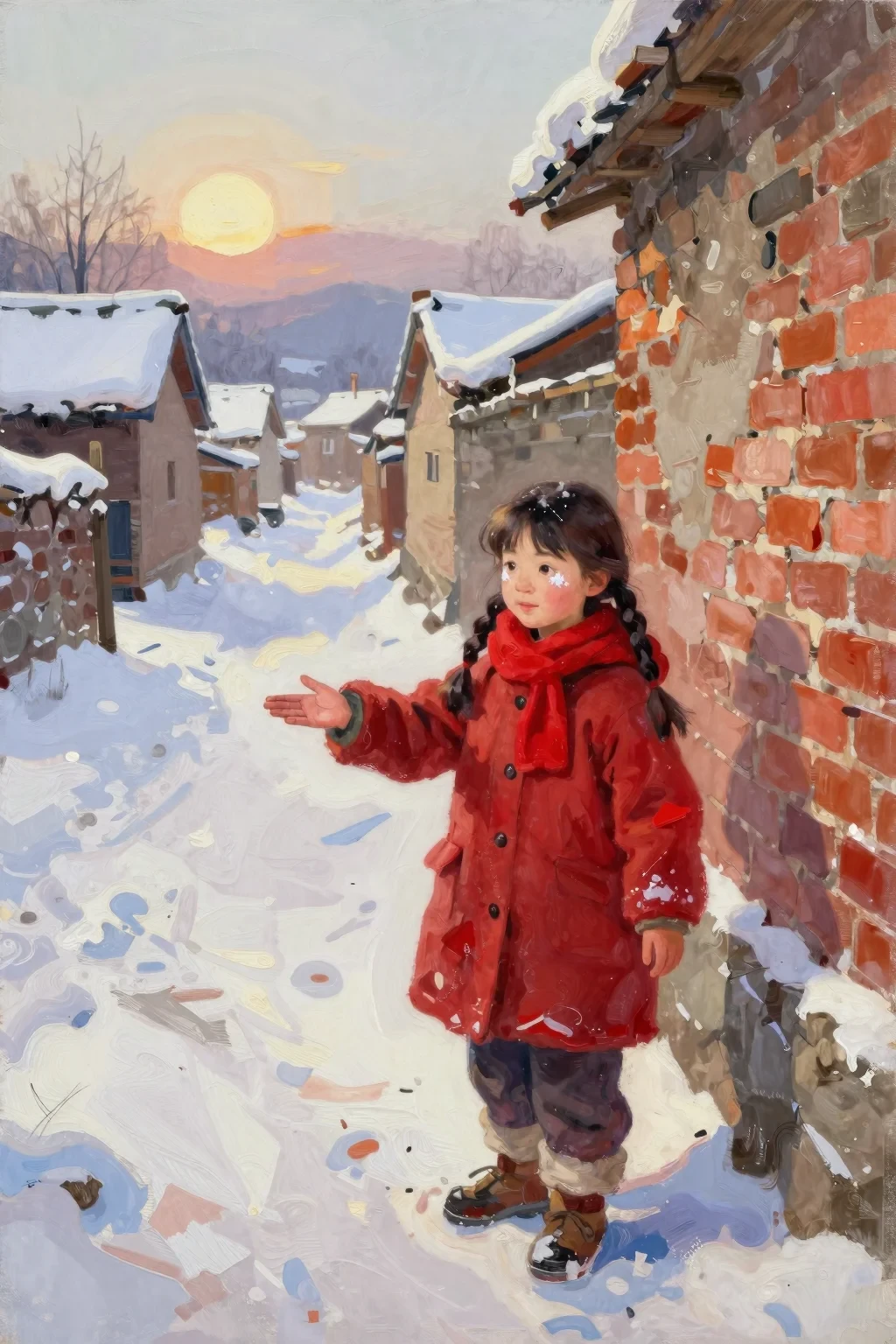
The village of Zelenna keeps a custom that has nothing to do with the river and nothing to do with the dead. At the top of the lane there is a wall, and no house against it, and a gate in it with no gate in it, only an opening about the width of a hand. The bricks on each side of it are worn round at the edges, because people have been putting fingers in there for a very long time. Once a year, when the first frost has come and gone and come again, and after the last sheaf is in, a child is sent up the lane and says the asking into the opening in the old words. Then the child waits. Then the answer comes back through the hole, and the year is blessed. There are three things about this, and every child who is chosen is told all three of them before she goes up. The blessing is asked in the old words, and it is answered once.
If it is asked a second time, the year is blessed twice, and the village owes a year for that, and owes it in kind, and owes it without ever saying so out loud. If it is asked a third time, the year comes back empty. Hesper was nine years old and had the best memory in Zelenna. She could repeat a thing back after a day and a half, in the order it was said, in the voice it was said in. She had learned the old words at seven from Ilma Vey, who kept them and made her say them over until she could say them with her eyes shut. Hesper liked a good sentence. She sat through a whole evening of the threshing because there was talk in it, and at seven she worked out that the asking was the longest sentence anybody in Zelenna ever said out loud, and she wanted it for a year before anybody thought to give it to her. She was chosen on the second of November.
The asking goes like this, and it has gone like this for longer than anybody can remember. I come with the year's asking. I come without a name and without a complaint. I ask for what is under the soil and over the soil and in the soil, and in the name of the field, and in the name of the roof, and in the name of the child that is not yet. Let it be enough. The answer is three words long. Then it is heard, and the year is yours to spend.
Nobody went up the lane with Hesper. Nobody ever did. She stood in the frost with her face a hand's width from the cold brick, and the frost got into her boots while she waited, and the waiting was the longest part. When the answer came it came up through the hole from below the ground, or it came from nowhere, or it came from the wall, and it never got louder and never got softer. Then it is heard, and the year is yours to spend. She said it back, because a child does, and went down the lane at the speed she went down it. That year was an ordinary year. The rye came in on the eighteenth of the month and the plums were small and the winter was hard but no worse than the one before. Hesper forgot the wall by the middle of December, which is what a nine-year-old is supposed to do, and which is exactly what she did not do the following year.
The second time she noticed the words. It had been in her since November, the way a bad tooth is in a tooth. Under the soil and over the soil and in the soil. Three times, and the earth is not three things. It wants the whole of it once, and asking three times is like asking a man for bread and then bread and then bread again. And then in the name of the field. The field has no name. A name is what a person is called so that you can call them, and a field is not called anything by anybody. You cannot say a thing in the name of a thing that has no name. She thought about it all winter, on the way to the byre and back, in the way that children think about things, which is by saying them out loud under the breath and trying them different ways. She did not want to say it better. She wanted to say it right.
The second time she went up on the second of November with the frost hard and the lane white, and Ilma Vey was standing at her gate and did not come up, as she never did. Here is what Hesper said into the hole in the wall. I come with the year's asking. I come without a name and without a complaint. I ask for the field, all of it, from under the frost to over the frost. I ask for the roof over the people under it, and for the child that is not yet, and I give them their own names and not the name of the ground. Let it be enough. And then she stopped, because there was one more thing, and it was the best of the whole sentence, and she had put it last so that it would sit at the end where a person would carry it away. And let the asking be a thing the year keeps. The answer came after a while, the same as ever. Then it is heard, and the year is yours to spend.
That year the hay came in so heavy that it could not be stacked and had to be carted into the lane, and there was still hay in the lane at Candlemas. The rye went over the top of the granary wall, the plums set on the sour trees where they never set, and the bees swarmed so thick on the ash by the wall that Hesper's father put out three hives he had meant to sell. Lasse the cooper built a new barn that winter, which he had wanted for eleven years and could not afford, and everybody in the lane said the same thing at the table, which was that the wall must like Hesper. She was asked about it all winter. People said, “You asked it,” and she said, “I said the words,” and they let it go at that, because nobody wanted to say the next part.
Then it was the second of November again, and the third time she had ever been up that lane. She went up at four in the afternoon because the frost came late that year, with the words in her mouth and nothing under her ribs but the wish to get it right. She wanted to see if she could do it again. That was the whole of it. She had said the sentence twice and it had never once been said well by anybody in Zelenna, including her, and she wanted to know whether she could take a thing that was hers and do it a third time and have it still be hers at the end. Timo was cutting the last of the beans by the gate and said, without stopping, “You have asked already, Hesper.” “Not this year I haven't,” said Hesper, and went on up the lane.
Here is what she said into the hole the third time. She said the second asking again, word for word, because it was hers now. Then she added one line, which she had made up in the lane, and which was the reason she had come. And let the year remember that I said it well. Then she waited. The answer came as it always came, and it said the same words it had said both other times. Then it is heard, and the year is yours to spend. Hesper stood in the frost a while after that, and nothing happened anywhere that she could see, and she went down and told her mother and her mother said, “Well,” and made no more of it.
The year came back empty. It did not come back empty in a way anybody could point at, and that is why what happened in Zelenna is still not said out loud. The rye went into the ground at the ordinary time and came up at the ordinary time. The hay came in on the ordinary day and filled the ordinary barns and left the yard empty. The plums set, and the fruit was hard and small and dropped before it was worth picking. Nobody starved. There was bread at every table in Zelenna that year, and mutton twice, and nobody went without a meal who had not gone without a meal the year before. And in the spring of the year after it, there was no seed.
That was where the year had gone. It was not in the ground and not in the river and not in the barns, because the barns were swept in March and the bins were empty in April, and the money for rye had gone on the new barn and on a bridge toll and on the two funerals of the good year. A surplus is a thing a village is allowed to have, and that year had used up the part of itself that it is allowed to have, and there was nothing behind it.
Nobody in Zelenna turned on Hesper. Her father shook her once by the shoulders in the yard in April and said, “Well,” and then went and looked at the seed bin and said nothing more. Pehr, who had been the other child who could say the words, cut her a new handle for the rake without mentioning it. The miller gave her a bun when she came for the flour and made a joke about the wall. What they did was worse than turning on her, and better, and she had no words for it until she was grown. They stopped asking her anything. Not what she thought of it, not what she remembered, not about the wall. Her mother asked her to fetch things and told her what to do with the evenings. Lasse the cooper asked her mother, in front of her, whether the girl would like to learn a gimlet, and her mother said she would think about it.
And in the November of that year they sent Bett, who was eight and had no memory worth mentioning at all. Bett said the old words. The three soils and the name of the field and the name of the roof and the child that is not yet, flat and fast, the way a child says a thing to get it over with, and then stood in the frost until her ears went white. That winter was hard but it was a winter, and in the spring there was seed.
Ilma Vey came to the house on the last day of the year with a board two feet long in her hands, with the old words scratched into it and the scratches filled with soot, the way she had taught Hesper to fill them when she was seven. She put it on the table and said, “You will keep that,” and Hesper said thank you, and Ilma Vey said, “Your mother was nine when she said it,” and after that she drank the tea she had been given and did not say one word about any of it. Hesper understood that the board was not a punishment. It was the old words given back to her in writing, in the state they had been in before a nine-year-old had decided they were clumsy, and nobody was ever going to say one word about that out loud.
She worked it out alone, over the winter and into the spring, which is the way she worked out everything. She began with the asking, because she had it whole in her head and it was the only thing she was certain of. She said all three of them out loud to the kitchen wall, one after the other, in the voice of the child who had said them, which was her own voice in all three cases, and when she had them side by side she could see what she had done. The first one asked for the earth three times and used a field's name, which is a thing you cannot do. The second one asked for the earth once, the whole way, and gave the things under it their own names, which was better than the old words, and was true, and had never been asked for. And it had one line in it that the old words had not got. Let the asking be a thing the year keeps. She had put a want of her own into the sentence. She had gone up to a wall in the frost and asked a year to remember something, and the year had heard it, because that is the whole duty of a wall and it does not refuse.
And then she did the thing that took her the rest of the winter. She said the answers. Three times she had stood in the frost and three times the same words had come back through the hole, in the same voice, at the same distance. Then it is heard, and the year is yours to spend. The wall had not changed once. Not in the words, not in the sound, not in the winter it chose to answer. Hesper had gone at it three times, in three different sentences, and had got back the same sentence every time. So whatever had been different was her. And a year is not a thing that gets better because the sentence that asks for it is better. She had gone up to that wall with a good sentence and come away with a year that weighed more than the wall could hold, and every house in Zelenna had been proud of her for it, and had spent it.
She had not asked twice for more grain. She had asked once, in better words, for the asking to be a thing the year keeps, and the year had obliged her. That is what a doubled year is. It is not a bigger year. It is a part of a year handed over early and spent by people who think it is a gift.
The frost came in March that year and went again, and in April Hesper sat on the step above the lane with the board across her knees and the old words under her thumb. She had learned it and had nobody to hand it to, and she worked out what a person is for, sitting there, in the way that a nine-year-old works things out, which is by saying them until they are plain. A blessing is not a machine. And the more you polish the words, the more you are asking for something else.