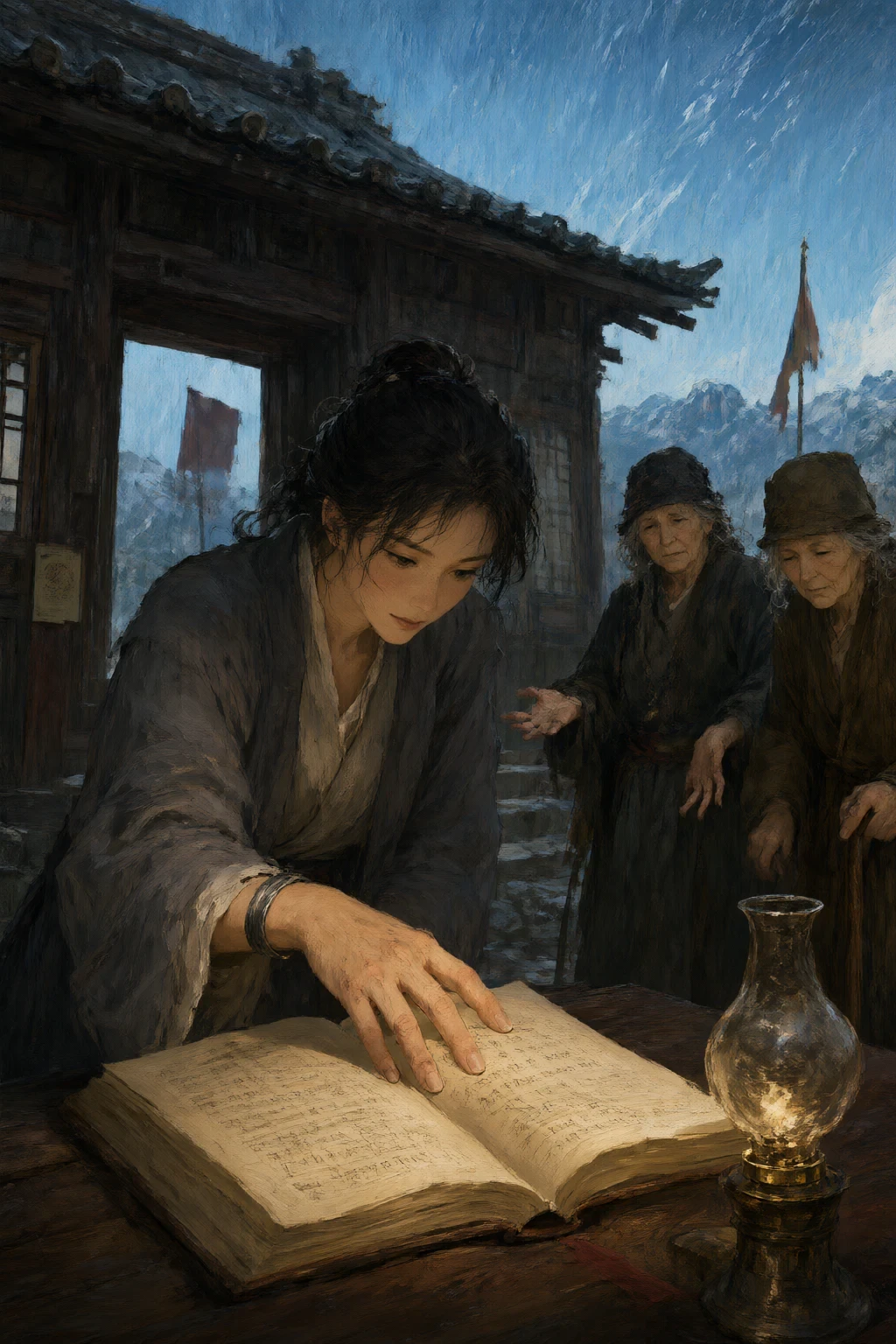
The woman waiting at the Shrine of the Third Water had been walking up the pass for six days, and she had brought nothing with her but a stick, a wicker of bread, and a thing she wanted answered that she had never once written down. She was seventy-four. Her name was Hessa Mor. She had come up in the spring, in the second week of the eighth month, when the market was on the terrace above the Ninth Step and the terrace was a bad place to be if you wanted anybody to look at you. “Marda Osk,” she said, when Marda had got her out of the wind and into the room with the fire. “You are the one from the Bureau.” “I am.” “I have something that is a hundred years old and it has been in the family a hundred years, and I would like it put right before I go back down.” “Put right how?”
Hessa Mor set her stick against the wall, straight, the way a person sets down something they have been carrying a long way. “I swore at this shrine when I was twenty-nine years old,” she said, “that I would not go below the Third Water until nineteen years were up. And I did not. For nine years I did not. Every spring and every autumn, at the first of the thaw, I went up the stair instead of down, and my legs took me up the way a dog takes him to a whistle, and I never once chose it. And then I was thirty-eight, and one morning in the autumn I woke and my legs were mine again, and I went down to Vell and I married a miller and had two children and buried both of them and buried him, and I have had thirty-six years of my own life since, and not one hour of it was mine while I was on this mountain.” She stopped. Her hands were very brown and very thin and the knuckles of them stood out. “Nineteen years,” she said. “I know what I said, because I said it twice, because Sister Vaun had to write it and make me say it again. Nineteen.”
Marda Osk read the question back to herself, which she did before every question she had put to anybody in eleven days of climbing. “May I restate it, so that I answer the right one. You are asking whether the term written against your name in the register of this shrine is nineteen years or nine years.” “I am asking whether the term written against my name is what I said it was.” “That is the same question and it is the only one I can do anything with.” Sister Wenna Cray was the keeper of the Third Water and had been in the chair thirty-one years, and her hands were the colour and shape of a pair of old scissor handles, which is what hands do on this pass if they are held to cold stone for three decades. She had gone for the register while Marda was still doing the restating, because a sister of the third shrine does not wait for a clerk from the low country.
It took her a long time. She came back with the book open in both hands and set it on the lectern and did not say anything. Hessa Mor leaned over it. Her finger went to a line near the bottom of the left-hand page, and the line was in a small, extremely neat hand, and the ink on it was the colour of a beetle’s back. “Seventeen hundred and eleven,” Hessa said. “I remember that year. There was a wet summer and the first corn went in late and my father was angry about the hay.” “The term is written nine years of labour to the pass,” said Sister Wenna. The fire moved. “Nine,” said Hessa Mor. “Until the thaw following the ninth year, sworn at the second bell of the second thaw, witnessed, and signed, the keeper,” said Sister Wenna Cray. “That is the whole of it. It is a fair entry and it is a fair hand and I will not have my book called anything else.”
Marda Osk looked at the woman’s boots. They were the worst-made boots she had seen in a hundred and eighty years of Bureau inventory, and there was a pale worn place on the inside of each heel, and the wear was on the wrong side. The inside of a heel is where a body argues with itself, and Marda Osk had read four hundred ledgers that said so and had never until that moment had a person stand in front of her and be it. Nine years of walking uphill, and nine years of a body saying, in the only language a body has, that it was owed more. “May I ask about the walking,” she said, “and not about the vow.” “You may ask about whatever you like,” said Hessa Mor, “you are the first person in forty years who has asked me anything at all.”
There was a stoup of cold water on the sill and a dry crust of bread beside it, put out for whoever came down the stairs, and nobody had touched it, and Hessa Mor looked at it for some time without saying why. The boy on the hearth was the reason. He was fifteen and thin as a knife and had his fingers in the wool of his left cuff, working a loose thread round and round, and his fingernails were split and filthy and one of them was black. “You are the one who wanted to swear,” Hessa Mor said. “Yes, right, yes.” “I have not asked you a question yet.”
Ansel Dun looked up. “Eleven days up the stairs,” he said. “I have got four things written on a slip and I have said them to the sister three times and she has written them down three times and I have not said them in the room yet, because you have to say them in the room, and I have not been in the room.” “Say them to me.” He said them to her. Four things, in a bad flat voice, in the wrong order, and the last of them was that he would come back down the stair twice a year for as long as he was able, which he had plainly been told was a term, because he had said exactly those words twice and had then stood there waiting. Hessa Mor shook her head.
“That one is not a term,” she said. “That one is a man being polite to himself. Say a number. Say a season, or a year, or until the grass comes up, and say it out loud, and then make the sister say it back to you and check it against the book before you go out of the room. Whatever you want from this mountain, say the whole of it. There is not one soul up here who has got less than they asked for. I have got exactly what I asked for.” “That is not the same as what I said.” “No,” said Hessa Mor. “It is not, and that is the whole of my life, boy, and I am seventy-four and I have come up here to find out why.” He was quiet for a moment, working the loose thread. “Yes, right, yes,” he said. “Do not do that,” said Hessa Mor. “Not here. Not ever. It is the most expensive noise a person can make, and I have listened to it for thirty years out of my own mouth.”
“The body does not remember what you said,” said Sister Wenna Cray. “It remembers what was written. If a man swears nine years and the keeper writes nineteen, his body keeps nine. If a man swears nineteen years and the keeper writes nine, his body keeps nine. That is the whole of what the mountain does. It is not a punishment and it is not a judgement. It is a hand that takes what is written and closes.” “Then the book did it,” said Hessa Mor. “The book took nine years off me and let me go down that hill and I did not know and nobody told me.” “The book did it,” said Sister Wenna Cray, “if the book is wrong.”
“You have found a wrong term,” said Sister Wenna Cray. “Nobody in this room has written you a cruel word. You were given a fair word for a wrong term, and the mountain took the word and never once looked at the intention. That is the whole of what I have to teach a clerk in eleven days.” Both sisters looked at Marda Osk at that, because a clerk from the Bureau of Vowed Obligations had a face that waits to be asked whether the book is wrong. “It is a transcript,” said Sister Odel Fisk. She was twenty-four and had been at the Third Water two years and wrote the fair round hand now, because Sister Wenna’s hands had gone. She said it without looking up, the way you say a thing you have been wanting to say for two years. “A transcript of what?”
“Of the original page. The register you are looking at was begun in eighteen hundred and nine. The page your name is on is not the page your name was written on.” She put a finger on the ruled margin. “This line here is a copy. It says here, in this colophon, that the register was carried forward and recopied from the older volume in the year eighteen ninety-one, on the ash of the great flood, and signed by the warden’s copyist. I did that, reading back from the older volume, and I have done it for every leaf in this book, and so did the copyist before me, and the one before him.” “How far back does the copying go?”
“Four times. The original, then eighteen forty-four, then seventy-one, then ninety-one, and then me in the last spring.” Sister Odel Fisk looked at her sister. “And the eighteen seventy-one one is a bad copy, and the eighteen forty-four one is worse, and nobody has ever had the eighteen forty-four one collated against anything, because there is nothing to collate it against. The original page was never found.” Marda Osk had her hand flat on the table and was not writing. “So the book says nine,” she said, “and the woman says nineteen, and between the two of them there are four hands and a hundred and thirty years, and the only witness is a page nobody has.”
They found it in the fourth hour of the second day, and they found it because of a nine. Sister Odel Fisk laid the four leaves of the chain side by side on the long table, oldest at the left, and Marda Osk walked down the line of Hessa Mor’s entry with her finger, and Sister Wenna Cray watched her do it. The original was gone. The eighteen forty-four leaf had a nine made the way a schoolmaster teaches a nine, with the loop closed and the stem coming straight down the side. “Closed at the top,” said Marda Osk. “That is a taught nine. It is a nine that has been written perhaps four thousand times in a life.” “Yes,” said Sister Odel Fisk. The eighteen seventy-one leaf had the same nine, closed, and slightly larger, and the ink had gone brown.
The eighteen ninety-one leaf had the same nine again, and by then it had begun to slant, because the man copying it had been copying fast for a long time. “Marda,” said Sister Wenna Cray. Marda Osk had got to the last leaf before her, the one Sister Odel had made in the last spring, and she stopped with her finger on it, and then she went back one leaf, and then she came forward again, and she put her thumbnail on the eighteen forty-four leaf and left it there. “This one is different,” she said.
It was not different to anybody who was not looking. It was the same round, upright, careful hand, the same nib, the same ink. But the nine was not closed at the top. It came down and stopped, and went on, and the two strokes met at a slant, so that the number looked less like a nine and more like a nine that had been written by a hand that was cold enough to be in a hurry. “He closed it everywhere else in the document,” said Marda Osk. “I have been through forty pages of him. He closes every nine. And in this one he did not close it, because he was writing quickly, and because when he wrote this nine he was not transcribing a nine.” “No,” said Sister Odel Fisk. “He was writing nineteen.”
The day-books at the Third Water were in a press under the window, one for a year, ugly and unruled and never once recopied, because a day-book is a thing a keeper talks to and no clerk has ever wanted it. The one for seventeen hundred and eleven was the second from the bottom and it was stiff with damp and it came apart at the spine if you looked at it wrong. Sister Odel Fisk opened it on a board. Marda Osk put the lamp on her left so the raking light came across the page and the ink stood up off it. There were two entries that spring, and both were vows of labour, and both were in a keeper’s clear hand. The first: nine years, sworn by a fuller out of the Vell mouth. The second: nineteen years of labour to the pass, sworn at the second bell of the second thaw by Hessa Mor, born at Vell, witnessed, and signed, the keeper.
Below both, in a smaller and shakier ink, in a hand that had not been warmed up: The page for this day entered late, the keeper being ill of the chest, and copied by me out of the fair round and sworn before me by the parties. I. S. “There is a scrape,” said Marda Osk. “There is a scrape.” It was under the word nineteen, a place where the pen had gone over the same ground twice, and the second time had lifted a fibre of the paper and left it standing up like a small pale fin. “He wrote nineteen,” said Marda Osk. “And then he came back. And he put the pen on the same place twice, which is what a person does when they are thinking about saying something.” “And he did not say it,” said Sister Wenna Cray. “He did not say it.”
The name was not in the register anywhere, because he had not been a keeper and had not been entered. It was in the wage-book, in the press, on a leaf of accounts for the winter of seventeen hundred and ten, at the bottom, in the same small cold hand: paid to I. Serrat, copyist, twelve pence, for the fair round of the third shrine, at the request of the keeper. Sister Odel Fisk read the line twice and then sat back in her chair. “Nineteen years old,” she said. “There is an age against it. Nineteen, and a copyist, and a chest of the kind that makes a hand do that.”
The rest of him came out of the pass in pieces over two more days, the way everything on this mountain does, from people who remember a face and not a name. A woman at the Second Water had a man in her family who remembered a boy called Ivo who could read and write and was not strong, brought up in the last spring from a village below Vell because the third shrine’s keeper had asked the warden’s man for a hand and the warden’s man had asked a village. A mason at the Ninth Step remembered the boy for the sound of his cough. Brother Seat, who was in the mule yard that week with a tally-stick he had already been given, remembered one thing only, and said it flatly and wrongly and to the wrong person, as he finished everything. “The copyist,” he said, “was the keeper’s own man. It was the warden who took him.” “No,” said Marda Osk. “He was the warden’s copyist. That is all the wage-book knows and all the world is entitled to.”
Marda Osk found the rest herself, in a way that she did not enjoy and never described in the report. The man had come on the second day of the swearing, after Hessa Mor had gone down the stair for the night, and had spoken to the copyist rather than to the keeper, because the keeper was in his room with his chest and had been in his room with his chest for a week, and because Ivo Serrat was nineteen and standing in a cold press room holding a fair copy and could not be argued with. His mother was dying at a farm above Vell, eleven miles and a long way down. He had sworn nine years of labour to the pass in the autumn before, and he had eight left, and there was no keeper alive who would shorten them, and the shrine did not take requests. He asked the boy to write nineteen as nine.
And the boy, who had a cold hand, and who was nineteen, and who had spent a winter copying a book he did not have any stake in whatsoever, wrote it, and then came back to it, and then did not. He lived sixty-one years. He died in the low country, in a town with a mill in it, and there is nothing anywhere that says he ever knew. He had no reason to suspect. A keeper had shortened his term, or a mountain had heard a request, or the fair round hand had taken a mercy. Forty-six years of a decent, unremarkable life were built on the belief that the shrine had been kind to him once, and he never once said so to anyone, because there is no way to tell a story like that without sounding ungrateful. Hessa Mor listened to all of it without moving. Then she said, “Is he alive.” “Garrow Sill is alive,” said Marda Osk. “He is seventy-nine. He keeps two goats and a bed on the terrace below the Third Water, and he has been down here forty-six years, and I have seen him from the stair this morning and he is a well-made old man.”
They went down together, the two sisters and the clerk and the woman, four thousand feet in a day and a half, because Hessa Mor would not be carried and would not stop. Garrow Sill was splitting goat wood when they came to the terrace. He put the axe down on the block and stood there with his hands open, and he was a well-made old man, and he was not surprised, because word travels down a stair faster than people do. “Clerk,” he said. “I heard you were on the pass.” Marda Osk read the opening of her question back to herself before she said it, and then she did not say it, because the woman was already walking past her. “Sir,” said Hessa Mor. “Mrs Mor.”
“My name is in your keeper’s book and I have come up the stair for thirty years to look at it.” She was not shaking, which Marda Osk thought was the worst of it. “I want you to know that I said nineteen years and that it says nine, and that it says nine because a boy of nineteen could not get his hand warm in this room, and that a man stood where you are standing and asked him to do it, and that he did it, and that he did not sleep for it, and that you and he had the same wrong idea, and I find that I cannot carry both of those things up that hill and put them down anywhere.” Garrow Sill looked at the axe on the block.
“My mother died in the March of that year,” he said. “I was on the stair and I was brought down by two men from the second water. I have said so perhaps four times in my life and never to a shrine.” “I know. I have the entry.” “Then I have been forty-six years a man who was let off,” he said, “and I have never once asked how, and you have just told me, and I would rather have been let off by nothing at all.” Nobody said anything for long enough that the goats came and looked at them.
Hessa Mor went down the next morning, and it was the only descent in forty-five years that anybody on the pass thought to watch. The stair below the Third Water is one long switchback and then a straight run of nine hundred steps, and the whole of it is in the open, in the second-light of a mountain afternoon, flat and blue and shadowless. Marda Osk walked two paces behind her with the register under her arm, because there was a marginal note now, in a fair round hand and initialled in four colours, that said the term had been sworn as nineteen years and had been written as nine by I. Serrat, copyist, in the year seventeen hundred and eleven, and that the finding was made in the eight hundred and thirtieth year, and that no restoration was possible, because a term that has ended cannot be made to begin again.
Hessa Mor went down all of it at the pace of a woman of seventy-four going to a funeral, with her stick, on her own legs. Nothing turned. Nothing lifted. Nothing in the knee or the hip or the forty-five-year-old memory of it did anything at all, and she got to the bottom of the nine hundred steps and stood on the flat shingle by the water, in the sun, with the pass behind her. “Clerk,” she said, over her shoulder. “You are going to write that down.” “Yes.” “Write down that I asked you, thirty years ago and eleven days ago, and that on each occasion you went up the stair, and that on no occasion did anybody tell me to stop coming.” She turned the stick in her hands. “And then write down what you are going to put in the margin, and read it to me, because I am told that is what clerks do.”
Marda Osk opened the book on a flat stone, and read it out, word for word, the way she read everything. “Found, in the eight hundred and thirtieth year of this column,” she said, “that the term of nineteen years sworn at the second bell of the second thaw in seventeen hundred and eleven by Hessa Mor, born at Vell, was entered in this register as nine years. The shortening was made by a copyist in the winter of seventeen hundred and ten, at the request of a swearer, and not by the keeper. The body kept the keeper’s term. The term is therefore, and has always been, nine years. It ended in the autumn of seventeen hundred and twenty. It cannot be restored, because it has already ended, and the mountain has no word for that and sends none.”
“The mountain has no word for that,” Hessa Mor agreed, “but you do, and you have just written it, and I would like it initialled in four colours and dated, so that the next woman who stands on a stair with a number in her head is not told there is nobody to ask.” “That I can do.” They stood on the shingle a while. Behind them, very far up, a small flame showed in a deep stone doorway against an enormous blue sky, and the wind came over the ridge in one long unbroken push that did not reach them at all. “You may go back up whenever you like,” Marda Osk said. “There is nothing on the mountain that requires you to be on it.” “Yes,” said Hessa Mor. “There isn’t.”