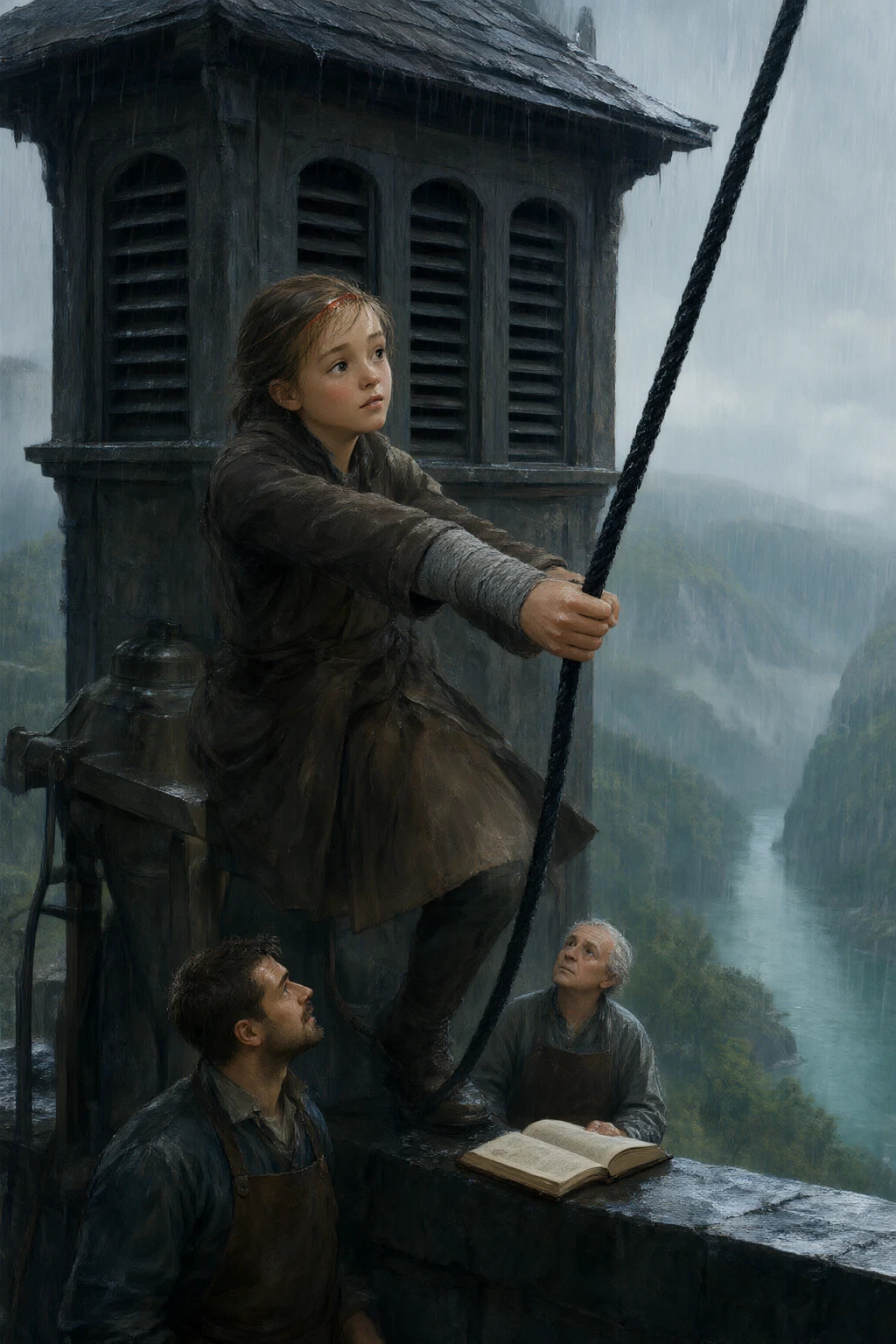
Odo Marrack got hold of her at the tram wharf on the Thursday, in the rain, with his black felt hat streaming and his left hand inside his coat. “Seventh casting,” he said. “Night pour. Are you standing it?” “I have never seen a night pour.” “You have never seen a night pour,” he agreed, “which is a different kind of education from never having been paid for one, and I am sixty-seven and I do not intend to spend my winters in a counting house waiting for the water in the pit to come back up to temperature. So here is the trade. You get me up that stair in the dark on the strength of a promise. I get told afterwards, by somebody who was not in the shed, whether any of it was true.” “That is not a trade, that is a subscription.” “It is a subscription,” said Odo, “and I have kept every paper in this town for fifty-one years.”
What they were pouring on the seventh casting of that autumn was a river bell. That was the whole of the town’s problem and it had a shape by then, and the shape was this: the Corrach rises in October and the low cottages at Bream Gill go under first, and the wharf goes with them, and the gravel in the gorge moves a hundred yards in a night twice a year, and the only warning Gethin Bell possessed was a fire bell with a three-inch seam in its shoulder that came out an hour early, which is no use at all to a man who is asleep in a house that is about to be a channel. “We asked in nineteen ninety-six,” Perrin Wadry, the smith at Bream Gill, had written, “and again in the spring, and we were told we were not a parish.”
The mould was Tamsin Lowe’s. She had cut the flaw herself at the lang bench, three weeks earlier, in the cold, with a candle-end of a trowel, and the seam it needed was a seam that would carry a voice over distance — a seam that took the moulder’s own voice, that is to say the intention, and threw it four miles down a wet valley until it landed in the ear of a man standing on a dark stair in Bream Gill who could not see the sky and would not know to go and look. “Do you know what you have cut?” Nan Ilva had asked her, that afternoon, standing at the bench with the candle-end of her own trowel resting on the frame. “A seam that carries,” said Tamsin.
“You have cut a seam that carries. Whether the bell can do anything with it is a question for the pour, and I do not know the answer, and I have never once pretended to know the answer in advance in twenty years at the ladle.” Nan pushed her sleeves down over the burn on her wrist. “The ladder is in the sand. It is the same ladder I have seen since I was fourteen. Nobody in this shed can read it and everybody in this shed can see it, and I will tell you the thing nobody tells you, which is that the ladder is the moulder’s handwriting and it is the only writing in this town that cannot be edited afterwards.”
The shed at dusk in the last week of October is a low black room two hundred and forty feet long with a roof of wired glass gone the colour of tea, and every conversation in it stops inside one second when the ladle comes out, because that is the arrangement the building makes with the people inside it. Odo came at six with two mugs of the barley drink the foundry drinkers insist is medicinal and a bag of oatcakes wrapped in a wet cloth, and he sat down on a barrow with his hat in his lap, and he did not take his coat off, and he watched the pit mouth the way a man watches a fire he has slept in front of. “You are going to tell me about the two,” said Ebba.
“I am going to tell you about the one I am not going to tell you about, and then you will guess, and your guess will be better than the one I would have told you.” “That is a trick.” “It is thirty years of practice,” said Odo Marrack, “and it has never once been the same trick twice.” The furnace was banked at eleven hundred and up, and Nan Ilva gave the night out loud for the shed the way she always did, and Tamsin took the mould down the pit stair on the barrow with the tread taken off it, and everyone who could fit stood on the landing, which is the one place in the building where you can see the mould and stay out of the splash path. The mould went in black and wet and cold, the stream came through the pipe in the wall and made a sound like a rope being pulled steadily, and Verity Ash was on the landing with a brass gauge, taking the reading she had come for.
“I would like it noted,” said Ebba, “that this is the seventh casting and there are four bells in the tower and I have been told what the new one is for, which is the river, and I would like to say it out loud so that there is no mistake later.” “There is never no mistake later,” said Tamsin, “but not about this one.” The pour began at twenty past two in the morning. The metal comes out of the ladle at thirteen hundred and the gauge went off the top of Verity’s scale and she wrote ZERO, SCALE EXCEEDED, and laughed once, in the middle of the hottest place in four counties, which nobody remembered until years afterward and which everybody agreed afterward had been the wrong thing to do. One hundred and forty seconds. Ebba counted them out loud on her knuckles, which is what everyone in the shed does and which nobody has ever asked her to stop doing.
Here is what Ebba Roke saw, and it took her thirty-one years to be able to say it in a room with more than one person in it. The ladle came down to the lip. The metal went in. The mould filled, and the surface of it came up level and turned from white to orange to a red that is not a colour there are names for in a foundry, and it came up to within an inch of the cope and stopped, and the steam came up past them all and the stair landing went white. And in the fourth second, with the metal still moving and the pourer still tipping the ladle and the whole shed bent forward over the throat of the pit, Odo Marrack said, in the voice of a man reading out a gauge: “It wants to be obeyed.” And Nan Ilva, at the ladle, thirteen hundred and holding, said: “It wants to be obeyed. Thirteen hundred, and it wants to be obeyed.”
Nobody could afterwards agree about the order of those two. There were eleven people on that landing and six in the shed behind them and the tram drivers coming up the hill with the last load, and in forty years of asking about it, Ebba has never found anybody who will swear to it except herself, and she is the one person in Gethin Bell with no reason to be believed, because she is fifteen, and because she wants so much to have been in the room that her wanting has been running her ears since she was twelve. What is not in dispute is that the founder repeated it. That is what makes a flaw. You do not get a flaw by saying something. You get it by saying it to somebody who believes it, and having it written in a book, and after that the bell keeps to it forever and cannot be argued out of it and cannot be renamed.
Nan Ilva had said it once, to a landing of eleven people who all believed it, at the fourth second of the pour of the seventh casting, and the shed had gone on making the noise it makes, and nobody had stopped it, because you cannot stop a pour, and because a founder does not pour a hole. Tamsin Lowe went down the pit stair in her socks and put her hand flat on the mould after the sand was knocked off the top, and the seam she had cut in September was there in the bronze, three inches, dull red where she had opened the metal with the file and refused to polish it back. “It is in,” she said. “It is in and it is the right one and it is the wrong one. It is three inches and it is a dead seam. It is a mark on the bell that says a thing about the bell that is not true, and it will be the only thing anybody can read on it.” “Then it has two flaws,” said Perrin Wadry, who had come in from the wet at midnight without knocking and was standing at the top of the stair with his hands dripping. “And the rule says one.”
“The rule says one capacity,” said Nan Ilva, from the lip, where she had not moved, and where her voice had gone flat in a way that Tamsin had heard exactly twice before in twenty months. “Your seam is not a capacity. Your seam is a scar with your name filed into it, and the scar is a thing that every founder in four counties will be able to read for the next two hundred years, and they will read it as a seam cut to carry a voice over distance, and they will be right about the shape and wrong about everything else, and there is not one thing in this shed or this valley that I can do about it.”
Verity Ash asked for the room to be quiet, which took a while, and then she asked a question that turned out to be the entire problem. “What is its purpose?” she said. “Not its flaw. Its purpose. The book is one line: one bell, one flaw, one word for what it is for, and there has to be a word, because a bell in a headstock is a bell only when somebody knows what it is ringing for. If the flaw is that it wants to be obeyed, then obedience is not a purpose. A purpose is a thing somebody can be doing when they hear it. So what is this bell for, and who is the hand on the rope?” “River,” said Perrin Wadry. “River,” said Ebba Roke.
Then the shed had the argument, and it is worth saying that the argument was not stupid and that everybody in it was sincere, and that the flaw of this town is that both of those things are normal. The river bell wanted to be obeyed, and the river was the need, and the obvious motion was to write RIVER in the book on the morning of the Tuesday and have it hung by the Wednesday and be finished. And Aldous Crenn was on the landing at twenty past four that morning with the casting book in a satchel, because he is the keeper of it and because a flaw named at a pour is a flaw that has to be in a book within the hour or it is a thing that happened in a shed and not a thing the town did, and he put it on the step, and opened it to a clean ruled line, and uncapped his pen.
“What is the word for the purpose?” he said. Nobody answered, and that is how it happened, and afterwards nobody could decide whether it was a silence or a decision, and that is a thing Gethin Bell is extremely good at. “The book says, in the hand of Ferrow—” began Aldous, and then, for the first time in forty-one years, he finished the sentence himself, which is that there is nothing in it, and he capped the pen, and he did not rule the line, and he put the book back in the satchel and carried it out of the shed with the lamp still burning on the open page.
That is what left the bell open, and Odo Marrack said so later, and nobody has ever been able to prove him wrong. A bell whose flaw has been named but whose purpose has not is a bell with nothing to hold on to. It cannot be rung for the fire, because it was not cast for the fire. It cannot be rung for the dead. It cannot be rung for a wedding or a school or a curfew, because the flaw serves the purpose and the purpose is not written down anywhere. It can be hung, and it must be hung, because a bell out of a headstock on a yard is a heap of bronze and cannot be heard at all — but hung, and waited on, and rung, and it will do whatever the first hand that rings it intends, and it will go on doing it for the rest of its life, because a flaw named and believed and written cannot be renamed.
“It is a general bell,” said Perrin Wadry, in a voice of pure astonishment. “It is the first general bell in four hundred years.” “It is a bell with no name on it,” said Tamsin, “and those are not the same thing, and one of them is a gift and the other is a hole with a bell hung over it.” In the hour after that, while the cooling metal was still ticking in the sand and the water in the troughs was going brown, Tamsin Lowe washed the bronze out of her eyebrows and sat down on a barrow and said the thing she had been not saying since two o'clock in the morning. “I cut it because I liked it.” Nobody pretended not to know what she meant.
“So which is it meant to be?” she said, to the room, to Verity, to the seam. “That is my question. That has always been my question. A river bell wants a seam that carries, and a seam that carries is a hard seam, and a hard seam is a beautiful thing to look at in a pattern, and I have been at this bench for four years cutting the ones I liked, and the difference between the ones I liked and the ones the town needed has not cost anybody anything yet.” She wiped her hands on her apron and looked at them. “It is costing somebody now. It has been costing somebody since eleven forty tonight. The metal took the thing I gave it and left my seam in as a note to the next man, and the next man is going to read the note and believe it.”
Nan Ilva sat down on the end of the barrow, which she had not done in front of a bench in nineteen years. “A moulder who cuts the flaw the town needs is doing the second-best thing in the trade,” she said, “and a moulder who cuts the one he likes is doing the first, provided he can say out loud, in daylight, in front of the founder, which of the two he did, and provided it is written down afterwards. The liking is not the fault. The not saying is the fault.”
There was a vote. Nan Ilva allowed it, and the vote was a vote of who would put their hand on the rope first in a wet belfry at dawn, and every hand in the shed wanted it, and every reason was a good one. A man who wants a general bell to change what people do is a man who is about to find out what a bell can do. “It will be whatever the first intention is,” said Verity. “That is not my figure, that is arithmetic. The first strong intention on the rope, awake, meaning it, on a bell with nothing written, and after that the book says the same thing and the bell has no opinion. I have surveyed this valley for eleven years and I will tell you the one thing I know about it. There is no such thing as a small intention. There is only an intention and a bell that will do all of it.”
Nobody in the shed had ever heard Verity Ash make a statement without a figure in it, and none of them could think what to say to that, so they all looked at the stair, because Perrin Wadry was standing at the bottom of it with his hand on the newel, soaking wet, from a settlement the book had never heard of, and he had said one word in a shed at midnight — river — and did not know yet that he was about to be talked out of it.
Ebba Roke was the youngest hand on the ropes in the Cloth Hall tower. She had been the youngest hand for two years. She was not allowed the fire bell, and the town had been careful for three years not to explain why, and the reason was in the parish minutes in a hand nobody read: a named hand on the rope, awake, and intending, and a fifteen-year-old on a ladder in the dark is a person who is asleep by the third stroke, and the whole valley hears a half sound as a mistake and cannot explain it. The rule is about the hour. It is not about age, and that was the discovery that made her put her hand out, and she made it at six in the morning on a wet stair in front of eleven foundrymen and a founder, and she said it out loud so that there would be a record of her having said it.
“A named hand,” she said. “Awake, and intending. It says nothing about how old the hand is. I am awake. I am intending. And you have all spent five hours deciding whose intention you trust, and every one of you has an interest, and the only person in this room who does not want the bell to be anything is the person you have been not letting near it.” “That is a very good argument,” said Nan Ilva, “and it is not the reason.” “No,” said Ebba. “It is not the reason. The reason is that I have never been given a rope.”
The belfry was cold enough in October that they could see their breath, and the wind came sideways off the moor and made the louvres tick, and outside the sound of the rain going through the tower frames was a hundred small ringing noises, none of them a bell, and Ebba had heard them since she was seven and had never told anybody what they were. The new bell was on the headstock at the end of the day, smaller than she had expected, with Tamsin’s seam up on the shoulder in dull red and the file marks still in it, and the crown stripped back, and bronze gone the colour of a wet stone. The four old bells stood round her in the dark. She knew their order without looking: the small one at four hundredweight for the school and the curfew, then the second, then the tenor, and then the fire bell with the seam that came an hour early and the second that had no bottom to it. “Right,” said Ebba Roke. “That is the river.” And she pulled the rope, and the bell said yes.
It was not a scream. Everyone who has ever heard it has gone back to it to find a better word, and the best they have managed is that it was a voice. It came out of the belfry and went down the hill and out over the Corrach and did not stop at the parish boundary, because no bell in Gethin Bell has ever stopped at the parish boundary. It went past the tram wharf and past the lime yard and down the river road to Bream Gill, and Verity Ash, standing on the tower floor with the watch in her hand, wrote a time on her cuff because she could not find the notebook, and the time was four seconds, and it is the only figure she ever took of anything that was not the air. In the smithy at Bream Gill, Perrin Wadry put his hand flat on the anvil and turned round and looked up the hill, and at eight cottages in the parish and nine houses in his own village and forty-two at Dykefoot, people who had not expected it looked up, because the whole of the Corrach valley had known for six years what a river bell was for. And it stayed that way. That was the part nobody in the shed had a word for and everybody understood inside a week.
It was not that the bell could not do anything else. It was that the bell would not. Whatever hand was on the rope, whatever hour, whatever the occasion, the thing it wanted was the river, and it did that, and it did it the way the fire bell does the fire, without any opinion about who was asking. A man rang it on a Tuesday for no reason at all and the valley heard the Corrach coming. Somebody rang it in June and the valley heard the Corrach coming. It rang for the school in the morning and the school came in early for four days until the parish understood, and the parish asked for it to stop, and Aldous Crenn wrote a line in the book — CORRACH — in a hand that was steady and very small, and the bell went on doing the only thing it had ever been told, for the rest of its life, exactly as the town had always said it would. The town got its river.
So the seventh casting has a line in the book with RIVER on it, and the moulder has a dead seam in her bell that everybody in four counties reads as carrying a voice over distance, and the founder has a paragraph in a pit book that says that the metal came out at thirteen hundred and the word was written in the morning and not at four in the morning, and the clerk has a night in 1971 he can talk about, and the town has a bell it asked for and did not design and got anyway, in the rain, at six in the morning, from a fifteen-year-old who has never been permitted the fire bell and who was permitted this one because the town ran out of hands to object. And the only person in Gethin Bell who knows that the bell was not the town’s to decide, and never was, and had an hour in which somebody who was not a founder said the words first and a founder heard them and repeated them into the hearing of eleven people because you cannot stop a pour, is fifteen years old and says it in her sleep, because she counts.
She did not tell them for a long time, and this is the part she can explain and the part she cannot. The argument in her, in October, at fourteen, was not honesty. It was this: if she said that Odo Marrack said it first, then the seventh bell in the town’s history was given by a retired founder with two fingers missing who had told the story of his two given flaws to so many people that the story had grown a third one nobody could account for, and every man in the shed would spend the next fifty years being asked whether the greatest bell in the valley came out of a man’s mouth instead of the founder’s, and there would be no answer, because a flaw is named by what the pourer repeats. So she kept it. And then, slowly, it became a third story, and she could hear it being told, and she understood what Odo had understood at the lime yard thirty years before her, which is that a thing which is only talked about gets bigger, and a thing which is written down can be read.
She told Verity Ash, in the end, and she told her on a Thursday in the counting house with the book on its lectern and the brass lamp on its swing arm and the sound from outside having to be guessed at, and she told it in one paragraph, flat, with her right hand held open on the table so that the grey wool was visible, which she had never done in front of anybody. Verity wrote it down. Then she put the pen down and said: “That is the first sentence I have written this year that is not a figure, and I am not going to rule it through, and it is not the book, and it will not be the book, because the book holds bells. It goes in the survey, in the front, where anybody picking the thing up will see it before they read a single reach.” “Will the town ever read it?”
“No,” said Verity Ash. “But it will be in the room. And that is not nothing, and I would like it minuted that I have said so, because I have spent this entire year answering questions with numbers and I have only just worked out that a person can do the opposite and still be a surveyor.” That was in the spring. The bell went up the hill on the last clear day and was hung in the third week of May, and the tower is cold in August, and the four old bells are on the wheel and the fifth is on the headstock, and the seam on the fifth is dull red and three inches long and filed visible by a founder who refused to hide it. And in the last week of October, in the wet, the Corrach came up over the wharf at Bream Gill and put eleven inches of green water through the front room of the lowest house, and Perrin Wadry was awake, because he was on the rope that night, because the rota says so, because his name is on a board in chalk in a cupboard in the Cloth Hall, which is the only document in Gethin Bell that nobody has ever pretended was old.
Nella Wadry was in the front room with her aunt’s ring on a string round her neck and a lamp, and the water came in and she put it out, twice, in a bowl, for forty minutes, and the bell said the Corrach was coming and the bell said it an hour early because a bell in Gethin Bell cannot do anything it was not made to do, and at the fourth stroke Ebba Roke, on the landing, in the dark, awake, intending, said out loud, in the way that she could not stop and has never been able to stop: “That is the first of three. That is the second of three, and there is no holding stroke in the second. That is the third of three, and that is an hour early, and it is the hour of the river, not the hour of the bell.”