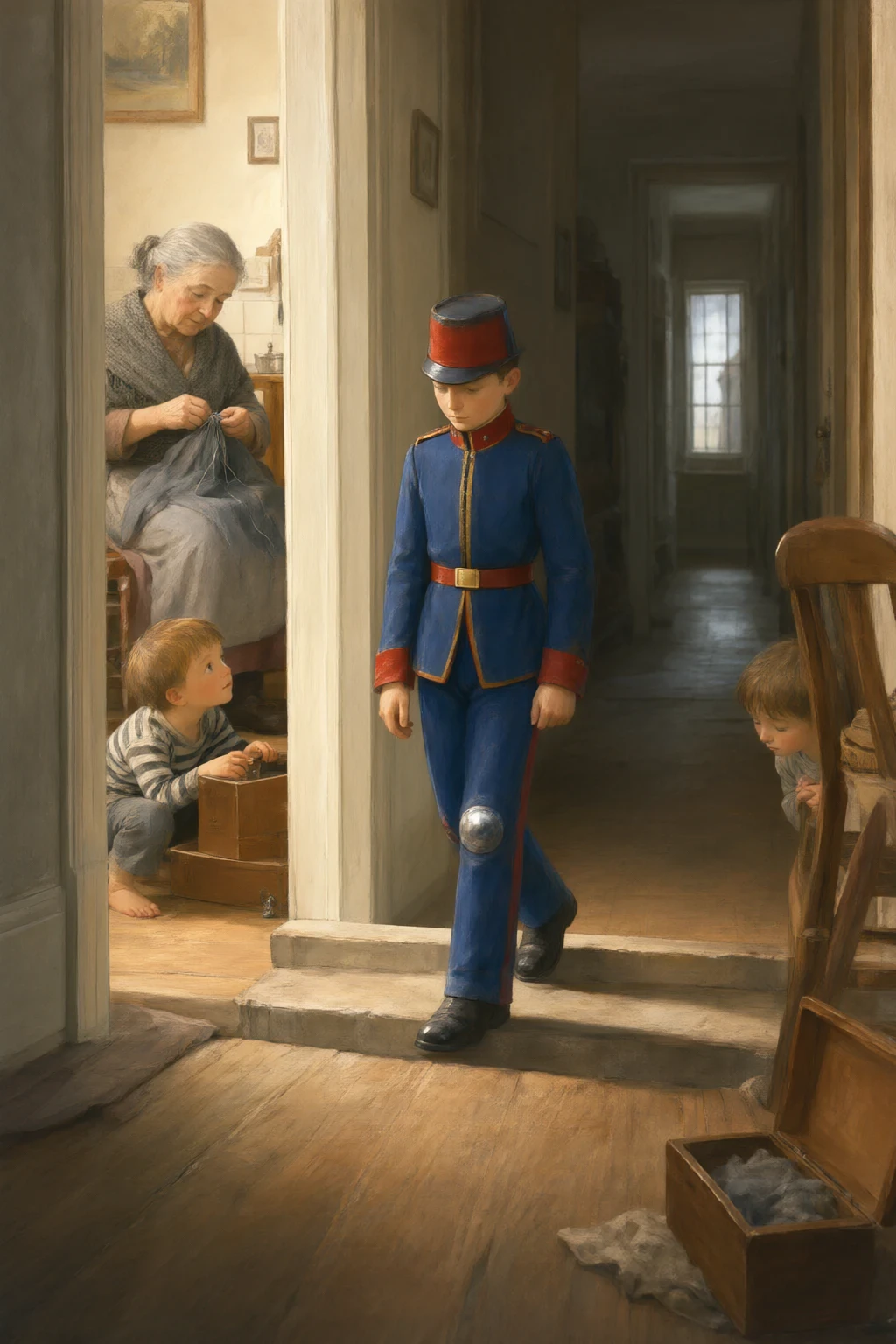
There were twenty-four tin soldiers on the nursery shelf, and all of them were the same size, and Nils had named every one of them, and none of them were allowed to move. Number One was the general. He had more gold than the others and stood at the front and had never once been told to do anything. "You don't do anything either," said Nils. "I watch," said the general. "You watch what?" "The shelf," said the general, and went back to being at the front.
The soldier Nils was holding was the fifteenth. He had come out of the tin in a long box with nineteen others and he had been on the shelf for two years and he had counted them every single night, which is two hundred and thirty times a night, which is a number he had no use for. "How many of us are there?" Nils asked him. "Twenty-four." "And what do you all do?" The fifteenth soldier thought about it for a long time, in the way that tin does. "Nothing," he said. "We're a shelf."
On the third of March a box of cardboard castles came down, and the soldier went off the shelf with the castles, and he went across the boards and off the edge and hit the nursery floor and his leg snapped off at the knee, clean, in two pieces. Nils picked him up in pieces. He put him in a matchbox and took him downstairs, because he was frightened to leave him. Grandmother was mending a cuff. She looked at the soldier for a moment and then said, "Well, you have brought me a job," and she did not laugh, which was better.
She heated the head of a tin teapot with a candle until it was soft enough to press with a thumbnail. She cleaned the break with her own clean hankie. She fitted the leg into the leg, and she pressed a flat rivet through it, and she tapped the rivet flat with the back of a spoon so it sat like a small silver button. Then she turned him over and did the same thing to nothing at all, just to be sure. He stood up on the dresser and took a step, and then another, and he did not wobble. "You are fixed," said Grandmother. "Properly. That will hold." "Thank you," said the soldier. "Two days' work, mind," said Grandmother. "I have done two days' work on a leg."
Nils put him back on the shelf, in his place, in the fourth row. And the soldier stood there and looked down the length of the nursery floor at the doorway. "Nils," he said. "Nils, I have been on this shelf for two years and nobody has ever asked me for anything." "You count." "I count. I have counted the shelf two hundred and thirty times a night and nobody has ever needed to know." He was quiet for a moment. "I would like to be somewhere a person has to walk past." "There is no soldier on the kitchen door."
"I know," said the soldier. "That is why I would like it." So Nils carried him down in both hands, and set him on the inside of the kitchen door, facing the hall, with one foot on the boards and the other on the kitchen side, the way a person stands when they are looking out.
The first night, nothing at all happened, and Nils was disappointed, and went to bed. The second night, his little sister Ruth came out of the room they share in the dark, the way she did most nights, because the hall between her bed and the kitchen was long and had a window in it and the window did not stop at the window. "Nils," she said. "There's something in the hall." "It's a soldier." "I know it's a soldier. It's stood there since Tuesday. It's just that when I come out at night I didn't know before, and now I do."
Nils told her about the shelf. He told her about the box of castles and the leg and Grandmother's two days' work and the rivet that sat like a small silver button, and Ruth listened in the dark, sitting on the bottom step with her knees up. "You can ask him something, you know," Nils said. "He can't answer. He hasn't got a mouth that does that. But you can ask."
So Ruth asked. She asked whether the kitchen was always cold at four in the morning, and whether the cat was allowed in, and whether Grandmother had ever lost a teapot. And the soldier could not answer any of it, and did not move, and stood with his shoulder to the door and his eyes on the hall, and Ruth answered her own questions out loud in the dark, which is a thing that is known to work.
Nils ran out of ways to think about it, so he took a stub of pencil and made a small mark on the door frame every morning, one per night, low down where a grown-up would not look. In February the marks had gone round the corner. Nils measured his own height against them in June and found that he had grown, and he was a little sorry about that, though he could not have said why. Ruth stopped needing the walk down the hall. That happened on a Thursday and nobody noticed it happening except Nils, and he did not tell her, because she would only have argued.
The summer came and Nils was nearly tall enough to be a nuisance to his mother, and one evening he stood in front of the soldier on the kitchen door and picked him up. "Off the shelf and back on the shelf," he said. "You're not needed in the hall any more. Ruth doesn't do it." He got as far as the bottom stair before he stopped.
There is a long hall inside their house with the front door at one end and the garden door at the other, and a window on each side, and the light that comes in it in the morning goes all the way from one end to the other, and there is nothing in it at all. Nils carried the soldier back to the kitchen and set him down on the outside step, half in and half out, looking east, where there was more room to see.
"There's more that way," he said. "There's the whole road and the field and the wood. And if Ruth ever needs the hall again, I'm not the one she has to ask, she can just walk past you and say good evening." The soldier had been made in a shop by somebody who stamped the base and soldered the arm and painted the eyes and never once asked what he was for.
He was on the step for a long time after that. The paint went duller on the sun side in the first summer. The little silver rivet stayed bright, because it was newer than the rest of him, and Grandmother never rubbed the tin and would not have let anyone else do it, and every Sunday there was a clean cloth and a Sunday job that neither of them mentioned.