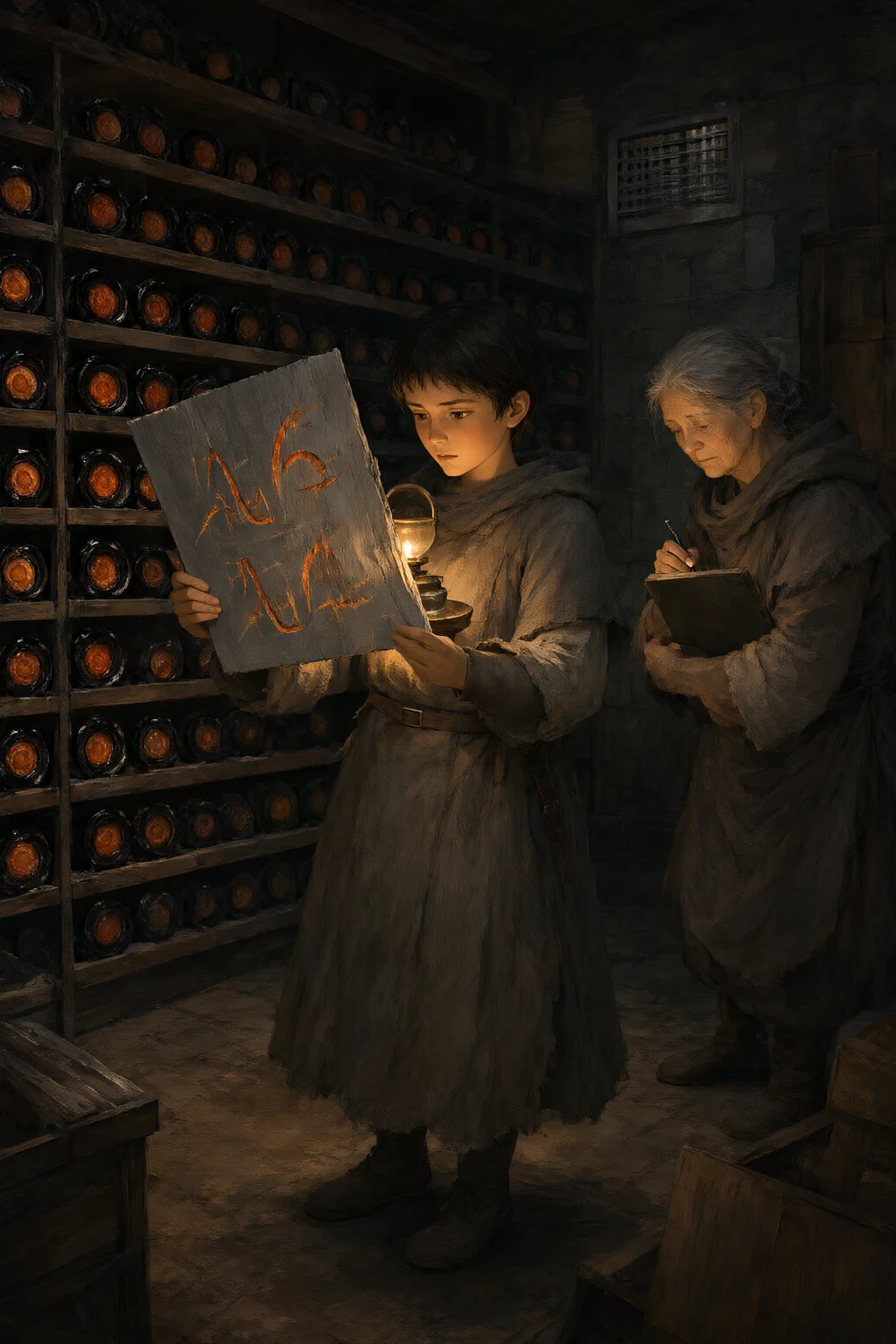
The House of the Quiet Ledger is one room under the terrace and it is the coolest place in the caldera, and Ashara Venn had been told twice in her life that it was the coldest, and had thought both times that this was a strange thing to be proud of. “You are early,” said Sister-Iven Carshal, without looking up. Ashara stood in the doorway with the copying slate under her arm and the linen cuff of her left sleeve pulled down over the fresh comma on her forearm, and she forgot to lower it, as she always did. “Apprentice Venn, for the noon reading. I want the founding index.” The stylus stopped. She was in her sixties and her eyes were grey and had gone hazy at the edges, and after a moment she brought the stylus out of her left sleeve, which she did at exactly the moment a thought arrived at her, and turned it over in her fingers.
“The founding party list is not a list, it is a leaf,” she said. “A leaf cannot be copied. It can be read, aloud, in this room, with witnesses. You have a slate, and this room, and me, and the three are not the same as a witness, and I would like to hear you ask for it properly, in the grammar, because the grammar is not decoration. It is the only reason any of this is still standing.” “Apprentice Venn proposes that the Keeper of the Quiet Ledger read the founding leaf aloud in the presence of the Sister of the Second Course, at the noon bell, and that Apprentice Venn copy it.” The wince went round the room before there was anybody in the room to wince. The doing-it-it-self, the borrowing of the council’s grammar by a girl of fourteen in a dead girl’s job, was the thing the senior keepers could never get used to, and she had stopped apologising for it about a year ago. “Proceed,” said Sister-Iven Carshal. “Noted.”
The founding leaf came out of its box on a board of two hands’ width. It was not vellum. It was ashboard, an inch thick, cut on one edge and bound along that edge into the chain of leaves that make up the founding instrument, with black cord through eight holes. Where a ninth hole would have been, if the cord had gone that way, there was a hole anyway, drilled and never used. “Seven cities,” said Sister-Iven, “and a hand held apart. That is what the leaf says. Read it.” The line was this: sworn in the founding year by the First, the Second, the Third, the Fourth, the Fifth, the Sixth and the Seventh, and by a holding hand not otherwise named, that the flame fail not, the measure fall not, and the promise hold to the end of the thing promised. “Eight entries. Seven cities and a hand.”
“Eight entries. And no name against the eighth. There is a shape cut into the wood where a name would be. It is not a letter and it is not a cut-out. It is deeper than the letters around it, and the same depth as the date, and cut with the same tool.” The first time, Ashara copied the leaf straight across and the copy read Toval Renn of Winterlow, a bar, sworn the founding year, discharged the ninth. She read it out and Sister-Iven said, “Noted,” and wrote it into the day’s book in the square hand, and Ashara was already copying the next line when she noticed that her own left hand had gone cold. The index said: Toval Renn of Winterlow, a bar, the founding year. And in the same hand, in the same line, it said: the party of the holding hand is entered above; the bar of Winterlow is the bar of the holding hand; see the leaf.
Then she did the thing she always did. “The founding year entry is sound. The carving is deep and even and it is in one hand and one tool, and I have had it under my own eyes for thirty-one years.” “Two paragraphs ago you told me there was a shape cut into the wood where a name would be.” “There is. It is very deep and it is not a letter.” “The shape is the same depth as the date.”
Ashara did not go and do the copying. She got a lamp instead, and put it low on the shelf almost level with the board, and asked Sister-Iven to turn the leaf on its edge and hold it, and looked at the eighth entry with the light running along the wood at almost nothing, the way you look at a field from a low sun to see what the ground has done under the crop. The letters of the founding year stood up in a thin ridge, all of them, T-o-v-a-l R-e-n-n, and they were shallow, a little proud and a little raw, with the grain standing around them. Underneath the shallow letters there were other letters. Deeper, wider-spaced, cut with a heavier tool by somebody who had not been worried about grain, because grain was not a problem yet on the day that was cut. Four letters and a surname. H-e-s-s-a R-e-n-n. “There,” said Ashara. “Sister-Iven. The leaf has been cut twice.”
The room was very quiet, and then the ash hissed in the wall vent, twice, and neither of them looked at it. “Noted,” she said. “You cut it.” “I did not cut it the first time.” “You cut it the second time. Sixty years ago. And you kept the index.” “Then why.” She was quiet for a while. When she answered she did not look at Ashara, and she looked at the lamp, which is a thing you have to be careful about, because the Keeper of the Quiet Ledger looks at everything except the person she is talking to when she is about to say the true thing.
“Because a bar cannot be sworn by a child. The flame does not take. There is not one entry in this room of a person under fifteen taking a bar, and there is a good reason, which is that paying is not something you can swear to until you understand what a thing costs. So the flame refused her, correctly, and she was nine, and the clerks had a leaf with a hole in it, and the Seven Chains wanted a bar out of Winterlow because the arithmetic of the founding would not close without one.” “Whose bar was it?” “Her father’s. Toval Renn. He had died in the winter before the founding. He is in the ground outside the village wall under four cairns, because that is where the covenant puts the people it has no standing over. I have never seen the grave. I have read about it four times this morning and I have not yet gone out of this room.” “So they wrote the father’s name on the father’s bar, and the flame refused, and the entry was paper.”
“Who held the book,” said Ashara, “when the page was torn out.” Sister-Iven Carshal did not pretend not to understand. “Four hundred years ago a man proposed taking the brands. Not a fraction. The brands. He got as far as a page in this room, and the page is still here, and the names have been torn out of it, and I was a junior keeper in the year it happened and I was told to hold the book, and I held it, and nobody told me what was happening, and I have not asked in fifty years and nobody has offered.” “That is not what I asked.”
“No. It is not.” She turned the stylus a half-turn. “What you asked is whether I would do it again, and the answer is yes, and I would like you to understand what that means, because if you are going to spend your life in this room you had better get it right the first time. Yes. I would re-cut that leaf. A child’s oath is not an oath and a dead man’s is not either, and the chain needs a name it can put a finger on. I have kept the index. I have never destroyed anything. I have made one correction to one leaf in thirty-one years as Keeper, and I made it at twenty-three, and I have told nobody until today, and I would do it again tomorrow, and I have not slept properly about it since about the year my teeth came in.”
Winterlow is three days out past the cairns, on ground where the covenant has no standing and does not pretend to. “The cairns are the boundary,” he said, on the first afternoon, when the ground went from black basalt to grey unburned pumice. “Anything past the last one is outside. No flame, no fixture, no enforcing. If somebody breaks a promise out here, it stays broken and it is only a story by morning.” “Then what happens to them?” “Nothing. That’s the point of it. Which is why nobody out here has ever signed anything.”
Marda Toln was eighty-one and she kept the wall. “You are the girl with the cuff,” said Marda Toln. “Yes.” “You have a fresh one.” “Then you will want to know about Hessa. Everyone comes for Hessa. Sixty years is a long time for a nine-year-old to be nine.” “She is not in the record.” “She is not in the record,” Marda Toln agreed, “because they wrote her father’s name on her. Which is a thing you could forgive a clerk, because a clerk is a man copying out what the man in front of him says. But it is not a thing you can forgive after sixty years, and it is not a thing you can forgive twice, and the second time it was a keeper with a stylus, and I know that because the wall says so.” “The wall says so?” “The wall says everything. Come and look at the ninth year.”
The ninth year was in the middle of the wall and it was the only place where the charcoal was thick enough to need two passes, because Marda Toln’s great-grandmother had gone over it again, later, with a heavier stick. It said: the bar of Winterlow is discharged in the ninth year. No coal, no salt, no glass. The chain says the debt is paid. We say the debt was struck out. Toval Renn is in the ground outside the wall. There was nothing to pay with. We gave them Winterlow instead and they gave us the quiet, and the quiet is the whole of what we got, and we have kept it. “They wrote us out,” said Ashara. “That is the discharge. They did not pay you. They removed you, and the removal is the payment.”
“That is the reading of the Ninth Course and I am not a Course.” Marda Toln looked at her own wall with the flatness of somebody looking at a hedge they have pruned. “There is another reading and I do not think it is the right one, and I have thought about it every year for sixty years, and I will give it to you because you have brought a candle and not a magistrate.” “What is it?” “They did not write us out to save themselves. They wrote us out because the debt was ours and not theirs, and the debt was never theirs at all.”
“Toval had been the one who took the glass,” said Marda Toln. “Not the covenant kind. The kind that comes up in a bad year when the mountain is awake, out of a crack four days east where there is no master and no grate and no keeper and no law about it. He took a double handful in the winter he died, on the way home, in his coat, because the year was bad. And Hessa was with him because she was eight and it was three days of road. And the covenant’s keepers found it in the coat, or found that the coat had been in a house that had it, or were told, and the founding year came round, and the Seven Chains wanted a bar to close the arithmetic, and Toval was the only man in the plain who had ever held any of it, and he was in the ground.
“They wanted the debt off Hessa. A child of nine cannot swear a bar, the flame would not take it, and they knew the flame would not take it, and they did it anyway, on paper, under her father’s name, and they made the plain pay for the glass that went up a woman’s chimney in a bad year.” “So Winterlow did not write itself out.” “Go on.”
“When a debt is struck out, the struck-out party is not owed. When a bar is sworn, the swearer is held. Hessa’s bar was never sworn and it was never discharged, because a bar that was never sworn cannot be discharged, it can only be written off, and written off is a different word, and it is in your index and not on your leaf.” The old woman looked at the black wall, all six hundred years of it. “So there is a bar in the founding instrument with nobody under it. It is not Hessa’s. It is not Toval’s. It is nobody’s. It is a promise to pay, sworn in the founding year, on the founding leaf, in the founding hand, and the person who made it is not named on any page in your house, and I have known that for forty years and have told nobody, because who would I tell.”
“Apprentice,” he said. “The wall is not a witness. A wall is a wall. I know that, and you know that, and I am saying it out loud so that when you write it up you will have to write down that a courier said it first.” “Then what is?” “A thing somebody wrote. Four-Fifty is a number. A number is a thing somebody wrote.”
Sister-Iven Carshal had the founding leaf out on the board again when Ashara came in, and she had cleared the front of the desk, which she did not do except in winter. “Apprentice Venn proposes,” said Ashara, “that the record be answered, not altered. A second leaf, sworn, sealed, laid in after the founding, carrying the true name and the reason. And that the Keeper countersign it and be answerable for it.” “I think it costs the Measure. A correcting entry on the founding record has to be burned for, because everything that goes into this room goes in through the flame, and the flame is fed from the cup, and the cup is the vein under the vent cone, and the number this year is low.”
“Noted.” Sister-Iven Carshal brought the stylus out of her sleeve. “Then here is the arithmetic, and it is the only arithmetic I have ever been good at, so attend. First, the record cannot be altered and you are right. A leaf carved twice is a leaf that can be carved a third time and a fourth, and in eighty years there will be a clerk with an opinion. So the correction goes on its own leaf, sealed with the chain-die, laid in after the founding, and it states the truth, and it states the name of the person who made the first correction, which is me, and the year, which is this one, because I did not write it down sixty years ago and I am not going to start.” “And second?”
“Second, the bar is still there. It has been burning six hundred years off nobody, and a promise to pay that nobody can pay is a hole in the arithmetic of the founding, and the founding arithmetic is what the whole chain stands on. You cannot close a hole by writing the name properly. The hole is the size of a debt, and the debt is a Winterlow glass debt, and it is the only thing in this caldera that cannot be argued with, because it is not a matter of oath. It is a matter of a double handful of first-fire glass out of a bad crack four days east, and there is no second double handful, because there has never been a second one, because the covenant recognises one place and that place is under the vent.” “So it cannot be paid.” “It cannot be paid, and it cannot be written off twice. It can be moved. Once. In a Quiet Audit, to an heir who takes it up freely and knowingly. That is the only road, and you have known it since you were twelve.”
Tova Renn was thirty-one and she came to the House of the Quiet Ledger because her grandmother had told her to, twice, over eleven years, and had explained on the second occasion exactly what it would cost, which is a season of a life, or a decade of a life, and that nobody knows which until it is taken. “You are the heir,” said Sister-Iven Carshal. “In law and in fact, the last of the line. Your great-grandmother swore a bar in the founding year. It has never been discharged and it cannot be. If you take it up it becomes yours, held, and you will pay out of your own body, and the flame will take it because you are of an age to understand what a thing costs, and you will be able to read it on your own arm for the rest of your life, and so will everybody else.” “And if I don’t?”
“Then the bar stays a hole in the founding, and the leaf says a dead man’s name, and in about two hundred years somebody in a good position with a stylus will be offered a very great deal for a very quiet afternoon, and it will be done, and it will be done well.” Sister-Iven Carshal did not soften it and did not sharpen it. “I have been the one who would do it. I am telling you that as an argument, not as a threat. I have been that person for sixty years, and what has kept me from being it again is a rule in a book, and a rule in a book is not much of a thing to keep a person on the right side of.” Tova Renn looked at the leaf on the board for a long time. She did not look at her own arm, which Ashara noticed and afterwards thought was the most impressive thing that happened that day.
“My great-grandmother was nine, and she did not know what it cost, and they wrote her father’s name, and they have been charging a dead man for sixty years. And you have been paying for it too, you, with a stylus up your sleeve. Twice.” “Yes,” said Sister-Iven Carshal. “That is fair. Sit down, please. The Audit is read three times and the first two are for the witness.”
It came up the pale mark and out of her forearm in the time it takes to boil an egg, and the mark was a bar, and it was a good colour, and Sister-Iven Carshal read it aloud as she read all of them aloud, and then said the number it had been sworn against, and the number was small. Everybody in the room had expected it to be enormous. Ashara had expected it to be enormous. Tova Renn looked at her own arm and then at the graduated stone cup on its carved plinth and laughed, once, out loud, the way people do when the thing they were braced for turns out to be a different thing entirely. “That is a season,” she said.
“That is a season,” said Sister-Iven Carshal. “Six hundred years and a season, and the six hundred years were somebody’s life, and it was somebody’s life the whole time, and it is in the ground outside a wall under four cairns, and it has been a season’s worth of a life every year that nobody came to count. A great oath costs a season or a decade. That is the whole of the pricing. Six hundred years of a debt that could not be paid cost one person a season of her life when somebody finally asked her, and everybody in this room who was frightened of the arithmetic for sixty years was frightened of the wrong size of number.” She wrote the discharge into the day book in the square hand, and the stylus made its small dry sound in the quiet room, and the ash hissed in the vent and neither of them looked at it.
The correcting leaf was sworn the same afternoon, and Sister-Iven Carshal let Apprentice Venn hold the taper, which is not a thing anybody lets a child of fourteen do. Ashara had a bar on her left forearm that she had not asked for and had not chosen, a promise to come, and she had spent the whole day being shown, by a woman with a stylus up her sleeve, that willingness and ability are two different things and that the flame knows the difference. “Apprentice Venn proposes,” she said, and her voice went, and she let it go, “that the correcting leaf be sworn under her own hand, for a promise to pay, in the amount of the entry: that this record be true, and that whoever keeps it after her be told by somebody who was not in the room what it cost to make it so.” “Apprentice Venn does not know what she is proposing.”
“Apprentice Venn proposes it anyway, and would be obliged if the Keeper would read the form.” The flame took. The mark came up under the one she already had, a second bar below the comma, and the pain was not the pain of the first one, which had been a hot wire drawn once; this was a hot wire drawn slowly, and it went on for a count of ninety, and Ashara Venn stood absolutely still with her hand over it and made no sound, because the room was the room. When it was done she was fourteen years old and had three hairs at her left temple white to the root, and the two fingers of her right hand did not feel the taper for a season, and Sister-Iven Carshal wrote the toll in the day book against her name, because the toll is always written against somebody’s name, and then said: “Noted.” And then, four lines later, very quietly, contradicting herself, because she is that woman: “Noted. And the amount was too much. It should have been a fifth of it. Somebody always says too much, and it is nearly always the young, and I have watched it for sixty years and have never once been able to say so to one of them in the middle of it.”
The last time Ashara Venn asked for the founder’s brand, she asked it in the wrong grammar, and she had rehearsed for a month. She had a bar and a comma on one forearm and three white hairs and two fingers that would come back in the spring, and she had been an oath-keeper for one year, and the founder’s own brand was the one thing in the world she had wanted since she was eleven and had never been refused in a sentence she could argue with. Sister-Iven Carshal listened to the whole of it, badly phrased as it was, and then took down the founding leaf and turned it on its edge and held it at the lamp with the light running along the wood at almost nothing, and made Ashara look at it herself. The deep letters. H-e-s-s-a R-e-n-n, cut by somebody who had not been worried about grain, because grain was not a problem yet on the day that was cut.
“There is no name on this leaf that a person ought to carry,” said Sister-Iven Carshal. “Not the one I put there and not the one underneath it. The deepest name on the founding record is a nine-year-old’s, and she swore it on her knees in a bad year because they came to the door, and everything that has happened in this room for six hundred years has happened because a man in a cloak decided that a double handful of glass out of a bad crack was worth a village, and then because I decided to let it stand, and then because you decided to be the one who finally wrote it down. That is the founder’s brand, Apprentice. There is not another one.” She turned the leaf back and laid it down and squared it to the edge of the board, because that is what you do. “You will get it out of me someday, or you will not. I am sixty-eight and I have already decided which of the two I can live with, and it is not the one where I tell you.”