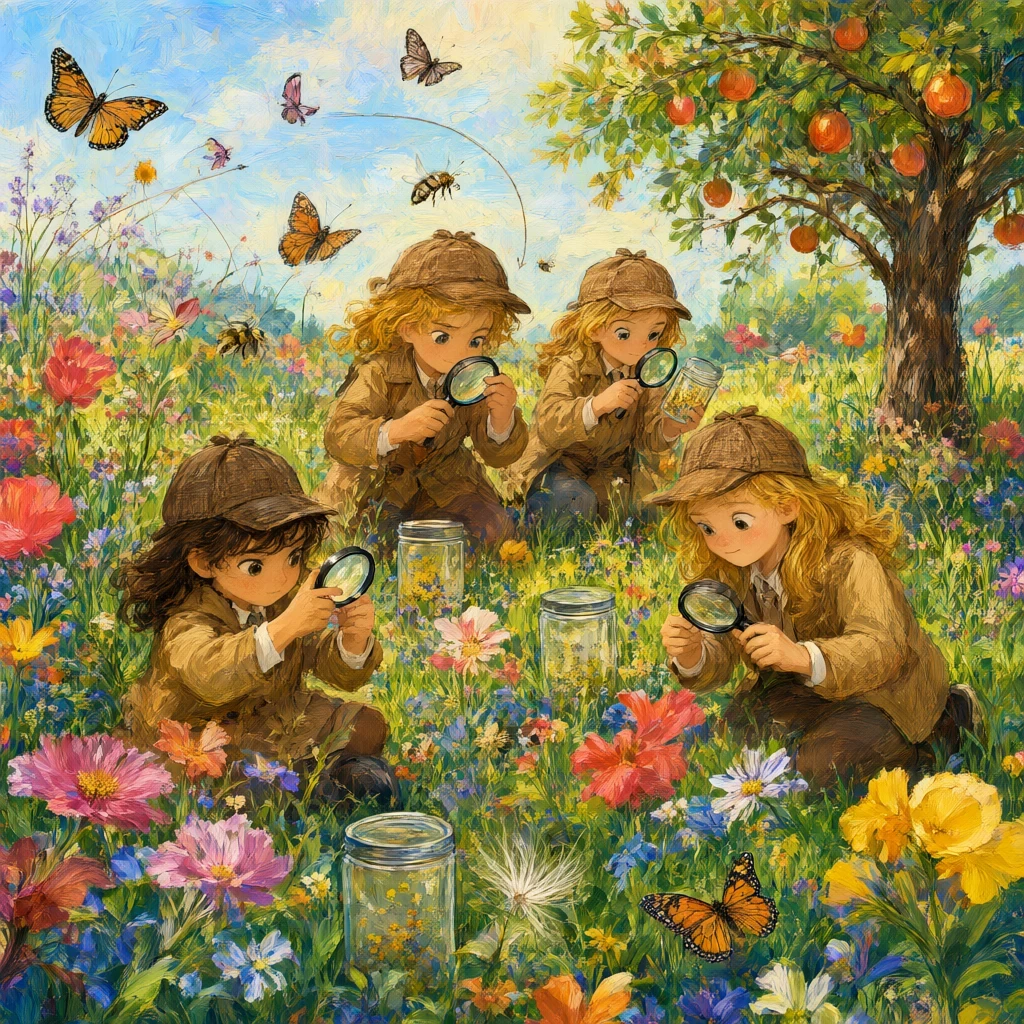
The blossom on the Ashcombe pear rows was the finest in nine years, and by the middle of June the whole valley knew there would be no pears at all. The harvest committee met under the elm and blamed the May frost, the way they had blamed the May frost the year before, and the year before that. Private grief was spreading quietly through the orchards. Some people had stopped picking the windfalls early because there were none to pick.
“You cannot know why a thing failed by feeling sad about it,” said Mr Aldis, who had kept the Rowan orchard for fifty years and had retired to a chair by the lane. He had said this to nobody, and the two cousins standing in the lane were the first people to stop and listen. “Are you the detectives?” he said. “Since this morning,” said Tobi. “Show me your evidence.”
They began with a bag, because a bag was the only honest instrument a village had. On the fourth of May, before the first bud opened, they tied three paper bags over three branches of the Rowan pear and sealed them with string. One bag stayed shut. One bag they opened every morning and dusted the flowers by hand with a soft camel-hair brush loaded with pollen they had shaken from a different pear tree, the old neglected one in the corner of the churchyard.
The third bag they took off entirely and left open to the weather. “Three branches,” said Tobi, “and the only difference is who is allowed in.” They also kept a notebook. Every hour on the hour, from seven in the morning until seven at night, they sat under the row and counted what came, in tallies, and wrote down the weather.
Bees: a hive row at the far end, but the only hives for four miles. On the first day they counted thirty-one insect visits in an hour. Hoverflies. Two bumblebees. A wasp that walked a flower without pollinating anything, which they noted, because they were writing down everything.
On the second day, at noon, the committee’s man went down the lane with a knapsack sprayer and treated the pear rows against the pear midge. He treated them for eleven minutes, in full flower, in the middle of a bright warm morning. The notebook says: one o’clock, four visits. Two o’clock, three. Three o’clock, one. At seven the next morning, nine.
“That’s the frost,” Mr Aldis said. “Or the spray. One of those two, and I know which one I would bet the chair on.” “Two causes,” said Saskia. “A notebook can hold two causes. It can hold two bad mornings and a third thing that nobody has looked at yet. That is why it is longer than a feeling.”
The bagged branch nobody touched made no pears at all and dropped every one of its tiny hard fruitlets in June. The bagged branch they dusted by hand made nine. The open branch made four. “Nine from a closed bag,” Tobi said. “Four from an open one. So the air was not doing it. Whatever made the fruit was inside the bag with us, and inside the bag there was nothing but a brush.” “And the brush.” Mr Aldis leaned forward. “Where did the powder on the brush come from?”
Saskia had the flower in her hand, a pear flower with five white petals and a ring of yellow things in the middle. Under their one good magnifier, each yellow thing was a stalk with a dusty head, furred with grains so fine they looked like flour. In the centre sat five green-tipped fingers, wet-looking, sticky at the tip.
“Those dusty heads are the anthers,” she said, “and that is where the powder comes from. The powder is pollen, and there is more of it on one flower than you would believe. Those green fingers are the stigmas.
The pollen has to be moved off the anther and carried to a stigma, and if it lands there, it can take root and grow down into the ovary to meet an egg. That meeting is fertilization, and that is what turns into a seed. Pollination is just the pollen arriving. Fertilization is what happens after. And for most pears, no pollen at the door means no seed, and no seed means no fruit to keep.”
“Most pears drop the fruit if no seed arrives,” Mr Aldis said. “But sometimes one sets a fruit and finishes with no seed inside it, and that fruit hangs on and sweetens anyway. The fruit and the seed are two different jobs.” The cousins had not thought of that. Saskia wrote it down. The third thing nobody had looked at was in the rows themselves.
The Ashcombe pear rows were a plantation of one tree, cut from one tree, planted in blocks forty deep. Every trunk in the row was the same tree’s own family, and the cousins dusted the closed bag with pollen from a different tree, the churchyard pear, a different kind.
Then Mr Aldis did a thing that took them a whole afternoon to understand. He took one brush-load of pollen from a flower of the Rowan row itself and dusted a paper square with it. “Wait,” said Tobi. “That is the same tree, so that is the same pollen.”
“Different from the churchyard pollen.” Mr Aldis tapped the Rowan trunk. “Every one of these is a piece of the tree I planted fifty years ago. When a pear flower receives its own pollen, the flower mostly shuts the door on it. It is not a rule for all pears, it is a rule these pears obey, hard, and forty rows of the same pear can hold every flower in the valley and still be alone.” “So the whole orchard is one tree,” said Saskia slowly, “wearing forty coats.”
“Which is fine until a disease comes looking. Or a late frost. Or a year like this one with a spray in it.” He sat back. “You do not fix that with bees. You fix that with a different pear in the same lane.”
They had eleven weeks of notebook still to come, and Saskia spent them following pollen instead of fruit. On the windy days in the strip of oaks along the high field, Tobi walked with a white handkerchief lashed to a pole and held it out at head height for a minute. It came back yellow.
“No insects up there at all,” he said. “Not one the whole walk. And that is oaks, and acorns, and a wind that never stops. Bag an oak branch and it sets nothing, because the bag is a wall and the wind pollen is outside it. The oak throws its pollen into the air and lets the wind carry it. Wind is a carrier.
It is just not a tidy one.” In the pond below the mill, they watched a water beetle climb out of the water onto a stone with its back furred gold, and then watched it walk to a clump of pondweed and push its way in, and three days later the beetles were at a clump forty feet away and the weed there had seed on it.
“Some pollen goes on the water and rides,” Saskia said, “and some goes on a beetle. It is all the same door. It just has more carriers than people think.”
They marked flowers with a twist of thread and came back the next morning. A thrush in the honeysuckle. A small brown bird in the damson, dusted yellow on the forehead, which they recorded with some excitement. A white moth at dusk on the evening primrose, and a bat working the campion hedge after that, and neither of them had any business being awake in daylight.
“We counted bees because bees have hives,” Tobi said. “That was the whole mistake. The hives are what we could see, not what was working.” The committee wanted an answer in June. The cousins gave them one with a hoe.
The plan went in on the eighteenth: eleven rows of the old churchyard pear, three varieties of apple, a strip of flowering white clover and vetch along the fence the hives could reach in a week, no spraying between the first open bud and the last fallen, and a brush and a bag of churchyard pollen kept in every shed for the week the weather is too wet for anything
to fly. Mr Aldis read the plan on the churchyard wall, and then he said the thing that had been sitting in all of them. “None of this is the frost.” “No,” said Saskia.
“The frost did almost nothing. It took the low blackthorn and it did not touch the pear rows at all.” He folded the plan. “You have put four things in a row: spray in blossom, one pear with no other pear in earshot, a nine-mile shortage of anything to eat and live on, and then a fortnight of wet that stopped everything flying.
Any one of them alone, we might have had pears.” “And the weather,” said Tobi. “And the weather,” agreed Mr Aldis. “But the weather is not something you can be cross with. The other three are.”
The pears came in heavy that autumn, low and round and freckled, and the committee gave the jam prize to the Rowan row, and Mr Aldis tasted it in the churchyard and did not say anything for a while. Saskia sat on the wall with the notebook on her knees, and Tobi came and leaned beside her with two more of the churchyard pears in his pockets.
“I still do not understand the nine,” he said. “The closed bag made nine pears and I have been told a pear is a fruit and a fruit is a whole thing that either happens or does not.”
“Nine, not four,” said Saskia. “The dust went on evenly. A bee works one flower and shakes off onto the next, and the wind puts most of it on the grass instead of on a stigma. We did the job properly because we were slow and stupid and had two hours.” “Slow and stupid,” Tobi agreed. “So the bag was the best pear tree in the row.”
“The bag was the best pear tree in the row,” said Saskia, “and it took eleven weeks to say so, and every one of those weeks somebody had to write down what they saw.” She closed the notebook. “You get to be wrong for a while, as long as you keep counting.”