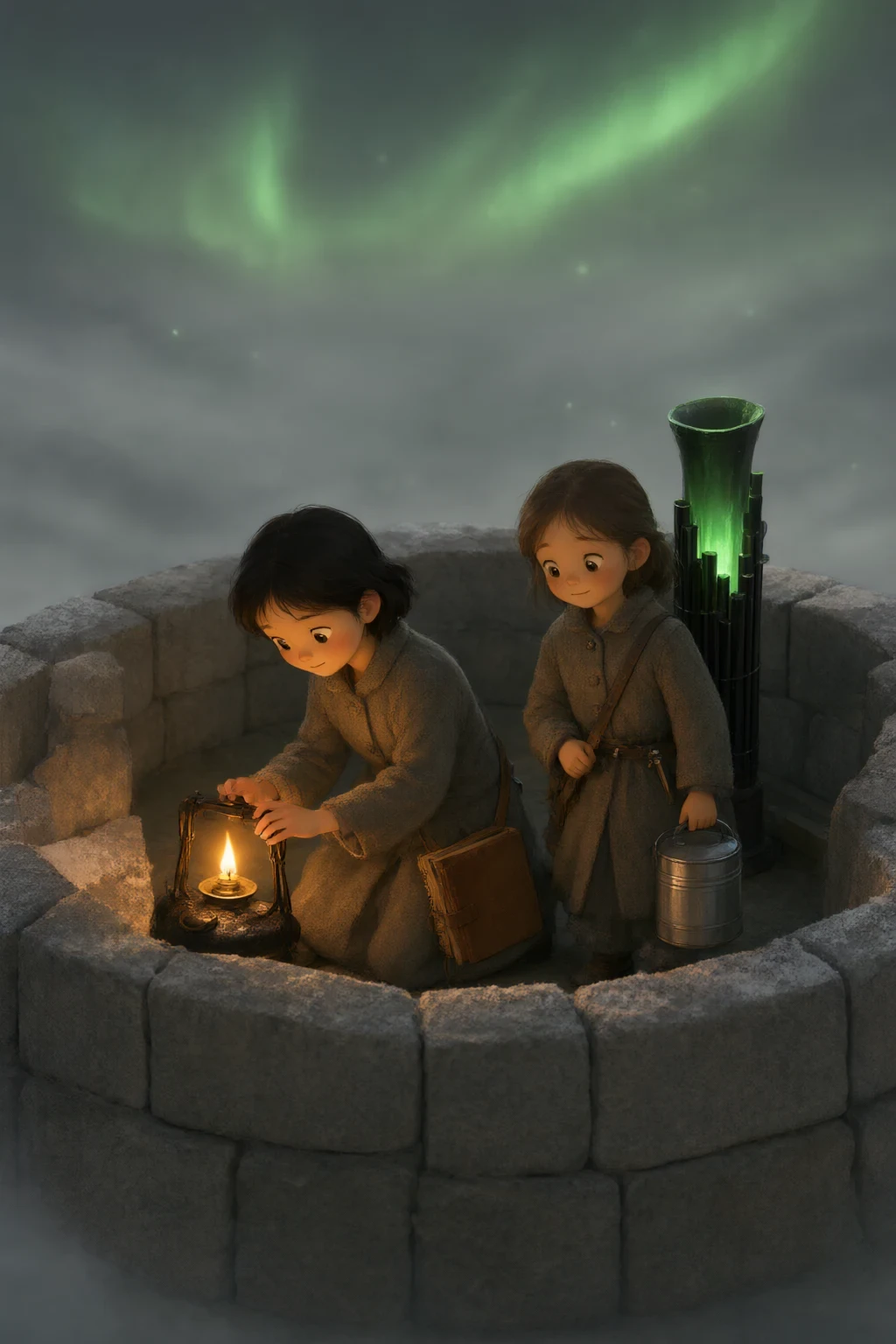
The month burned down to a fog week, and on the ninth night of it the nine lamps went out. Not one after another. All nine together, the way a hand goes out on nine candles at once, and the Shoulder of Nine Notes was left with nine cold frames of oiled iron in the gaps and nothing else.
The lamps were the lamp-keeper’s, and that had been true for six hundred years. The lamp-keeper kept the road lamps of Sillvane, one at every bend, and the keeper’s child trimmed the wicks and carried the oil up the Gallows Stair on the ninth night of every month. This month the lamp-keeper was in Sillvane with a bad back. So the child came up.
Her name was Sena Bray and she was nine years old. She came up the two hundred and forty steps in a grey wool coat with a wick-trimmer in a leather loop at her belt and a tin of lamp oil slung across her back on a strap, and she came up at the time when the light was going out of the sky the colour of a wet slate, with the wind pushing steadily at her from the west and a whistle in it. She was not frightened. She was counting.
“One hundred and ninety. One hundred and ninety-one,” she said, when she got to the ninth gap and the door in the wall. “I have done it four times. I know where the bowls are.”
The lamps stand one in each of the nine gaps, iron frames the height of a person’s chest, each with a name cut into the front of it and filled with black. Hearth. Needle. Antler. Rye. Drowned Bell. Sole. Cloudberry. Hound. Wake. The names are not decoration. A lamp that has not been told which lamp it is does not take the flame. Sena’s father had told her that on the first night she ever climbed, and he had said it the way he said everything, once, and then not again.
“Trim the wick. Touch the flame to it. Then say the name into it. If the name does not go all the way in, the lamp does not light, and you start that one over from the trim.” “There are nine of them.” “There are nine of them and they go round, and each one is the next one’s reason.” Sena reached the first lamp. The fog came in behind her and filled the ring.
It was not water fog. It did not move like weather and it did not dampen. It came over the wall and lay in the ring like something poured in, and where it was deep the ring’s own chord went muffled and far off, and where it was thin the chord came through bright and clear, right up under her feet. It did not kill sound. It ate it, in patches, at random.
“Ah,” said Pell Underhay, coming out from the bass end with a ledger notebook in her hand and no sound in her boots at all. “Ah, no. It is you for the lamps, then.” Sena turned round. “It is me for the lamps.” “Nine of them.” “One person is the number there is,” Sena said. “That is the whole of the errand. Nine is not two.”
Maran Ostler came along the horn-line to the first gap, moving the way people move who have not sat down in six hours. She had her mitten on, the thumb cut off it and grey wool frayed at the edge so that her left hand could get at the valve, and the hand under it was white to the second knuckle. She had worn mittens for warmth for six hours, and it had not helped. “Apprentice,” she said. “Chord-line.” “Leave the ring.” Pell’s hand went to the notebook inside her coat. “What is the number for that?”
“One ninth,” Maran said. “The ring does not keep you. The ring keeps the nine. The moment your boot crosses the sill, the ninth place is a hole in the wall, and the wall will lean while you are gone. You may go. The leaning is the price. I am telling you the price because nobody else will say it in a language you can use.” “How long is the leaning?” “Until you are back on the sill.” “Then I will be quick.”
“You will not be quick,” said Maran. “You will be slow, and you will be careful, and I will hold the third for both of us. The third is fine.”
They started at Hearth. “Stay on my shoulder,” Sena said. “And when the fog takes a name, I will tell you, and you will say it back to me, and I will say it into the lamp. And do not shout. Shouting goes out and does not come back and you cannot tell the difference.” Pell pulled her mittens off and her fingers were red and shaking. She put her hand flat on Sena’s shoulder. Sena trimmed the wick. She touched the flame from the ring’s own small taper to it. The wick caught.
She leaned in and said, into the little flame, in the voice of somebody reading a name off a door in the dark: “Hearth.” The flame took it. The lamp stood up in its frame, gold and small, and the fog drew back from the two of them a hand’s width, exactly as much as a hand’s width. “That is one,” Sena said.
Needle went. Antler went. The fog fought the word Antler. It came back at Sena as a thing with no middle to it, a shape of sound with the ends bitten off, and the lamp did not light, and Sena started the trim again, and it happened again. Pell opened the notebook with its broken spine and flattened it against the frame. “What did it sound like?” “An.” “An?” “An. And then nothing.” Pell looked down the column in her own pencil. It was the first thing she had ever written in that book that she was glad of.
“Anter,” she said. “Antler. A, N, T. It is four letters and the third one is the loud one.” Sena said it again. The lamp lit. “That is two and a half,” Pell said. “And I counted that as one. What is the number for a half?” “A half is a fog,” said Sena. “A half is a thing that is there and not there. It is not in the book. Leave it out.”
Rye. Drowned Bell, which took three goes, because the name was long and the fog had a long one to bite. Sole, and Cloudberry, and Hound. By then it was properly dark, the eight lamps stood round the ring in a wide arc, small and gold and low, and the fog had a shape to it for the first time. It ran round the inside of the wall the way a dog runs round a house it is thinking about, and where the lamps were it went round at a distance. The ninth lamp was Wake.
Wake stood at the top of the Gallows Stair, in the ninth gap, the same gap the stair comes out of. Between Cloudberry and Wake the fog was as deep as it had been all night and going deeper, because the stair is a cut in the rock and the fog came up out of the cut the way water comes up a drain.
“It is not fair,” Sena said. “The fog goes round the wall on nine segments and it should not get ahead of us. But the stair is a way in. So it comes up the stair. So Wake is the last one and the worst one, every time, all my life.” Pell put her hand on the sill and tried the ring with her ear.
Not the way she had heard it in the afternoon, with her own voice inside it. From outside, the way you hear weather from a different house. There was a place in it, down to the left, where it went thin and hollow and kept on being hollow, and behind that hollow place the rest of the chord came back in strong. “It is thinnest there,” Pell said. “If the fog is fat where its own note is loud, then it will be fat there, because there is nothing of the ring in the way.” “And if we go there?” “The lamp will take in one go.”
It took four goes of hard walking and four goes of the fog closing up behind them like a door. Sena’s lamp oil went into the frame of Wake and the flame stood up, and she leaned in. The fog took the name on the first breath. It took it on the second. On the third it came back as a long rolling sound, the fog’s own held note, the whole week of it, right in her face. Sena came out of it and stood with her head down.
Pell looked at the iron rail of the stair, one line with no join in it. She looked at eight small gold lights going round a ring wall, a green line in the sky, and a black iron organ pipe with the cold standing in its throat. Then she said, in a voice with no air in it at all, exactly one word, and not the name: “Nine.”
Because Wake was the one name on the whole ring that was not a thing anybody owned. It was already a held sound. It had been the only sound on that shoulder before the chord came, and it was the only sound there now that nobody was making. Wake was already being said. All around them, in the gaps, in the stone, in the air. Sena heard it. She put her mouth to the lamp and said the name into it the way you would take a splinter out of somebody’s finger, gently, because you knew exactly where it was. “Wake.” The lamp lit. The fog stood still. Then it came apart.
It did not go. That is the thing about a wall that is not a wall: it stops pretending, and everything behind it turns out to have been standing there the whole time. Behind the fog was the night, the ordinary night, cold and enormous, with stars in it going all the way down behind Sillvane, and the pine forest three thousand feet below in a black fold with one small orange window in it. Sena sat down on the sill stone and put her face in her hands and laughed until she had to stop to breathe.
Pell stood with the nine lamps in an arc behind her and the whole sky open in front of her, and she was not laughing, because she was listening to the ring. The ninth place was empty and the wall was leaning. She could hear where.
Maran was at the horn-line with her hand on the third valve and the band of green above the wall pinched to a thread exactly over the ninth gap. The leaning had a sound. A very small one, under everything, like a door in another house with the wind getting at it. The chord had it in it and could not get it out, and it had been in the chord for four hours.
When Pell stepped back over the sill, the ninth place filled, and the sound went out of the chord, and the green band above the ninth gap came open like a hand. Maran took the valve off and stood with her white hand hanging. “Four hours,” she said. “I know. I am sorry.”
“Do not be sorry. Be accurate.” Maran lifted her chin at the fog lying out flat in the valley below them, harmless now, the way a spill lies. “That was eleven days of weather. It is on your account. Write the number and do not round it down.”
The next night, Sena Bray did the lamps with a grown person holding the oil. She did the trims herself. She did the names herself. But she had somebody on the sill with her for the whole round, and when the fog bit a name in the middle they had two of every word between them, and it was the difference between a lamp that would not light and a lamp that lit first go. That is all a pair is. Two of a word, so that one of them is left.
Pell wrote it down in the notebook with the broken spine, in pencil, in a column: the ninth, empty, four hours. And underneath it, because she was fifteen and because it was true, one more line. Not halved. Not a fog.