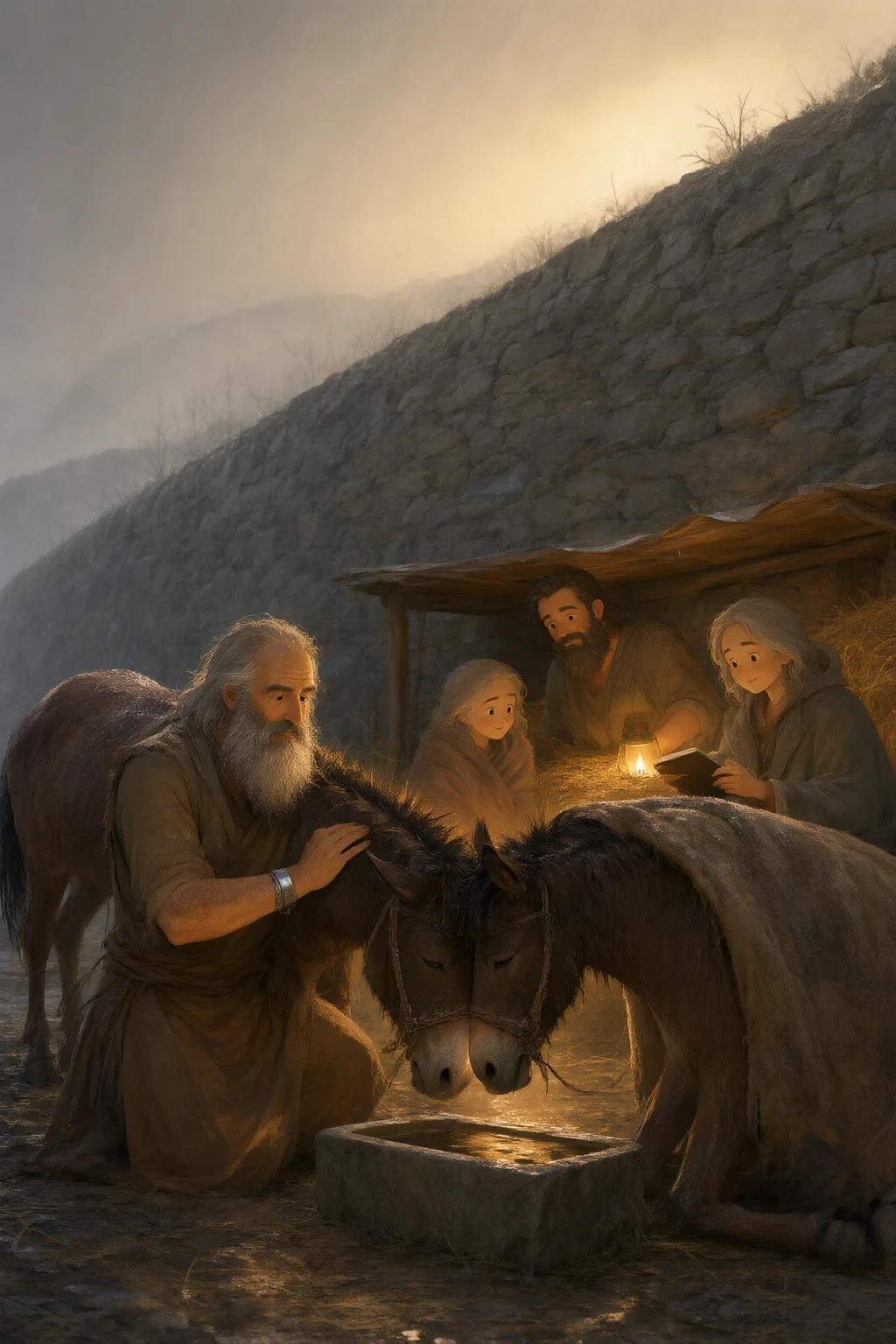
The Mule Yard is the only flat piece of ground on the pass, shored up with a retaining wall, always in the lee of it, and it smells of animals whichever way the wind blows. Six of them stopped there for the night. Nobody had said a word about a vow all day, and the Registrar came over the ridge at nine in one long push and did not stop until four.
The mule called Ash put her nose over Ansel Dun’s knee. “You have had your nose on my knee for a whole minute,” said Ansel. “All right.” “She likes you,” said Tam Garrow. “She likes the bread, and it is the only bread she has ever known.” The other mule, Bone, was chewing something that made a sound like a hinge. “He eats the bootlace,” said Ansel. “And then he looks at you as if you owe him something.” “Where is he going?”
“Home. So am I in the morning, if the weather lets.” Ansel pulled the blanket up. He was fifteen, had come up the pass for the first time eleven days ago, and was going down it in the morning, having sworn nothing at all. “It is a long way down.” “Six days, my father used to say.” “I have walked four thousand steps and I am already sick of stairs.”
“Tam.” “Mm.” “What would you swear?” Tam Garrow lay still a while. He was twenty-seven, with a rope-maker’s hands, and had carried a term in his head for a year and could not get it out into the open air. “I do not know,” he said. “That is a good answer.” “That is not a good answer, that is the whole of the problem.” He sat up. “You have to say it out loud, in the room, with a term on it, and then your body takes the not-doing. Not your character. Your character is no use to anybody.”
“So which not-doing?” “That is exactly what I have not got.” “I have not got one either.” Ansel said it to the dark. “I had one, all the way up. I was on the black stone with one step to go, and she put her hand up.” “Who?” “The keeper of the Ninth Step.” He turned the blanket over. “I said I would not leave the herd. Under this pass. As long as I lived. It would have made me somebody.” “What did she say?”
“That it had no number on it. That a vow needs a term, and without one it is not a vow, it is a noise the room makes at you, and nothing is written down and the body keeps nothing.” He laughed once, with no humour in it. “Eleven thousand steps for a noise.” Tam was quiet. “So that is what is up there,” he said. “That is what it is for.” “No. That is what I am too thick to have.” “Will you go back?” “When I have a number. She said come back with a number.” “You will go back.” “I will go back.”
Across the yard a lamp was burning, and two people had their backs against the retaining wall, the only place on the Mule Yard the wind does not find you. Tovan Rell was sixty-eight, with ink stains on his cuffs up to the elbow, holding a magnifying glass he did not need, because it had been in his coat since he was thirty. “You are the Bureau,” he said. “Marda Osk. Registrar’s clerk, sent up by the Bureau of Vowed Obligations.” She said it as it had been printed. “May I put this as I would put it in a report. How many vows are sworn on this pass between the First Water and the Shrine of the Pass?” “Eleven thousand and some,” said Tovan Rell. “And how many are still held?”
“Eleven thousand. The sticks are all kept, cut a notch for every year of the term, and the notches are the only place on this mountain where anybody ever wrote down when a thing ends.” He turned the glass over. “Eleven thousand sticks in the Reliquary under the top shrine. The old ink has the terms in it and not the dates. Terms. Not dates. That is the whole difficulty, and it has been for a hundred and eighty years.” “And that is the Bureau’s problem,” said Marda Osk. “That is the problem.”
“Then will you state it again for the record, please. Why the Register cannot answer the question.” Marda Osk took out a flat black book and a pencil. Her right middle finger was hard with ink, and the lamp oil in her sleeves had not come out in nine days.
“Why the Register cannot answer the question,” she said, word for word. “Because it was never written down to answer it. A keeper writes the term, and the term is what the person said, and when it stops, and that is all the page wants. A vow is not about the end. A vow is about what you said you would do.” She looked up. “Is that right.” “That is right.” “Then the Bureau is asking the wrong book.” “The Bureau is asking the only book there is.”
Tovan Rell held up a hand. “Numbers,” he said. “Numbers are what I have. Eleven shrines. Four hundred miles. Four hundred ledgers. Eleven thousand sticks. Four mules.” He nodded at the dark, where the animals stood over each other. “And if I have it right — and this is the year I have waited sixty years to say, so let me say it slowly — this pass has been busy for a hundred years. Every term sworn in a busy year comes due in a busy year.” “So they come due together.”
“They come due together. Hundreds of them. In one season.” He put the glass away. “I said so in the year of the great thaw, and the warden-copier before me wrote it down, and then the Bureau’s people came up and said a man of sixty-eight does not read the older hand, and it was put in a drawer.” “I have never seen that drawer,” said Marda Osk. “No. It is a very good drawer.”
“Do you have it written down anywhere you could show me?” “It is in my head. I am seventy per cent sure, and that is the best I have ever had.” He turned to look at her. “You will not put that in a report.” “No. But I will write down that you said it in the year of the great thaw and were not listened to.” She wrote. “That is not a number. It is a witness.”
On the other side of the yard, under the awning where the hay was, Brother Seat was awake. He was fifty-two, and his left shoulder sat an inch higher than the right and had done since he was thirty, and he had grown a full iron-grey beard for the first time in his life, because a clerk told him last month that a man halfway through a term ought to look like one. “I have got nine years of this,” he said. “Nine years of labour, sworn at the top shrine. I am in the last of them.”
“How do you know you are in the last of them?” “Because I am in the last of them. I do not know when. Nobody will write it down and nobody will say it aloud, and I have stopped asking, because a man who arranges his life around not asking does not get to complain that nobody answered.” The woman beside him did not move. She was fifty-eight and thin the way people are thin when the thinness is not about food, a blanket over her knees in the ninth month. “Your beard is new,” she said. “Everybody says that.”
“It suits you. It makes you look expensive.” “It makes me look like a man who is nearly out of something. That is what I asked for.” He laughed, and it stopped. “You have got a term too. I have nine years, and I would not swap it, and I would not do it again, and both are true at once, and there is nobody I can say that to.” “There is nobody you can say that to,” said Wenna Fisk, “because I would only tell you that you are right, and you could not tell the difference.” “That is a fair thing to say to a man with nine years in.” “It is a fair thing to say to anybody.”
“What is yours?” he said. “Your term. What did you give for it?” “I do not eat before I have fed whoever comes to my door. That is all of it. I did it for my sister’s boy, because he was thin and nobody fed him.” She put her hands inside the blanket. “Three years and eight months. It is very good, and I know exactly what is left. And I do not want it to end.” “Ah,” said Brother Seat.
“Two days of it left, and I have been walking round this pass for a month getting ready for the end of it, and now it is here and I have not one single thing to do with it.” “You will eat.” “I will eat on Thursday.” She said it flatly. “And then I shall be a woman of fifty-eight who eats, and nobody comes to my door, and nobody has for a year. And I have made a habit of the not-eating, and it is the only interesting thing about me, and it is nearly over, and I did not know until tonight that I would mind.”
Brother Seat opened his mouth, then shut it, because nothing he could have said to that would not have been a smallness. “You will be all right,” he said. “I will be fed,” said Wenna Fisk. “That is not the same, and you know it.”
At two in the morning Ansel Dun came back from the wall, where he had been sitting out of the wind, and found them both awake. “Is it the cold?” he said. “It is the cold,” said Wenna Fisk. “No.” She shifted over. “Sit. Are you going back up?” “I do not know yet.” “You went all the way up and swore nothing.” “I went all the way up and did not swear anything,” said Ansel, “and I would do it again, and I have not slept since, which I think is all I have learned.”
“What would you swear now?” she said. “If you had a number. If somebody gave you one.” Ansel thought about it a long time, hands flat on his knees, the way you hold a horse that has decided to go. “I would not swear about the herd,” he said at last. “The herd is all right. It does not need me to be brave at it.” “What would you need?”
“I do not know yet.” He turned his hands over; they were dirty, the nails were split, and there was a thin hammered iron band on his right wrist that his grandmother had put there for a buckle with her own teeth. “When I know what I want to stop doing, that is the same as knowing what I want. I had it the wrong way round, and it cost me eleven thousand steps.” Wenna Fisk looked at the band on his wrist, and at his hands, and at nothing else. “That is nearly right,” she said. “Ninety per cent. You will not get the ten per cent out of me tonight, because it is nearly two in the morning and I am cross with everyone.”
At four o’clock Ansel Dun got up, took his coat, and went out of the yard. Nobody asked where. Tam and Brother Seat watched him go, and Tovan Rell said, “Four in the morning is the worst hour there is,” and Marda Osk said, “Where is he going?” “Up,” said Ansel, from outside the wall. “Up to what?” “To the door. The Second Water has a door. It is forty steps. I want to stand in it.”
The Registrar came over the ridge at four in the morning in one long push, and went on coming for an hour. Ansel was gone two hours. The sky behind the retaining wall went from black to a hard cold blue to a flat grey. The four mules stood in the lee, heads down, backs full of wet. The hail came once, sideways, and stopped, and came again an hour later and stopped. At six, Ansel Dun came back into the yard and sat on the wall and said nothing for a while, and Wenna Fisk put the blanket round his shoulders without looking at him. “I stood in it,” he said at last. “Did you say it?” “No.” “Why not?” He turned the iron band on his wrist round once with his thumb.
“Because there was nobody in there to hear me except the lamp, and I had been up and down that stair three hundred times in my head for nine days. And if I said it into a room where nobody was listening, it would be a noise, and I would have done the eleven thousand steps twice.” He pulled the blanket tighter. “And I could not do that twice. So I stood in it a while, and came down, and I have not sworn anything.”
Nobody said anything for a moment, which on that mountain is a considerable thing. “You could have said it into a bucket,” said Brother Seat. “Eleven thousand people on this rock have sworn into a bucket, me among them, in a bad winter, and the bucket did not care and the mountain did.” “That is a thing to think about,” said Ansel. “It is a thing I have had nine years to think about.”
Tovan Rell cleared his throat. “Two days,” he said. “For what it is worth, and if I have it right, which I am seventy per cent sure of, that woman’s vow is two days, that man’s nine years and a bit, and that boy’s nothing at all, because he never said one. And if he had said one without a number on it, we would be talking about that this morning instead of about the cold.” “Thank you, Mr Rell,” said Marda Osk, and wrote it down. “You will not put a number in off me.” “No. But I have written down that you said it.” “A very good drawer,” said Tovan Rell, “and there are not many of us left who know where it is.”
They got the four mules loaded in the flat light, one at a time, and the animals did not want to go anywhere, and there was an argument. “I am going down,” said Ansel. “You are going down,” said Wenna Fisk. “I am going up as far as the Ninth, and then home to a house with a door. And on Thursday I am going to sit down and eat, and if anybody comes to that door I am going to feed them. That is the whole of my life now, and I am not complaining.” “You are a bit,” said Brother Seat. “I am a bit,” she agreed. “Goodnight.”
They went down the stair in the wet, six of them, the bowls in the steps smooth from six hundred years of feet. The Shutter-Stone was not on the way down. It was eight thousand steps back up, on a terrace at the midpoint of the pass, and on a clear morning you can see nine of the shrines at once going up and two coming down, each with its own weather, and the black square of it lying up there with a wide worn arc all the way round it, where six hundred years of people stepped politely aside.
Nobody in that yard swore anything at all, that night, or in the morning, or on any of the six days after it. They all went home changed and most of them a little thinner. And one of them was a boy of fifteen with a number he had not found yet, and a thin hammered iron band on his right wrist that he never took off. He came back up the following spring, eleven thousand steps, with a number, and a keeper turned her whole body round to face him and repeated the last three words of what he had said before she answered it.