Tace Aldren could hear, from the third anvil, when her grandmother’s name came off the mill tally, because the tall man who wrote it always stopped his chalk for a moment first. It was a wet Tuesday with the waterwheel turning, which meant the mill was working, which meant every hand in the forge shop was watching the office door instead of the fire. “Off,” said Tace, and put her hammer down flat and blew the fire back to life. “Somebody tell him the fire’s off or I’m charging him for the charcoal.” Joss Rennick was not slow. “Nan Aldren’s off the tally,” he said. “Read it out.” “That is not how it works.” “Read it out anyway.” So he read it out. The fourth line said that the account of the late BesNan Aldren, foundryman, in respect of one bar of bog iron, bar-marked and delivered to the Barren Ring lamp-frame in the twelfth year, was closed, no balance remaining, and the name struck. There were eleven people in the Cindermill and all of them looked at Tace. “Right,” said Tace. And then she took her apron off over her head, hung it on the anvil horn, and went out into the rain, because there was nothing else she would have liked better to do.
Oren Vall caught her at the north end of Lamplighter Row, which he must have known she would cross, because there was only one way out of the mill and it was past the lamp-posts. He was sixty-two, his staff had a brass cap polished by twenty years of going first on the left, and his left knee made a small sound on the gravel like a pebble in a shoe. He had been doing that since she was nine. “Aye,” he said. “Aye, but—” and then he did the thing he does, and the pause went on past the point where a sensible man would have stopped, and the rain came down into the gap and used it up. “I need a founder’s apprentice in the Scriptorium today, and I need one who does not talk during the reading. Line thirty-four. You will find it grey. Do not let me down over a board, Miss Aldren.” “Slag luck to you,” said Tace.
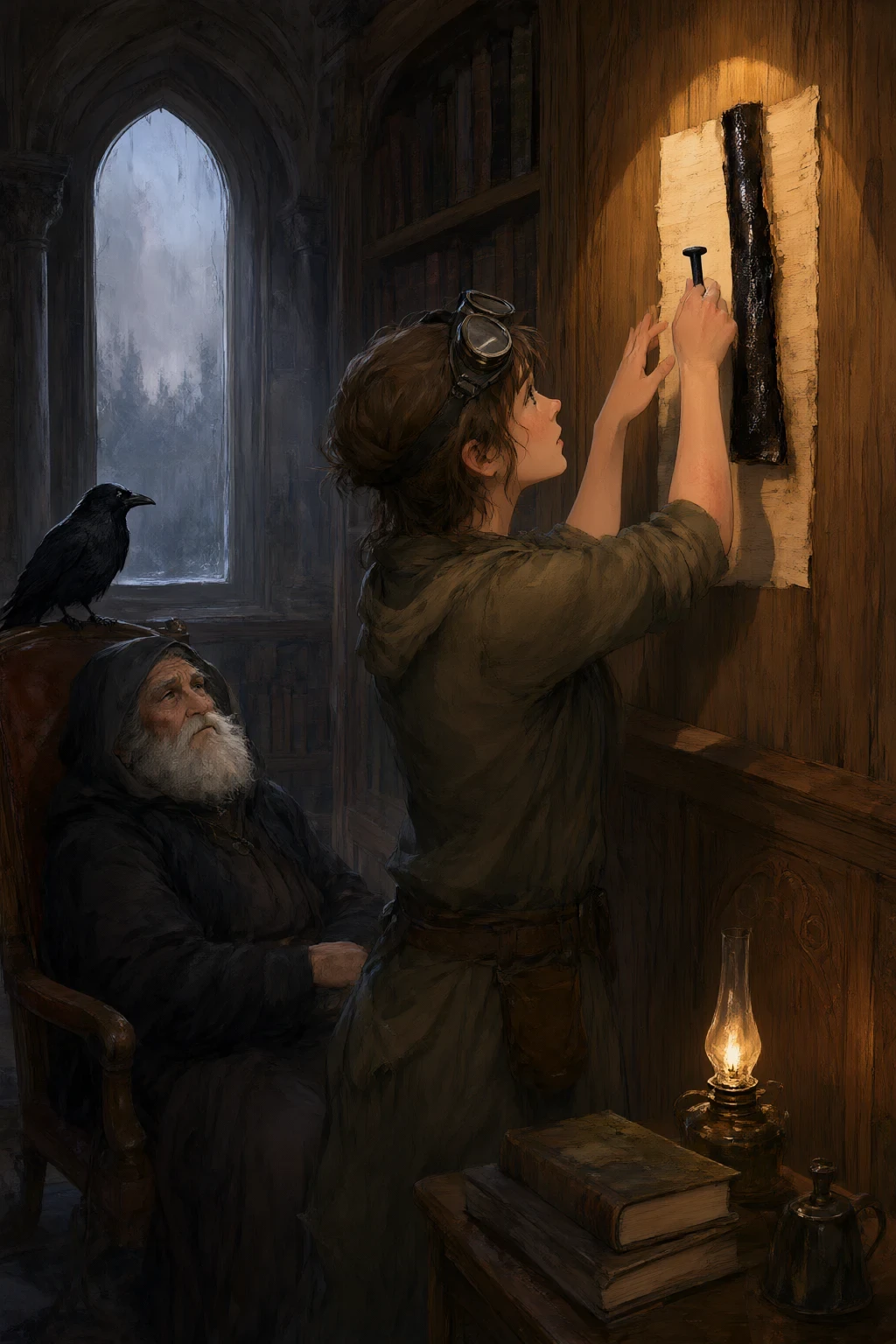
The Scriptorium was a cold upper room over the tithe store with one north window, a wall of birch-bark leaves on oak boards, and forty years of lamp smoke in everything. The pact-board filled the far wall: forty-one lines of sap script, glossy and black, with a cold-iron nail through the last one, square-headed and cold even in July. And to the left of the middle, a grey rectangle the size of a door panel, which was where somebody had gone at the wood with a knife. “That rectangle is mine,” said Elder Sable Ashdown, at the reading stand. “You may be angry afterwards, in the correct order.”
Line thirty-four was grey the way a thing goes grey when daylight has been at it for a hundred years. Tace put her thumb on it. The Eldress kept no fire in this room at all, on purpose, on the grounds that a fire in the Scriptorium made her read too warmly. “Two hundred and thirty-nine words,” said Elder Ashdown. “It has been two hundred and thirty-nine words since before I came. It is the lamps clause. Everything else in the pact is about trees.” “Is it? I have read it.” “Reading is not the same as carrying. That line is in the small hand, my sight has one eye in it now and it is the wrong one, and I have not made out nine words since Michaelmas. And it is read aloud on Samstag nights, and a line read aloud wrong is a line read aloud as something it does not say.” “So it has been going wrong for two months.”
“It has been going wrong in a way nobody noticed, because what it says is a smaller version of what it should say. Fewer lamps. Fewer spoons. The crowd hears fewer, and cheers.” The Eldress turned her good eye on her. “You have a knife. You have a hand that does not shake when it is hot. Restore it.”
The first thing Tace did was wrong, and she did it because she was good. She cut a fresh strip of the year’s supply, pale as a lamp-shade, and matched the old line’s width, because a strip laid over the old would double the thickness and the pin would never sit flat. Then she mixed the ink. Sap does not want to be written with; it beads. You mix it with ash from the Cindermill and a little gall from the tallow vat and write it cold, and then you wait, because fresh sap crawls. A line written in sap keeps moving for three days, and that is how you know a line is new. “No chalk,” said the Eldress. “Sap and ash and gall. Give me your reading of it before I put it down.” And Tace read it, and the reading was not what was on the board, because the reading was her reading.
“Nettlefold keeps its lamps. The Wood keeps its trees. Neither party buys the other. No lamp is dimmed to save oil while the border stands. A spoon of sap to each lamp, each season. Two readings, the Elder’s and the Warden’s, and the nail in the last line holds them. What is not read is not held, and what is not held lapses, and the border comes in by however far the dark was.” “Emphatic,” said Elder Ashdown. “It is a paraphrase and not a restoration. Set that on the board in place of a binding text and the village will read a summary instead of a promise, and the summary will be true, and that will be the end of it. A promise you can boil down to what it means is a promise you can boil down to what you meant. Do you see the difference between a paraphrase and a forgery?” “No,” said Tace, honestly, because she had learned in the shop that a joint which looks right and is not right comes apart under load. “Good. Then write what is there. Not what it means. What is there.”
So Tace wrote what was there, and it took her from the middle of the afternoon until dusk. It was the small hand, and the small hand was the smith’s hand: no curve that could be mistaken for another curve, no stroke that could be read two ways after thirty years in the damp. She wrote in the order of the old line, stopped the old line dead, matched its serifs, and wrote the whole two hundred and thirty-nine words without lifting the style more than four times. Then her shoulders came down out of her ears for the first time since the waterwheel. The Eldress read it in a soft sing-song, and then stopped, and said it again slower. “That is very good,” she said, which from the Eldress was nearly an embrace. “Draw-filing hell, but it is very good. Come back Thursday and let it settle. If the slip holds, you have your trade.” “Yes,” said Tace, and went down the stair and out into the wet and stood in the road with the rain running off the front of her nose, thinking about two hundred and thirty-nine words in a dead hand.
She came back at one in the morning with a lamp, because if it was going to be found out she would rather find it out herself. The Eldress was asleep in the chair at the stand, which is where the Eldress sleeps when there is a reading. Tace shaded the lamp to a slit. The line was dry. It was crawling, as it must be; she could see the last three words sitting a hair’s breadth lower than the rest. And it was exact. She put her hand flat beside it, and it was a good join, and she knew it was a good join. And under it, in a hand she had not made, there were three lines.
They were not in the Eldress’s hand either. They were finer than anything Tace had written, or anything she had seen in three seasons of carrying that woman her tea. Where Tace’s hand had been a smith’s hand, this was one that had never needed to hurry: small, level, even, the little strokes lying down like wire in cold butter. The letters were glossy and still crawling, so they were written tonight. “They have written on my line,” said Tace.
“Who else has a key,” said Tace, standing in front of the Scriptorium fire with the Eldress in the chair. “Nobody. It stays on my belt. I have not had it off in nineteen years except to be married and to be buried, and the second has not come round.” The Eldress unfolded her hands out of her sleeve. “And it wants a test. You could not tell my wrong joint from my good joint by looking, so you told me by loading it. Write two things: one true thing that costs us a great deal, and one thing you would like to hear, offered in the shape of a promise. Leave both. See which comes back answered.”
They laid the strips side by side, and Tace wrote them, and the Eldress stood over her arm with a hand on the edge of the first one, so that nothing could be swapped afterwards. The first said the village would set a lamp on the standing stone at Nettlefold Cross to burn from dusk until the reading was done, and would not take it down for oil or weather in any season while the border stood. The second said what Tace wanted, which was that the Eldress might lay the board down beside her and read those two hundred and thirty-nine words again in the spring. She wrote both in a plain hand that was not her own, left them, worked a full day at the forge, and came back at dusk. The second was untouched. Dry, uncrawled. The spring, where she had written it, stayed the spring.
The first had four lines under it in the fine level hand, and Tace stood in the doorway and read them, and felt the floor go out from under her, because they were not a refusal. They were a better offer than the one she had written. “It has refused,” said the Eldress. “It has refused, and come back with a counter.” “Then it is a party.” Tace’s hand had gone to her hip without her meaning it, to where the draw-file lived, which is a thing she does when a part comes loose. “A smith does not set a tenon and walk away. Somebody comes back with a different tenon and now you fit it to something else.” “So read the rest aloud, and slowly, and let me hear it in the room.”
Here is what the four lines said, as Tace read them and the Eldress repeated them after her, slower, twice. For one season, from the Samstag on which this line is read, the Wood will hold the outer thirteen posts, the eleven at the Barren Ring and the two at the Mere of Slow Water, without oil and without sap, and will not draw one spoon on the village. In that season the village shall set four lamps within calling distance of the Ring, and one on the reed shore, and shall not take any of the five down for oil or weather. And in that season the Ring shall be named aloud at the reading, and a line shall be read for the Ring, and the Ring’s answer read after it, and no line of the Ring shall be struck from the board by the village or by the Ring.
The offer was a year of free light on the worst stretch of border the village had, and it was more generous than anything the Warden would have dared write. And it was a trade, and it was fair, and Tace understood inside a minute of standing there why it was fair, which was that what it was buying was not oil. It was four lamps at the Ring, a lamp on the shore, and the Ring put on the board with a voice. “You have found what was under the boot,” said the Eldress. “Say it out, so that I know you have it.” “The village has been reading forty-one lines at itself for four hundred years,” said Tace, “and the Ring has been out there in the dark the whole time with nobody reading it. A line that is not read is not held. Slag luck, the Ring has not been held to anything. It has just been dark.” “And now you would light it.” “Now I would light it and let it answer, which is worse, and which is the point.”
Tace went down to the Cross on Thursday evening, because that is where the orders were nailed up so that people could be angry about them in public, and there were nine people there, as there always were. Oren Vall was standing at the standing stone with his back to the slate. His knee made its sound as he shifted. “Aye,” he said, to the stone. “Aye, but—” And he did not finish it. That was the first time in Tace’s life she had heard him not finish it, and she understood that if she asked for the rest of it he would say all of it, and that he would not be able to, and that it was none of her business anyway. “The offer is a year of the outer thirteen posts free,” she said instead. “Four lamps at the Ring, one on the shore, and the Ring gets a line and an answer on the board.”
“I have read it. It is a good offer, and it is better than the one I would have made, and I have been the Warden eleven years and I have never once been able to make an offer better than the one I was sent.” He turned round. He looked older than the rain. “Miss Aldren, the eleven posts at the Ring are eleven posts because that hill is a graveyard.” The graveyard. Tace had walked the Ring twice, once for bog iron and once for gorse, and both times the walls had been underfoot.
“There is a stone on the north side of that hill,” said Oren Vall, “and a woman under it, and she asked me on her deathbed for a stone with no lamp on it and no lamp within a mile of it. I said yes, because I said yes to everything she asked, and that is the only thing I have ever been careful about.” His staff came down on the gravel. “I am not objecting to the offer. I am telling you what I am going to have to do about it, and I do not have to do it tonight.” Tace Aldren, who had many faults and one of them was that she did not notice when a person was bleeding, said, “Slag luck,” and left him at his stone.
She made the nail on Friday. It had to be cold iron, and by the end of the winter the Cindermill had four bar-ends of true bog iron, black through, and the rest was puddle. She picked the best and squared it and drew the shank to the length of her little finger and the head out square, four faces at right angles, no burr, no feather, no file-mark she could find with a thumbnail. It was the smallest thing she ever made. It took two days and she ruined eleven off. Her grandmother had made cold iron, and that was the whole of what BesNan Aldren was remembered for three generations on, and it was why her name had sat on that tally for nine years: the bar was delivered, and no account was filed.
She put the finished nail in the fire anyway, to colour. When it came out she waited for it to cool, and then held it, and it was black and square and cold, colder than her hand, colder than the anvil, colder than anything that had been out of that fire two minutes before. She held it for a count of forty and it did not change. She put it in her apron pocket and went up, and stopped on the Scriptorium stair to go back and file her grandmother’s account, which took her until dark and involved the words no balance remaining and the name struck and a signature she was not permitted to give as one. So she wrote entered by T. Aldren, apprentice, for the late BesNan, and Joss Rennick initialled it and hung the slate back and did not look at her.
She hammered the nail in on the Samstag night, with the board read and the village in the room, because a nail of cold iron goes in once. The Eldress read the new line, and then read it again slower, and then read the four lines under it, and the room went very quiet in the middle of the part about the Ring being named, because everyone in Nettlefold had lived their whole life inside a light that stopped somewhere, and not one of them had ever been asked what was on the other side of where it stopped. Then Elder Ashdown came to the end of what was on the board and stopped, as she always did, and looked up. “And what does the Ring say?” she said, to the room, in her soft sing-song, and waited.
The crow was on the top rail of the reading stand, four years old and hooded and entirely black, with the top third of his left beak gone, so that everything he said came out with a whistle in it, in the one place in Nettlefold where nobody had ever thought to look for a bird. “Count it,” said Sixpence. Tace stood at the end of the board with the square black head of her nail in the middle of her palm and watched the Eldress wait for an answer that had not been written yet. She understood that she had spent two days being careful and had still got the worst of it, because the offer she carried home was not the end of anything. It was the beginning of the part where a village four miles east of the lamplight found out that it had a voice, and the first thing that voice would be used for was to complain. The nail in her hand was still cold. She put it away and went out into the rain, and the waterwheel at the Cindermill was still turning because the stream was still up, and Tace listened to it a while before she went to bed, because a stream keeps the same sentence going all night without ever once saying anything.