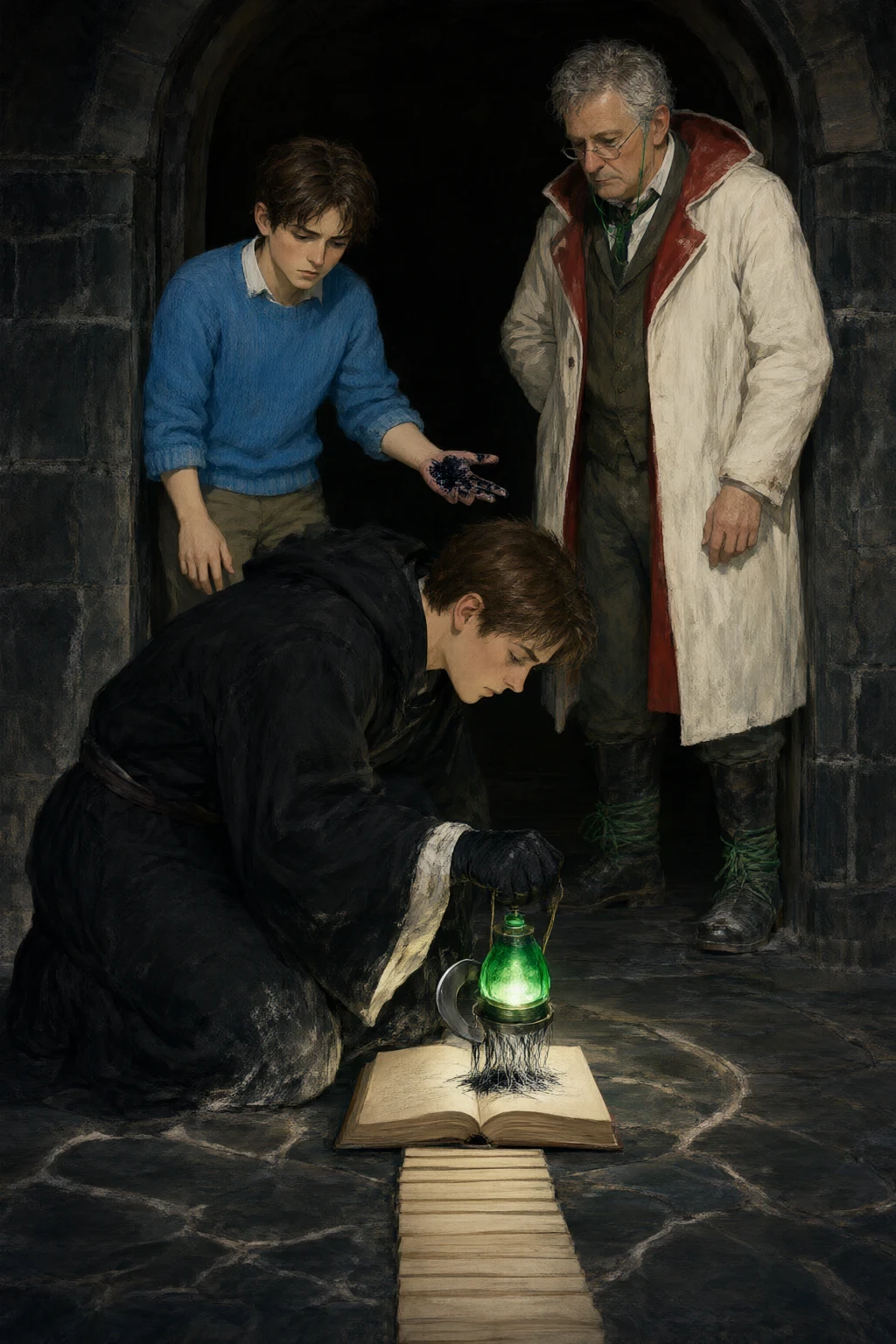
The kettle had been singing for nine minutes and nobody had wanted it. Niko had been asleep sitting up at the end of the Servery table, boots off, where the draught comes under the door. The kettle was the only thing in the building that had not noticed anything wrong. Then the smell came up the stair, hot ash and salt together, and it went through the Servery like a hand on the back of the neck. “That is the Quire,” said Niko. “That is the Quire,” said Anja Roe, from the doorway, where she had been standing some time. Her cassock was stiff as board and salt-bleached at the hem, her right hand was in its blackened wool glove, and her hood had slipped back and stayed there. “Boots on. Now then. Sister Anwen, take the lantern. Archivist, you are coming, because you will want this written down before it is finished. Boy, come along and keep your mouth shut for ninety steps, which I know is beyond you.”
The Quire is behind the Numbers Room and is deliberately unnumbered, and it is the hottest place in the Tide Library. Four hundred scraped spines stand in one long line, and the floor is worn into shallow slate bowls. The air tastes of ash and salt and old hot stone. “One. Two. Three. Four,” said Anwen Tarn, counting, which she did before every door she opened anywhere in the world. “Four bowls,” said Anja. “Four bowls. The blade is clean and I wiped it.” Her sea-grey habit was grey to the elbows. “Under yours. From the year of the fever. To Merrin Fenn. Warding at need, without order. It is pinned under the third bowl, because that is where a person puts a paper when they mean it to stay.” “You count yourself,” said Niko. “I count everything I touch.” She counted again, and this time she was not counting the room. “I was at one hundred and forty on Monday. I am at one hundred and forty-nine now.” “There is no tin,” said Anja. “There is no tin,” said Anwen.
The Quire had two records. One was the slate on its lectern, three hundred years of names in chalk, one to a line, which told you who the Library was holding. The other was the fair Index, in a tin box in the north wall of the Atlas Room. The tin was not in the Atlas Room. The tin was not in the building. “It is on the standing,” said Niko. “The standing says the night’s work is recorded. The night’s work was the Index page. The page went out with the paper.” “Who said paper?” said Anja. “Who decided that?” Anja looked at him slightly too long, and then at the slate, and said nothing at all, which from her was a considerable speech.
They found the prints in the gutter of the Spine, where a hand’s width of black water was running with the rain. “It is fresh because it is falling,” said Perran Hesk, one boot still laced with green twine, “and also because it is falling on nothing. It is falling off a boot that was not on this building half a minute ago.”
The Atlas Room is the widest Room in the Library, and the only place in it where the rain does not sound. Its north wall is solid basalt to the tall barred window. “It is not,” said Perran, with the plan already out of the satchel. “I drew this room to scale eleven years ago for the window tax. Nine feet six of north wall, one window, no door. The basalt there is the founding stone, and founding stone does not take a frame after the first four winters, because it moves.” “There is a door-shaped thing in that wall, which is not the same statement, and I want it noted that I made the second one.” He put the lantern close. “Nine inches narrower than any door in this building. And there is no salt on the sill.”
“The tidemark runs at one height on every sill in this building, on the bench in the Servery, on the rail of the Verandah, on my boot this morning. There is none on that sill because that door has never been wet from this side.” The rain beat the tall window grey and made no sound at all. “It opens out,” said Perran. “It opens out,” said Anja.
Behind the door was a passage nine inches wide and entirely dry, and at the end of it a room that was in no plan in the building. Nothing on the shelves at all. Undisturbed dust, except four long drag-marks and two sets of heel-scuffs, and the drag-marks went to the floor and stopped, and out of the floor, through the door, and away. “It has been saved,” said Anja. “Saved,” said Perran slowly. “It has been saved. From the wrong side. Somebody carried the whole of the Archive out of this building over the mud in the dark, up to their chest, and thought they were being merciful, and they were.” “It was not the Archive they carried out,” said Niko. “It was the Index.” “It was the Index,” said Perran, “and the Archive went with it, because the Archive is the only other thing in this building that knows where a name is. I should like that sentence written down exactly as it was said.”
There was one thing left on the floor of the narrow room. A sheet of waxed paper weighted with a stone, and on it a receipt in two hands. The first was small and hurried: Received of the Atlas north case, this date, the fair Index, one tin, complete, all bundles of slips, complete. Signed, Merrin Fenn, of Greyhaven. Beneath it, a second signature in a heavier, older, very even hand, and a line above it: Witnessed and standing granted, the senior keeper, in the year of the fever. Anja took the lamp and read it from the top and stood a long while. “I wrote that,” she said.
Merrin Fenn had not run. That was the first thing Anja said when they came down to the Porch. “Now then. Whoever that was, she did not run. There is a woman on the first step who has not moved in an hour and a half, because she has decided that running is the part she cannot afford.” The building stood in its own reflection, doubled and upside down, and the water was going off the black sand in long grey sheets, and the tidemark showed pale along every stone and post at exactly one height. Merrin Fenn was about fifty and dressed for weather, with a net-mender’s palm. When Anja came down the seven steps she stood up and put her hands behind her back, in the manner of somebody who has decided not to be able to say she is afraid. “Sit down,” said Anja.
“Sit down, because I am sixty-one and have been up since two, and if you make me do this standing I shall do it badly.” She sat and moved a tarpaulin aside. Under it was the long tin box, and it was not dry, and it was not closed. “I brought it back,” she said. “I have had it under my coat since four. I want that said first, because the only thing I can still say after four hours of thinking is that I brought it back.”
They went up into the Servery, because it was the only room with a fire lit and because the Servery was where things were said. Niko made more tea and then put the kettle off, which Anwen marked by counting eleven things in the room instead of the room itself. “You warded for three weeks,” said Anja, “at four in the morning, unasked.” “Yes. That is the part I cannot get past. That was the whole of the arrangement.” “That is the whole of it. You came to me in the year of the fever having read six books that winter looking for the part of you that could still do what it used to do, and you asked me what a person could do. And I said: a person can be useful. I said: I will teach you, and you will work at need, without order, and I will not be the one who decides, because I do not want to be.”
“You said it because you wanted the Quire empty.” “I wanted the Quire empty by morning.” “That is what I wanted to hear,” said Merrin Fenn. “I heard it. I do not think you were lying.” “I was not. That is the trouble. Nobody in this story has lied to anybody, and the building is still empty. Now then. What did it cost you?”
She put her hands out in front of her, both of them, and looked at them, in a way that nobody looks at their own hands. “I know the names. Every one, in order. The date they came, the date they read, the Room, what they read. Two hundred and eleven, and I can give you the eleven who have not been in this building since before the great flood, and the Room each of them was standing in when the water took them out of it.”
“And I cannot tell one face from another. Not one. Not yours, and I have been looking at you for ten minutes, and a year ago I would have known you in a crowd of a thousand. I have your voice and your coat, and if you stood behind me I should not know it was you until you spoke. That went in the first week, and I did not tell you, because on the seventh night you told me the part had lifted.” “Two hundred and eleven, in order,” said Perran Hesk, who had a pencil out and did not appear to remember producing it, “including the eleven who were carried out of a Room by the water, which is a category I have never seen written down anywhere.”
“You cannot enter it,” said Merrin Fenn. “The only piece of paper in the world that says it exists is the Index, and I read it. On the step, at half past three this morning, in the moonlight off the water, holding it open in my two hands.”
The Servery went quiet in the way a room does when everybody in it has arrived at the same place and one of them would rather not say so. “Reading makes a watercopy,” said Anja Roe. “In this building, in a book, at the turning of a page. And you read a list of every person this Library is holding, all of it, unguarded, on the step. And the water was standing on it.” “Yes. And I have been sitting on your step for an hour and a half working out that I have not improved matters by bringing it back, and I could not improve matters by dropping it in two feet of water either, because the tide borrows and the tide returns, and it is not the water that keeps things.” “Which means the list is now inside a book in this room, and we have handed the one piece of paper in the world that said where any of it is to the party that was always going to use it.” “Yes.”
The rest of the morning is in the Quire, and it is hot. The first thing was the standing. Anja took the paper from under the third bowl and read it out once, in full, so that it was said in a room and not only written, and then held it over the spindle lamp until it went. “Warding at need, without order. It is off. It is off because it is the reasonable rule, and reasonable rules are the ones that get you. I would have taken it back in a fortnight if I had ever thought of it. Nobody thought of it. That is the entire history of this building.” Then Niko said, “No, wait,” in a voice nobody had heard from him, and everybody stopped, and he stood there with the wet navy streak in his left palm open at his side.
“It is not gone. It is somewhere else, and it will be somewhere else tomorrow, and there is a name on every line of it. You cannot cross it out, you can only move it. And there is one thing in this world that stops that, and you have both written it down somewhere.” “There is,” said Anja. “Once in a lifetime a reader may read their own watercopy aloud, all of it, in their own voice, and go down the ebb in one pair of shoes, dry, and unremarked, and it is the door to the whole of it, and it is the last thing we shall be asked to do.” “Then we do that instead,” said Niko. “We read the list out. Not a watercopy. The list. Aloud, in here, in a room, in six voices, so that the room has it and the building does not.”
Perran Hesk sat down on the scraping stool and put his atlas away, which he had never once done in the Quire. “I have kept the Maps Room nineteen years and written down forty-one thousand things, and believed every day of it that a thing written down properly is safe. Most people have one small belief, and mine has never let me down, which is the trouble with a small belief.” He turned to Merrin Fenn. “I will write as you say them and date them and place them, and it will be in the record in a morning. It will also be in your head, in this room, in six people. And the building will not have it, and the only thing better about it than the Index is that I have said so out loud in a room with witnesses.” “That is not a defence,” said Merrin Fenn.
“It is not a defence. It is a receipt. I have wanted all my life to confuse the two, and I have never had the chance to do it in front of a witness.” He looked up at Anja. “May I?” Anja looked at the four hundred scraped spines, and at the slate, and at the three hours since the smell had come up the stair. “Read them,” she said. So he read them, until the middle of the afternoon, at the scraping bench, badly at first and then better, and the room got used to it. It cost him. He read unguarded, in the building, past the turning of a page, and the part it took was the part he had been living on. He came out of it able to remember every line and unable to say why any of the lines mattered. Perran Hesk wrote all of it down. Date, place, index. His hand did not shake.
Then Anja took the blackened wool glove off her right hand in front of six people, because it was in the standing of keepers that the keeper who calls for a warding at need makes the first cut, and Anwen counted before she opened the lamp. “One. Two. Three.” The ink came off in grey threads and hung in the air and settled in the ash.
They blinded what was in Merrin Fenn before she left, and Anwen did the cut, because she was the only one of them who could be trusted with a blade at three in the afternoon. “Twelve slips on her and I do not know what they are and neither do you, and I am going to write twelve on my cuff in chalk and leave it there.” She wrote it small on the dark blue of her own sleeve and did not rub it out. “I was at one hundred and forty on Monday. I am at one hundred and forty-nine now. I have known for eleven weeks that I do not know what I am counting, and the reason I went on counting is that I thought if I kept the number still, the thing I was not looking at would stay still too.” Anja put the glove back on. It took the green light and did not shine.
“I am not going to tell you it was worth it, because you did not do it for me. The standing is ash. The Index is threads in a dish. The names are in a room with six people in it. I made the first cut, and in a year I am going to find that I cannot tell you what your boy was called, and you will not be here when I find it out, and that is the arrangement, and I made it, and it was reasonable.” Merrin Fenn gave each of them in turn the short bowed head of a woman who has been let off something, which is a different thing from being forgiven. Then she went out onto the flat and walked up the seven steps with the tarpaulin over her head, and nobody followed her, because it was broad daylight and she had walked it since she was eleven.
Niko stayed in the Servery, which was unusual, and Anja noticed, and said nothing, and made him a cup of tea. He was not thinking about Merrin Fenn. He was thinking about a small green-bound book on the second tier of the Stacks, with a lighthouse on the front, that he had found in a box of odds in his first winter at thirteen, and had read four times. He went and got it, and opened it at the page he knew, the one about the keeper climbing in the dark with the door swinging, and read it. It was very good. He could not have told anybody in the world why it was good. “I gave that up when I was fourteen,” he said. “I did not put it down. I read past a page and it went. I have read four hundred books since and got four hundred things I cannot feel, and I thought I was getting better at reading.”
He closed it and put it back in the gap he had made for it, with the spine out, in a library that has never once been asked to do that and never will. “I am going to keep reading,” he said. “I have decided that this afternoon, with all of my faculties, which I am informed I have seven of left. But who decided that? Who decided that a library is the sort of place a person gives things to and gets a great deal back, and never put the two facts in the same book?” Perran Hesk laid it out on the long oak table in the Atlas Room. One line, in his even hand, saying exactly what had happened in the Tide Library from four in the morning until the middle of the afternoon. There was not one word in it about the Reader Niko Sarran’s feeling on a stair. “Ink dries,” said Anja Roe, from the Quire doorway, with her hood still back. “Go on.”