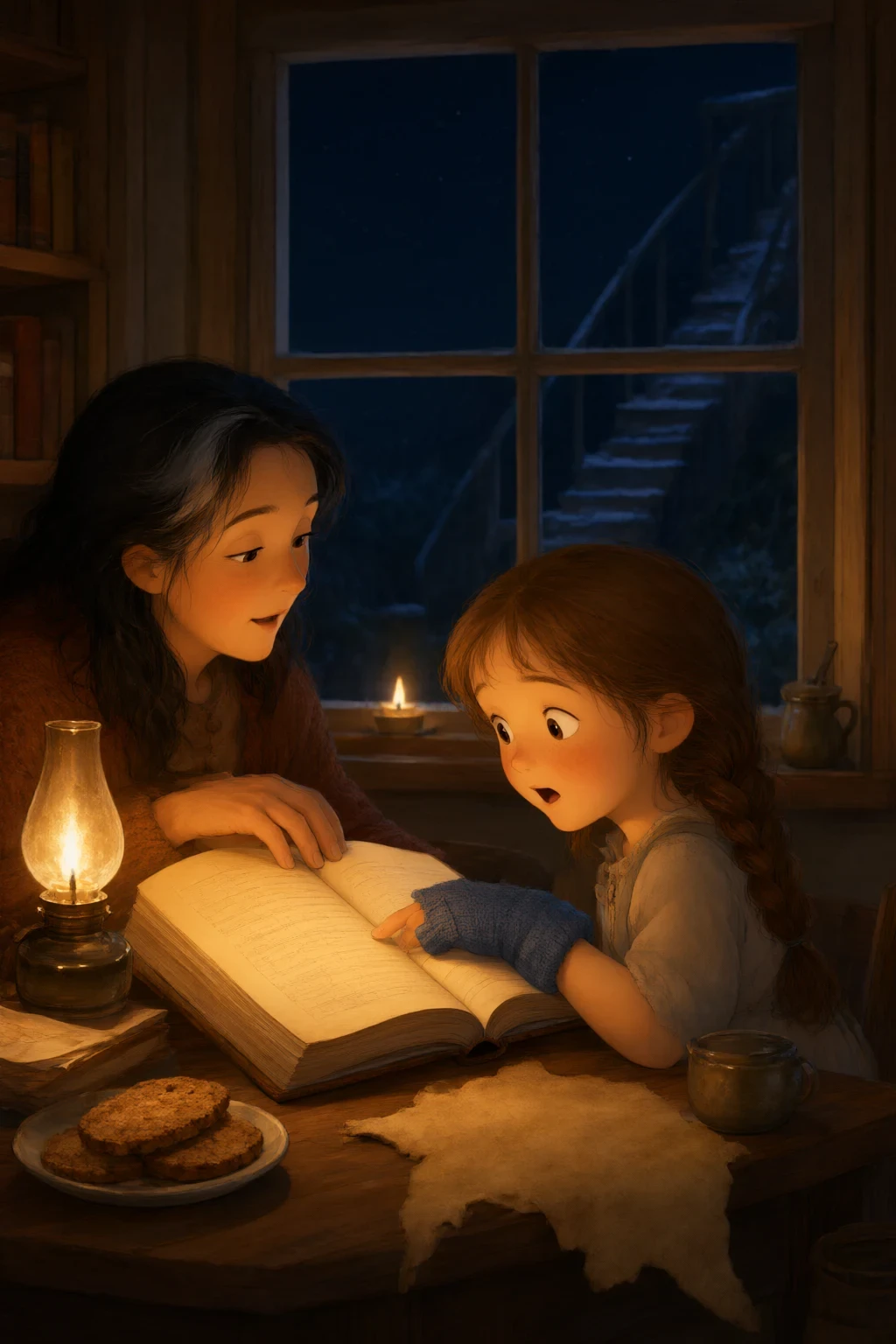
In the cold hours, when the wind came over the ridge in one long push and the lamp had burned down to a blue bead, Het Kalder took down the Register. She took it down with both hands. Her right hand was bare. Her left hand had a blue knitted fingerless glove on it, the only glove she owned, and she could not remember anybody giving it to her.
The Register stood on the highest slate shelf in a row of forty, and the one she wanted was the oldest and the softest, a ledger with a mouse in it. She opened it, and the smell came up at her: ink, tallow, and old sheepskin, the three smells of the one warm room on the mountain. She read out loud. She always did, in a very soft voice, because the room is made of stone and the words would otherwise go to the ceiling and be lost.
“This is Het reading the old one,” she said. “The mouse one. Het is on the page with the hole in it. The hole is in the shape of a thumb.”
At first light the stair came out of the cloud and went up away to the north in a long white curve, and the day was flat and blue and shadowless, with no colour in it. Mother was already up, and kept a lamp burning at the window, because there is a stoup of cold water and a dry crust of bread on that sill, and it is for whoever is coming down the stairs. Nobody has come down the stairs for a very long time. Het puts it there every morning, and has never asked. “Het is wiping the sill,” said Het. “Wipe it the other way,” said Mother. Het wiped it the other way.
Supper was boiled mountain lentils and oatcakes baked in the ash, and the bitter root tea, and the good lamp turned down. Mother sat with the Register shut in front of her and her hands flat on it, the way you sit on a thing you have finished arguing with. “And the term of that one is until the first snow,” said Het. Mother did not look up.
“And the term of that one is for nine years. Nine. From the day it was sworn.” Het turned the page. “And this one says for life, and this one says until she is forty, and the mice have eaten the term off the next one.” Mother said, “Het.” “It is only words, Mother.” “It is not only words. That is the whole difficulty and you are nine.” Mother turned her face all the way round, the way a door swings. “You have been reading that out.” “Yes. In the cold hours. It is nice in the cold hours.”
“What have you been reading out?” “The terms. The thing that says when it stops.” Het put her finger on the page. “Every one of them has got one, Mother. You said that if there is not one it is not a vow, it is a noise. So all of these have got one. Can I read you the one that is yours?”
Mother turned her whole body to face the table. “You have read that one already.” “Yes, right, yes. But I have never heard you say it.” “That is different.” “It is exactly the same, and you told me so.” So Mother read it. “Sworn in the eighth month, at the Shrine of the Ninth Step, by Ilse Merrow, keeper. I will not go down past the last step of this shrine while any of mine is on the pass. The term of this vow is the same, and it is when any of mine is not on the pass.”
The lamp hissed. The wind pushed once, hard, and the shutter knocked and did not open. “Is that the whole of it?” “That is the whole of it.” “Had you somebody then?” Mother put her hand up to her hair, on the left, where there is one white streak in it.
“Benna was on the pass,” she said. “Benna was my mother, and there was an evening when the Registrar came over the ridge and she was not going to last the night, and I put both my hands on the lintel of this door and said it out loud into a room with nobody in it but me. And it took.” “It took.” “It took. It does not care that I meant her. It took the words.” “Was I on the pass?”
“You were not born. You were a year off.” Mother said it flatly, and then said, before she answered anything else, “The last step.” “What?”
“I was not on the pass either. A person is not their own. I have had ten years to think about that and it has not got me anywhere.” She turned the Register round so the page faced Het. “But the mountain does not read it the way you read it. It reads only what is said, and only the plain sense. If you say any of mine, it takes a person. It has been waiting ten years for a person of mine to be on this mountain.”
And Het Kalder did the thing she had been doing in the cold hours without knowing she was doing it. She looked at the page, and she looked at the shelf of forty ledgers, and she did not read a term out loud. She counted. “One,” she said. “Mother. I am on the pass. That is one.” “Yes.” “So it is one of mine.” “Yes.” “So it has not stopped.” “No.” “So it stops when I go off the pass.” Mother did not say anything at all.
And Het went to the window and looked down the stair, going down in switches, grey and wet, shiny where the feet had worn the bowls, and down to where the cloud came up and the stair was only weather. “How far is off the pass?” “Eleven thousand steps, and four hundred miles of walking weather between here and there. The pass ends at the Shrine of the First Water, and below it is the valley road, which is the first place that is not the pass.” “Two days?”
“Two days and a half. If the weather is kind. It will not be.” “I have never been below the last step.” “You have not been below the last step in your life.” Mother turned to face her, all of herself. “Why do you want to go?” “Het wants to know what is down there.” She said it to the window, because it was easier to the window. “And Het is nine, and Mother’s leg will not go down past the last step, and so it is me, and so I am going.”
Mother sat very still. Then she said, “The last step.” “The last step,” said Het. “I have not asked one question about that page in ten years.” “I know,” said Het. “You are going to ask me one.” “Yes, right, yes.”
So Het asked it, standing in her stocking feet with the cold coming up through the flags. “What did she sound like?” Mother turned to face her. “Your grandmother.” “What did she sound like saying it?” “That is not a thing you can hear from a page.” Mother stood up and opened the door, all the way, and the Registrar came down the stair in one long push and set the flame in the doorway sideways and stood it back up. “You want to know what it sounds like.” “Yes. Het wants to know what it sounds like.”
“Very well. Stand still. Both feet. Do not say anything, because if you say anything you will be swearing, and I do not want you to have sworn anything.” So Het stood still in the doorway with the wind going over the top of her head, and Mother said it. “I will not go down past the last step of this shrine while any of mine is on the pass.”
The room behind her did not answer. The lamp did not lean. Nothing came out of the stone, because it had been sworn already, ten years ago, and a thing that is already sworn is not sworn twice. “That is what it sounds like,” said Mother. “It sounds like nothing at all. That is the good part and the bad part together.”
“And now I am going to do a thing properly, and you are going to watch me do it.” She stood up straight inside the doorway with the flame in the door and the wind on the slate roof. “I will not open this door again for anybody but my daughter until the first snow.” Still nothing. “That was a vow,” said Het. “That was a vow. Do you know what it was worth?” “No.”
“Three weeks, and my arms, and my hands being cold, and the man at the Third coming up tomorrow for a room, and me saying no to him in my own doorway. Nine years costs the colour off your face and the ease of your breath. It is only arithmetic, and the arithmetic can be wrong, and it is never wrong on purpose.” “Does it stop by itself?”
“It stops by itself. That is the good part. On the day it lifts, and nobody has to forgive anybody, and there is no ceremony, and you will not feel it much. You will just find that a thing you were carrying is not there any more.” She put her hand flat on the lintel. “But I am not going to wait for the snow to find out whether I meant it. I am going to know that I am holding the door shut.”
Mother went up the stair at the half hour after noon with a pack and a staff, and Het watched her from the terrace going out into the weather like a spark going along a road. And at the First Water, where the pass stops and the valley road starts, Het turned round and looked back up the whole four hundred miles of stair, and stepped off the end of it. She did not know what had happened. She was a long way off in her own feet by then, on ground she had never walked on.
Up above, in the copy-desk, Ilse Merrow was sitting with the Register open in front of her, doing nothing at all, when the two words came off her legs and turned south. She looked down. The stair went down in switches, grey and wet, with the cloud coming up over it. She put her hand on the wall, and the wall was cold, and she went down four steps, and nothing stopped her, and the cold was only cold.
Nothing was wrong with her feet. That was how she knew. It was not that they were free. It was that they were feet, and they were hers, and they had been somebody else’s all morning, holding her on a stair for the sake of a person who was not yet born when she swore it.
She sat down on the fourth step in the middle of the worn bowls and put her face in her hands and cried for about the length of a cup of water, and then she got up and went down, in a hurry, the way you go down when you have found out what you are actually doing.
The next morning there was an inch of fresh snow on the terrace, the first of the season, lying in the bowls of the steps and on the arc around the black square, and the sky behind it was the colour of a knife. A man came up the stair from the Third with a horse collar in his hands, wanting a room. Mother opened the door.
She had not opened the door for anybody but her daughter since the day she had said the words in the doorway, and she had said the snow could come when it liked. It had come in the night. The flame in the doorway stood straight up. Her arms were warm. Her hands were warm all the way to the tips of the fingers, and she noticed that, because she had been counting the days of it on her fingers, and there was no more counting to do.
“Come in,” she said. “Sit down. There is bread on the sill, and it is for whoever is coming down the stairs.” It was not for anybody in particular. It had never been for anybody in particular. But she knew the name of the person it was for, because that person was out on the valley road at that moment with snow on her hair, walking fast, and she was nine years old, and she was the only thing on the pass that was anybody’s, and the pass had let her go.