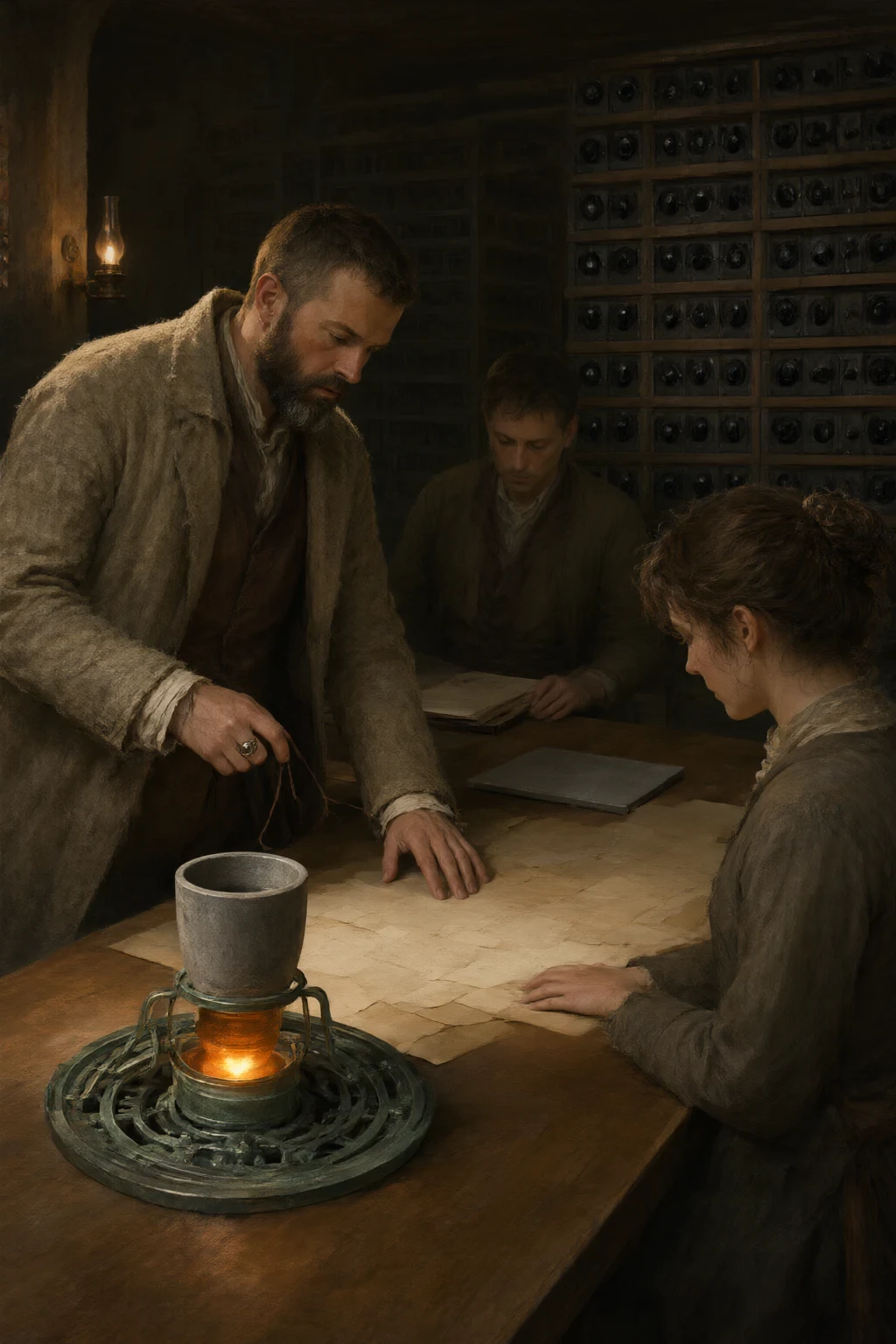
The covenant of the founding was sworn for six hundred years, and the six hundred years had run out nineteen years ago. Nobody had noticed. That was not an oversight so much as a habit. The term of an oath is not a fact anybody reads off a body; it is a figure in a keeper’s column, and the column is the Table of Diminution, and the Table had been reduced in the ordinary course of business twice a year since before the last three generations were born, always by a small amount, always in the same hand, always without comment. The first entry is dated the year of the harvest proposal and reads, in full, as follows: maximum term of any new oath sworn under the founding covenant, one hundred and eight months. The last entry, made in the cold of this year, reads: nine months. In nineteen years the Table had lost ninety-nine months, which is to say it had lost the founding covenant in instalments, on the reasonable assumption that nobody would ever audit the instalments against the parent.
The consequence of a nine-month maximum was that almost nothing in the caldera could be sworn any more, and the consequence of almost nothing being sworn was not visible for about a decade, and then it was visible everywhere at once. A mason could not swear to a house. A bridge gang could not swear to a span. A man could not swear to his daughter’s marriage, because the girl was five and a nine-month term would run out in her first winter. Couriers could not swear a running order. The Chain Causeway, eleven miles of obsidian-seamed basalt from the Sixth Gate to the Third, had been repointed in eleven years entirely by unpaid labour, and nobody had sworn a word of it, and the reason was arithmetic, and the arithmetic was correct.
What nine months is, is easy to say in a council and hard to say in a street, and the street is where the Table of Diminution had been quietly spending itself for nineteen years. A mason of the Ninth Terrace could not swear to a house, because the shortest house is four years, and the practice had become to lay the first course under an oath of warming that covered the work of the day, which is a real oath and takes a day of a life and does not make a fixture. A woman at the top of the Bonding Stair could not swear her daughter’s marriage, because the girl was five, and a brand on a five-year-old that runs out in her first winter is not a marriage, it is a bet. A courier gang could not swear a running order, so the order went out unsealed and was carried, when it was carried, on a boy’s word. None of that was law-breaking. There is no law against a short oath and no law against no oath. The only law is that an oath may not exceed the parent, and the parent has no term at all, so in the strictest reading of the strictest rule the maximum term of a new oath is unlimited, which is why every keeper in the chain has quietly declined to reach that conclusion, and why the Table exists.
Kel Rusk put it in one line, on the second day, and did not put it in again. “The chain has stopped making things that will outlast it,” he said. “It has not stopped building. It has stopped being able to say out loud, in front of a fire, that a thing will outlast it, and a mason who cannot say that lays a wall the way a man carries a barrow uphill: he will do it, and it will be good work, and it will be gone in fifty years, and nobody will ever be able to say why.” The league of seven was constituted in the first week of the first warm month, in a room under the terrace with walls of cooled shelves, and its only formal characteristic was that every member of it had been named by nobody.
The seven city-states had each sent a delegate to the Ascendancy, as they called the sitting, and the Ascendancy had been going badly for eleven days when somebody observed that the delegates had all come with instructions to want the same thing. Not the same terms. The same thing. Every one of the seven wanted a successor instrument with a full term in it, and the reasons were so various that the observation had not been made: the Second wanted its salt-road concessions written in; the Third wanted the causeway repaired on somebody else’s account; the Fifth wanted a clause about the wastes that would let it say it had tried; the Sixth wanted the apportionment of the dregs settled before the winter; Cindergate wanted to be seen to have insisted; the Fourth wanted nothing at all and had come to watch. “Every one of you wants the same instrument,” said Odo Harrow of Harrowfoot, who had been in the room for two days and had not yet spoken, because Odo Harrow apologised before demands and had spent both days apologising for the fact of being there. “I am sorry to say it plainly. It would be better if you wanted six different things. As it stands, one good instrument would satisfy all of you, and I do not think one good instrument exists, and I would rather we found that out in a room than in a market.”
Nobody contradicted him, and the delegate of the Second, Halvard Ness, who was fifty-one and said every number twice, said his number twice. “Six hundred years,” Ness said. “A successor sworn for six hundred years. The founding cost one thousand one hundred measures. The cup stands at one thousand one hundred and eighty. We have eighty measures of margin and four hundred years to find the rest, and eighty measures is a great deal of margin for a chain that has learned not to spend.” “The founding also cost one thousand one hundred measures,” said Ashara Venn, “and the founding got six hundred years, and the thing that made those six hundred years cheap was that nobody swore anything big for the first eighty of them. We have not got eighty years. We have got nineteen years of shortfall already, and the shortfall is why the Table reads nine months, and the Table is why your salt-road concessions cannot be sworn for a year, let alone a generation.” The delegate of the Fifth said that this was a matter for the measuring house and not for a room, and Ashara said, “I am the measuring house,” and then heard herself say it in the council’s grammar, in front of strangers, and the wince went round the table, and the delegate of the Third, Ivet Lask, said, “Apologies,” which is a thing delegates say when they have decided to be polite for the rest of the sitting.
Odo Harrow had come to the room with a phrase in his mouth and had been holding it for two days. He was forty-two and chewed a burnt-cork stopper when he thought, and he had a little book of debts the size of his hand that he had never once collected from, and the book was in front of him on the table, closed, and it had been on the table for two days and no one had asked about it, and that was also correct. “Nobody’s delegates,” he said. “That is what we are. Not unaligned. Not impartial. Nobody’s. Six of you can be named by somebody and have your name be that somebody’s price, and the seventh of you is from a town that is not a party to the covenant and never has been, and so I am sorry to say that I am the only one of the seven whose instructions are to leave.” “Your town is a beneficiary,” said Ashara. “Harrowfoot stands on covenant-built road and sells on covenant-enforced contracts. That is not neutral. That is the cheapest seat in the caldera.”
“Yes,” said Odo Harrow. “That is exactly what it is, and I have known it for twenty years, and I have never once been asked to write it down, and there is a book on this table that says how much of it there is, and if the league would permit me I would like to read it out.” They permitted him. He read it out. It took ninety minutes. Harrowfoot owed the chain, for causeway tolls enforced and not paid, for road-work done under sworn gangs and left unpaid, for water-rights on the Third, for a bell-foundry’s worth of bronze and a rope-walk’s worth of hemp, a sum that came to four thousand six hundred and eleven measures of value, none of it sworn, none of it collectable, none of it ever pursued. And the chain owed Harrowfoot, for the free passage of the market road through the town for two hundred and eleven years without toll, and for the refuge given to about ninety people a year who came out of the chain with nothing and were not asked where they had been, a sum that came to nothing at all, because you cannot put a number on a thing that was never promised.
“That is the whole of my instructions,” said Odo Harrow. “I am sorry it is not more dignified. It is nine pages and it is a bill, and I have never collected it, and if I had collected it, half of it would have been owed in men and not in money, and I did not want to know which half.” Kel Rusk, who had not spoken for two days, said: “Four thousand six hundred and eleven. What is that in spans.” “It is not in spans.” “It is in something,” said Kel Rusk. “Everything is in something. Give me the barrow and I will give you the spans.”
Ordwin Sparre spoke on the sixth day, later than anybody expected and earlier than he had intended, because he had wanted to be asked and was not going to wait. He was thirty-five and he was the only man at the table with nothing on his arms, because the wastes do not swear, and the only mark on him anywhere was a black one, a broken-oath brand that ran from his jaw to his collarbone and had been treated and re-treated until the skin over it was silver rather than the colour of a person. He wore it open at the neck in a room of keepers, which was either the bravest thing in the chamber or the rudest, and Ordwin never explained it. “We says,” he said, “that we has read the draft of the four hundred years, and we says it is a good instrument, and we says we will sign it, and we says that we has not come here to be thanked for that and we would like the room to stop waiting for us to want something.” “What do you want?” said Ashara, who had asked the question eleven times in six days of other arguments and had got eleven different answers.
“Admission,” said Ordwin Sparre. “Not a clause about us. A party. On the same article, in the same hand, with our own seat, and the seat to be filled by somebody we send, and that somebody to be able to sign, and the signature to count, and the counting to be done by the same cup that counts the rest. We says that is all, and we says we have never once asked for anything else, and we says the room has spent six days discovering that arithmetic is arithmetic and we says we have known that since we were nine years old and burnt a toll post.” Nobody at the table looked at his neck, and the effort of not looking was the single most conspicuous thing that happened in the room that day. “You burnt a toll post,” said Ivet Lask of the Third. “We burnt a toll post,” said Ordwin Sparre. “We were fourteen. It stood on wastes ground with a chain city’s prices on it, and we took an axe to it in the night, and we were caught, and the brand you are looking at is the record of it, and the record is true, and we do not come here to have it explained away. We says that a black mark is not a binding. We knows that. We says it here so that nobody in this room can later say that we came with a grievance and put it in the draft.” “Then what is in the draft for you,” said Odo Harrow, apologising.
“Admission is not forgiveness,” said Ordwin Sparre, “and we would like that written down in a place where it will be read in a hundred years by somebody who has never heard of a toll post. We says the two are different. We says we have understood the difference since we were nineteen, and that we have not forgiven anybody, and that we are not asking for that, and that the room may put down in its record that we did not ask for it.” He looked at Dain Callow, who was at the end of the table with his hand flat on the wood. “We says there is a bell. We says we have read in the ledger-book that two hundred and eleven of the dead of the last sixty years cannot be rung for, and we says that a number of them were ours, and we says that a cairn cannot be sworn, and we says that this is not a wound, it is a rule, and we do not ask you to break it. We asks that our dead be in the book, and we says the seven of us cannot get them in, and we says the room can.” Dain Callow said, for the fourth time in six days, that he would attend to it, and meant it, and this time somebody wrote down that he had said it.
“We says one more thing,” said Ordwin Sparre, “and then we says we will sit down. The draft says the wastes are admitted on terms to be set by the league. We says do not do that in a later article. We says set them here, on this page, at the same weight, or we says the word admission in your document is a door you can shut again, and we have stood outside doors for eleven years and we know what one looks like.” They set them on the same page, at the same weight, on the ninth day, and it took four hours, and it is Article Two.
The draft occupied nineteen days and the table occupied the room, and on the fourth day the league discovered what it had been convened to do, which was not to write a covenant and never had been. It was to write down what the chain could afford. Ashara had the arithmetic and the arithmetic was short, because the arithmetic was one subtraction. The founding covenant cost one thousand one hundred measures of first-fire glass, drawn from the single buried vein beneath the vent cone at Cindergate, and that one thousand one hundred had bought six hundred years of peace for seven city-states and everything they had sworn in the time. The cup was graduated to nine thousand. The cup now stood at one thousand one hundred and eighty. So the founding had cost a little under one ninth of the vein and a little over a twelfth remained, and the chain could afford exactly one more covenant of the founding’s size and not one covenant more. “There is no version of this in which the successor is affordable,” said Ashara, “and the reason there is no version is that a covenant is not a document. A covenant is a quantity, and every word of it is drawn against the same cup.” “Then we write a smaller one,” said Ru Quen.
She was forty-five and kept the swap-stall at the north end of the Ninth Terrace market, and she had been the seventh member of the league for eleven days without once being asked to speak, because a woman who trades promises for collateral is a person the room is careful with. She had spent the eleven days listening, and by the ninth day Ashara understood that she had been doing the arithmetic on the room itself. “Smaller is not worse,” said Ru Quen. “Smaller is what a stall is. You cannot sell a man a tenth of a horse. In here you have been trying to sell the seventh city a whole horse, and the horse costs a thousand one hundred measures, and the customer is standing in the mud with a rope in his hand. What is the tenth of a horse, and what does the man do with it?” “The tenth of a horse is a term of sixty years,” said Ashara. “Then a term of sixty years costs a hundred and ten measures, and the room has a thousand one hundred and eighty, and there is a table in here with the number on it, and the customer can count.”
“No,” said Ashara. “Because the strength of a covenant is not divided among the swears. The founding bought six hundred years of peace, and the peace was bought once, and every small oath sworn in the time hangs from it and costs almost nothing. If I swear a covenant for sixty years, the strength has to be there on the first day, holding sixty years of chain together, and it is not divisible. That is the whole of the arithmetic.” “Then the founding was expensive because it was long,” said Ru Quen, “and everything else in this room has been long for six hundred years, and I have been selling eighth-year clauses at that stall for twenty-two years and I can tell you what has happened to them.” She put her hand flat on the table, which she did before she said anything she wanted remembered. “They have stopped being worth what they say. A clause of eight years and four months was collateral in my mother’s time. It is the best collateral I have now, because it is the longest thing anybody can swear. Two years ago the ceiling was eleven months and nobody could swap a season’s work against it, so people went back to their word, and their word was good, and it is now the most liquid thing in the caldera, and none of it can be proved by anybody.” Nobody at the table had a number for that. Ashara had a number for the fuel and Ru Quen had a number for the swap-stall, and between them they had the two halves of a thing no delegate had ever asked to be told.
They went down to the Ninth Terrace on the twelfth to see the swap-stall, which is not a thing a drafting league is supposed to do, and which the league did because Article Twelve would not settle in an upstairs room. The market was on its fifth day and the light under the oiled sailcloth was the colour of weak tea, and the lantern flames at ankle height threw shadows up the black basalt wall of the terrace four times the height of the men casting them, and the heat came up through the paving in warm patches that everybody had learned to step over without looking. The Measure had been called at noon two hours before, and the bellows-smith had the number, and the rope-stitcher had the number, and by the third rank of trestles there was a man who had it approximately wrong and was being corrected by two people at once.
Ru Quen’s stall was the fourth on the left, and it was the only one in the market that was not selling a thing. She sold time. A man could come to the swap-stall with a year’s labour in his hands and go away with a clause, and the clause could be held against anything the covenant could enforce, which is how a cooper secured a lease and a woman secured a dowry and, in one case the stallholder still remembered with some pleasure, a man at the Third secured a whole bridge against a bride’s portion. Ru Quen put the stall ledger on the board and let two keepers and a mason and a deaf courier look at it, which nobody in the chain had done before, and which took four minutes, and which is the whole of Article Twelve.
“There,” she said. “Four hundred and nine entries in eleven years. Two hundred and eleven of them are sworn clauses, and every one of those is now under a year long, and none has any value, because there is no point in collateral that expires before the loan. The other hundred and ninety-eight are not clauses. They are witnesses. Two people, a fair hand, a place and a date, and it says who said what to whom, and that is worth what a memory is worth, which is a great deal in a town and nothing at all in a court.” Ashara Venn looked at a page for a long time. “What is the rate,” she said. “Between the two kinds.” “Two in the hundred, a year, to the lender,” said Ru Quen, “which is what it has always been, because that is what a person’s word costs to hold, and people do not know that is what they are paying. The covenant’s rate is nothing, because the covenant is a witness that does not forget and does not move house. You have taken the witness away and left the loan. That is the whole financial history of the last eleven years, and it is one line, and it is not in your draft.” “It is not an instrument,” said Ashara. “No,” said Ru Quen. “It is two people and a fair hand. It is the oldest instrument there is. It is the one you had before the flame.”
They argued about the fuel clause for six days. The delegates’ fuel clause was one sentence and it was the same sentence in all seven capitals, and when Ashara finally wrote it out on a slate and put it on the table it read: the covenant is sustained by first-fire glass, drawn from the vein at Cindergate, in such quantity as the several parties shall from time to time determine. It was a beautiful sentence. It had no number in it anywhere, and the absence of the number was the entire problem, and every person at the table understood that a beautiful sentence with no number in it is a promise that will be settled by whoever is angriest in the year it comes due. Ashara’s clause had a number in it. She drafted it on the eleventh day and read it out, and it was the best thing she had ever written, and it failed in the room within ninety seconds. “The successor instrument is sworn for a term of four hundred years at a strength of one thousand one hundred measures drawn against the vein at the covenant vent, and no oath sworn under it shall exceed the term of the instrument, and the apportionment of the draw shall be fixed at the reading of the Measure in the first month of each year, published, and not altered except by a further instrument sworn under this one.”
“It is elegant,” said Odo Harrow, apologising. “I am sorry. It is elegant and I am not able to sign it, and I would like to say why, because if I do not say why, I am a man who has had nothing to do for two days.” “You may say why,” said Ashara. “It costs one thousand one hundred of the one thousand one hundred and eighty, and it says in its own seventh line that the apportionment of the draw shall be published, and the apportionment of a thousand one hundred measures over four hundred years is two and three-quarter measures a year, and at two and three-quarter measures a year the chain cannot swear the thing you have just described. It is a covenant to keep a covenant’s housekeeping. It is a stove to heat a house with nothing in the house.” He turned his book over and did not open it. “And it is the best draft that has ever been put in front of me, and I have read four.” “Then we write one that leaves the eighty,” said Ashara.
“Then in three hundred and ninety-nine years the eighty is the last of the chain, and the chain spends it, and then there is a hundredth year in which there is nothing at all, and in that year every oath sworn under your instrument falls slack on the same day, all together, because they all hang from the same tree. Your four hundred years end in an avalanche.” “Yes,” said Ashara. “You have known that since the second day.” “Yes,” said Ashara, and heard her own voice do the thing it does with a proposal in it, and nobody in the room winced, because by the nineteenth day they had all stopped.
On the fifteenth day Sister-Iven Carshal brought out the founding register. It took two keepers and a magistrate and four hours in the cold, and it cost eighty measures of the cup to have it unsealed and resealed under the rule that the glass may not be out of its case for more than one day, and that cost was the subject of the only real fight the room had all afternoon. Ashara argued that the eighty was the margin, and Kel Rusk argued that the eighty was the difference between a floor and a hole, and they settled it by splitting it, which is the oldest method in the caldera and which none of them enjoyed. The register is a metre and a half of first-fire glass with nine oaths cut into it in the founder’s own hand, and there are no numbers on it anywhere. There are no dates. There is no term clause, in the first oath or the fourth or the seventh, and no word in the whole metre and a half that says six hundred, and no word that says the name of the wastes, and there is a fifth column. “The founding covenant was sworn for six hundred years,” said Ashara, before anybody else could, “and the number six hundred is not in it.” “No,” said Sister-Iven.
“It is in the Table. It has been in the Table since the Table began. Someone entered it, at the first reduction, nineteen years ago, or earlier, and then reduced it, and the reductions are in the same hand, and the hand is yours.” “It is mine,” said Sister-Iven Carshal. “Noted.” “You have been reducing the term of every oath sworn in this chain by a day at a time, twice a year, for nineteen years, on the authority of a number that is not in the founding instrument.” “Yes.” “Why?” “Because the founding instrument has no term, and the Table is how we hold it,” said Iven, “and I have wanted for eleven days to say that sentence and I have been waiting for the register to be in the room before I said it, because you would not have believed me and because I wanted to be able to point.” She put her finger on the glass, one side of her face dead, her eyes grey to the edges, the slate stylus in her left hand.
“The founding did not swear the peace for a period. It swore it for the peace. There is no term, and there is no renewal, and there is no successor, and the whole of the Table of Diminution is nineteen years of people politely pretending that a thing with no end has an end, and the reason it is written that way is that a man who names a number in an instrument has put a day on his own peace, and everything after that day is a different instrument, and somebody has to be alive to swear it.” She took the stylus out and put it back. “The peace ends when it stops holding.” Dain Callow, who had been sitting at the end of the table with his hand flat on the wood because the room was loud and he had been deaf since the ninth of Emberfall and had not told anybody he had told nobody, said: “Thirty-One. How do you know when it stops holding.” Nobody answered him, and Ashara Venn wrote it down, and it is in the League Book in the first week of the first warm month, in her hand, with no comment, and it is the ninth line, and it is the line the whole of the next three years turns on. They delivered the draft on the twentieth day and read it out in the same room with the delegates in it, and it ran to forty-one pages, and it was the best document any of them had ever been near.
It had a term clause. It had a fuel clause with a number in it, and the number was the founding’s own figure, and there was an appended schedule setting out in a hand anybody could check exactly what one thousand one hundred measures buys and exactly what eighty measures buys, and the schedule was the reason the delegates were quiet, because nobody in the chain had ever been shown the second number. It had an apportionment clause. It had a clause admitting the wastes as a party, which Ordwin Sparre had fought for over four days and had won on the fifth, on the ground that admission was not forgiveness. And it had Article Twelve, which was Ru Quen’s: that any promise not sworn under the covenant, being made between persons in the open and before two witnesses who are not parties to it, should be entered by those witnesses in a fair hand and kept in three places for not less than seven years. There was no flame in Article Twelve and no measure in it, and Ashara had lost it in eleven minutes, because Ru Quen had asked her one question about it, which was what a keeper is for. And at the front, in the place where a founding instrument puts its arithmetic, a single line in the fair hand of the Keeper of the Measure. The successor may be sworn once.
The delegates read it. Halvard Ness read the number twice. The delegate of the Fourth, who had wanted nothing in particular and had come to watch, read that line last and read it twice as well, for as long as the room allowed him, and then said, in a voice nobody had heard him use before, that the room had spent nineteen days producing a beautiful document with a sentence at the front of it that says the end is coming, and that no delegate could sign a document containing his own city’s ending, because a delegate who signs that has not been instructed to do so and cannot afterwards claim to have been. “That is not in our instructions,” said the delegate of the Sixth, Sabra Drenn, who had not spoken for nine days, and the room understood that she was neither defending the document nor attacking it, and was reporting the position of seven city-states in a single clause. “Apologies,” said Ivet Lask of the Third. “But the arithmetic is the arithmetic.” “The arithmetic,” said Ashara, “is at the front, on purpose, in my hand, and it stays at the front. I will not put a good document in front of this room and a number in a drawer. The whole of the last nineteen days has been a search for a version where the number is not true, and there is not one, and I would rather hand you a true document that you cannot sign than a false one that you can.” Nobody in the room had ever heard a keeper say that the document was hers and not the room’s. The wince came and went.
Odo Harrow left on the twentieth day at the third hour, because he had a town to go back to, and he left the book on the table, which was not an accident, and which he was extremely apologetic about. “If the league wants the nine pages, they are the nine pages,” he said. “I have never collected any of it, in twenty years, and there is a reason, and the reason is that the moment I open that book in the market at Harrowfoot I am a magistrate collecting four thousand six hundred and eleven measures of value from people who mostly cannot pay it, and I would have to do it, because I am the magistrate, and I have spent twenty years not being the magistrate, and the not-being has been the best administration this town has ever had.” “You are a free town,” said Dain Callow. “You have never sworn.” “We have never sworn,” said Odo Harrow, “and we have eaten off the chain every year of it, and I have come here to be told so in front of witnesses, and I would be obliged if somebody would put it in the record, and I am sorry that it is me asking.”
They put it in the record. It is the twenty-second line of the League Book, and it is the only line in the League Book that was not written by a keeper, a mason, a courier, a bell, a magistrate, a spokesman or a stallholder, and it is the line the sixth proposal of the following year is built on, and nobody at the time knew that. Ashara went down the Bonding Stair at dusk and stood at the top with her hand on the warm rail where the copper wire and the bread are knotted, and tried the only arithmetic that was left, which was the one that had nothing in it. The founder had sworn a peace with no end to it, and the end came when it stopped holding. She had spent nineteen days learning that the chain had been living on a number that a woman her teacher had been quietly reducing in her own hand for nineteen years, and that the reduction had kept the chain alive by making the promises shorter, and that the promises had got shorter and shorter until they were shorter than a marriage, shorter than a house, shorter than a course of stone, shorter than a season, and that the chain was now a chain of nine-month promises and a great deal of unpunctured basalt.
Somewhere below her the lamps were being lit one at a time from the bottom up, the way it is done, and the whole city was going orange from underneath, and on the Ninth Terrace a man with a slate was writing down a number that everybody already knew, and at a swap-stall a woman of forty-five was closing a book in which nothing longer than nine months could be written, and at a toll post on the Twelfth-Gate a man of about fifty was flexing his fingers in the lamplight and finding that he could not quite be certain what was written on them. The measure at the front of the draft was one thousand one hundred and eighty, and Ashara Venn stood at the top of nine hundred steps and did not have a way of making it larger, and the founder’s own brand, which no living person had ever carried, was in her chamber in a lead-lined case with the register, and she had never once been permitted to touch it, and she wanted it more than she had ever wanted anything, and it occurred to her, on the top of the stair, in the last of the light, that wanting it was not the same as being equal to it, and that she had known that for some time, and had never once written it down, and that the woman who had written down everything else for sixty years had not written it down either.