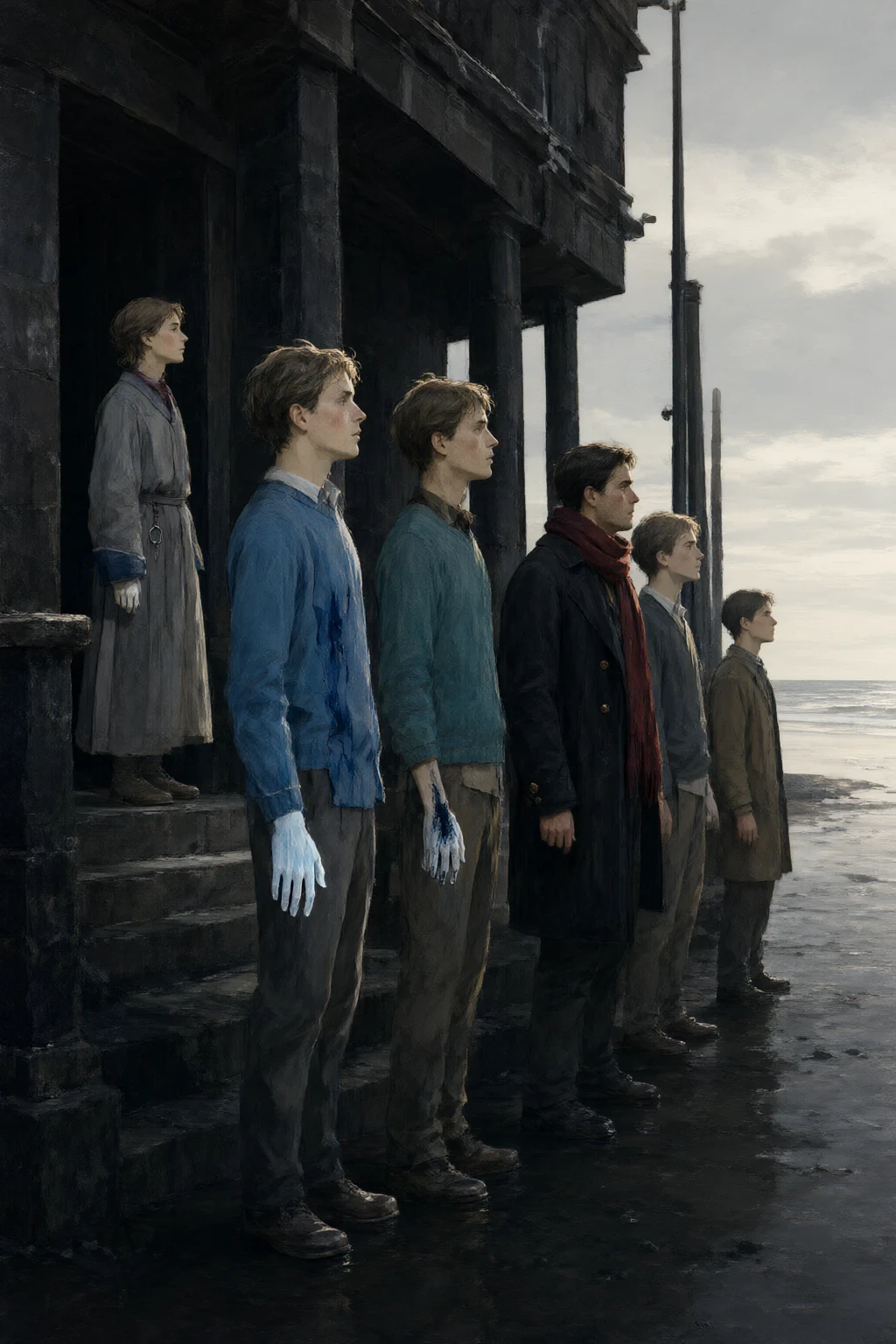
The lowest tide of the year came on a Tuesday, and by the time the Greyhaven cart had finished coughing up the stone road and Market Day had begun in earnest, the sea had gone out so far that you could walk out to the Library’s footings on the hard sand with a barrow and not get your knees wet. The mud Shelf had been opened at four in the morning, which is the only time it is ever opened, and by six the whole floor of it stood in two inches of grey silt with the drying racks down the middle of it and the oldest and wettest books in the world standing up on those racks to dry in the air like washing on a line. It is the finest reading room in the world for about five hours a year, and everybody who has worked in it agrees that this is a working condition and not a gift.
Sister Anwen Tarn came up the seven steps at ten past six with a slate under her arm and a short grey cloak buttoned to the throat, and stopped dead on the top step, and began to count. “One. Two. Three. Four. Five. Six. Seven. Eight. Nine. Ten. Eleven.” “Eleven what?” said Niko. He had been on the Shelf since five with a lamp and a short ladder, because the Shelf is unnumbered and unheated and the only light in it comes down the hatch, and because when the seventh night comes the building grows a step and he has started sleeping badly in the week before it. He was seventeen, in a sea-blue knitted jumper with the cuffs permanently rolled, and there was a wet navy streak of ink across his left palm that had not washed out in a year, and he read standing up, and had been standing up for two hours.
“Eleven of something,” said Anwen. “At the foot of the steps. I counted them twice and I counted them from the Porch so that I could see the whole queue, and there are eleven, and they are standing in a line the way people stand in a line, and they have not moved while I have been inside this building.” They went down together, past the Porch, into the light.
The sea had left black sand ribbed with a hundred little ridges, and the whole flat lay west of them under a low grey sky, and the Library stood on its eighty-one iron stilts with the water four hundred yards off and the reflection of the building lying under it upside down and shivering. At the foot of the seven stone steps there was a line of eleven people. Niko said, “But who are they?” “They are wet through to the knee,” said Anwen, “and the sea is four hundred yards off, and they have been standing there since before the hatch was opened at four. It is not a tide coming in. They are not wet because the sea reached them. They are wet the way a page is wet.” He looked at the line, properly, for the first time, and the light was flat and grey and it took a while.
There was a woman of about forty with her arms at her sides holding a slip of paper in both hands. There was a man with one of his shoes off and swinging it by the laces, and the shoe was full of water and the water was not spilling. There was a tall thin boy, tall the way a boy gets when he has been drawn out of a shelf. Behind him a small woman with a shawl pulled over her head, and behind her a girl of about nineteen holding a slip against her chest with both arms, the way you hold a plate of soup. None of them was talking. None of them was shivering. The water stood in the shape of each of them and did not run off, and where the sun came through a break in the cloud it lay on the water on the woman’s sleeve in a bright edge and stayed there. “They are wet paper,” Niko said. “They are a part of somebody, in a book, that got up,” said Anwen Tarn.
Each of them was holding a slip of paper about the size of a playing card, and on each slip there was a line of writing in the Library’s own hand, because the Library cuts its own slips with its own shears, and it has done for four hundred years. Niko went down the flat on the hard sand and read the first one. It said: Issued, the mud Shelf, one volume, the borrower to return on or before the turn of the following tide. “It is a due-slip,” he said. “It is a library slip.” “It is a due-slip,” Anwen agreed, “cut and signed by this building, for a book that this building has not given back, in four decades. And look at the dates on them, boy. Look at the dates.”
He looked at the dates. They were not all the same. They ran from the year of the fever to the year after the great storm, and they were as ordinary as a market day, and the oldest of them was forty-one years old and the paper was not rotten, because the paper in this building is the only paper in the world that does not rot. “There were eleven of them borrowed and never given back,” he said. “There were eleven of them taken,” said Anwen Tarn, “which is the same sentence, and the fact that you can say it either way is the whole of what has happened to us this morning.”
They went in and up to the Servery, which is the highest room and the only one with no books in it, and Anwen laid her slate on the scarred amber table and squared it, and Niko put the kettle on, and then stood looking at the kettle for a long moment and did not go away from it. The Servery is where the rules are kept, or what is left of them. There is a slate on the wall with the Rules of One scratched on it, and underneath them, in a hand that went in hard and shook, the Rule of One has been scratched out.
“The first rule is that a loan runs a season,” said Anwen. “Which is eleven weeks in a spring tide and three weeks in a bad one. The second rule is that after the season the book is the Library’s. The third rule is that a book may be recalled at any time. The fourth rule is that a borrower is not asked to pay twice.” “That is a kind set of rules,” said Niko. “It is the kindest set of rules on this coast, and they are reasonable, and every one of them is a way of not having a conversation.” She put her cold blue-white palm flat on the table. “If I salt those eleven slips, the claims go blind, the queue stops, and the Shelf closes this afternoon with the racks dry and nothing lost, and we do all of it with a bowl of salt and four minutes’ work. That is the reasonable course. That is what I would put in a report.”
“Then why are we not doing it?” Anwen Tarn did not answer for a moment. “Because those eleven are the only record I have that eleven people ever sat in that room,” she said. “Their names are not on the slate. The slips are in their hands. If I blind the slips, the Library never tells anybody those eleven came here, and never will, and the eleven questions stop being asked, and that is not a resolution. That is a library that has learned to answer a question by making sure the question is never asked again.” The borrower came in at eleven. He came up the seven steps one at a time and stood in the Servery doorway with the rain running off the brim of a hat that had been good in about forty-one years, and he had the look of a man who has walked three miles and would walk them again, and Niko did not know him, and Anwen did. “Tam Pellow,” she said. “Boatwright. Greyhaven.” “I want my book,” said Pellow. “Which one?”
“That is the trouble, Sister, and you know it is the trouble, and I have come three miles to say so to somebody who writes things down.” He put his hand flat on the table, in the manner of somebody who has used a table in a shop for forty years. “I came in the year of the fever. I took a book off the bottom of that shelf because it was the only one about a hull. I read it in there, because it is the only room on this coast where a man can sit down, and I read it to the end, and I remember the end of it better than I remember my own wedding, and I cannot tell you which book it was. Not the title. Not the colour.”
“You have a slip,” said Niko. “I have a slip, and I have had a slip for forty-one years, and I have never once been asked for it.” Pellow took it out of his inside pocket, and it was in eleven pieces and had been folded and unfolded so many times the folds had gone through. “And here is the thing I have come to say. It is a slip of paper. It is not a promise. I never promised. I did not know it was a promise.” “You were not taking anything,” said Anwen. “You were being lent. That is the entire arrangement, and it is the only one we have.” “Then I will hold to it, and I will take the paper off you, and you will not have me after that.” He turned the broken slip over in his hand. “I have thought about nothing else on the walk down.”
Wray Imbrie came in at half past eleven, and he came in the way he came in every time, which was as though the building had asked him and he had decided at the last moment to accept. He was thirty-four, in a long dark wool coat with tarnished copper buttons and a long red scarf, and there was ink permanently stained into his right cuff, and he was the only living reader whose watercopy was complete, and everybody in the Servery knew it the way everybody in a small town knows which house is the one that burned. He looked at the eleven through the window, and Niko watched him look, and watched the thing happen to his face that happened to everybody’s face. “Say the term and I’ll sign,” said Wray. “But I am not discussing it until the term is said.” “There is no term, borrower,” said Anwen. “Nobody has said a term.”
“There is always a term,” said Wray Imbrie. “That is what a term is. If nobody says one, you have chosen it, and the Library always chooses the same one, and it has chosen it since before I was born, and I have read the whole of it.” He put his hand into his coat and brought out a slip of paper, and it was in four pieces, and it was much newer than the other eleven. “Twenty-sixth of the ebb,” he said. “Three months ago. Mud Shelf. One volume, to be returned on or before the turn of the following tide. That is my slip. I have carried it for three months and never shown it to anybody, and I would like it noted that I have come now on my own account and not because I was sent.”
“You have never shown it to anybody,” said Niko, “because the Rule of One is that a borrower deals with the Library alone, and everything happens in one pair of shoes.” “Everything happens in one pair of shoes,” Wray agreed. “The reason I do that is that I have worked out the arithmetic of this building, and the arithmetic says a person who brings a second person ends up paying for two. You are all extremely kind and I would like you to understand that I have never once thought you were using me. I have thought that the arithmetic uses everybody, and that it is very tidy, and that a tidy thing should not be disturbed by a boy with a kettle.” He looked down at his slip.
“But I have read all of my own, you see. That is what makes me the only one of you who can read all of one. And if I stand down there on that sand and read it, all of it, out loud, in my own voice, then every one of those eleven hears the answer to the question it is asking, in a living person’s voice, in a room with a witness, and it can go.”
Niko put the kettle off. That was the moment he chose. It was not dramatic, and Anwen saw it, and she did not say anything about it afterwards. He simply walked to the hanging lantern, took it off its hook, and set it on the table, and turned the wick down with his thumbnail, and then sat down on the bench end with his elbows on the scarred wood. “There is one thing nobody in this room has said, and I have been waiting since half past eleven, and who decided that a slip of paper is a debt at all? The book is the Library’s. He read it. The reading is finished. Where does the claim come from? Somebody walked in here four hundred years ago with a piece of paper and a pair of shears and cut those slips, and they cut them because it was the kind thing. And nobody ever wrote down what happens when the kindness is used up.”
“It is not a kindness, it is a loan,” said Anwen, “and a loan has a date on it, and the date is what makes it a debt, and the date is the whole of it, and I have said the word debt out loud in this room exactly once before and I did not like it.”
They went down at one o’clock, because there is no point in solving anything at a comfortable distance from it. The eleven were exactly where they had been. The water had not dried on any of them. The sun had come out properly now and stood on them in long bright edges and stayed there, and one of them, the man with the shipwright’s collar, turned its head to follow Niko as he came down the last of the steps, which nothing else had done. Anwen set her slate on the flat sand on the first step and put her hand flat on it, and did not open it. “The eleven of us are going to read the eleven slips aloud,” she said. “That is the only thing that answers a question in this building, and it is a stupid, expensive, correct thing to do, and I am going to do it, and I would like somebody to write down that I said that first.” “It will be me,” said Niko. “Only I can write, and I am not a keeper, so nothing I write is a record. That is a real advantage and I would like it noticed.”
Anwen Tarn read the first one. She read it in the flat voice she used for everything, counting first, out loud, as she had counted every door she had ever opened in the world. “One. Two. Three. The first slip. Issued, the mud Shelf, one volume, the borrower to return on or before the turn of the following tide. Borrower, Hester Cray, of Greyhaven. The volume is the second tier, the blue boards, the thing about a boy who counts ships.” The woman on the flat with her arms at her sides did not move, and the water on her sleeve did not run off, and after a moment the shape of her went — not dramatically, not as smoke, but the way a wet word goes off a stone in the sun: from the edges in, and thinner, and then there was sand where she had been standing. Anwen read the second. And the third. And the fourth.
The fifth was the man with the shoe off its laces, and when his slip was read the shoe fell over on its side on the sand and the water ran out of it and went away into the sand, and the shoe was a shoe. The seventh was the small woman with the shawl over her head, and the shawl settled, and went on lying there in the shape of a person on the flat, and Anwen Tarn, who counted everything she touched, did not look at it.
By the eighth, Niko had stopped being able to see the steps. It was not the salt and it was not the crying and it was not the cold. It was that he had read in this building, unguarded, past the turning of a page, more than most men do in a life, and the parts he had given went where the parts always go, and what he had left was correct in every particular and could not account for a single one of them. By the ninth he knew it had happened, because he went into the Servery at half past two for the lamp oil and stood in the doorway of the highest room in the building with a can in his hand, and the kettle was singing. It was singing exactly as it had always sung. He had known that sound since he was thirteen. He had heard it on four hundred separate afternoons, in wind, in rain, in the dark, from this exact door.
He put the can down on the table and stood there. Then he came back down the seven steps and stood beside Sister Anwen with his hands hanging and his left palm open, and the wet navy streak in it went the colour of the wood of the step. “I have lost the kettle,” he said. “I would like it entered that I know exactly what I have lost and can name it.” “Entered,” said Anwen Tarn, reading the tenth. The eleventh slip was the tall thin boy, and he was the last, and when his name was read the whole line of him went in about the time it takes to say a word, and the flat was empty from the first step to the twelfth one. Tam Pellow was standing at the top of the steps with his hat in his hands. “That is me,” he said. “Then it is not,” said Anwen Tarn.
“It is your slip,” she said, “and it is not you, and that is the difference, and it is the only difference there is. Those eleven are parts. They are not borrowers, and they never were. They are the part of a person this building took at the turning of a page, and the slip is the only thing that was ever going to tell it what it was asking after. The part did not come here for the book. The part came here for you. And you cannot be given to a part, because the whole of you is still walking about Greyhaven with a bad hat.” “Then where is my book?”
“That,” said Anwen Tarn, “I can do something about, if it is the one I think it is, and I have not looked, and I am not going to look until you have said so, and if it is the one I think it is then I am going to have to ask you a question I have no right to ask.” “Ask it.” “When you read it, did you put it back on the shelf, or did you take it out of the room with you?” Pellow looked at the water four hundred yards off for a while. “Took it out,” he said. “In my coat. I have had a hull book in my boat for forty-one years that I could not name.”
Wray Imbrie read his own at four o’clock, on the flat, in the wind, with nobody asked him to. He did it because he had said the term, and the term was a signature, and a man who says the term and does not sign is a man who has discovered that the arithmetic is a rule he invented. He read all of it, in his own voice, in order, and it took eleven minutes, and it was not a performance. It was a man reading a list of things out loud on a beach to a building that owed him for them. Somewhere in the middle of it the wind dropped, and Niko noticed, and thought about the wind dropping, and could not afterwards say whether the wind had done anything remarkable at all. At the end of it, Wray Imbrie stopped, and stood there in his long dark coat with his tarnished copper buttons and his red scarf, and was dry.
That was the thing that undid Anwen Tarn. She had been in warding for nine years and she had seen it twice, and both times she had said to herself that the word for it was luck. It is not luck. A person goes down the ebb in one pair of shoes, dry, and ordinary, and unremarked, because the building has taken everything it was ever going to take out of them, and there is nothing left of the sort a tide can carry.
The hatch was shut and the racks were down and the Shelf was dry at nine that night, with two hours to spare, and the whole of it entered in a fair hand on a long sheet, because Perran Hesk had come down from Greyhaven on the afternoon tide and had not been told anything and had simply written down what was on the table. Eleven slips, read and answered. One book, in a boat, forty-one years. One volume, read whole, in a living voice, on the flat. “Anja is going to want to know what it cost,” said Perran, “and I have written the cost as nothing, and I want it minuted that I have written the cost as nothing because the ledger has no column for it, and not because nothing was paid.” “Two of us paid,” said Niko. “You paid a kettle,” said Perran. “I am sorry about the kettle. I have written a kettle in the margin, and drawn a line under it, and written who is to blame beside it, and left it blank, because I do not know, and I have never before in nineteen years written down a thing I did not know.”
Anwen Tarn went up onto the Roof at the turn to look at how far the water had come, and stayed there an hour after the highest of it, in the wind, with the empty iron cradle of the Night Bell beside her. She took the chalk out of her sleeve and looked at the dark blue of her own cuff, where twelve was written in small letters. She counted out loud, alone, on the roof of a building on stilts in the dark while the whole black flat lay west of her under the moon. “One. Two. Three. Four. Five. Six. Seven. Eight. Nine. Ten. Eleven. Twelve. Thirteen. Fourteen. Fifteen.” She looked at the number on her cuff. She did not rub it out. She wrote the new one underneath it, smaller, and left the two of them there, side by side, in chalk, for the next person who could see them, which is what the Quire is for.
Down on the flat, the eleven sets of heel-scuffs were still there, and the tidemark was exactly where it had always been, one pale line at one height on every stone and post in the building. “A slip of paper is not a promise,” said Niko, “and a promise is not a defence.” “No,” said Anwen Tarn, buttoning her cloak to the throat. “It is a debt. The only thing a slip of paper is good for is telling you exactly how much you owe, and we cut them ourselves, and we cut them out of kindness, which is the most expensive way there is to cut anything. Now then. I am going to bed, and if anybody reads anything in this building tonight they can do it in the morning, in the Servery, where there is a table, and I will be the one who says so.”