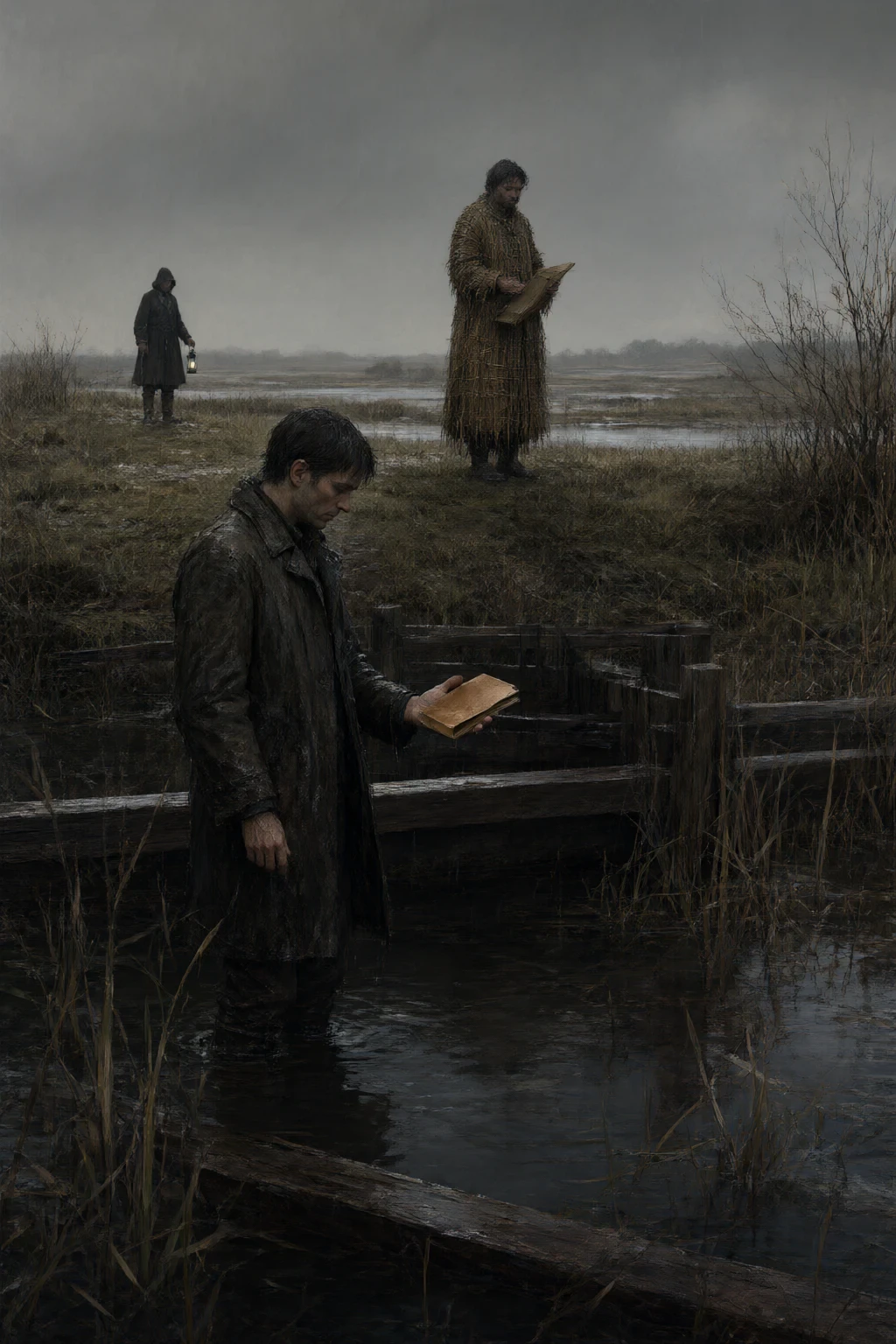
Huldbrand had read the water gauge at the Low Gate every day for eleven years, and in all that time he had never once seen the marsh do anything that was not written down. The marsh did not threaten. It entered an item. He was thirty-four then, and the reave of Breholm, and the town behind him was nine hundred souls and a great deal of debt of its own making. The dikes had been raised in his father's time, and they stood, and the fields behind them were the reason the town had a name instead of a history. Every ninth year the district paid the fen its due: a written schedule, sealed by the provost, drawn up at Michaelmas, and the due was a person. Huldbrand's uncle had been the due of 1141. Huldbrand's grandfather had been the due of 1113, and had gone to the fen walking, in good boots, carrying a lantern, and had not come back, and the fields had stayed dry for nine more years.
"You have the whole of the assembly behind you," the provost said. "And the fen has no whole of anything behind it. That is not an argument. It is arithmetic." "I am not going to take a person to the fen," Huldbrand said. "Then take the money. The fen has never refused coin. It took coin in 1188 and the water stood still for nine years afterward, and that is documented, which is more than most things in this district."
They struck the bargain on the spot, and it was the proudest day of Huldbrand's life, and the town paid eleven years of ditch-work, culverts, sluice-gates, and lime in coin, and the fields held, and there was a great deal of shouting in the assembly about a man who had made the fen behave like a creditor instead of a god. What they did not say, in the taverns, afterward, was that a creditor is never paid. A creditor is only ever current. And nobody in Breholm said the word deficit out loud until a boy in waders brought up a slip of oiled leather from the record chamber under the Low Gate, laid it on the reave's table, and said that the fen would take payment in persons that year, and there was no coin in the treasury to argue with it.
The marsh king's daughter lived in a hut of reed and living willow at the foot of the fen, where the water was knee-deep in August and the alder stood in its own reflection, and she was not beautiful the way the songs say. She was small, and brown, and about forty, and she stood with her knees slightly open to keep her balance, like a person who expects to be in water for a long time. She wore coat after coat of woven reed, layer on layer, all of them the colour of a wet road, and her hands were cracked white at the knuckles. Huldbrand had met her twice before, both times at the Low Gate, both times because she had sent for him with a slip of paper folded into eight.
"The fen is not a place," she said. "It is a creditor. The reeds are its warehouse. The book is its only body. Everything that has ever gone into the water of this district is written in the book, and everything written in the book is owed." "And who are you?" "The clerk. I have been the clerk since I was nine years old, because my mother could not hold a pen in cold weather and my mother was dead before that. The marsh king is not my father. I have not met him. He is a name in the first column and nothing more." She said it without bitterness, the way a person states their title. "I have taken the name of the marsh for the fen's use, since the fen needs a name to put on its demands. It costs me nothing. I have never had a father to lose." "Can a thing like that be true?" Huldbrand said. "Or are you saying it that way because I will believe it?"
She almost smiled. "You have been talking to me about coin for four years, which means you have already decided I am a mechanism. Keep that opinion. It will make the next part easier." On the table in her hut, under a hanging lamp, lay a book nine feet from end to end when it was opened, bound in tarred cord, its boards warped like shells. Huldbrand had been reave of a lowland town for twenty years and had read land-rolls and tax-lists and the tariffs of three bishops. He had never before held a document older than the oldest person alive by more than a century and a half, and he understood, with a kind of vertigo, that he was looking at the only object in the district with no opinion about him. She found the page for him without looking. "Your name, and your father's hand, and the year before you were born."
Huldbrand read his own name in a clerk's careful upright, dated 1188, and beside it a sum he could not at first parse, and beside that a column of small numbers marching down the whole width of the page, each one a little larger than the last, and each with the same two letters in the margin. "Interest," she said. "The fen lends money." "The fen holds what the water holds. When your father asked for earth to build the eastern dike, the fen gave it. Three hundred lasts of good black peat, and four weeks of men, and a stow of lime nobody could account for. The fen does not sell. It only holds. And it keeps the charge at four in the hundred, compounded, because that is the oldest rate in this country and it is not the fen's to change." "The dike is a hundred and thirty years old," Huldbrand said. "The interest must have been paid."
"The interest has been paid," she said. "In persons. Once, at the top of the column, in 1196. Once, in 1205. Once in 1214." She said the three numbers without any particular weight. "A man goes to the fen, and the fen writes received against the capital. That is what those words mean. They do not mean that a man is frightened. They mean that a man is weighed, and the weight is entered, and the column stops growing for nine years. Nobody in Breholm has ever read that page. Your predecessors could not read. The provost will not read it aloud in a church." "So when my uncle went, and my grandfather before him, the town believed it was a tax. It was a payment. And the town has been paying it into a column that had already been settled."
Huldbrand went back over the shed in a wind, twice, and then a third time, and he understood, suddenly, that he had spent his life defending this town from the fen. He had raised the northern dike with his own hands and the town's cart, and the fen had taken interest on it, and the town had paid interest on the interest in human beings, and the second of those had been written in ink by a woman who had never once lied to him. He was not a stupid man. He was an honest one, and being honest in a valley means the water only ever has one way in. He came back to the hut at dusk and asked her the question he had spent a day building. "What is the fen paid in, then? Not a person. A person is an amount. What is a person worth, in the fen's book, if a person can be entered as payment at all?"
Else set down her pen. This was, he understood later, the whole of her in one evening: the length of time she considered the question before answering it. "Two hundred and eleven years," she said. "In trade, a life is a fine ox and a good hammer and a year's grain. Your great-grandfather is entered at nine oxen. Your uncle at eleven, because he was young and a good swimmer. The fen takes the value at the time of entry and does not adjust it. It does not need to. In two hundred years a man and a woman produce a great deal for the price of one and a bit of a boat." "So the fen's price list is two hundred and eleven years old." "And the fen is owed more than the whole of Breholm is worth." "And it does not come to take the town. Why?" Else looked at him for a while, and the wind moved the reeds, and the lamps swung, and her face was not the face of anything at all.
"Because the fen does not want the town," she said. "The fen is owed. A creditor that takes the collateral has nothing left to be owed. Whatever I write, I write it honestly, because I am the fen and the fen cannot lie about a figure; if I lie about a figure then the fen is a liar and a liar cannot be owed anything, and the whole arrangement stops, and the water comes up to the doorsteps of every house in this valley, and there is no clerk and no column and no one to hold the book. That is the only law down here. That is the entire covenant. I have kept it since I was nine years old and I will keep it until I cannot hold a pen, and then somebody else will keep it, and it will not be a good clerk, and it will be a great deal worse for the fen than for you."
The notification came on the ninth of October, as the schedule said it would, and it was not a threat; that was what Huldbrand could not get over afterward. It was a statement of account, folded in eight, in a fair hand, addressed to the reave of Breholm and the provost of the district, and it specified the balance as of the preceding Michaelmas, and it specified the manner of settlement, and it closed with the words the fen will accept coin in lieu of value at the rate of four in the hundred, and will credit the same against the principal.
Huldbrand took the treasury down to the water in four barrows and it took the water two days to swallow, and the fen credited it, and the column did not move. He took the bell metal, and the provost watched him do it and did not stop him, and afterward said only that the bell had been a poor bell. He argued, and he shouted, and at one point he stood in the Low Gate with the account in his hand and addressed the fen the way a man addresses a man who is being slow on purpose. Then Else came out of the reeds and looked at the water, and the water was higher than the third marker, which happened twice in forty years, and neither of them said the number out loud.
"You have paid in money for eleven years," she said. "The fen has credited it. The fen has never once pretended the credit was not there. But the fen does not live on coin. A valley that is eleven years of coin richer and a foot of water higher has not settled anything. It has bought the right to be owed in a currency that was always the only one." "And if the water comes anyway," Huldbrand said. "If I have paid the fen and the fen gives me nothing, what in God's name have I bought?" "You have bought the nine years of the north dike, which held last spring," she said. "That was the purchase. It was a good one. Make your mind let it be a good one."
Then the water came over the Low Gate at two in the morning on the eleventh, and it came the way water comes, without any of the malice the songs assign to it: it simply arrived, shoulder-high, and took the south gate off its pins, and put a foot of brown water into the church and a foot into the school and four inches into the field that Huldbrand's uncle had died to keep. He scuppered the east gate by the third hour and the water was down two feet by noon, and Breholm counted its damage, and it was small, and the whole valley understood in the same hour what it had been for eleven years: that the water had not been stopped by the money. It had been scheduled.
The assembly met on the fourteenth with forty-one men in a room built for thirty, and the fen's clerk stood at the back in a coat of woven reed and let them look at her. Huldbrand had spent nine days on the account. He had learned to read the fen's columns the way he had learned to read a tax-roll, which is to say by learning where the men who made it expect to be disbelieved. The fen charged four in the hundred, compounded, and it charged it upon the compounded sum as well as the capital, so that every year the balance grew larger than the law allowed by one part in four. The dikes were paid for. The peat was paid for. The lime and the men and the stow had been entered as gift, in the first column, in the fen's own hand, as the fen gives, which he had not known was possible.
The arithmetic of the restatement took him nine days and it was not difficult. It was arithmetic he could have done at nineteen. He had simply never known the rate was a number, because to the provost and to every family in Breholm for three hundred years, the fen had been a place where a person went to be quiet. "The overpayment," he said, "is one thousand seven hundred and forty daler of the old reckoning, compounded, over one hundred and forty-one years. The true balance is less than the true cost of the north dike. You have been paying a creditor's compounding on your own money." The room was very quiet. Then the harbour master said, into the silence, that the dike had been raised, and it had been paid for, and that everyone in the room had put money into it, and that it had held, and that this was the whole of the enterprise.
"Which is what I am telling you," Huldbrand said. "We owe nothing that I cannot show you in this column. And what the fen is asking for this year is not the column." "So we pay it," said the miller. "We have paid it. That is the point. There is nothing to pay it with, because it has already been paid, and the figure they are asking for is the figure you get by charging interest on a gift." "And who do you propose," said the miller, "to tell the fen that?"
Nobody had an answer, and that was the part Huldbrand turned over for years afterward: not that the assembly refused, but that it never once heard itself refuse. It heard itself decline to look. The vote, when it came, was to pay the fen in the manner set out and to move on, and the four in the hundred stood, and the miller did not look at Huldbrand as he left, and Huldbrand did not blame him, because a miller who asks a question of the water is a miller who is asking the water to be fair.
The condition was a person, to be given freely, or the fen would take the principal entire, which was to say: the whole valley, an inch at a time, over the following decades. Else had read him that clause on a Thursday, standing up out of the boat, in the rain, without any particular expression, and then had said the other thing, which she had obviously been carrying up and down the river in her coat for some days.
"There is a way out of a contract that is not a gift," she said. "The fen has a column for what it has taken and a column for what was given, and there is a third thing, which is only used in a bad year and which my predecessor had in his hand, and which is the reason that column is still here at all. If a person enters the water of their own will, at the place the fen named, and says the words the fen named, and carries nothing, then the fen writes received, in full and stops. Not a payment. A discharge. The fen is not owed. There is nothing after that, for ever, and the book is closed on the account, and no clerk writes on that page again, and the entry stands as the last figure in the column." "And who says those words."
"You do. Not me. I could not say them if I were you; I would only be quoting. The words are not the important part. The words are the form. The important part is that a person is not owed anything they did not walk into the water to give. It is the only thing the fen cannot do for itself, and it has never once had to make it do." "Who is the person," he said. "The fen's debtor is a dead man and a reave. The person is whoever goes."
He went on the twentieth. He took no lamp, and he carried his boots in his hand, because he would not go in wearing them. He did not tell his sister, and his sister knew anyway, and she was on the bank at four in the morning with a hooded lamp she did not light, and neither of them said a word about it, in the way of a family that has been living in a valley for three hundred years and has learned exactly what may be said out loud.
The water was up to his chest at the middle marker. The words were short, and they were not words of power; they were the fen's words for a transaction complete. When he had said them, nothing happened for a while, and he thought: that is the end of it, and a poor enough ending for a man of thirty-four, and then the water took hold of him, from everywhere, the way a clerk takes hold of a book, and it was not violent. It was simply enormous and it was in no hurry, because it had been waiting a hundred and forty-one years to be told that the column closed here.
Else wrote the entry at the edge of the cut with the lamp on the bank behind her, in the rain, and he did not see it, and afterwards she would not tell anyone what it said, and the copy in the new book is in her hand, and anyone may go down and read it now, because the page is kept high and dry in a locked press, and it is the most quoted line on the whole account.
Huldbrand's sister kept the reave's office for a season and then put the key on the table and went to her brother's house, and the election fell by lot, as it does, to a boy of nineteen called Wille who had been a wader in the record chamber under the Low Gate since he was fifteen and who could read a hand the way other boys could read weather. The record chamber is a stone room under the Low Gate, and the water comes into it twice a century, and the town has never once put anything of value in it. This is not carelessness. It is the town's understanding, older than the provost, that the fen is owed and that the record of what is owed may be allowed to suffer, because a creditor's own ledger is of no consequence to the creditor, and a man who keeps his receipts somewhere dry is a man with something to hide.
Wille found the book the way he was told he would: behind a stone that came out more easily than it should, under the third bench, in a press of oak that had gone grey. He carried it up the stair on his shoulder, and set it on the reave's table, and it weighed what it had always weighed, which was more than a boy of nineteen expected a thing to weigh. Then, because the sluice had failed in the flood of the eleventh and nobody had money to rebuild it, the Low Gate chamber filled again in the wet spring, slowly, over nine days, while the whole valley watched a boy's careful housekeeping and said nothing. Wille took the book out and carried it up the second time, and this time he carried it high, above his head, in both arms, the way you carry water, and he got it eleven steps up the stair before the water in the chamber came over the sill and closed over the doorway. The great ledger went first.
It opened in his arms, and the water got into the warp of the boards and the pages went soft and the ink lifted off the paper in long grey veils and came away in strings, so that the two thousand entries of two hundred and eleven years, the whole of the peat and the lime and the oxen and the men, the names in the careful upright, the column that ran and ran and stopped on the last line in a hand he had read every day of his life, all of it turned to grey soup on the stones of the record chamber, and the water took it, and the town of Breholm lost the fen's book the way a town loses a thing it never really owned. And the receipt survived, because a receipt is not paper.
It had been in the book for one hundred and forty-one years, at the hinge, folded in three, and it was a slip of oiled calfskin the size of a playing card, and the fen did not write on paper because paper is a thing of dry countries, and the fen was written in a hand so fine that the clerk who came after her had checked it twice and found only one word in nine that she would not swear to. It had been in the water the whole nine days, in the cold, in the dark, and it came out of the chamber that morning dry as a bone, and stiff, and unspotted, and it had lost nothing at all.
Wille carried it up the stair in two hands. He laid it on the reave's table beside the ruined book and the wet stains and two days of his own work drying on the floor, and he stood there, nineteen years old, with the water still running off his coat, in the exact middle of a sentence he had not yet learned how to finish. He put the receipt in the tin box. The tin box is in the press, and the press is above the second marker, and the key hangs where the key has always hung.