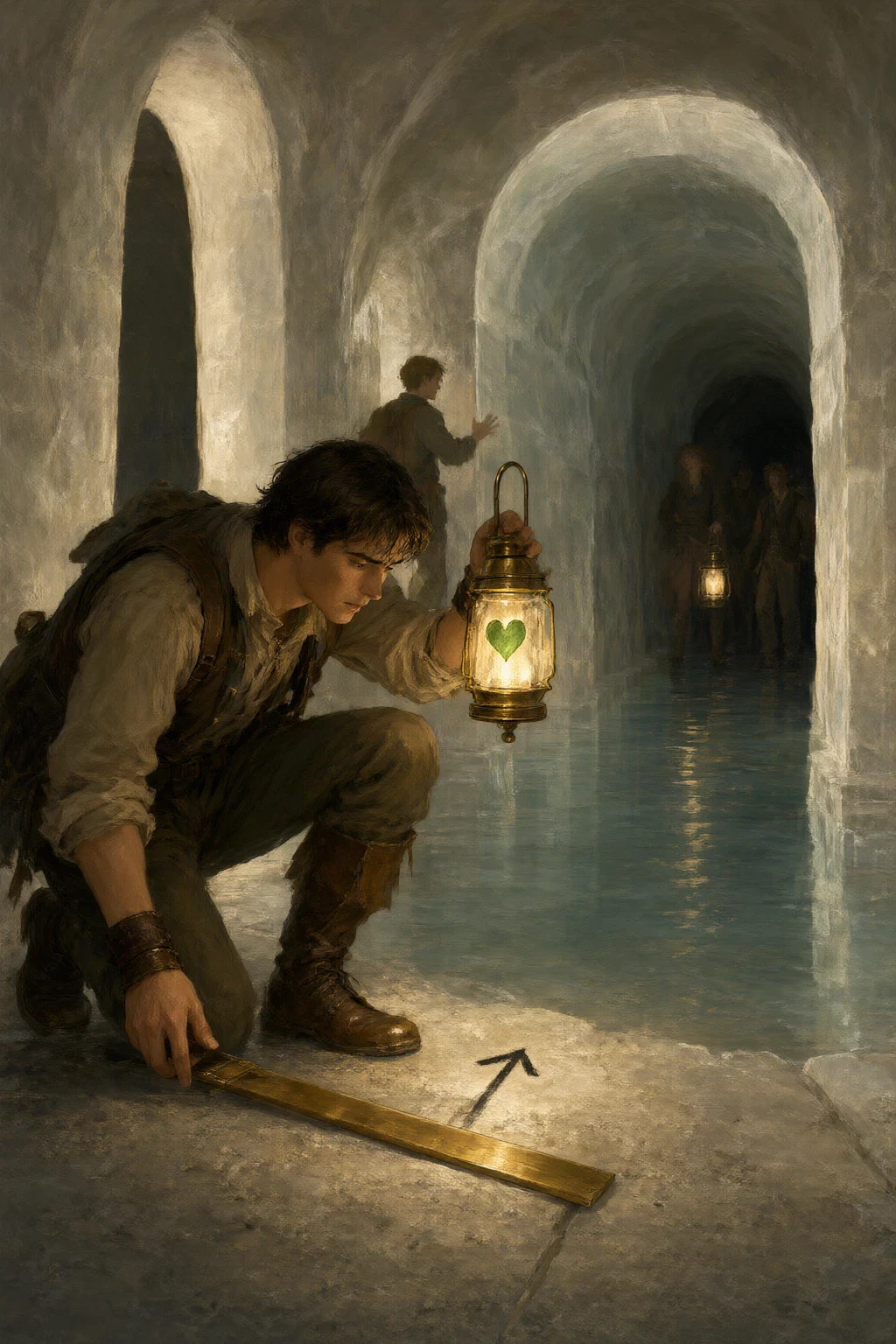
“On the first page of the survey,” said Lida Trask, “there is a box for the age of the surveyor.” “There is,” said Garrick Bole. “And a box for the date of his first service.” “There is.” “And the two boxes are not the same size.” “The age box is wider,” Garrick said. “I have looked. I looked at it for a quarter of an hour last night and then I went down to the cistern and put my hands in the water and thought about it, and the water is not a page and it does not care.”
Lida Trask was thirty-nine years old and the book was forty years old in her keeping, and she had the cancelling schedule inside the front cover in a small neat hand, and she had been Reader for nine of those forty years, which was the longest anyone had held the post since her predecessor, who had held it eleven and had died in the Ledger Room on a Tuesday afternoon of no particular distress. “I am not asking your age to be interesting,” she said. “I am asking it because the form asks it, and because a survey that cannot state who did it is not a survey, it is an opinion with a rule in it.” The brass rule is chained to the lectern in the Ledger Room by a chain of eleven links, and the chain is fastened with a hasp, and the hasp takes a key, and the key lives in a sealed envelope in a box on the same lectern, and the box has a tally scratched into its lid beside the tally on the envelope, and both tallies read four.
Garrick Bole signed the box out at the fourth hour. Sula Iven, the alto, who set the hard surfaces flat and level and who had a way of standing with her palms flat on anything within reach, signed the envelope as opened. The empty envelope was not thrown away. Hesper Vail wrote the time of its opening on the envelope itself, in her own hand, and the envelope was put back in the box, and the box was locked, and the box went back on the lectern, and the tally beside it was scratched from four to five, and nobody could afterwards say which of them had done that or why. “Hesper has done the box,” she said. “Hesper has done the box and the chalk.”
The chalk was the Reader’s chalk. It was on the lectern too, in a tin, and the rule is that a dated station mark may only be cut in the Reader’s chalk, because a station cut in a stone-cutter’s chalk is a mark, and a station cut in the Reader’s chalk is an entry, and an entry is a thing the book can be told about. The Reader does not come down. The Reader has not been below the crossing at the second set in nineteen years, and the reason, which is on no form anywhere and which Lida Trask gave once and never again, is that a book kept in the damp grows a page a season. So the chalk came down in a tin with a bit of string, and the string came back up.
There were eleven stations and the rules for them were four, and the rules were printed on the back of the survey sheet in a hand nobody remembered writing. A station is a cut and not a mark. It is cut with a cold chisel and a rawhide mallet, three strokes, in the flat crystal of the gallery floor, and it is one inch long and one-eighth deep, and it is cut at right angles to the aisle and not at an angle, because an angled station measures the length of a line and not the length of a wall. The station is dated, in the Reader’s chalk, beside the cut. The station is read. The brass rule is laid flat across the cut, the length of it, and the figure is read off in inches and eighths where the growth crosses the cut, and the figure is read aloud by a second person who did not cut the station, and both figures go down. And a station may not be cut within four feet of a growth, on pain of voiding the survey, which is a rule nobody could explain and which cost them station six and sent them back up the sacristy stair with a sheet of wasted paper and a very short temper.
“The figure is thirty-one and three-eighths,” said Nissa Ashkel. “It is not,” said Garrick. “It is thirty-one and three-eighths. I have read it twice.” “You have read it from the near end. The growth crosses the cut at a slant, and the rule is laid flat, and the far eighth is the eighth.” He took the reading again himself and did not read it aloud, because he was not to read it, and gave her the number to say. “Thirty-one and five-eighths. Say that one.” Nissa Ashkel stood in the wet aisle with a lamp in one hand and said, “Thirty-one and five-eighths.” “Enter it,” said Lida Trask. And Hesper Vail, who had the tally sheet on a board against her hip, and who was not a singer and had no vote and had the best handwriting of anybody in the cathedral, wrote it down and said, “Station four is thirty-one and five-eighths,” which is a thing she had said after every station, because saying a figure aloud is half of what a figure is.
They came up out of the gallery at the ninth hour with grit squeaking under every boot and the air tasting of a dentist, and Lida Trask went to the lectern and turned to the back of the book, which is where the count is kept, and put two fingers on a line, and did not say anything for a while. The gallery runs off the north side of the second bay and it was a sacristy two hundred years ago. It is not beautiful. It is very smooth, faintly warm, and it hums a fifth above the choir. It has grown a half-inch a week for two hundred years, always in the same four directions at once, and the whole of it is one uncounted mass, and the book has never had a page for any part of it. The count on the back of the book is one line, and the line is the length of gallery the book believes it is holding.
It said, in figures, one hundred and eighteen feet and four inches. The survey said, in eleven stations, read and countersigned and summed twice, one hundred and twenty-seven feet and three and a half inches. “Per the back page,” Garrick said, “there is nine feet of gallery that the book does not know about.” “There is,” said Lida.
“There is a second line,” said Hesper. Nobody spoke for a moment. Lida Trask looked at the second line, which is written immediately under the figures, in the same ink, in the same hand, because the hand of the line above had been the hand of the line below for as long as either had existed. “Words,” she said. “The count is entered in words as well as in figures, and where the two differ, the words prevail.” She read it out. It took a while. “It says one hundred and twenty-seven feet and four inches,” she said. “The words say the gallery is nine feet longer than the figures say, and the words prevail, and so the survey is right, and so the book has been crediting itself with nine feet of arcade since somebody put it there.” “Then correct the figures,” said Sula Iven. “It is a morning’s work. Rule the figures to the words, initial it, and the book is true, and we can all go to bed.” “No,” said Garrick Bole.
He put the brass rule down on the lectern, which he was not permitted to do.
“No,” he said again, “because the rule is not that the words are truer than the figures. The rule is that the words prevail where they differ, and it does not say why, and I am not going to apply a rule to a two-hundred-year-old discrepancy by picking the half of it I like. Somebody wrote those two lines at one sitting, with the same ink. If the words are a measurement of that day, then the figures are a lie and we strike the figures. If the words are a copy of the line above from the year before, then the words are a carry-over, and the figures are the only measurement, and the gallery is a hundred and eighteen feet and four inches, and the survey has found nine feet nobody has counted for two hundred years, and that is a debt, and the debt is nine feet, and the schedule is on the inside cover and it has three names on it for the twelfth month.” He put his thumb on the two lines. “One of these is a fact about the building and one is a fact about a clerk’s afternoon in eighteen hundred and four. I will not guess which. Per the count, per the entry: we go and look.”
They took two lamps and the rule and the tin of chalk and went down to the north aisle. The aisle was warm, and the crystal underfoot gave back both lamps doubled, so that they walked in a room with four of themselves in it, and their shadows went ahead of them up the curve of the ceiling and stood there waiting. Station ten was at a hundred and sixteen feet and two inches from the mouth, and the rule went across the cut, and the growth came up under it, and the crystal was wet and the same temperature as a hand. And on the floor, from station ten to the end of the aisle, there was water.
It was not deep. It came to the second brass stud of the rule and it was perfectly still and perfectly clear and warm, and it was in a shape. That was the thing that stopped them. It was in the shape of an arcade: nine feet of it, a low arch repeated three times along a low wall, the water standing where the wall had been and the arches where the arches had been, and every edge of it as true as a ruled line, and the whole of it humming a fifth above the choir. Lida Trask sat down on the floor. She had never sat on the gallery floor in her life. “The strike released it,” she said. “The strike releases the salt the column was holding back to brine, and the brine stands where the column stood, because nothing has ever told it to be anywhere else. It has been standing here for two hundred years.”
“Then the words are a carry-over,” said Garrick. “The words are last year’s line copied forward, and the figures are the measurement, and the gallery is a hundred and eighteen feet and four inches, and the nine feet in front of us is a debt of nine feet of standing water that no column answers, and the twelfth-month schedule has three names on it, and the twelfth month is in five weeks.” “It is exactly three names,” Lida said.
The schedule was on the inside cover in her own small hand, and the three names were in her own small hand, and the order of them was her own arrangement, and the arrangement was two years old, and nobody had ever asked her about the order and she had never offered it. Column ninety-one, a plate column at the mouth of the eleventh bay, sound. Column one hundred and four, a spire column in the triforium, sound. Column two hundred and six, a plate column at the west end of the sacristy stair, sound. All three sound. All three of them on her list anyway, and not one of them the least damaged thing in the building. “That is the schedule you mean,” said Hesper. “That is a draft,” Lida said. “That is a copy of the schedule,” said Garrick.
It was not. There was a sheet of carbon paper under it, and the carbon had taken the impression of three names in reverse, and Lida Trask had kept the carbon the way other people keep a grudge, and she had kept it in the same box behind the envelope, and she looked at it for as long as it takes to count to three, and then she said: “If the nine feet comes back into the count, the schedule is empty, and I will burn the schedule, and there is a carbon, and the carbon is not a record. The carbon is a thing a person does when they cannot sleep. Hesper. Hesper will not say anything about the carbon.” “Hesper has not said anything about the carbon,” said Hesper.
Page two hundred and eighty-nine was cancelled in the year eighteen hundred and four, on the ninth day of the second month, by a Reader whose name was in the succession list at the back and who had held the post six years and whose hand Garrick knew from four hundred lines of running figures. He read the page. He read it twice, in the way he read everything, which is to say slowly, and with the brass rule laid across the ruled lines, because he had nothing else to lay across them. The entry was in order: column, station, note, singer, witness, date. The strike was a single diagonal in the same ink as the entry, from the top rule to the bottom, and the stamp was a red CANCELLED set square across the foot of the page, and the wax had gone grey and cracked along one edge.
In the margin, in the small writing that the Reader used for arithmetic rather than for fact, there was one line: “Carried forward nine feet of arcade, released per the strike above, not struck in words, the words being a copy of the preceding leaf. Recomputed and held in figures.” Nobody had read that page since eighteen hundred and four. It was read aloud in the Ledger Room in the check of cancelled pages, because Hesper read all of them, and she had read the strike and the stamp and the date and the column number, and she had stopped at the margin, because the margin is not part of the face of the page, and the form does not ask anybody to read the margin.
“To reinstate a column,” said Lida Trask, “we require a form, and a date, and a witness to the note, and the note sung, and the note entered, and the entering hand to be the hand of a person who is not the Reader.” “There is also,” said Garrick, “the question of the page.” “The page is the page.”
“The page has a strike on it and a stamp on it, and the stamp is in wax, and the wax is two hundred years old. Per the count, I cannot un-strike a strike. I can enter beneath it. I can write a fresh entry on the face of the page, under the diagonal, dated today, with a witness, and the stamp will sit on top of the new ink, because the stamp is on the paper and not on the writing, and the page will carry a strike and an entry and a stamp, and every reader after me will turn past all three and see them in the order they happened in.” Lida Trask took off her gloves, which she had not had on until that moment. “That is not a form I have ever seen,” she said.
“No,” said Garrick. “I have ruled a page and I have never restored one, and I am not going to invent a form in a warm room with a candle in it. I am going to enter the fact. The fact is that the column is entered, and if there is a form for it, the form will arrive at the same time as the fact, and we shall deal with it then.”
The note was on the page in the founding hand, in the shorthand, a squiggle with a tail and a dot, and it had not been sung in this building for two hundred years, and the salt that had been holding it had been standing on the floor as water since the day of the strike. Nissa Ashkel went down to the water and stood at the edge of it and did not put a hand in, and stood there a long time with her eyes shut and the white fringe of her hair stuck to her temple. “It is not gone,” she said. “It is not a note any more. It is the water. It has been saying the same thing for two hundred years and now it is saying it all at once because you are all standing on it.” “Nissa —” “Hundred and sixteen feet and two,” she said. “and then, and then, and then it stops being. and then it is standing up.”
That is the only description of the eighteen-hundred-and-four note that anybody in the cathedral has ever been able to give. It is nineteen words long, and it is in the running notes at the back of the ledger clerk’s own working book, and Garrick Bole copied it out that night, and dated the copy, and signed it, and put it on the damp leaf that is not a page, on the second of the two ruled lines.
The alto set it, because it was a plate column, and the plate order sets the hard surfaces flat and level, and a plate column is a hard surface. Sula Iven stood on the dry side of station ten with her sandals off and the wet crystal to her knees, and Ordin Brack held the lamp, and Nissa Ashkel stood behind her with two fingers on the brass rule laid across the last cut, and Hesper read the figure aloud so that it would be witnessed, and Lida Trask stood with the book shut under her arm, because a book is not carried into a gallery. “It is a plate note,” Sula said. “It is two hundred years cold. I have heard it in a page. I have never heard it in a wall.” “Sing it,” said Garrick. “I will enter it as it is sung. Sula is the singer, and Nissa is the witness, and the date is today.”
She sang it for eleven seconds and the water came up out of the floor. It did not splash and it did not rise. It stood up. Nine feet of still warm brine lifted off the grit in the shape it had been standing in for two hundred years, and it came up the way a man gets up off a wall he has been leaning on, and where it went it left crystal: white, with a green heart, hard to the touch in the time it took her to stop singing. Nine feet of arcade with three low arches in it and a low wall along the top, set, and clear, and humming a fifth above the choir. Nissa Ashkel took her fingers off the rule and read the figure. “One hundred and twenty-seven feet and four inches,” she said. “One hundred and twenty-seven feet and four inches,” said Hesper, and wrote it down twice, once in the tally and once in the book of the survey, which are two different books, and the second is kept with the schedules.
They went up. Lida Trask took the page and the pen and sat on the stool, which is a thing that has not happened twice in twenty years, and Garrick Bole stood and read the line out to her before she wrote it, because he does not dictate to a Reader and does not allow an entry in his own hand on her stool. “Column two hundred and eighty-nine,” he said. “Station ten, north aisle, the arcade. Plate, the founding hand, sung this day by Sula Iven, alto, and witnessed by Nissa Ashkel, soprano, and entered this day by Garrick Bole, ledger clerk, at the ninth hour. Restored. The salt it was holding is returned to the count. Nine feet of arcade are held.” “Struck is struck,” Lida said. “The stamp stays.”
“The stamp stays,” Garrick said. “The strike stays. I cannot take either of them out and would not if I could, and they are both true, and the entry goes underneath them, dated today, and the order on the page is the order the facts happened in.” She wrote it. She stamped nothing. She put the date in the hand she keeps for dates, and turned the leaf forward to the back of the book where the count is, and she did not rule the figures and did not touch them, and she put one line under the two lines already there, in the same small neat hand, and dated it.
“Figures unchanged,” she said. “One hundred and eighteen feet and four inches. Words unchanged. One hundred and twenty-seven feet and four inches. Survey of this date: one hundred and twenty-seven feet and four inches, witnessed. The discrepancy of eighteen hundred and four is entered on page two hundred and eighty-nine, and is resolved, and is not to be carried forward.” “Lida.” “I have three names on a schedule for the twelfth month and I am striking them off,” she said. “All three. The schedule for the twelfth month is empty and I am burning it, and there is a carbon, and the carbon is in the box, and the carbon is not a record.”
At the sixth hour on the next morning Garrick Bole went down with the rule and the chalk and cut station twelve, one inch long and one-eighth deep, three strokes, at right angles to the aisle, and cut the date beside it in the Reader’s chalk, and laid the brass rule flat across the cut, and read the figure, and chalked it on the wall of the aisle with an arrow, which is what the book requires. The gallery measured one hundred and twenty-seven feet and four inches, and the book said the same, and the water that had been standing in the shape of an arcade was a wall, and the wall had a number cut into the plinth by the founder’s masons, and the number was two hundred and eighty-nine, because the founder’s masons had cut it two hundred years before anybody thought to cancel it.
Growth at station twelve: one-eighth of an inch over the past week, which is a quarter of the usual rate, and which is the first figure on the whole sheet that is smaller than the last. He chalked the figure and the date and the arrow, and stood in the grit with the lamp at his knee and his shadow up the crystal ahead of him. And the book in the warm room above him had a strike on page two hundred and eighty-nine under a dated entry with a red stamp across the foot of it, and a second dated entry on a damp leaf that is not a page, and a count of four hundred and eleven columns, of which one had been dead for two centuries and was not dead now, and one had no number at all, and every one of them, on the evidence of a brass rule and a piece of chalk, was holding.