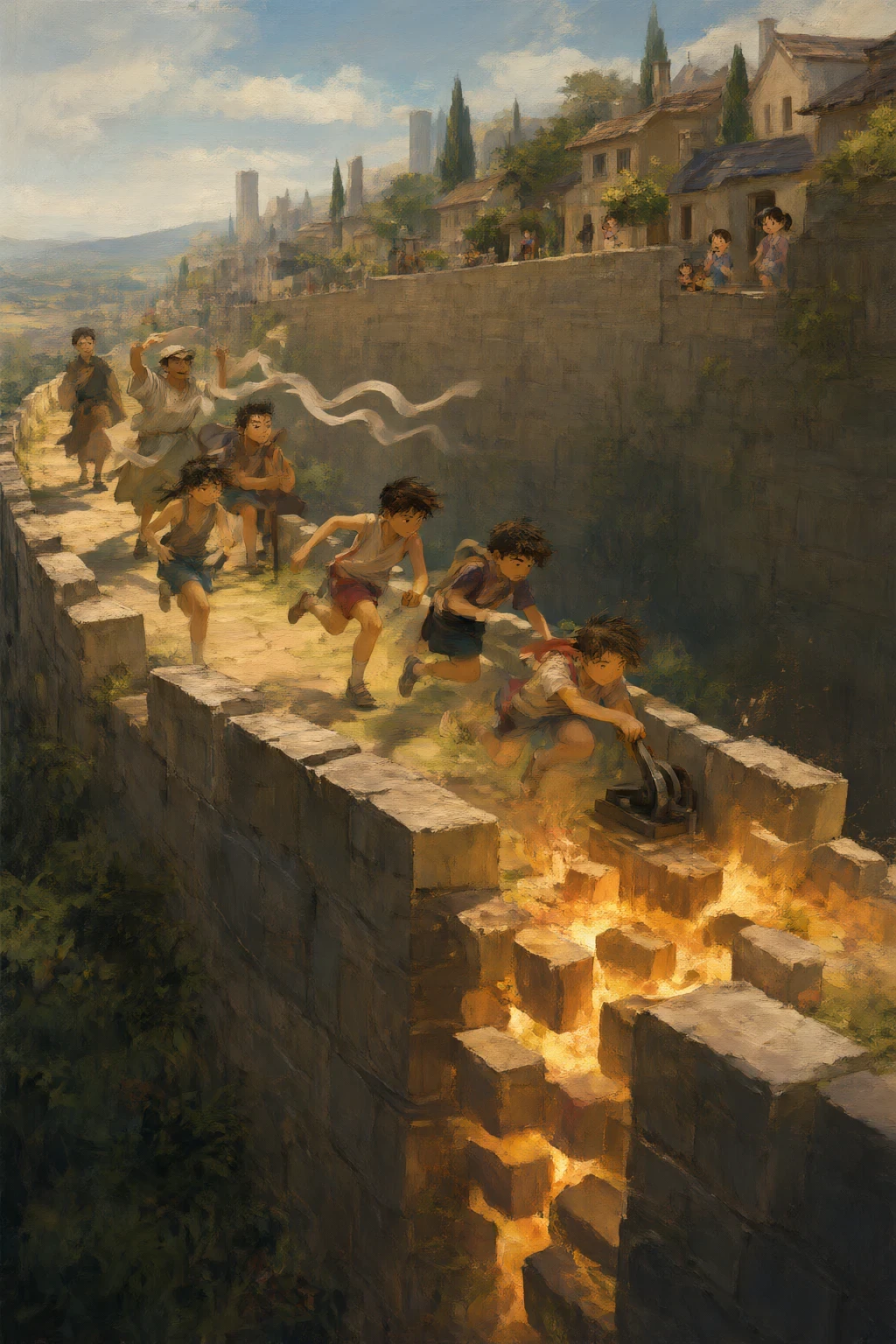
The shortcut began as a line of blue chalk between two hedges. It crossed the field behind Bellweather School, slipped through a gap in the old stone wall, and came out beside the finish arch in half the time of the street route.
No adult had made it. The first summer, runners had followed a deer path, found a loose place in the wall, and discovered that the stones were warm on one side and cool on the other. The shortcut was legal, flat, and almost perfectly straight. It was also unlisted. By the autumn race, nearly everyone used it.
Mira was the race director. She was eleven, which meant the adults kept saying “young” as if it were an explanation for everything she did. She had a stopwatch, a whistle, and a map with the shortcut marked in red. The race committee had voted not to remove it. The wall stood for a hundred years. The field belonged to the town. The runners knew where they were going.
On race morning, the sky was the color of a nickel. At 8:03, while the first runners waited at the starting line, Mira felt a faint vibration through her shoes. She thought it was a bus. At 8:07, a runner named Tovi stopped halfway across the field. He said the wall had sounded like someone clearing their throat.
Mira looked toward the old stone. A thin crack ran from the ground up to the top row of stones. Dust sifted from it in a steady line. “Everyone stay where you are,” she said. The race director from the year before, Mr. Vale, laughed. “It’s an old wall. Walls settle.” “It is not settling.” Mira pointed to the crack. “It is opening.”
A breeze moved through the gap. Warm air smelled of wet stone. Somewhere behind the wall, a dog began to bark. Mr. Vale checked his watch. “We have a schedule.” “The schedule has a hole in it,” Mira said.
The wall had been built when the school field was a quarry. A forgotten river ran beneath it, carrying water toward the houses on Marsh Lane. The wall’s magic held the bank together, but the magic had been weakening since a winter earthquake. Children could pass through the loose section because the stones moved around them.
A full crowd moving in the same direction might do the same thing to a wall already tired. Mina, the school caretaker, came with a metal rod and a jar of red dust. She tapped the stones. “There is a void behind this,” she said. “If the runners break the line, the old support will come out.” “Then we can close the gap,” said Tovi. “Just move the stones back.”
“The stones are holding the field up,” Mina said. “Move the wrong one and the field moves with it.” The race had four hundred runners. The street route was longer but solid. The shortcut could be closed, but the decision would cost the race its special course. The sponsor had promised medals shaped like wings. A local shop had baked hundreds of buns. The town council had sent a photographer.
The adults turned toward Mira. She had made the map. She had approved the shortcut. She had stood at the finish arch and told runners to use the fastest safe route. “Close the shortcut,” she said. A groan came from the wall. Dust fell onto the blue chalk. Mr. Vale grabbed her arm. “You cannot cancel a public race for a crack.” “I can close an unsafe route.”
“If you close it, you will not finish your first event as director. You will be the girl who ruined race day.” Mina looked at the red dust. “If we leave it, we may not have a race to ruin.” The bell rang. Somewhere beyond the wall, a group of runners began to cheer because they thought it was the starting signal.
Mira climbed onto the equipment crate. She could see the blue line, the crowd, and the roofs of Marsh Lane. The homes were close enough to hear a whistle. The shortcut looked harmless because it was narrow, bright, and familiar. Harmless things could still carry weight.
“Race organizers, stop the runners!” she shouted. “The shortcut is closed. Use the street route. Walk, do not run, until the crossing teams clear the wall.” Some runners obeyed. Some shouted that the crack was small. Tovi pulled the chalk line across the gap and stood beside it. The photographer lowered his camera. A child began to cry. The sponsor’s winged medals caught the wind and knocked against the table.
Mr. Vale climbed onto the crate beside Mira. “You could wait for the engineer.” “The engineer is on the other side of the wall,” Mina said.
The crossing team came with ropes and hammers. They did not knock down the wall. They built a temporary brace from the school’s stage flats and tied it to two trees with long straps. The work took ninety minutes. Mira counted each minute, though the clock seemed to have forgotten how to move.
When the brace held, a engineer named Tarek climbed over the wall and examined the crack. “The void has widened,” he said. “The wall is carrying the hillside. It needs a proper retaining arch, not a race path.”
The engineer ordered the field closed. The runners who had gathered near the gap backed away slowly. Some shouted at Mira. One runner said the wall had been there longer than anyone’s memory. Another said a race was not worth a whole field of mud. Tovi, who had wanted the blue shortcut most, said nothing.
At noon, the race organizers gathered in the school hall. The sponsor wanted the medals presented anyway. The bakery wanted to sell the buns. Mr. Vale suggested a small race on the field after the closure. “We could run the street course,” Mira said. “Later, when the families have been moved.” Mr. Vale looked at the clock. “Then it will be dark.” “Then we don’t race in the dark.”
The council’s race chair said, “This is your first year. You can learn when not to cancel.” Mira thought of the crack, the warm breath from the wall, and the homes behind it. “I learned it when the wall told me.”
Tarek agreed. The race became a walk to the library and back along the street. The sponsor gave blue ribbons instead of wings. The bakery sold the buns at noon, and the money went toward a sign that showed the closed route.
The retaining arch took eleven weeks. Tarek used stones from a demolished garden wall, but not the shortcut stones. Mina taught the children to recognize the warning signs: a new crack, a warm draft, a stone that rang when struck. The town created a map of the old river beneath the field, and the race committee removed the blue chalk permanently.
The race was held again the following spring. The street route was marked with yellow arrows, and the finish arch stood farther from the wall. Runners complained that the course lacked excitement. A younger runner said the corner at Marsh Lane was better, because you could see the library and the river at the same time.
Mira timed the race from a folding chair. She did not carry the shortcut map. It was sealed in the town archive beside a note from Mina: A fast route is not a safe route until the place beneath it agrees.
The last runner crossed before dusk. Mira handed her a ribbon, then walked to the wall. The repaired arch blended with the old stones, but fresh mortar showed where the work had been done. Behind it, the hillside stood under a clear sky. In front, children leaned over the finish table and counted medals.
An adult asked if Mira regretted losing the first race. She thought about the empty field, the dust, the angry faces, and the signs that had been put up after the closure. “I regret the crack,” she said. “I do not regret the people who noticed it.”
Then she took the stopwatch from her pocket. The next group was already warming up, and the yellow arrows pointed toward a longer road.