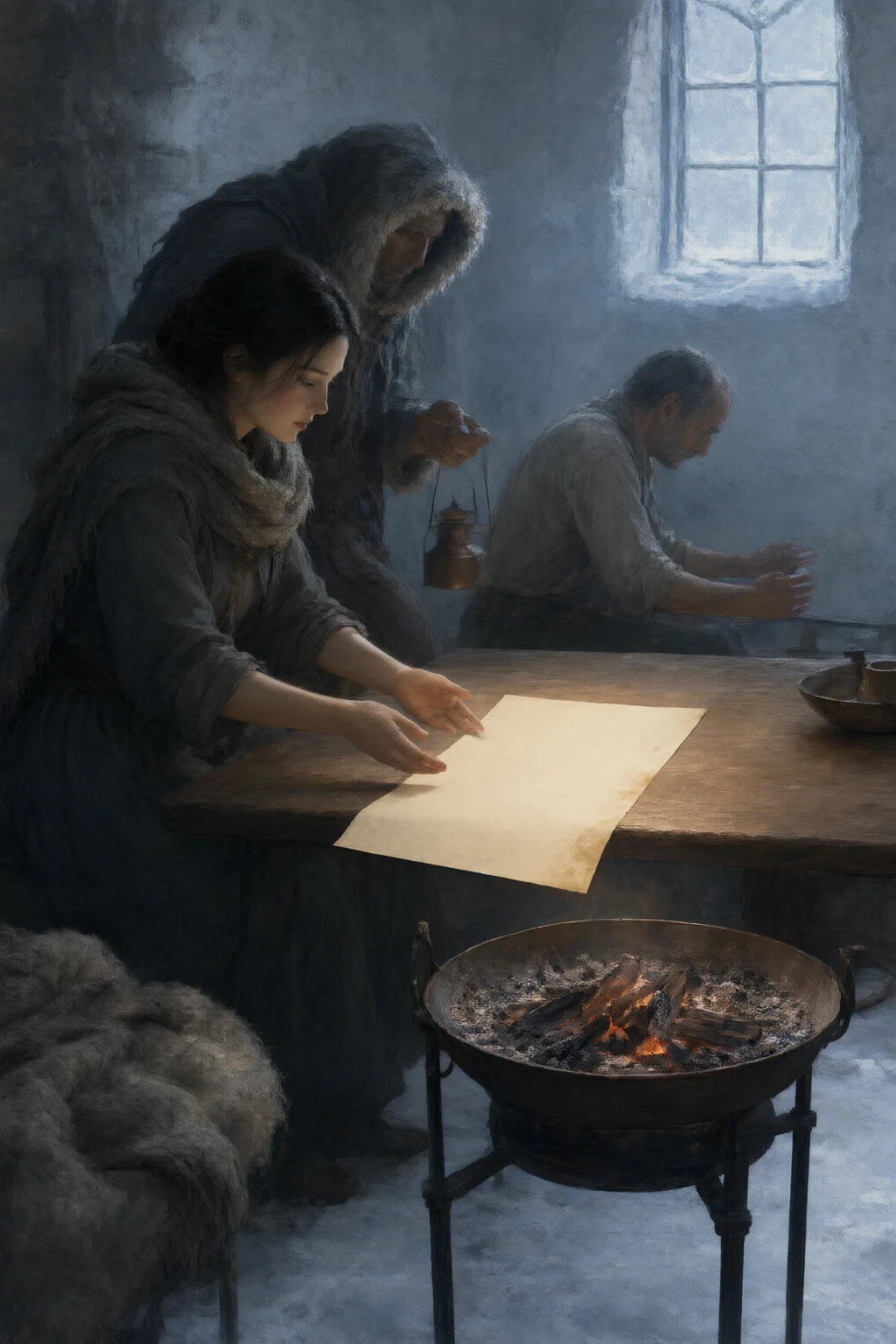
The boy came to the palace in the winter of his ninth year as a page, and he was given the south desk in the writing room, and for four years he was the best hand in the castle. His name was Bendik Vaage. He could do the two sorts that clerks do, the slow even hand for the roll of provisions and the fast bad hand for the fair copy that nobody reads, and he could do both on the same day without his wrist telling him which one he had done. The under-clerk, whose name was Rova, said that a page who can switch is worth two pages, and paid him accordingly, and for four years Bendik was the only person in the writing room who was happy. Then, in the fifth winter, the north stair, and a woman in white with frost on her eyelashes, and a corner of paper going into him like a needle.
There was no blood. He was not cut. That was the first thing everyone who saw it afterwards agreed on, and the second thing was that he did not scream, and the third was that he was heard, very clearly, to say that is not the whole of it.
The under-clerk Rova was on the stair at the time and gave the account that went into the record, and the record is short because he would not make it longer. He said the woman came up out of the dark of the north stair as though the stair had been a doorway, and she was white, and she was not large, and she had the raised chin of a person who is used to being obeyed. She asked the boy, in a voice like a door closing, which of the sheets in the writing room were made out of what. He said he did not understand. She said that there was a sheet at Halden that had been cut in two, and that the half of it was in the wrong kingdom, and that nobody in the wrong kingdom would touch it, and that it had been lying in a cold room for four years.
Then she took the corner of the sheet out of her own sleeve, and it was a strip of vellum folded and refolded until it was the size of a thumbnail, with a torn edge on two sides and the clean cut of a knife on the third, and she put it into his heart. Bendik Vaage did not scream. He said, that is not the whole of it, and then he was on the floor, and the frost went out of the stair within the hour, and the page went north with her, and the castle did not pursue, because the castle has other business.
Three weeks later the archive at Halden burned, which was four months later than anyone expected, and the boy was not there for it, and the boy was not ever going to be there for it. It burned on a night in the fourth month, and the wind was from the east, and it went through the storeys in nine minutes, and the whole of the lower archive went: eleven thousand rolls, the levy rolls of a century, the harbour books, the deeds of the whole hundred, and the tallies. The county court came in the summer and found that the fire had begun in the lamp room, which had no lamp in it that anyone could produce, and that the store door had been unbarred from the inside, which was a fact it entered and did not dwell on. The finding was: fire, origin not determined, loss total.
Eleven thousand rolls is a large number. A clerk in the copy office at Halden, whose name was Runa Holt and who was seventeen, sat in a room for two months writing out the lists of the lists, and no document in the kingdom says so clearly what fire does to an administration, which is that it does not stop the work, it removes the ground the work stood on. Most households that had paid a duty for forty years simply paid again, because that was cheaper than the argument. There was one thing nobody could re-evidence, and it was the only thing in Halden that everybody knew the number of.
The Roll of the Fire is a single sheet of vellum, four feet by two, and it hangs in the copy office because there is nowhere else for it. It is the list of what was taken out of the lower archive in the three days before the fire. That is the whole of it. It is not a list of the dead. Nobody died in the burn who was not already dead. It is a list of the contents of a building, made in advance, in order, by two men, so that the county could prove afterwards what it had held, and then, when somebody asked how the county could prove a thing it had itself removed, the sheet was the answer, and the sheet was the reason that asking was fatal.
The sheet was cut once, in two, in the fourth month of that year. The half that went north went in a cart, in the care of a man who was paid in full and was not heard from again. The half that stayed stayed because Rova, the under-clerk, put it in his coat. Here is the text of what remains of it, as it has been read in the copy office every day for sixty years, and as Runa Holt has copied it eleven times.
> Roll of the lower archive of Halden, of all writs, rolls, tallies and books according to the inventory of the store, made in the days preceding the burning, and witnessed. > > First, the rolls of the levy, of the years of the reign of Gudmar the Elder to the present, being ninety-one, of which the first eleven are bound and the rest loose. > > Second, the harbour books, thirteen volumes, of which nine are water-stained beyond reading. > > Third, the deeds of the hundred, in two chests, and one chest was full. > > Fourth, the tallies, and the small books of the assay, and the account of the woodward, and the accounts of the bridge. > > Fifth, and last, the sheet of the bound petitions of the winter of the famine, which was kept apart because it was consulted often, and which is of ninety-one leaves, of which none was saved. > > Witnessed by Rova Holt, under-clerk, and by \_\_\_\_\_\_\_ for the reeve.
The last line is the cut. The sheet was cut and not torn, and the cut goes through the second name in the witness clause, so that what survives of the line is Witnessed by Rova Holt, under-clerk, and by, and then nothing at all, and then on the next line aard for the reeve, and whoever cut it knew exactly where the knife was going, because they had been looking at the sheet a good deal. Runa Holt was the granddaughter of the man whose name is on that sheet, and she had known this since she was nine years old, and she had never asked anyone about it, because the copy office has one rule about surnames, which is that you do not put your own where you can read it back to yourself.
The Queen was sixty-two years old when the page boy was nine, and she had been born in the ruin of a fishery at the top of the world, and she had been an archivist for nine years of it, and then the burning had taken the archive and made her a person without an occupation. She did not tell the boy any of this. She told him that the sheet was the only instrument in the kingdom that could still be produced, and that instruments need carrying; and she told him that a boy of nine is the only person in the world who cannot be reasoned with, because a boy has no settled opinions to reason from, and this was true, and it was the reason she chose him and not a soldier, and not a priest, and not a man of the law, and not herself. The rest she told herself, in a room of ice, over fifty years, in a way that made it sound each time less like a justification.
A man will deny a thing he said. A man will be frightened. A boy will not be frightened of me, because I am the cold in his chest, and you cannot be frightened of your own circulation. And a boy's word is not evidence, because he is a boy. So the sheet goes into him and I go north with him, and the court has nothing to argue with but a cold child, and after nine years the child is forty-eight and still cannot be cross-examined, because by then he is a man and I have had to be his whole life. I had one piece of paper with the only true sentence in it in this kingdom, and the kingdom had four hundred judges, and no one of them would touch it, because the sentence has a name on it and the name is the reeve's brother, and the reeve's brother owns the ship. So I did the only arithmetic I had. I made a person out of the sentence. It is the arithmetic anyone would have done.
They went north, and they went slowly, and the reason they went slowly is that the Queen has never once been in a hurry, and the reason for that is that a person who is in a hurry arrives. Runa Holt went north eleven months behind them, and not after them. She did not go to rescue anybody. The copy office sent her because the Roll had been reduced by half and the county's standing orders said that a reduced roll is a roll in error, and a roll in error is corrected from the double entry, and the double entry of the Roll of the Fire is the only other copy in the world, and it is at the House of the Sunnivan, three days north of the last village, in an ice house cut into the fell.
The copy office paid her nine shillings and told her the cost of a sledge-hire, and gave her a week's bread, and said nothing at all about the boy, and she asked about the boy on the morning she left and was told, in the voice the copy office keeps for the dead, that the entry said gone north and the entry was from sixty years ago and there was no standing order for sixty years.
The House of the Sunnivan keeps ninety-one boxes and one cat, and in the eleventh year of Bendik Vaage's stay the old woman arrived, who was the second of them, and whose name on the door was not written, and who read by a stove because the ice takes the ink. Her name was Aas, and she had been born in the town at the foot of the fell, and she had come up as a servant at nineteen and had not left, and the reason she had not left was that she was the archivist of the double entry, which is a title with no duties and no pay and one rule, and the rule is that the duplicate must be kept where the original is not.
The rule is four hundred years old and it has never been tested, and she had read the sentence maybe ninety times in a stove-light with her shoulder against the flue, and she said, to nobody, that the Rule assumed the second copy was cold, and that a thing kept very cold is a thing kept well, and that the Rule had been written by men who had never had to read a page in their own hands. And she was wrong, and she knew she was wrong, and she had been the archivist for fifty-one years, and on the fifty-second the door opened and a girl of seventeen came in out of the weather carrying a document tube and asked for the Roll of the Fire. "It is here," said Aas. "Then I will take it to Halden."
"You will not," said the old woman, "because you cannot read it, and neither can I, and it has been here for sixty-one years, and the whole of the kingdom may come and look at it, and not one of them has ever read a single line of it, and I am the archivist of the duplicate and I have never been able to tell anyone what is in the box I am responsible for."
They thawed it in the spring, which is against every rule in the house and against the archivist's own judgement, and Runa Holt had a letter for that, or rather she had her own hand on a piece of paper, and the old woman read it and gave it back and did not argue. The method was this. A sheet of the double entry is taken out and laid on a board. A brazier is set at a distance of four feet, and the sheet is warmed, and the ice leaves the ink, and the writing comes up out of the vellum the way a leaf comes up off the bottom of a pond. Then it is read, and it is copied, and it goes back into the box, and the next sheet.
The ink comes up. That is the difficulty nobody had thought about. Every letter that stands up is a letter that can be lost again, because heat takes the sizing out of the vellum, and after three warmings the sheet is a skin, and after five it is a thing you could not write the year on. So they did one sheet a day in the spring and one in the summer and nothing in the winter, and there were ninety-one boxes, and Runa Holt was there for two years, and she was twenty when she left and twenty-one when she came back in the autumn and twenty-two when she came back again, and in the third autumn she was no longer copying.
The old woman read the numbers aloud as they came up, because the numbers were the only part she had ever been able to guess at, and the girl wrote them into a fair copy, and the count went up. Eleven thousand is a large number to say out loud, but it is not large to write down, and after the first fortnight of the first spring nobody said it out loud again, and they only wrote it. The boy was forty-nine when the first name came up in the tray. He had been in the house for forty years, and the Queen had been in it for forty years, and they had a routine that Runa Holt understood in about a month, which is that the Queen sat by the north window at the hour when the light comes along the floor, and the boy sat where he could see her, and neither of them said very much, and he could not stop shaking between the third and the fifth hour of the afternoon, and the shaking had a shape.
There was no ice palace. That is the thing the ballads have got wrong and the people who were there got right. There is no palace. There is a long stone room over the fell with a stove in it, and a table, and a woman who will not let a boy be warm, and forty years of the same conversation, in which the boy asks, every day, what the paper is, and the Queen answers, every day, that it is a corner of a sheet, and that when the sheet is whole again he will be able to read it, and that until then nobody in that room can produce it, because a corner of paper in a hand can be hidden and a whole sheet cannot, and the day it is whole it will be taken out of him, and on that day he will be a boy of nine standing in a courtyard with no name that works. Runa Holt heard that in the fourth year, from the old woman, who had heard it from the Queen, who had said it as an instruction.
They had the Roll whole again in the autumn of the third year, and they had it in a fair copy in Runa Holt's own hand, and she carried it down in the tube on the last stage of the sledge road, and she was twenty-three years old. The corner came out of him in the north room, without ceremony, on the evening before she left. He had been shaking for nine hours and she had been holding his wrist in the way the old woman had taught her, which is not to stop the shaking but to be there for it, and the paper came out of him in a single piece and went on the table, and the letter M came up first, in a warm brown, and then the point, and then the O and the s and the t and the e and the r and the g, and the whole of it was nine characters long.
The next morning he could not get up. That is what the cost was, and there was no other cost, and nobody had promised there would be a great one. He was nine years old for about two hours. He was warm, and he was a child, and he was a man of forty-nine with the whole of a northern winter in his limbs, and he was sick with the heat of a warm room and had to be taken out onto the stair in a blanket like a bundle of laundry. He asked for his mother eleven times in an afternoon. His mother had died of the winter fever in the year before the fire, when he was eight, and was not coming, and had never been anywhere but a town she had left. He was a child for two hours and then he was forty-nine again, and the memory of the two hours stayed with him, and he did not tell anybody about them, and he could not afterward say why not.
The Roll went south and the county court sat on it in the winter, and the finding of the fourth month was opened again, and the court did what a court does when it is handed a document that convicts eleven people and exonerates none: it appointed a clerk to look into it, and the clerk was forty years old and had a good hand and was not frightened, because the thing about a good hand is that it can be kept entirely out of the opinion.
The Rova Holt who had been under-clerk on the day of the list was dead by then, which took the worst of it out of the question and left the rest, and the rest was: the name on the sheet was a name that had been cut out of the evidence, and the man who had cut it had taken half a sheet down to a fishery at the top of the world in a cart, and had not come back, and had left behind him a boy of nine with a scrap of paper in his chest and a court that could not touch him. Nobody ever found the cart. Nobody ever found the other half. The court found the ship.
The House of the Sunnivan closed in the sixth year. The fall of the fell road and the cost of moving ninety-one boxes had been argued for a decade, and the argument ended in the way those arguments end, which is that a clerk wrote a finding and the finding was minuted. They brought the boxes down in nine carts over two summers, in the keeping of Runa Holt, who was thirty-one by then and who had the standing of a woman with a document, which is a form of standing that nobody has ever bothered to define and everybody recognises. They put them in the copy office at Halden, in the two rooms that had been rebuilt on the burnt ground, and there they are.
They are read now in the ordinary way, in a warm room, on a table, by whoever is sent, which is a thing that would have astonished every archivist who ever held the double entry, and the Rule of four hundred years has been amended, in one line, to say that a duplicate is a duplicate only when somebody can use it. The old woman died before the boxes came down and was not consulted about the amendment. The Queen was not consulted either. She was sixty-eight, and there was no stone room, because there had never been a stone room, and the girl who had fed the stove and the boy who had held the wrist were the only two people in the world who knew where she was, and in the spring the fell road went over the top and there was nothing on it but the two of them and the cart and the boxes.
The boy read. It was not a gift and it was not quick. You cannot read a name you have never had a use for, and the use had gone, and there are a great many names in ninety-one boxes. He learned the letters first, which took a year, and then the form of a heading, which took another, and Runa Holt sat with him on the north side of the copying floor with a slate between them and a lamp behind her, because a person learning the small hand needs the light out of his eyes, and she taught him the way nobody teaches anything, which is by making him copy the same line until it stopped being a shape and became a name.
The Roll itself she hung where the Roll had always hung, and under the lamp it has a clean edge, and every clerk in the room can see where the cut is, and the boy can see it, and the name that was in the cut is the reeve's brother's, and the reeve's brother owned the ship. There is a shelf mark on the Roll where the name should be, and on the paper slip in Runa Holt's hand are the nine characters that came out of the boy's chest, because a copy has to show what is missing, and because she is a clerk, and a clerk does not tidy.
On the eighth day of the first spring they thawed the first sheet of the bound petitions of the winter of the famine, and the ninety-one leaves that were not saved, and the first name came up in the tray like a leaf off the bottom of a pond, and the boy read it out, and Runa Holt wrote it in the copy, and then they brought up the tray, and did the next sheet.