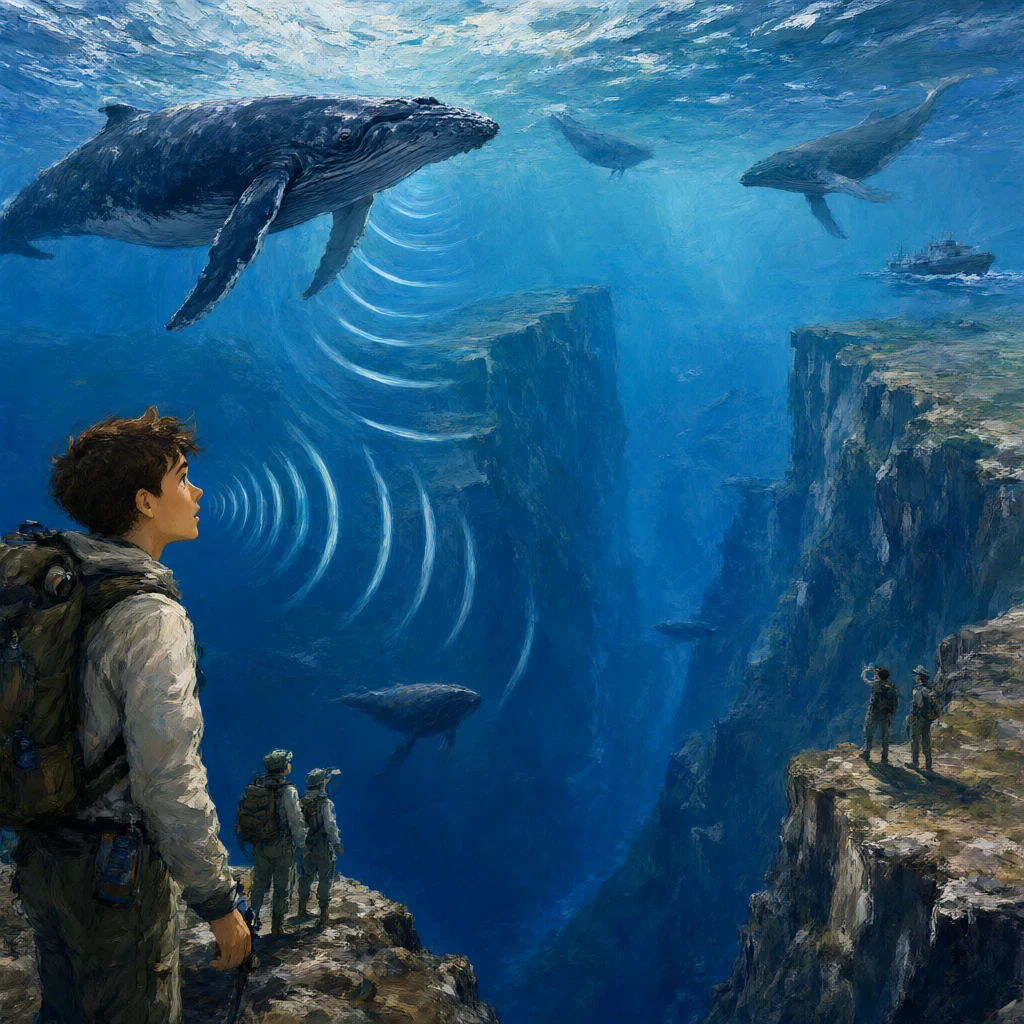
The fishing boat Marrow went into the Slot on a Tuesday morning with two men in it and did not come out. By Thursday night there was still nothing: no flare, no float, no sound but the town’s own outboards bouncing off the canyon walls.
The search party had eleven boats. Hollis Tape, who had recorded the water off Pike’s Landing for forty years and was mostly deaf now and entirely unembarrassed about it, brought Marta Quill out to meet them in the Kittiwake because she was the only thirteen-year-old on the quay who could read a tape without being told what she was hearing.
“Listen,” he said, at the mouth of the Slot, with the Kittiwake’s engine off. The water was flat. For a long time there was nothing at all, and then there was a sound like a fingernail tapped on a wet slate, and again, and again, faster, a whole volley of it going out into the dark.
“And the echo,” Hollis said. “Count to yourself. Click, then wait. The echo comes back off the wall. The time in between is the distance, because sound goes through salt water fast and not instantly, and every metre it crosses costs it a piece of time you can hear.” Marta watched the second hand of the bulkhead clock, which ran off a carriage wound every eight hours and had a tick you could feel through the deck. “Ten seconds,” she said.
“Ten seconds is about fifteen kilometres of there and back. Seven and a half each way.” He tapped the rail. “That is a wall seven and a half kilometres down the Slot. The chart says four. The chart was made in 1911 with a lead line and a lot of hope.”
She got the hydrophone over the side herself, a cylinder of oiled wood and a spool of cable and a glass jar to keep the drops out of the recorder, and by that evening she had four hours of tape with the pod in it. The first thing she learned was that the town had been wrong about the voice.
“There are two animals,” she said, when Hollis came to listen. “And they are not even related, and one of them has nothing to do with the Slot at all.” She played the first stretch. The clicking, hard and dry, in runs of six or seven with a long silence between.
“And the other one.” She played the second stretch, which came from a recording taken three miles out in open water the previous autumn: a low note that rose for nine or ten seconds, wobbled, and fell away, and then came back up again higher than before, and did it again, for twenty minutes.
“That is a song,” Hollis said. “That is not a hunter. That is a different animal entirely, one with no teeth, feeding the way a sieve feeds. It is not listening for walls the way a clicking whale does. It sings, and the song carries for miles over water too big to see across, and it is how they find each other.
That is why the same whale arrives on the same note at the same hour in different years: it is calling to the others, not bouncing sound off a rock.” “Which one is in the Slot?”
“The one that clicks.” Hollis nodded at the reel. “A clicking whale is looking. It makes a noise and it waits for the answer, and the answer tells it what is there and how far off. In the dark, at depth, that is the whole of its eyesight. The sound goes out and the world answers.”
They went out again the next day with the engines off, and Marta saw it happen for the first time. The pod came up under the boat in a long grey line, eight or nine of them, and the largest turned and swam a slow arc away into the black, and then stopped, and the front of its head changed. That was the part that made Marta put her hand flat on the rail.
The forehead was a great soft wedge, taller than the rest of the animal, and just under the skin of it, up where the head narrows, sat a pocket of thick tissue with a set of heavy fleshy lips inside it, the phonic lips, and those lips were what made the click, snapping shut and open and snapping shut again.
Then the wedge visibly narrowed, flattened, and aimed, the way a hand cups around a lamp, and the rough noise up under the skin came out of the front of the head as a beam.
“The click is made by the phonic lips, up in the nasal complex, not out in the jaws,” Hollis said, so quietly that Marta had to watch his lips. “But it does not leave as rough noise. The melon, that lens of fat and muscle in the forehead, gathers the sound up and focuses it into a beam, the way you aim a lamp.
Whatever the beam touches comes back as a squeak off a fish, a crack off a rock, or nothing at all out in the middle of the water. If it hears nothing, that is how it knows the way is open.” “Or that there is nothing there at all.”
“Or that there is nothing there at all,” he agreed. “The trick is that it does not need to understand the answer. It only needs to know when the answer comes back.” They ran the Slot twice more. Marta sat in the bow with the headset and a stopwatch, and every time the pod turned and the clicks went out, she wrote down the second hand when the click went and the second hand when the echo came.
She drew the Slot as a corridor with walls at different distances, and where the echoes came back fast she drew close rock, and where they came back slow she drew the deep bend at the north end, and by the third day she had a chart of a place that no lead line had ever found, drawn entirely out of waiting.
Then the Gannet came in. It came in at speed, with a thumping outboard rebuilt by a man who believed in power and not in pitch, and Marta felt it in the hull before she heard it. The whole recording turned to gravel.
On the tape the pod’s clicks arrived as a hiss, and the echoes came back smeared into the noise, and the wall three hundred metres off, which had returned at four tenths of a second on Tuesday, was gone by Friday. Marta looked up.
The pod, running a clear line up the middle of the Slot, altered. The animal at the front swung wide, went up hard toward the ceiling of the canyon, and the others came after it in a ragged wedge, and for a few seconds there was nothing on the recording but noise and the crash of water.
“They cannot hear themselves,” Hollis said. He said it without drama, the way a man reads out a number. “Their own clicks are a lantern. Every engine in this harbour puts a blanket over that lantern, and a whale driving blind into a canyon at night does not swerve politely. It swerves at the last second, and the last second is the wall.”
The Gannet’s owner wanted to know why his boat was in the middle of eight large animals with a bent propeller, and Hollis told him to shut down and let them listen. They killed the engine. The water settled. In the headset, the clicking came back, faint and far to the north, and then the echoes, and Marta wrote down what she heard with a pencil that was shaking and did not trust herself to use the clock.
“Left,” she said. “There is a pocket in the left wall about a hundred and forty metres in, and it is deep, and it is round at the back. The pod has gone into it. It is not trapped. It is choosing it.”
The skipper of the Gannet wanted a light. Marta swung the lamp twice, and the Gannet came down the Slot at two knots with her screw still turning, and the pod came out of the pocket ahead of her and went out through the mouth in a long grey line, the last one hanging a few fathoms under the Kittiwake’s keel before sliding away west.
They found the Marrow on the sixth day, in a side inlet on the north wall at four hundred metres, upright and intact, her back against the rock, her crew in the bilge with a fouled lamp and forty minutes of air remaining. The Slot had a second pocket on the north side. It was not on any chart, because the men who had drawn the charts had never once waited in silence long enough to hear a wall.
The council met on the eighth. Marta took the reel and played them what Hollis had played for her: ten seconds of silence, a volley of clicks, the echoes coming off both walls in their own times, the pod’s calls, and underneath it all the noise the town made on the water. “You have told us where the walls are,” the harbourmaster said. “In time, not in feet.”
“It is the same wall,” Marta said. “It just came back at us instead of a lead weight.” They did two things after that. The first was a slow zone, agreed over considerable argument, that ran from the north buoy to the mouth, where nobody went above four knots and every crew was told to check for the pod before they started their engine.
The second was a book, which was Marta’s, drawn from six days of stopwatch, in which the north pocket and the north wall appear where the chart showed open water, and the Marrow appears in it, upright, with a cross on her.
Hollis put the tape away in its tin when it was done, and wound the Kittiwake’s clock, and stood a moment at the rail with his thumb on the recorder’s lever. “Forty years of that water,” he said, “and the best thing on it is not what I have been listening to. It is what I could not hear.” “You listened to the quiet,” Marta said. “I listened to the quiet,” he agreed, “and the quiet was full.”