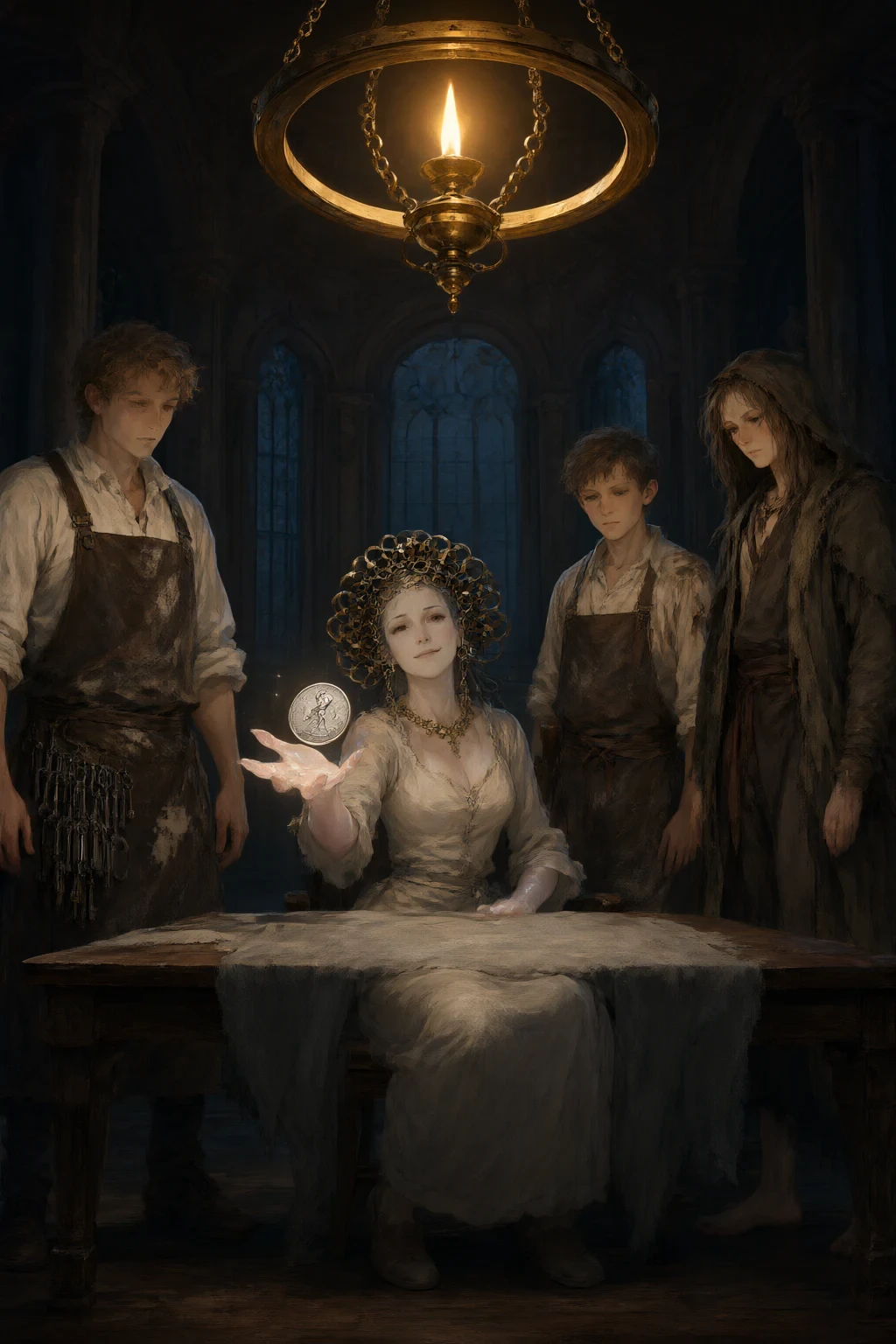
Aurel Sarn had been coming up the road to the shelf for thirty years, and he had never once knocked, because a man who knocks has decided to be a guest, and he was not a guest. He was a buyer. He came at the turn of the season, when the mud was worst, in a coat of fur so good that four men had died for the animals in it, and he stood in the yard of the Chaff Mill, looked at the hopper, and said, “You are grinding husks.” “I am grinding what there is,” said Grist Bellweather, who had flour in the creases of his scorched leather apron and both thumbs hooked in his belt.
“Of course you are. You have been grinding husks for four years. It is the only honest thing about your mill.” Sarn had a list on a board. He had it the way other men have a sword. “I will take them. All of them, at the ordinary rate, and I will pay in coin and not in promises, because a promise is a husk you have not milled yet.” Grist Bellweather did not say anything at all for a moment, which for him was an oration. “A year’s flour,” he said. “Honest flour. Lamp oil, salt, turnips, and a cart of rope. Delivered to the gate, not to the yard, because the gate is where the Court buys.” “That is a very great deal of flour,” said Sarn, “for four years of chalk.” “It is a fair price,” said Grist. “Sit. Sit, there is broth.”
Tallow Merrick brought the buyer up through the palace herself, because a Keeper of the Vault does not leave a man of that sort to wander, and because she wanted him where she could see him. The Hall of Telling was empty and cold-blue at ten in the morning, the long oval of silvered pine with no corners, the brass ring-lamp the size of a wagon wheel burning one clear steady flame over a hard-edged disc on the boards. Cresset Ombre was on her ladder, and she looked down at the visitor with the flat professional look of a woman who intends to be up it for twenty more hours. “Three hundred and eleven, dull,” said Tallow, showing him the tray. “Three hundred and twelve, dreadful. Four hundred and one, this one is a fourth-tray, do not buy it, it is a pleasure to look at and a waste of money.” “I will buy it,” said Sarn. “I buy it because I sell it.” “To whom?”
“To people who like the shape,” said Sarn, and did not say anything else about that, and moved on. He stood in the Hall for the better part of two hours with a lamp and a board and a list. He had a version of the Queen’s story for every decade there was a version in, and he could date them the way a man dates coins, by the wear. “Here,” he said. “The accession. The receiving. That is the oldest, and it is nearly all queue. Here is the flood of the cistern, and here is the lamp kept by a man named Ovain, and here is the good one, the good one is very good, the good one is the one I would buy. And then— and then it stops.” “It stops?”
“In three hundred years it stops.” He tapped the board. “The good one is from, I would say, a hundred and forty years ago. Everything after that is a shorter telling. Everything after that is somebody’s memory of the good one. I have bought four hundred of them.” Tallow Merrick had gone the colour of the wax she kept her keys in. “Then you know everything there is to know about her.” “I know everything anybody has ever paid to write about her,” said Aurel Sarn. “Which is not the same, and I have been in this business thirty years, and it is the only distinction in the world that has never once been wrong.”
The bell rang at two in the afternoon. There is no better word for it than bell. It was not a sound the Hall made; it was a sound the palace made, in every room, the whole of the silvered pine ringing like a bell that has been struck once, hard, in a building that is not a bell. In the Hall of Telling the coin came out of the air, and it did not go into the tray. Grist Bellweather was standing in the disc of light with his hands open at his sides, and he had been telling, and the telling had been very good, and everybody in that Hall had been crying, and the coin hung in the air above the deal table spinning slowly on its edge, and it rang. “What is it,” said Cresset, from the ladder, in a voice that had gone out of the ordinary. “Cresset can feel it in the wick. Cresset has never felt it in the wick.” “It is a good coin,” said Grist. “It is not a good coin,” said Cresset. “Cresset has held a good coin. That is the other thing.”
Here is the story Grist Bellweather had told, and every part of it was true, and that was the whole difficulty. The cistern cracked in the year of the flood. The lower floors went under in two hours. There were four hundred and eleven sacks of milled tale in the bottom of the Chaff Mill, husks, worth nothing at all, and the water had begun to rise on the mill floor at four o’clock in the afternoon. And the Queen came down. Nine hundred years old, or near enough, and pale at the edges, and she went down the outside stair into four inches of rising water and began to carry sacks out on her back, one at a time, up and up and up into the yard, and a hundred and forty people stood there and watched her do it for six hours, and Cresset held the mill lamp so that the stair was lit, and at the end the Queen went back down and brought up the last one herself.
And she never said a word about it to anybody. Not that night, not that year, not ever. And when the good one came to be told, which was about eighty years later, there was nobody left who had asked her, so the telling grew the way tellings grow, and by the time it reached Sarn’s board it had a hand on her shoulder in it, and a lantern in her hand, and a sentence at the end about the lamps, and every single part of it happened. “It does not hold,” said Tallow Merrick.
She put her hand near it, not on it. The coin was spinning on its edge four inches above the deal table and the wood underneath it had gone dark, and the coin was not touching the wood and was not falling, and the shape on its face would not settle. It was a stack of sacks. Then it was a lamp. Then it was a woman on a stair with a sack on her back, coming up, and up, and up, and it would not hold still long enough to be read. “Put it on the sill,” said Sarn. “Do not put it on the sill,” said Tallow. “Four hundred and eleven sacks,” said Aurel Sarn, from the edge of the disc, “is the best story anybody has tried to sell me in this palace in nine years, and I have a month of lamp oil and a cart of turnips in the yard, and I will put my own name on the receipt.” “It is not for sale,” said Tallow Merrick. “It is for signing. And it will not be signed, and it will not be sold, and it will not be spent, because it is not a coin. It is a bell with a coin on it.”
They put it in a velvet tray because there was nowhere else, and the tray began to hum, and then the tray began to lift, and Tallow dropped it on the stone floor where it went on humming at a pitch that made the bones of everybody standing near it, and out in the yard a dog under the cart of turnips stood up and would not lie down again for two days. And over the minting table, about the width of a coin, a ring of dead air opened and hung there and began, very slightly, to swell. “A silent,” said Cresset Ombre, from the ladder, for the second time in her life. “Pay for it,” said Cresset. “That is the rule and there is no other one. Somebody goes back and pays it, and until somebody does, the palace rings, and the rings do not get quieter, and there are thirty-one hours of lamp in this building. And paying cannot be done with the true part. It has to be done with the asking. That is what the old word means. Cresset has never seen it done. Cresset is fifty-five.” Nobody wanted to be the first person in nine hundred years to find out.
“Nobody in this room was trying to do a bad thing,” said Ysandre the Long-Waited. She had come into the Hall at some point during the four hours of telling and had stood in the disc of light throughout it, and everybody in that Hall had been looking at her, and she had stood there and let them, and now she was speaking in the formal beautiful cadence she had been taught by people who are dead. “That is the part I would like put down first,” she said, “because it is the part that will be argued about later, and it is the part that is true, and then it was— well. It was something.” “Your Majesty,” said Tallow, “you stood in the light.” “Yes.” “You were awake.” “Yes.” “He told it with you standing there and nobody asked you.” “No,” said the Queen. “Nobody asked me.”
“Your Majesty,” said Grist Bellweather. He had flour on his hands and he had not moved out of the disc of light since the coin came out of the air. “Grist will say the true thing. Grist did not lie. It is all true. Grist has ground that tale in his own hopper for four years and it is the only good thing in the building and Grist could not think of it happening to anybody else.” “It happened,” said the Queen. “It happened, and you did not tell it, and that is why it is yours, and Grist is sorry.” “Sorry is not the metal the mint works in,” said Tallow Merrick. They argued it out in the Long Table hall, because the Long Table hall was where the Court went when the Hall of Telling was not available, and because the coin was still humming in a velvet tray on the stone floor two rooms away and could be heard, faintly, through nine hundred years of silvered pine, like a note held under water. Grist wanted it settled quickly, because Grist had a yard full of a buyer’s flour and eleven weeks of nothing after it. Tallow wanted an accounting, and produced the Palace Ledger, and put it on the dark oak under the grey linen, and it was not the first time.
“Ninety years of chalk,” she said. “Her Majesty’s supper, ninety consecutive entries. Your Majesty, I have read these out in this room before and you have never once asked what the word meant, and it means that we have fed you the Court’s own worn-out tales for ninety years, and that is the whole of the debt, and it is itemised, and it is on this page, and we can settle it tonight with a coin and never speak of it again.” “No,” said the Queen. “Your Majesty—” “No. That is not what is owed and you know that it is not what is owed, and you are the best keeper this palace has ever had.” The Queen put her translucent hands flat on the cloth. “You may pay me in flour for the rest of my life and I will go on being the woman in the light who is described. Ask me what else there is.” “Ninety years of chalk is a debt,” said Aurel Sarn.
“It is an entry,” said Tallow. “It is not a debt. A debt has a person on the other side of it who knows they are owed.” “There is a form for it,” said Tallow, and went and got it, because she always knew where everything was: one leaf of silvered pine, two hundred years old, called a retraction, used eleven times since the flood of the cistern and one of them about a dog. “It says the Court withdraws the story, that no part of it shall be told again, and that the coin, if there is a coin, is void.” Grist read the retraction of the four hundred and eleven sacks out loud, standing, with flour on his hands, and he read it well, and the room believed every word, and the note under the floor did not change by a hair.
“It does not work,” said Sarn. “The metal asks one question, and the question is whether the thing being said happened, and a retraction of a true thing did not stop happening. I have four hundred and six retractions in my warehouse. A retraction is an honest man’s proof of exactly what was being said before somebody changed their mind. Yours is not a retraction. It is a signature.” Marrow had been sitting on the end of the table for an hour with his bare feet on the wainscot and his moth-eaten cloak pulled round him, and he said, “Ask me what I think.” Nobody did. “A Court that asks permission before it describes you,” said Marrow, “has already described you four hundred times, and will describe you four hundred more, and the asking does not put a single one of them back in the tray. And that is a coin in somebody else’s pocket, and the somebody else is her, and she has been spending it since before you were all born.”
“One more thing,” said Sarn, “and then I will stop, and I have been in no hurry for three hours and I am not going to start.” He turned the board round and showed them a column of figures that were not prices. “My year of flour and the oil and the turnips are in that yard because the sacks are the sale. If the coin is not spent, the flour goes back on the cart, and the four hundred and six go in the cart with it, and they go down the road to people who will believe every one, because they are true, and because those people will not have a Court to tell them they are not.” “So the Court has until morning,” said Tallow.
“The Court has until morning, and no keeper alive has ever put a price on that before, and I have,” said Aurel Sarn. “Nine hundred and fourteen for a bushel of flour. It is absurd, and it is the only absurd figure in this palace, and I am the only man here who believes in it.” Aurel Sarn asked for the lamp. He asked it politely, and Tallow gave it to him, because a buyer who cannot see is a buyer who buys on somebody else’s word, and she was tired. He held the coin up in the flame, and turned it, and made notes, and after a while he said: “I have four hundred and six of these, and every one is true, and no two of them agree. That is what happens to a true thing when a hundred and forty people tell it in a room and one of them is the subject. It goes soft in the middle and hard at the edges, and after a hundred years the middle is gone.” “What is the middle?” said Nim Ollowan.
“The Queen,” said Sarn. “In every account, the Queen is a shape. She does the thing. She is described at the beginning and at the end and she is never once in the middle, because the middle of a true story is what the person thought, and nobody can know that, and so everybody agrees to leave her out.” He set the coin down between them, and it hummed. “I have been buying a woman who is only ever on the rim.” “Then you know the story is wrong,” said Tallow. “I know it is unfinished,” said Sarn. “I am not here to tell you it is wrong. I am here because you will not sell it to me, and because a coin that will not sell is not the same as a coin that is untrue, and in thirty years I have never once seen that distinction made in this building, and I would like to make it now, in front of witnesses.”
“Then what do we do with it?” said Tallow. “Do the only thing there is,” said Sarn. “Go and ask her.” “Nim has asked her things she has not been asked before,” said Grist. “And the Queen answers them, and the answers are small, and they are hers.” “Then ask her one more,” said Sarn. “Nine hundred years, four hundred and six accounts, the whole of my trade, and I will tell you what is in every single one of them and what is in none. Nobody has ever asked her whether she was glad.” The Long Table hall was very quiet. Somewhere under the floor the coin went on humming. “Whether she was what,” said the Queen. “Glad,” said Aurel Sarn. “Nine hundred years. The boat. The receiving. The flood. The lamp. The accession. And in four hundred and six tellings there is not one word about whether the child in the boat was pleased to be picked up.”
Nobody asked her in front of the buyer. Cresset Ombre came down off her ladder for the first time in nine hours and stood in the disc of light in front of the whole Court, and said, “Cresset will ask it, because the flame has to be in the Hall, and the question is going to be asked over the flame, and Cresset does not ask questions for money.” They moved the table out of the Hall, where a hundred and forty people could not all get in, and into the disc, and the Queen sat down on the step of the minting table, and Cresset Ombre stood over her with her right hand up and the brass of the stand catching the whole lamp, and the Court stood at the rim of the light in a ring, at a respectful distance, and Aurel Sarn was made to stand in the ring with them, and he put the board down.
The Queen was, for the first time in anybody’s memory, not the only one with nothing in her hands. “Cresset will say it plain,” said Cresset, “because the old way is what has been wrong for three hundred years. Your Majesty. When they lifted you out of that boat, and turned you round, and made you look at the line of people standing in the rain who had been waiting nine days for you — and then— and then you were cold, and wet, and four years old, and somebody’s else, and there was a whole row of strangers in front of you. Were you glad?” And rule seven came. The Queen did not answer for a while, and the Hall thought she had lost the end of her sentence again, and then somebody at the back of the ring made a small sound and it was Marrow, and he had put his hand over his own mouth.
The true part happened again in her body, and the true part was this: she was four years old, and two strangers had her by the arms, and they turned her round, and there was a whole line of wet people looking at her, and she had been in a boat for nine days and she was so glad to see anybody at all that she could not stop, and she said, “Yes.” That was all. One word, in a voice like a child’s. And it came at the same moment as the mint, and the mint did not drop this time, because the coin that came was not the coin that came before. The one on the stone floor of the Long Table hall went quiet in its velvet tray, in the middle of its hum, the way a struck bell goes quiet, and the silent over the minting table came in on itself and shrank and was gone. The air in the Hall was ordinary air again, and Cresset Ombre felt it go out of her wick like a held breath let out. And the Queen’s hands were in her lap and they were pink, and warm-looking, the colour they had been ninety years ago.
“Now,” said Tallow Merrick. Her voice was not steady and she did not try to make it. “Now we have a consent, and a very small one, and it is not consent to the four hundred and eleven sacks.” “It is consent to one word,” said Sarn. “It is consent to one word, and the sacks are another matter, and the Court will not sell the sacks.” Tallow got her ledger open on the step beside the Queen. “Grist told a true story. It is a good true story. It is the best thing anybody has put in the air in this Hall in my time. And it is not hers, and it never was hers, and the only thing wrong with it is that it is nine parts true to one and that one part is a woman, and we have spent three hundred years getting the ratio wrong.” “Then it stands,” said Grist. “It is true.”
“It stands and it is not yours to give,” said Cresset Ombre. “It cannot be signed, because she would have to hold it. It cannot be spent, because the Table is the only place and the Table will not take a coin that is still ringing. And it cannot leave the building, because the gate does not take a coin that is not a coin, and the man in the yard is in no hurry whatever, and he is going to sit there until one of us explains.”
The Queen got up off the step by herself, which nobody thought she could do. “Spent,” she said. “Your Majesty?” said Tallow. “Spent. On the Table. Tonight. Not signed, not sold, not in the Vault, not in his list.” She put one translucent hand out, and it was still faintly pink, and she looked at it, and then she put it flat on the deal table. “And I want the flour. All of it, and the turnips, and the salt, and the Long Table laid for the whole Court, every person in this building off the same cloth, including the man with the board. And then it is gone, and nobody can ever sell me again, and that is what it costs, and I would like somebody to write that down as well, because in ninety years somebody will offer a very great deal of flour for it.” “Grist can write it,” said Grist. “Grist cannot write,” said Tallow.
“Grist can write,” said Grist Bellweather, “and then— and then I will put it on the mill door, where the flour comes in, so that the flour man reads it before he sells us anything, and then I will grind the good tales and I will tell you all, and I will sit, and there is broth.” They laid the table for nine, as they always did, except that this time the cloth went down the whole forty feet, and there were places at it for everyone in the building, and the Hall of Telling stood empty and cold-blue above them with its lamp burning one steady flame over an empty disc of light, because nobody was telling anything tonight. Tallow Merrick put the coin on the deal table and it lay there and did not ring, and it was warm, and it had a story-shape on its face that Tallow could read at last, plainly, in the lamplight: a woman on a stair, going up, going up, and going up.
“Nine hundred and fourteen,” she said. “Good. Four hundred and fourteen, dreadful, because it is going to be bread in ten minutes and the worst of it will be on the plate. The worst and the best, in one evening, on one coin, and I have been signing coins for fifty years and that has never happened before and I am not going to pretend I know what to call it.” The Queen put her hand flat on the deal table beside it, because she was not going to be dramatic, and it went across the rim of the Table as easily as a coin goes into a purse.
Aurel Sarn wrote the receipt. It was the largest number he had ever written on that board and the smallest meal he had ever bought, and he wrote it out twice, and then he folded the board and gave it to Tallow, and he shook her hand, and he said, without any irony at all, that he would be at the road in the spring, and that he would bring the spring price list, and that he expected it to be worse. “Sarn is not wrong,” said the Queen, when he was gone down the ladder. “Sarn has never once been wrong about what a thing costs. Sarn is only wrong about what is worth paying for, and there is a difference, and it is the whole of what this palace has to learn, and then it was— well. It was something.”
They ate. The flour was honest flour. Grist had not had honest flour in the building for four years and he stood at the head of the sideboard and made a noise about the smell of it that was not a word. The bread came up out of the oven the colour of a loaf instead of the colour of a hearthstone, and there was a great deal of it, and a hundred and forty people ate it in a hall built around one table, and the noise they made was not a court noise. Cresset Ombre did not come down. She was in the Hall of Telling with the lamp, because the lamp does not care what is happening downstairs, and she ate a heel of bread standing up in nine inches of lamplight, alone, in the whole of the building, because that is the arrangement, and because somebody has to.
And at the top of the table, with her hands round a bowl she had not eaten from in ninety years, Ysandre the Long-Waited, nine hundred winters old, crown of hollow gold ringlets, ate bread that had been made out of something nobody had told before, and found that it was sweet, and was not surprised, and said so out loud, in the beautiful voice that loses the end of itself, to a Court that had described her for three hundred years and had asked her exactly one question. “Eat,” said Grist Bellweather. “Eat, there is more.”