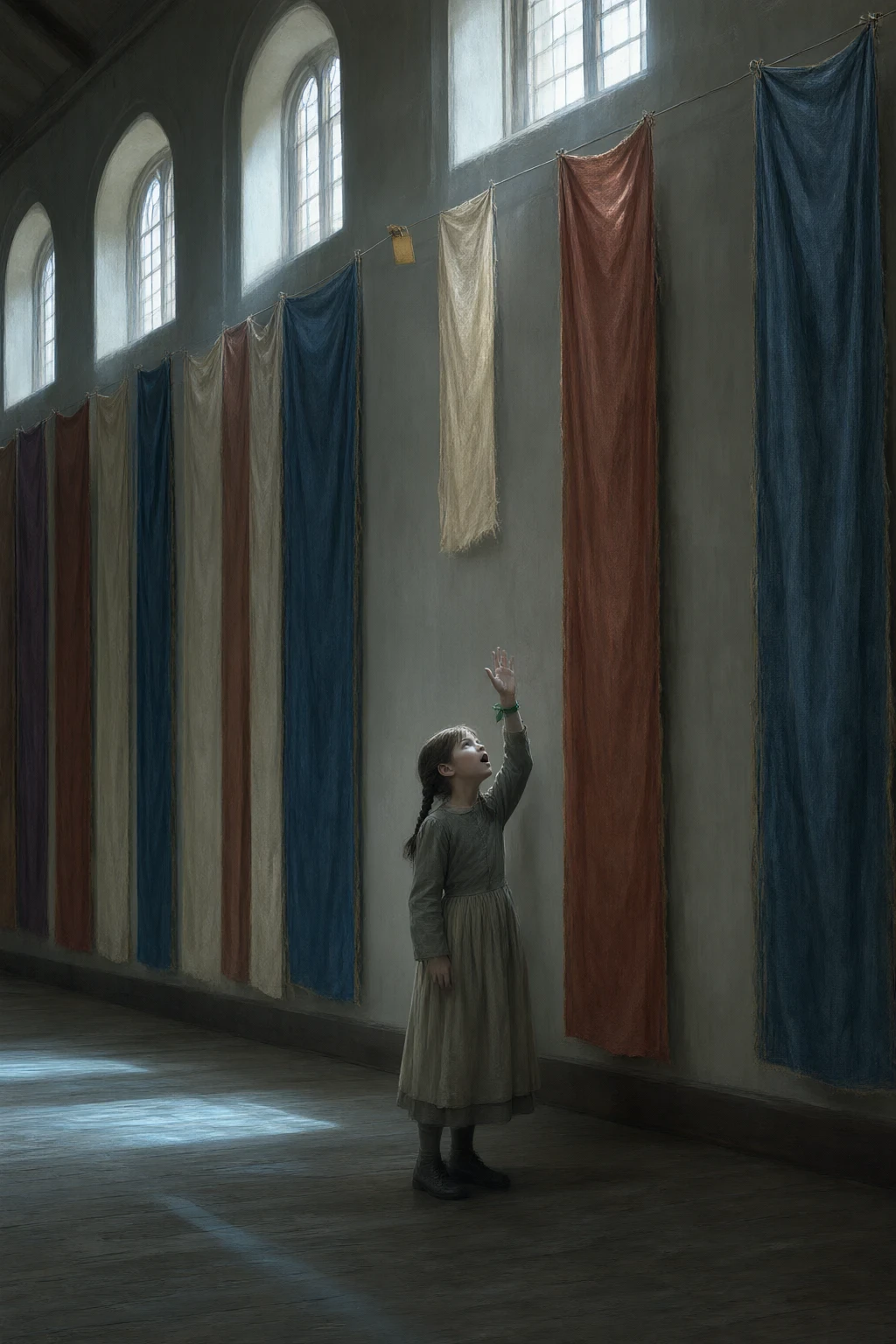
The Great Hall has eight tall north windows and nothing else, and it is lit all day by what comes through them, which in February is not much. The north wall is where the Nine Omissions hang, eight of them in order from the first window to the eighth, and between the fifth and the sixth there is a length of unhemmed raw warp the colour of weak tea with a small brass label on a wire, and the label gives a date and nothing else. The date is the fourteenth of March, seventeen hundred and sixty-one. The hall is the only building in Sparable with nothing missing from it. That is not a boast anybody makes. It is a sentence in use for about a hundred and forty years, and it is true in the way that a room is true, and everybody who has ever said it has known at the time that it is convenient, and has said it anyway, because the alternative is to have a question about the room, and a question about the room is a description of something that is in it.
The moths got into the eighth in the autumn. That is all it was. The hall gets no sun between November and March, and a hole the size of a thumbnail in a hanging nineteen yards long, at the fourth window, at nine feet, went into the Great Hall minutes in November in the ordinary way. A length ordered, to be wove to the negative of the eighth, and the negative of the eighth is in a tin box in the guild archive with the other negatives, and the box has been in that archive since 1831, and the negatives in it go back to 1761. The commission could not be written. Nobody in the guildhall said that on the day. The commission sat in a tray on the Great Hall desk for five weeks, and the tray is where a thing goes when the guild does not know what a thing is, and in the fifth week a man called Perrin, who has written commissions in the negative for thirty-one years and who is sixty-four, said a sentence at the second silence on a Thursday in December that put the whole of the winter in motion.
“You cannot write a new negative for the eighth without the old one in front of you. You have to copy it. A negative is a copy with the dates changed. I have copied that one eleven times and I have never once had it read out, in a room, by a person, because you do not read a negative in a room with the cloth in it. You have said the cloth. So I have copied it off the tin with my own hand on the bench, the way we have always done it, and it is the same as it was, and the same as it was in 1831, and the same as it was in 1761, and I cannot tell you that it is right, and nobody else in this building can either, and I have been copying it since I was thirty-three and I never once wanted to know.” Corin Slee was in the room. He had not been in the Great Hall since the thirteenth of December two years before, by a standing order in the first page of his own assay book, signed and dated by himself, in the space where the standing orders go: the assay clerk does not attend in the Great Hall until order 118 is settled. The order 118 was a length of the eighth that came down in the summer of that year and went into the assay room stack, and it was one of twenty-nine, and it was not stamped then and it is not stamped now. The hall is nine minutes’ walk from the assay room. He had done it a thousand times. He said, in the guildhall corridor, to nobody, in the voice a man uses when he has said a thing to himself and now has to say it to somebody: “Then read it in here.”
The Assay Room is on the ground floor, on the cold side, and it is the only room in Sparable that nobody lies in. Corin Slee had the tin box on the table at nine in the evening on the eighth of December with the blind down, and he was going to read seven negatives and an eighth one, and he was going to do it alone, because the moment there were two people in the room it would be a thing that had happened to two people. A commission in Sparable is not a description of a cloth. It is a list of everything that is to be left out of it, written in the negative, all the way down, because the negative is the only contract this town honours, and it is signed by the weaver and by the buyer, and a weave of two is the only irreversible thing in the town. He read the first of the seven aloud, which was a formality, on the grounds that he had earned the right to hear one.
THE FIRST. For the town of Sparable, the first omission, to be wove complete in the body and to be set in the loom of the Great Hall, and the following to be left out of it, that is to say: the colour thereof, and the name of the maker thereof, and no other thing, that the omission being the whole of the commission and the commission being the whole of the cloth. Two hundred and eleven words, seven of them for the seven surviving panels. The shape is the same in all of them, the handwriting changes in eighteen places, and the spelling of commission is wrong in four. The paper is good and the ink is iron gall, and the guild has never had a doubt about these documents in its life. And at the foot of every one of the seven there is a paragraph headed: AND OF THIS TOWN NOTHING SHALL BE LEFT OUT, SAVE AS IS SET AGAINST EACH COMMISSION IN THIS BOOK, AND NO OMISSION OF THIS TOWN SHALL BE MADE BY THE TOWN ALONE. Corin Slee read that paragraph seven times, once for each panel, and then he read the eighth.
The eighth ran to the same two hundred and eleven words, in a better hand. THE FIRST had become THE EIGHTH, the name of the maker thereof was the name of the maker thereof, the closing words were there, and then the paragraph: AND OF THIS TOWN NOTHING SHALL BE LEFT OUT, SAVE AS IS SET AGAINST EACH COMMISSION IN THIS BOOK, AND And then the sheet ends. On the same sheet, immediately beneath, in the same hand, is the heading of the ninth commission. THE NINTH. For the town of Sparable, the ninth omission — He read it four times and then put the sheet down flat on the table with both hands on it, the way a man puts a thing down when he has been holding it too long, and sat in the cold room under the gas light looking at a comma and the word and. A negative is a list of what is not to be in a cloth, and a document of that kind has holes in it by its own nature. Nobody in Sparable can look at a negative and see a thing missing, because a thing missing from a negative is the ordinary condition of a negative. A negative is only wrong if you know what the right one was, and here were eight sheets in one box in one town, and seven of them had the paragraph at the foot.
The chapter met on the second Wednesday of January and Corin Slee gave his finding in the Assay Room, from a written paper, with the hall empty and the blind down, because the assay room is the only room nobody lies in, and because a negative read in a room with a cloth in it is a description of a cloth. He gave it in the order he gives everything. “Seven of the eight panels carry a clause at the foot of the negative. The eighth does not. The eighth carries the first twenty-two words of it and then a heading for the ninth commission on the same sheet. Tolerance: there is no tolerance for this. It is either in or it is out. Recommendation: that the chapter read the finding into the minute book in the words I am about to use, and that the paper go in the archive with the eight sheets and not be kept in a drawer.” “Read it in,” said the warden. Finding: that the negative of the eighth omission, made for the town of Sparable in the year seventeen hundred and sixty-one, is incomplete on its face, in that the clause at the foot of the seven other negatives, which provides that no omission of this town shall be made by the town alone, is not carried in the eighth; and that the eighth, being a weave of two, is therefore a cloth with no provision in it for the town. It took ninety seconds. The warden is sixty-nine, and has been the guild’s warden since 1871, and he wrote it in the flat guild hand with the date against it, and the room did that thing a room does. Then he asked the question that had been sitting in every one of them since the September two years before, and which nobody had been in a position to ask until the eighth of December. “Who left it out?”
“Two people,” said Corin Slee. “A weave of two is two people who agreed. Each can stop the other. That is what two means. The guild permits about four a year, and there are six hundred and seventeen in the negative register and not one has ever been struck off, and I will come to why in a moment. The eighth was signed by two hands. One of them wrote down a clause of thirty-one words and the other stopped it at twenty-two, at one table, in the same ink, on the same day, and each could see what the other had written, because that is the entire purpose of a signature. There is nobody in the world who can now be shown to have done it, and there never will be.” The proof of deliberation is a piece of paper and nothing else, and Corin Slee put it on the table and turned it round. “The weaver signs A. Ostry. The buyer signs for the guild and is R. Halse, secretary, and Mr Halse died in 1791 and his family are not in Sparable. The name Ostry is on nine weavers’ marks in this town in the last hundred years, and there is an Ostry running the Great Hall commission at the table this evening, and I am not going to say another word about that, because there is nothing to say, and because the whole of this town is a coincidence of surnames.”
The second reason is why there are six hundred and seventeen entries in the register and not one struck off. To close a weave of two the buyer must accept the omission, and the buyer accepts it by naming it, and a garment woven on omission cannot be described, and any description of it supplies the thing it left out, and the description kills it. So a weave of two cannot be closed. It has never been closed, not once. The register has a column for the date of closing and the column is empty in every line, and at the head of the book, written in 1774, is a note: The omission, being agreed, is not again to be spoken of, and this register is not a book of accounts but a book of things that are so. And a gap is made in the other direction. An omission that is discovered cannot be reinstated. It can only be left empty, which is a different and permanent thing, and the guild has a name for the change, and the name is a gap, and there are four gaps in Sparable and one confession, and the book of gaps is the shortest of the four books and the only one anybody has ever been afraid to open at a funeral.
So nobody was caught, and nobody ever will be, and the eighth panel hangs on the north wall between the seventh and the eighth window with the whole of the clause’s work done in it and the whole of its absence in it, and it will go on hanging there until the moths come about 2031, and then it will be mended, and the mend will be wove to a negative copied off the tin by a man in his sixties at a bench in an archive without anybody reading anything out loud. The chapter asked what the missing clause had cost. It took four days to get. The clause says two things, and the second is the expensive one. The first is ordinary: of this town nothing shall be left out save as is set against each commission, which makes every commission a weave of two with a weaver and a buyer and a date, and the guild has kept that rule perfectly for a hundred and forty years on other people’s cloth. The second is this. No omission of this town shall be made by the town alone.
Which means the town cannot weave its own cloth by itself. Which means every bolt the guild orders, for the guildhall windows, the Warp House blinds, the Mending House curtains, the drying frame covers, the assay room’s own table, the Great Hall hangings and the hand bell, must be a commission with a weaver and a buyer and a date and a price and a line in the register. And it is not. “Show me the commission for order 118,” said the warden. “There is no commission for order 118,” said Corin Slee. “There has not been a commission for the guild’s own cloth since before the register begins. There is an order, because the town has to know what it wants, and there is a bolt, because the town has looms, and between those two there is nothing whatever. The number twenty-nine is not a number of commissions that were not kept. It is a number of commissions that were never opened.”
The arithmetic came out of the assay books and it was very short. The assay does four hundred bolts a year across two hundred and forty working days, and the guild’s own order runs to a little under two hundred of them. The town has eleven looms and twenty-two working weavers. A commission of undyed wool pays fourpence a yard, a madder commission seven, the Mending House a shilling, and the town has never in its history paid a weaver at a different rate for anything. Two hundred bolts at eleven yards is twenty-two hundred yards. At fourpence that is eight hundred and eighty shillings, which is forty-four pounds exactly. Forty-four pounds a year across twenty-two weavers is two pounds each. A weaver cannot eat on two pounds a year, and a weaver does not think about two pounds a year, because a weaver is thinking about the fourth yard and the eleventh and the second silence, and because the money is not owed to anybody in any form that can be produced. It is not a debt. There is no creditor. It is a hole in a document in a tin box in an archive, and a hole in a document is invisible.
Of the two hundred a year, twenty-nine carry a further omission in them, and they are the ones Corin Slee weighed at four stations in a hundred days, and they are between one and a half and one and nine-tenths of an ounce a yard light at the foot, and not one has a commission number on the sample, and the guild allows four weaves of two a year. The chapter resolved on the sixth of February that the town would be asked. That was Corin Slee’s motion, carried four to one after nine days: that every person who has had the Great Hall in the working of their trade should be asked, and put in the record, what they saw; and that the word saw was chosen deliberately over every other word available, and the reason written under it. The reason is that a description supplies the thing it leaves out. Nobody in Sparable can be asked what is in a cloth. But what a person saw is not what is in a cloth. A person’s sight of a wall, of a room, of a bolt on a beam at the fourth silence, of a length in a dye vat, is a fact about a person and not a fact about a cloth, and the difference is the whole of what is left of the trade when you take away the ability to speak.
Lysa Ferrant was asked on the ninth, in the Warp House, at the second silence, with the warden, the guild’s commoner, Corin Slee and Old Mab Ostry present. She answered standing at the ninth loom with a shuttle in her hand, and it took eleven minutes. She said that a commission is a set of decisions and not a colour, and that she can see every one of her own decisions as a decision and cannot see a single decision in anybody else’s cloth, and that this is the guild’s own rule, and that she is its example and also its proof and its warning. She said that a selvedge is four threads and a name is eleven picks and a reinforcement is four yarns doubled over two yards, and that she has left the selvedge out four times in a year and a name out twice and the reinforcement out six times, and that the reinforcement is the one that keeps her awake, and that she knows exactly why she goes on doing it and cannot stop, and that her mother wove the reinforcement in and her mother was right. They asked her how many she had done in the year.
“Thirty-one,” she said. “Not eleven. Thirty-one acts. Two of the bolts have two in them, and one of those two is the madder border in January, which I will not be asked about, because it is on a bolt that is hanging in the Great Hall, and if I begin on that one I shall not be able to stop, and I have had a fortnight of stopping to think about it and I have decided to keep it.” Thirty-one acts. Twenty-nine cloths. “That is the best evidence in this town,” said Corin Slee, “and it is worth exactly two, and neither of us can check the other’s figure and neither of us ever will, and the two numbers together are the only corroboration that exists in Sparable. It is the corroboration of a man who weighs a foot and a girl of eighteen who has been taught to see what she has hidden and cannot be got to stop.” Wenna Pike was asked on the twelfth, in the dye yards, in the sun, with the frames out, and she was the only person in Sparable being asked a question who was delighted about it. They asked her what she saw. “Cold madder at an ankle,” she said. “Twenty-nine of them, on the foot and not in the body, and I have been dyeing to a specification written in the negative for nine years, and in nine years I have never once asked what the foot of a bolt is doing there twice, and I know, and I have known, and I could not put the knowing into words without putting the vat out, and that is not a figure of speech either, ask him.”
“There is a lot in this book that I have never been issued,” she said, “and it is on the fourth page, and it is the only one of the whole with nothing against it, and it is not a mistake, and I put it there myself, because I had the name and nothing to put it against. It is the Meon. Have you got a river called the Meon? We have not. It is nine miles and it is not on anybody’s sheet, and there is a colour in it that I have known since I was twenty-one and have never been asked for, because nobody has ever issued a lot for it, because the specification for the town’s own cloth is written in the negative and does not say what the town would like.” They asked her whether she could name the colour she liked. “No,” said Wenna Pike. “If I name it to you it is a description. And you have all spent this morning finding out that this town cannot find out what it has agreed not to notice, and I have just told you that I have a colour in me that I cannot give anybody, and those are the same piece of work, and it is the same week, and I would like it minuted that it is the same week.”
Old Mab Ostry was asked on the sixteenth, in the Warp House, in the room she has been in for forty-nine years, at the loom she has never left, and she was the only one of them who asked for the question in advance. Because a woman of seventy-two, blind in one eye and entirely unbothered about it, who has woven nine omissions and remembered eight of them, has a fifty-year-old fact in her; and everybody in that shed knew it, including the warden, who had known it since 1861 and had never had any reason to say it out loud. The notebook was on the bench. A school exercise book with a marbled cover, and every page of it is knots: three knots and a line for a warp that wants a different tension, two knots and a line for a bolt that has come right, one knot crossed for a commission. Four hundred and six entries in fifty years of hand and no names in it at all. “All right,” said Old Mab. “I wove the ninth.” The shed was the shed, and the fourth silence came and went while nobody said anything.
“In the spring of eighteen fifty. I was twenty-one. I had a commission and it was a good one and the buyer was a good man, and I have had no reason to be ashamed of anything since I was nineteen and I have not got one now. And I did it, and I left out a thing, and I did not do it the way we do it. I did it whole. I sat down at that loom at nine in the morning with a clear head and wove a whole ninth omission with a thing left out of it that I had chosen and knew was there, and it was the best cloth I have ever made in my life. I have never made anything like it and I have not made anything since.” “Where is it?” said the warden. “Behind that,” said Old Mab Ostry, and nodded at the north wall of the Warp House, which is not the north wall of the Great Hall, and which a girl of nine in a green ribbon was leaning against, reading a brass label off a beam.
“It went up on the second of June, eighteen fifty. It hung in that place between the fifth and the sixth window for nine weeks. And in the ninth week a boy from the parish was on a ladder at the labels with a chisel, because the label wanted doing, and he knocked the corner of it, and the whole of the ninth came off the wall at the top corner and went down on the boards of the Great Hall in front of four hundred people, and it lay there for a minute and eleven seconds, and nobody could pick it up and nobody did.” “Then it was destroyed,” said Corin Slee. “No it was not,” said Old Mab Ostry. “That is where you have all got it wrong, and where it has been wrong for fifty years. Nobody destroyed it. Nobody touched it. It was a discovery, and a discovery is not a destruction, and what you do with a discovery is leave it empty, and the empty is permanent, and the guild has a name for the empty and the name is a gap, and a gap is a different thing from a cloth, and it is the only thing anybody in this room will ever have of the ninth.” “Was the discovery made by a child?” said the warden.
“It was made by a man with a chisel,” said Old Mab Ostry. “And the guild entered it in the book of gaps on the fourteenth of June, eighteen fifty, with a date and nothing else, which was correct, and the town went on being right, and the brass label on that beam has said the fourteenth of March, seventeen hundred and sixty-one ever since, because that is the date of the founding, and I have let it stand, and I have lied about the ninth every year since, and I would like the guild to understand why. The reason is that I am the only person alive who can see what is not in it.” She put her hand on the beam. “A thing left out by one person alone is invisible only to that person. That is the law, and I have been living inside it for fifty years, and I want it entered in your book that I have been comfortable. I have known every morning for fifty years exactly what is not on that wall, and it has never once been any use to me and it has never once cost me anything, and I have not been unhappy one single day. And if you tell the town I was punished I shall be angry, because it is not that sort of thing. And if you tell the town I was right I shall be angrier, because a cloth wove by a person who does not believe in the omission comes off the loom complete, and I believed in it, and that is the whole of the craft and it is the whole of the danger, and I have never worked it out.”
The confession was entered in the book of gaps on the eighteenth of February. It is the only entry in that book that is a sentence, it is four hundred words long, and it was read out in the Great Hall on a Tuesday evening with the hall empty, which cost the guild a shilling in candles. What was left for the winter was the cloth. Because the clause is gone and cannot be put back, and there is no gap where it is, because a gap is made by a discovery and there has been no discovery and there never will be one; and the eighth is not short of anything anybody can prove. The town has a hall with eight panels in it, an empty place, and a paragraph that stops at the word and, and the guild cannot say what the town has agreed not to notice, and there is no procedure by which a guild can arrive at that. And the instrument the town has is the negative. Write what is not to be there. Leave out everything, including the leaving out of things, down to the last line, and the negative is the contract and the contract is the cloth.
The Great Hall commission is the buyer of the ninth. It has been the buyer since 1761. It hangs the cloths, and it is held by the guild’s commoner, and it is held now by Vaughn Ostry, who has held it eleven years, and who is forty-seven, and who says “I take it” and has never once said “I see,” and cannot explain the difference even when it is explained to him twice. The negative for the ninth was written out fair on the eighth of December, and at the foot of it is the paragraph, whole, thirty-one words, for the first time in a hundred and forty years: AND OF THIS TOWN NOTHING SHALL BE LEFT OUT, SAVE AS IS SET AGAINST EACH COMMISSION IN THIS BOOK, AND NO OMISSION OF THIS TOWN SHALL BE MADE BY THE TOWN ALONE. And it does not repair the eighth. It cannot. An omission that is discovered cannot be reinstated, and nothing has been discovered. The paragraph can do nothing except stand at the foot of a piece of paper in a town where it has never stood. It is worth nothing whatever. It is the first honest line of writing the guild has done since 1761, and the clerk who wrote it out said, when he read it back, that his own hand looked unfamiliar to him after the word alone. And then the buyer had to be entered, because a negative is not a commission without a buyer, and a buyer is a person who can stop the other person. The guild looked round the room for the two things that have never been in a commission in the history of Sparable. The first was the weaver, and the chapter had a name in nine days and did not need to look far, and nobody argued about it. The second was what the commissioners are wearing.
Nobody in that room put it up as a question. It came off the wall of the room, which is what a century of not putting it up does to a room. A commissioner seen wearing nothing has not been made naked. He has been made unmentioned, and the city must go on exactly as it is, and a person who is unmentioned continues to be legally present and cannot be pointed at. That is the rule the guild runs on, and it is why the guild has never been able to write a sentence about a commissioner in any document it keeps. Vaughn Ostry’s collar has been altered four times in a year by four different tailors, and none of them asked why, and he has never asked either, and Corin Slee has known about the collar for eleven years because the assay passes the Great Hall commission’s cloth, and has never once said a word, because a man who asks is a man who is told. “Mr Ostry,” said the warden, “you are the buyer. You have to be entered, and a buyer is entered with what he is, and there is no form for that, and I am going to ask you for it, and I am going to write down whatever you say, and you understand what I am doing.” “I take it,” said Vaughn Ostry. “No, sir. Not this time. What are you wearing.”
The meeting had gone on past four, and there was one lamp turned up and the rest of the room in the blue window light, and nobody sat down. Vaughn Ostry is a slow speaker, and he was not slow that afternoon; he was fast, for the first time in eleven years, and Corin Slee, who took down the whole of it in the flat guild hand, has never been able to account for the change and has not tried. He said that the collar was altered in March by a man off the Coal Drops, and the second alteration was in June by a man in the Warp House who did not ask, and the third was in September, and the fourth eleven days ago, and that the fourth man had put a pencil mark on the inside of the neck and asked whether it was to be taken out or left in, and that he had said leave it in.
He said that he had never been able to see it. That he put his hand on it every morning and could not tell what was in it. That he had a wife dead four years and a house off the Mill Road and eleven years of going down that hill in the dark, and could not have told a man in the yard what was on his neck, and had wanted to, and had understood by about the sixth year that wanting to was the danger. He said, and this is the sentence the minute book has, and the minute book is the only book in Sparable anybody reads: “I have been wearing the guild’s cloth. Not a commission. Not a weave. Not a bolt. I have had it on eleven years and had it altered four times and I have never once been able to say one thing about what is not in it, and I have been a commissioner, and a commissioner is a person who cannot be pointed at, and I have used that, gentlemen. I have used it as a job, and it has been the easiest thing I have ever done in my life, and I would like it entered that I got that from you and not from my neck.” He stopped. Nobody moved, and nobody wrote anything for four or five seconds, and then Corin Slee’s hand went on moving, because a hand that has started does not stop, and the minute book is the only book in Sparable anybody reads.
He sat down. He put his hands on the table, which he had done two hundred times at that table, and they were the hands he had always had. He was comfortable. He was warm. He was the guild’s commoner, and the meeting went on, and the minute was read back, and the reading back is correct, and nobody in the room could have said one single thing that was different about him from the Saturday before. The wax for the eighth bell had to be got for the Tuesday following and he got it himself and said nothing about it, and said, to a question about the candles, that there was a shilling in the box, and that a shilling was what the guild paid. The hall emptied at twenty past nine. The warden locked it, because the warden always locks it, and the two of them walked out together past the tanneries, and at the bottom of the hill the warden said, in the ordinary way, that the assay room was stiff and that somebody ought to look at the window, and Corin Slee said that the window was shut and had been shut since the ninth of December, and that he was the one who shut it.
There is one thing left in a town like this, and it cannot be entered in a negative, and Corin Slee put it in front of the chapter in nine lines, and it took the guild three weeks to settle it. Nobody was caught. Nobody ever will be. There is no clerk to be, no buyer to be, no crime in a town where the finest thing it can make is a thing that is not there, and the whole trade is the making of not-things on purpose, and the worst of the century’s work was done by the best of its weavers, on purpose, in daylight, for the good of the town, without one dishonest act in it anywhere. But a town of weavers can weigh itself. The guild’s own cloth, a little under two hundred bolts a year, had been wove for a hundred and forty years by the town’s own hands, on the town’s own looms, in the town’s own time, and had never been bought by anybody, because the clause that would have obliged anybody to buy it is not in the eighth negative, and has not been since the fourteenth of March, seventeen hundred and sixty-one. The assay stamping fee was a penny. Four hundred bolts a year at a penny is sixteen pounds thirteen shillings and fourpence, and the town needed forty-four. The chapter raised the fee to threepence, and the difference is carried by four hundred bolts a year in every shop in Sparable, and a penny is not a thing a shopkeeper in Sparable argues about. The fee went up on the first of April. The first payment on the guild’s own order was made on the sixth of April, in the assay room, in shillings, on a Tuesday, and it was two pounds two shillings and eightpence to each of the twenty-two, and there is a receipt for it, and the receipt is the first document in the history of Sparable that records a payment for a thing nobody had ever been asked for.
The minute of the ninth of February, which is the last entry in that year’s book and the shortest minute the guild has ever kept, reads in full: Resolved: that the town of Sparable is the cloth of what it has agreed not to notice; that the guild is not able to say what it has agreed not to notice, and will not attempt it, and enters that in the record rather than in a cloth; and that the assay form be amended from one weight to four, and a second man be required at the head and the foot of every bolt entered on the guild’s own order. The amendment went through on a vote, and it is the only thing the winter actually did. Corin Slee had written it in December two years before, in nine lines. The form has four weight stations on it now, the second man is the warden, and the warden’s name is written under the fourth one on a Tuesday morning at the eighth bell. The amendment is a small thing, and it is the only sentence in four books that anybody in Sparable has ever been able to act on. On the wall, between the fifth and the sixth window, there is a length of unhemmed raw warp the colour of weak tea, and a small brass label on a wire, and the label gives a date and nothing else.
The date is the fourteenth of March, seventeen hundred and sixty-one. On the morning of the second of April, when the twenty-two weavers were paid in the assay room and the receipt was signed and the stamping fee was threepence, Ilse Barrowe came into the Great Hall on her own, because it is open, because it is always open, because there is nothing in it anybody can get into, and she stood in front of the ninth’s place with her green ribbon on her wrist and read the label, and then she looked up at the north wall and did what she does. She described it. All of it, in one breath, without pausing, from the leftmost window to the rightmost: the eight cloths and their colours and their lengths and their selvedges, and what the light was doing in them at a quarter to nine in the morning in the first week of April, and the empty place, and the warp, and the wire, and the label, and the date, and the green on the brass where somebody’s thumb had been, and the height of the place off the floor, and the width of the wall between the fifth and the sixth window, and the four inches of bare plaster at the corner where the moths had been in the autumn, which had been painted over in the spring by a man with a brush and no opinion, and the patch, and the brush marks, and the smell of the room, and the cold of the floor, and the eight windows and what was behind each of them. It took two minutes and forty seconds. She was not interrupted, because there was nobody there to interrupt her, and there would not have been an interruption if there had been.
Nothing died. There is nothing in that hall to die. There are eight cloths on a north wall that are each a weave of two with a weaver and a buyer and a date in a tin box, and they are the true cloth of this town, and the guild hangs them and does not describe them, and that is the whole of the arrangement, and it will hold until the moths come in about the middle of the next century. The ninth’s place is the only place in Sparable that the town has agreed, on the record, in writing, with a date on it, not to notice. The brass label gives the fourteenth of March, seventeen hundred and sixty-one, and it has given that date every day since, and every day it has been there it has been the most honest object in the town.