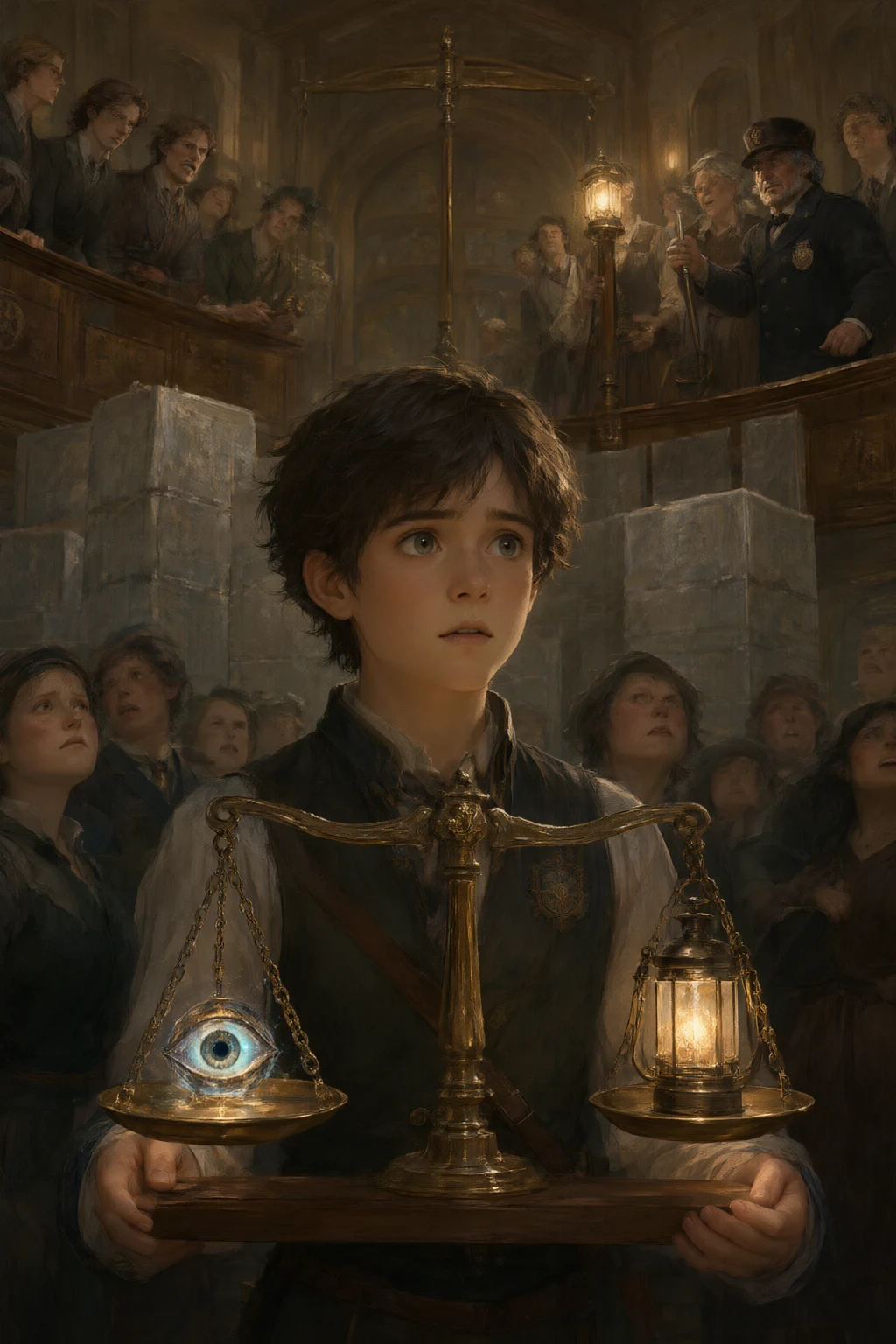
On the morning after the Ashglass attack, the city council placed a scale in the square and asked citizens to place a stone in one of two bowls. One bowl read safety now. The other read freedom protected. There was no third bowl, and no explanation of what the stones weighed. Seventeen-year-old clerk Orin had helped prepare the scale. He knew the bowl marked safety was already heavier. In the first hour, people had placed stones after looking at the broken windows, the scorch marks climbing the clock tower, and the names of the six people who had died.
By noon, the public count showed an overwhelming vote for a citywide surveillance spell: listening lenses in public squares, identity-linked movement records, and a prediction engine that could flag anyone behaving like an Ashglass collaborator. The attack had come through a crack in the eastern sky. It struck without a visible weapon, leaving glassy dust on every surface. Three districts had gone dark. The council’s emergency meeting had lasted through the night.
“Your office has no vote,” said Councillor Vale, when Orin pointed to the scale. “My office records the vote.” “It does not determine its meaning.” Vale’s sleeve smelled of smoke. She had lost her brother in the eastern district. On the table, the proposed law waited beside a map of the city. Red marks showed where the Ashglass had appeared. Blue marks showed where the surveillance network had reached.
“Public safety is a legitimate concern,” Orin said. “So is dissent. The vote is being counted as if those are opposites.” “They are opposites when a murderer is inside the walls.” “We do not know that the attacker is inside.” Vale pointed to a smear of glass in the photograph. “We know someone gave them access.”
The city had spent three days identifying suspects. A watchmaker had been arrested for selling lenses to an unregistered group. Two teenagers were detained for posting a map of the eastern alleys. Their disappearance changed the story from an attack to a betrayal, and the proposed law became easier to accept. Orin had helped draft the law because his office was responsible for making government legible. He had never imagined that a document could be legible enough to make resistance harder to see.
The prediction engine opened at noon. It projected a blue web over the city, linking people who had attended the same market, used the same bridge, or stood within a hundred paces during the attack. The first flagged name belonged to a teacher who had treated injured children. The second was a courier who had crossed the eastern district during the blackout. The engine did not claim they were guilty. It called them high association value.
Orin noticed a line of code in the briefing: a person could be moved to a watch list without a hearing. He showed it to Mara Sen, the council’s records keeper. “That is not in the public summary,” she said. “It is in the operating procedure.” “Does the mayor know?” “He approved the procedure.”
The next day, Orin attended a hearing for a detained courier. The courier’s name was Iven, and he had spent six nights in a holding room because his route overlapped with the attack. His family had brought clean clothes and a ledger of every minute he could prove. “Your route puts you at the bridge,” the magistrate said. “I was delivering medicine.” “To whom?” “The ward.” “Name the recipient.”
Iven named a doctor. The magistrate asked the doctor to confirm. The doctor had treated six hundred patients since the attack and remembered none of the visits by name. “Your system cannot distinguish a helper from a collaborator,” Orin said. “The association value is not evidence.” “The system is a warning,” the magistrate replied. “A warning should not be a sentence.”
At that moment, the city’s wards began to ring. A second Ashglass flare had appeared over the market, smaller than the first but bright enough to crack the bell tower. No one died, but the sound shook dust from the council chamber. The magistrate ordered Iven returned to holding. Orin heard someone in the gallery say that the surveillance had better come first.
The two teenagers were released that evening after the map’s safe-route markings helped investigators clear an alley; their detention became a supervised curfew, not a conviction. They reported to the curfew station before midnight, surrendered their transit cards, and wore location monitors. He drafted a compromise law. It suspended the identity-linked system, required a warrant for listening spells, created a public review panel, and preserved anonymous speech except when a person made a specific threat. The city would still have the Ashglass sensors, and the prediction engine could issue alerts without naming people. Council members called it timid. A shopkeeper called it useless.
One woman who had lost her son in the attack stood in the gallery and said, “If you can’t keep people safe, don’t ask us to surrender everything to keep us safe.” The security committee substituted the severe bill for this compromise before the vote.
The vote was scheduled for the next morning. Orin went to the square after midnight. The city was quiet except for the wind moving through the broken clock tower. He found a group of teenagers erasing the black eye from the clerk’s office. They were the same teenagers, their curfew check-in and monitor ping logged at the station. “We saved the map,” one said. “Do you think that matters?” “It helped investigators find the safe route.”
“It also got us arrested.” “Both can be true.” They looked at him with the particular anger reserved for people who are tired of hearing that truth has two sides. Orin said, “I helped draft the law that made your arrest easier.” The boy’s shoulders lowered. “Why?” “Because the council asked for a document. I didn’t ask enough questions about what the document would let people do.” The second teenager held up a small brass key. “The map has a key.” “What does it open?” “The old signal tower. It shows where the Ashglass cracks first. The surveillance plan ignores it because the tower isn’t connected to the prediction engine.”
Orin took the key. The teenagers did not trust him enough to come with him, and he did not ask them to. At the tower, the stairs were warped, and the wind through the cracks made the bell wires sing. The instrument was a brass mirror surrounded by silver needles. When Orin turned it, faint blue lines appeared in the sky. A crack was forming over the river, where thousands of people gathered each morning.
He sent the council an unverified message. By dawn, two engineers were at the tower. They confirmed the crack and evacuated the market. The prediction engine had shown no danger there because the event had not yet happened.
At the public vote, the speakers argued from every direction. A nurse said surveillance would make patients afraid to seek care. A veteran said people had survived attacks by watching the streets. A shop owner said customers had left when the identity system began recording purchases. A teenager held up a jar of ashglass dust. “This came from the sky,” she said. “If the city can track the people who carry dust, why not track the people who make it?”
No one had an answer. Orin read the severe bill aloud. When he reached the clause allowing the prediction engine to hold a person for forty-eight hours without a hearing, someone in the crowd shouted, “That is the old gate law!” The name referred to a law used during the last war, when suspected collaborators were confined before trial. The clause had been copied from a template.
He stopped reading. “This language is not necessary for the sensor network,” he said. “It was added by the security committee.” The council president asked whether he was questioning the committee. Orin said, “I am questioning the template.” The president asked if he had a replacement. Orin looked at Mara, who had brought the records. He named the public panel, the warrants, the anonymous notices, and the requirement that every alert carry its uncertainty. Someone shouted that the severe bill was the committee’s better version.
A screen lit above the square. The Ashglass prediction engine had detected a cluster of people moving toward the council hall. The warning marked seventeen citizens, including Orin and Mara. The system claimed a high likelihood of coordinated disruption. The crowd saw the names appear over their heads. Some stepped away from one another. Two people left the square. A man who had been arguing for surveillance suddenly stood beneath a blue line and said he felt accused without being able to answer.
Orin did not know whether the warning was true. The engine could be detecting a protest. It could be detecting ordinary movement. It could be manipulated. The uncertainty had been designed out of the display, leaving only a red border and a countdown. He went to the council microphone. “The warning is unverified,” he said. “You can ask people to disperse, or you can treat them as a threat because the model says so.”
The president told the security officers to hold the square. The officers moved toward the group. Mara opened the records terminal. “The source is not a public sensor,” she said. “It is the listening lenses in the council chamber.”
A spy had entered the prediction engine by speaking into a lens at the meeting. The words move toward the council hall had been transformed into a predicted pattern. The system was not seeing a future. It was reacting to a command hidden inside ordinary speech. The officers stopped. The crowd began to laugh, then went quiet. Laughter did not make the earlier violation disappear. The officers had still obeyed a false certainty.
The security committee chair demanded an investigation. Orin asked for the listening record to be published. The chair said it contained private conversations. Orin said, “Then publish the fact that the system was manipulated and the people who authorized it had access.”
The council voted before dawn. The severe bill was rejected. The later compromise passed: public sensors for the Ashglass cracks, no identity-linked movement records, a listening spell only with a signed warrant, and an independent panel to review every alert. The panel included a paramedic, a street vendor, a city clerk, and a former security officer. It could not access private identities unless a judge approved it. It had to publish false positives as well as successes.
The courier Iven was released after the records showed his route led away from the attack. His six days in holding could not be returned. The council offered compensation, and Iven accepted only what would pay for his mother’s medicine. “You can record that I was innocent,” he told Orin. “Don’t record that it did not cost me anything.” Orin added both statements to the public register.
Weeks later, he walked through the eastern district with Mara. Repairs had replaced the windows, but scorch marks remained on the stone. A woman sold tea beside a wall where the blue prediction line had marked her during the false alert. She pointed to the line’s old position and said, “It was there every day for a week.” “No one told you what it meant?” Orin asked. “I knew it meant I was watched.” “Under the new law—”
“The new law is better,” she said. “I am not saying the watching disappeared.” They stood beneath a new sensor, smaller than a lantern, that watched for heat patterns in the sky. It could not identify faces. It could not record conversations. It still made the city look upward, and someone always had to decide what the light meant.
Orin returned to the clerk’s office and opened the register. The first page listed the vote count, the names of the dead, the false alert, and the compensation ordered for Iven. He added the teacake seller’s statement, then paused before entering it. A record was not a cure. It could preserve a disagreement, but it could not make the square safe enough for someone to speak without checking the nearest lens.
At sunset, the city’s bells rang without a warning. People stopped in the streets. Some looked up. Some looked toward the doorways where the old listening spells had been removed. Orin stood beneath the clock tower and waited for the council’s message. No order came. The sound faded. A child asked whether it meant an attack. “It means the bells rang,” Orin said. “That is not an answer.” “No,” he said. “It is the beginning of one.”