The village of Vetrana kept four hundred sheep on the ridge above it, and the ridge ran up into the Sasso pass, and the pass was where the wolves came from. This was not a story. It was a road, with a name and a season, and the shepherds of the upper village had known it since before the road was cut. What had changed was the road. The quarry at Rocca sent four trucks a day up the shepherd's track in summer, and the trucks had a horn on them, and after three seasons the dog that had been with the flock on the high pasture was a dog that would not leave the oak scrub. The dog was called Bella, and she was nine years old, and she sat at the edge of the oak and barked at nothing all afternoon.
"You cannot have the high pasture," said the shepherd's daughter. She was eleven. Her name was Nella and this was the first winter she had gone up with her grandfather. "Nobody said that." "You cannot have it," Nella said. "There is nothing up there but Bella and the rain."
The commune had a book. Every winter the book was opened and the losses were written in it, and at the end of the year the commune paid for the losses at a fixed rate: so much for a ewe, so much for a lamb, so much for a goat, nothing at all for a dog. For eleven years the losses were small. Two lambs. A goat. One year, four. The book balanced the way everybody wanted it to balance, and the elders of Vetrana would tell you that the whole arrangement worked because of the night watch, which was eight men, two at a time, from dusk to the second hour, walking the length of the ridge with lanterns.
Then the tax came, and there was a vote, and the night watch was struck out. The reason given in the minute was that the commune could no longer afford it. The reason everybody understood was that the tax had been raised and the watch had always been the first thing anybody thought of, and because it was the first thing anybody thought of, it was the easiest thing to lose. Nobody replaced it. The hill looked exactly the same. The sheep looked exactly the same. The difference was that from the second week of October, the only living thing between the flock and the pass was a girl and an old man and a dog that would not leave the oak.
The first report came on the ninth of November. Nella had been sitting in the lee of a wall at half past four in the afternoon, in the light, in the last of it, with the flock spread below her and the light going off the pass, and she had heard a sound up on the stones that was not a bell and not a raven. It was low, and it was a single note, and it did not come from a bird. She came down in the dark, two hours, and stood in the piazza in front of the tavern in a coat that did not fit her, and said that there was a wolf on the ridge.
The men laughed at the coat. They did not laugh at the rest. Three of them went up with lanterns and a dog and came down at the tenth hour and said there was nothing on the ridge, and the shepherd, Nella's grandfather, said, "I told you," and one of the men said, "We walked it, Ciriaco. We walked the whole of it." "Then it was something else," said Ciriaco. "And there is nothing up there for it to have been, Ciriaco. There is no water on the upper pasture in November. There is nothing to come for." That was true, and it was the whole difficulty, and it took Nella until the following spring to understand that it was true.
The second report came on the third of December. This time six men went up and stayed until midnight, and they found the tracks, and they found them and came down, and the tracks were a wolf's and there was no doubt about it, and nothing else was found, and in the morning the elders held it in the square that a child could not walk a ridge in the dark and be right twice. The third report came on the eleventh of December and nobody went up at all.
There was one more report, and it was the only false one, and it was not the worst thing anybody ever did in that village. Nella was seven. It was summer, and the tavern yard behind Vetrana had a fig tree and a bench and a dog, and the dog was a fox-coloured thing with a torn ear that came in under the wall and stole bread and was chased and came back, and Nella wanted the whole tavern to come out into the yard to look at it. She went up on the step and made the sound. She made the noise that you make, low, one note, the noise of a thing on the stones. Forty people came out of that tavern.
That is what killed it. Not the noise, and not the dog, and not the fact that she had wanted a laugh. The fact that forty people came out of that tavern at once, on an evening, and walked a hundred yards, and found nothing, and went back in, and that somewhere in that night the word began. By the time she was nine, the elders had stopped saying her name and had started saying the noun.
In February the commune ran a count. The book was opened on the vestry table with the priest, and the clerk from Rocca wrote, and the line for the year read: three lambs, one ewe, one dog, no further. Ciriaco read it and did not say anything for a long time. Then he closed the book and gave the crook to his son-in-law and sat down on the wall by the sheep trough and stayed there, and the daughter brought him soup, and he ate it, and he did not say anything for three days. On the fourth day Nella found him with the commune's other book.
It was a bound book in a grey cover and it was the ordinances of the grazing, and it was the oldest book in the commune and the only one anybody had ever needed and had never opened. She opened it, because she was eleven and because she had been reading ledgers since she could sit still enough to be useful, and the third title of the fourth section said this: That the shepherd of the high pasture shall keep a tally at the hut of the flock, of the number of beasts brought up and of the number taken down, of the weather, and of the hour; and that the tally shall be nailed to the door of the hut on the morning following; and that no loss shall be paid by the commune save where the tally is found.
"And they have not paid anybody since the watch went," said Ciriaco. "No," said Nella. "They have not paid anybody at all, because nobody has kept a tally since the year of the vote, and the ordinance says they pay nobody, and the elders have been reading the other book, and the other book has been saying three lambs and a ewe for two years, and both of those things are true, and one of them is a lie by accident." Ciriaco looked at her for a while. "The book is in the sacristy," he said. "Under the shelf. The priest does not know what is on that shelf. I have been up that ridge forty-one years and I never once opened it, and I want you to understand that I am not a clever man, Nella. I am a man who goes up a hill in the rain." "You go up a hill in the rain," said Nella, "which is the whole of the ordinance. It is not about being clever. It is about a board on a door."
She was on the ridge alone for six weeks, because the old man had gone down with a cough and the son-in-law had a mill and the commune's ten sheep, for which somebody had to be paid, took every pair of hands that offered. Her uncle came up on Sundays and went down on Saturdays and was extremely good company and entirely useless. She kept the tally. Chalk on a board, in a hand her grandfather checked on Sundays. Day. Hour. Weather. Ewes, then lambs, then the dog. And then, in a fourth column that was not in the ordinance, which she invented for herself: the tracks, the sounds, the hour, and the number of people who came up to look. The fourth column was the one that mattered and it was the one nobody had asked for.
On the nineteenth of March she wrote: one, low, one note, off the stones, second hour before dawn. And in the last column: nine, who did not come. She did not shout for anybody. She wrote, and she took the flock down herself on the two following days as the ordinance allows, and she came down the hill with four hundred sheep and no dog.
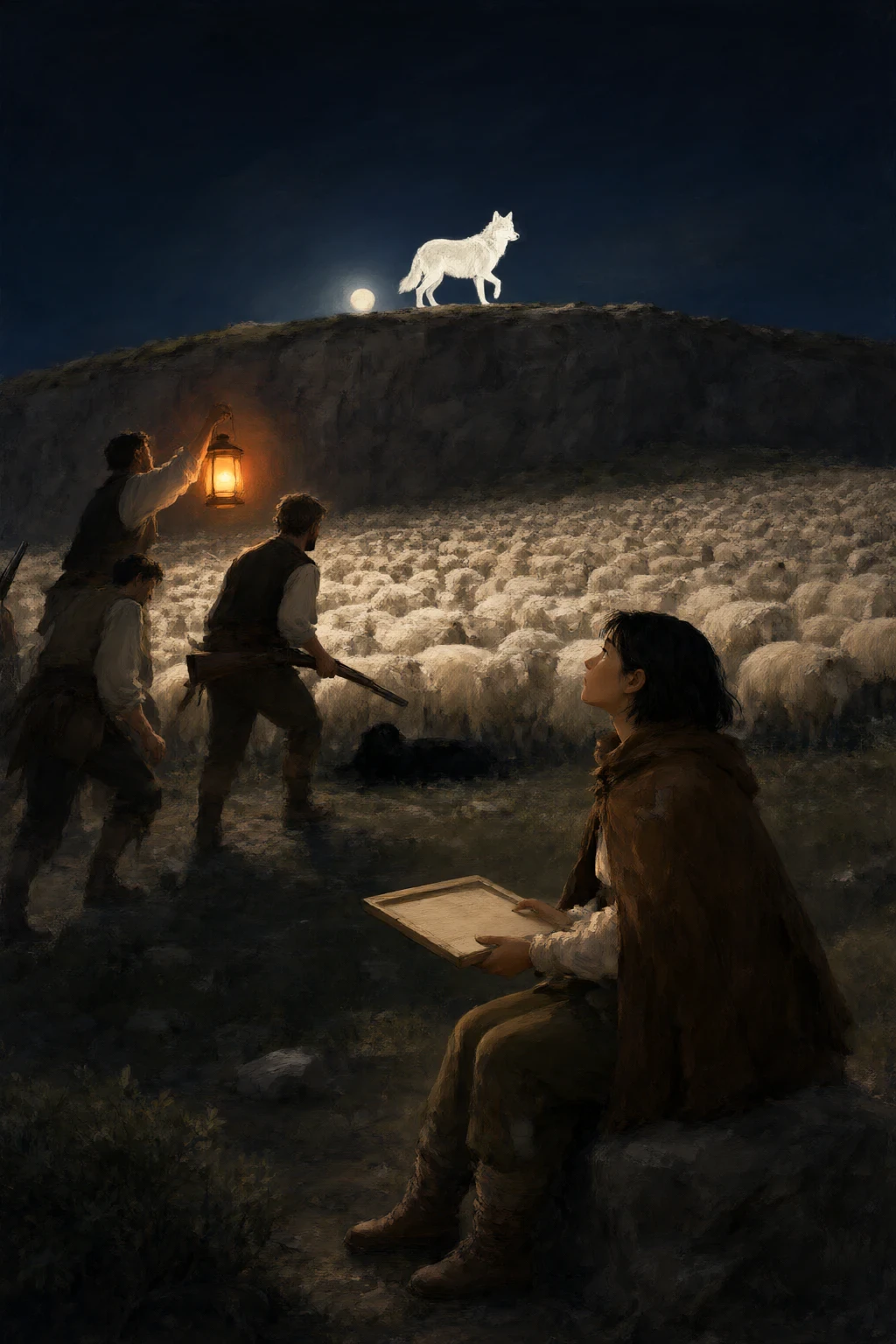
The night was the eleventh of April. The flock was up again and Nella was fourteen by then, and the dog had come back, or a younger dog had, a black one that would work. She saw them at the first hour. Three of the dogs came off the quarry road where it crosses the top, and they were not stray. The commune had had them rounded up twice. The road was the problem: a truck road runs all night in summer, and the dogs live under it, and a dog that lives under a truck road has never met a flock and does not need to, because a truck kills a sheep for nothing and does not have to be caught. They came across the top in a line, fast and low, the way they do. Behind them, at two hundred yards, something else came out of the pass.
It was not the noise it makes when it comes to kill. It is a short bark, repeated, high, the noise a dog makes, and the Nella who had been telling people about wolves since she was seven knew it at once and had never heard it in her life. The black dog came off the ridge at a dead run and did not stop. The other two went after it. The flock did not move, because four hundred sheep are a great deal of animal and there is nothing on that mountain at all that could make four hundred sheep move that night. The wolf turned and went up over the crest with the two dogs still coming, and it did not come back down.
The shouting brought Vetrana out. That is the part that is in everybody's memory and nobody can account for. Eleven men came up the track in forty minutes, in shirts, with lanterns and one with a shotgun and a dog that would not go, and they found the flock standing in the dark, and the black dog, and the girl sitting on a rock with a board on her knees. "What is it?" somebody said. Nella turned the board round and held it up so the lantern could find it. She had written it before they came, because she had promised herself she would write it down, and she had known that if she did not write it down she would spend the rest of her life being a girl who said a thing.
Tally for the 11th of April, first hour. Tracks in the rain of the 10th, from the pass, one animal, large, and the prints of three dogs off the road, and no loss. "That is all?" said somebody. "That is all," said Nella. "And the tracks of the wolf are the tracks of the wolf, and the tracks of the three dogs are the tracks of the three dogs, and there is no flock between them tonight that is not still standing here, and you can count it yourself, and you are going to count it twice, and I am going to stand here while you do." They counted it twice. It was four hundred and eleven.
They do not say the girl's name in the square at Vetrana. They say the word, and it does not mean what it used to mean, and there are boys in that village who do not know that their grandmother cried in a doorway and who regard the whole affair as a boast. The commune restored the night watch, at eight men, two at a time, at four soldi a night, and it is still restored, and the ordinance is nailed up in the hut with the tally board under it, because an ordinance nobody can read is an ornament. The book from that spring is the fourth, and each of them has a fourth column, which the ordinance does not require, which somebody in the sacristy found room for.
And the young man who took the mill, and Nella, and two of the nine who had not come up that year, were on the ridge on the eleventh of April, and they are there still, in the same rotation, on the same night, and the tally that year is a plain one. Ewes: 214. Lambs: 197. Dog: one, black. Loss: none. Cause of loss: --. Under it, in the new column, in the small square hand, the single line that is the whole of the story: At first hour, one large animal, off the pass, put itself between the flock and the dogs and drove them off the road. It went up over the crest and did not come back down. It did not ask for anything.