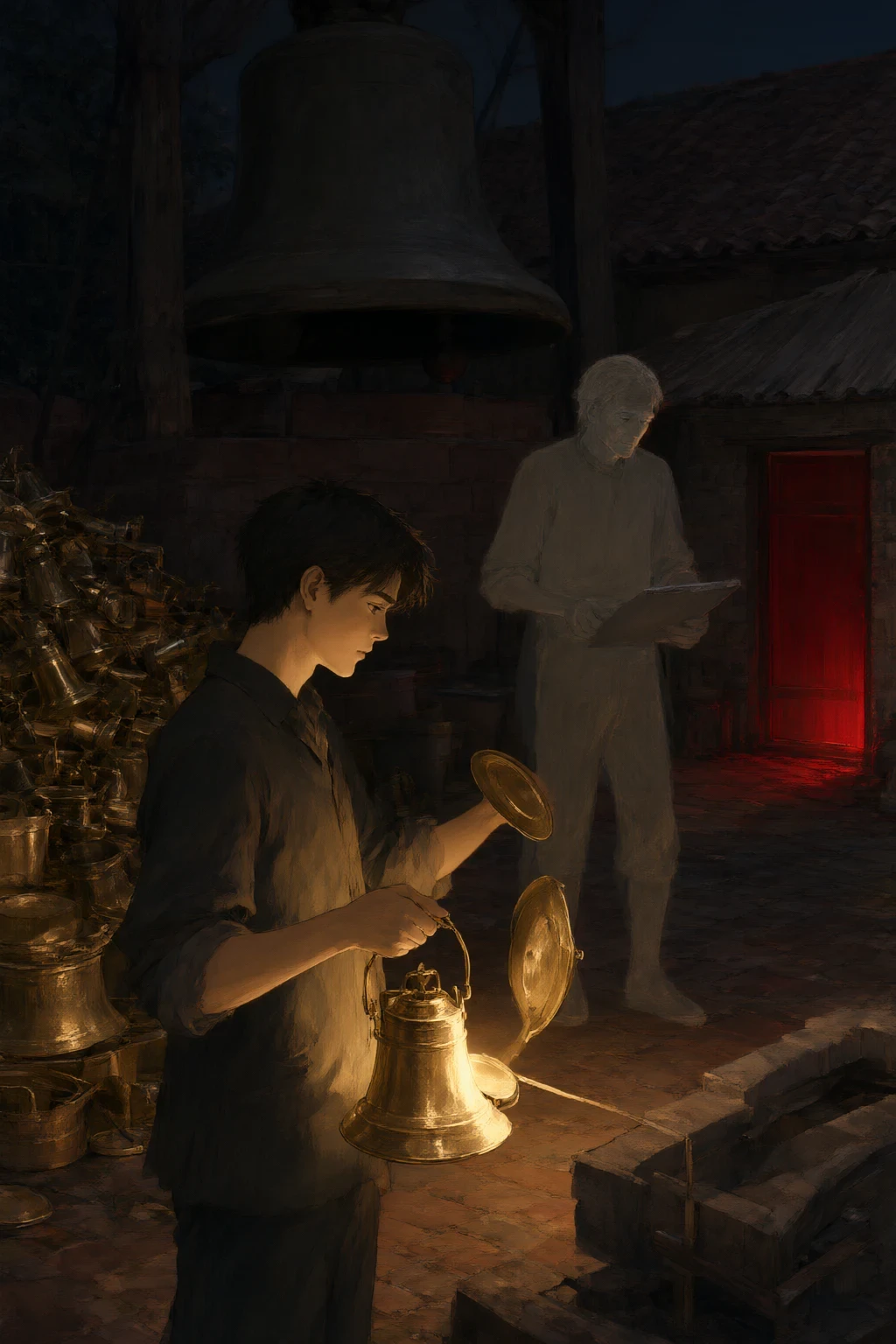
The Huo bell foundry stands on the west street of Keshui, between a paper shop and a well, and it has stood there for one hundred and forty years, and the reason there is a well on one side of it and not on the other is a piece of town history that everybody knows and nobody will explain. In the eighth month, the year the boy came to work at the foundry, the pawnbroker two doors down put a lot of unsold household goods out on the boards, and among it, on a cracked tile, was a lamp.
It had no handle and no spout, and the body of it was the colour of a thing that has been in a fire, and the lid was a separate piece fitted badly. It was not old. That was the first thing the boy understood about it, standing there with a string of cash in his hand and sixpence of his own. Brass this colour has been out of a kiln maybe thirty years. Brass this colour with a lid fitted badly by a man in a hurry is thirty years and a bad week. It cost him eleven cash. He had sixpence of his own, so it cost him the rest of the day's lunch and a week of his standing.
He was Wei, seventeen, a runner. He carried things between the foundry and the guild wharf, and he could read. That is the whole of his qualification and the whole of what is wrong with him. He could not write, because he had been on the wharf from the age of six and there is no school on the wharf; he read because a runner who cannot read a shipping mark is a runner who gets sent for tea, and so he had taught himself the marks on the wharf, and then the marks on the brass, and then the marks on the bell-faces, which nobody in Keshui outside the foundry can do, because a bell-face is a contract with weather.
The founder of the foundry was a man whose name was carved on the lintel in a very old hand, and the mark he used on his work, a square with a bar through it, is the Huo mark to this day. Nobody at the foundry wanted the lamp. Old Qiao, who had been at the bench for fifty-one years and whose hands were not steady enough for work any more, turned it over twice, said "not mine," and went back to the fire.
The writing was on the inside of the lid, and it was nine clauses long, and it was in a hand that Wei could read about as well as he could read a bell-face, which is to say: he read the marks, and the marks told him things, and he had to guess the sentences. It had taken him four days. He did it in the loft over the shed, on his back, with the lid on his knee, because he had learned at eleven that a thing you cannot read is a thing you must not be found holding.
Clause one bound a spirit to the holder for the term of the holder's natural life. Clause two said the spirit would be bound to the lamp and to nothing else, and would not pass, and would not be lent, and would not be given away while the bond held. Clause three said the holder might rub. Clauses four, five, six and seven were about what the holder might ask, and they were the four longest, and Wei read all four without understanding a single one of them, and wrote them out on a slate from memory, and then found that he had written one of them out twice with different words and was frightened about it for a full day.
Clause eight said the claim could be made only once, and only aloud, and only in the holder's own words, and only for a thing the holder was able to do himself. Clause nine was one line and it was the reason he sat on the floor of the loft for a while.
The nine went like this, as near as Wei could make it out: this bond is discharged on the holder's claim, and the last of the line is released. He went down and found Old Qiao by the fire and asked him what a line of spirits was, and the old man looked at him for a long time and then said, in the voice he used for a thing he had been carrying up and down stairs for forty years and had never been asked about, "Is it nine clauses?" "How did you know it was nine?"
"Because it is always nine." Old Qiao turned a ladle over. "I have been in this shop since I was fourteen. There were two before me and there is nobody after me. It came down the line with the shop. My master's master's grandfather had one and it came from a magistrate in the north whose name nobody here can read, and the ninth is always the same, and the ninth is the one that everybody reads and nobody understands." "So they are released," said Wei. "When somebody makes a claim."
"When somebody makes a claim," said Old Qiao. "Nine hundred years of a family, boy, every one of them down here rubbing and wishing, and not one of them ever read the ninth, because the ninth is on the inside of the lid, and if you are holding the lamp to rub it, the lid is on the table. It is face down, because that is the way you put a lid down." He put his hand flat on the bench. "For nine hundred years they have all put it down face down."
Wei said, "Then how is it my claim and not somebody else's?" "Because you cannot write." Old Qiao said it without any pleasure at all. "Look at me. I have signed for this shop's brass for fifty-one years. I have signed for the guild, for the temple, for the tax office, for a magistrate in the capital who cannot be reached in less than a month. I have a seal with my name on it and it has cut wax a great many thousand times." He held up his hand. "You cannot write a single character. Do you understand what you are? You are the only man on this street who has never signed anything. A bond like that is not addressed to a man who can sign, because a man who can sign is a fool who signs without reading." He looked at Wei's face, and then at the fire. "I have wanted to tell somebody for fifty-one years," he said, "and there is nobody in this town to tell."
The boy did not go to the well and make a claim. He went to a stone on the north side of the west street in the second month after, and he sat on it with a slate and a stick of ink-mud, and he drafted it, and he did this eleven times, because the eighth clause was the one that mattered and he would not trust a sentence he had not made fit inside it. The eighth clause said the claim may be only for a thing the holder is able to do himself. It did not say the claim may be for money, and it did not say it may be for a house, and it did not say it may be for another person. It said: a thing the holder is able to do. Not a thing he is able to have.
So Wei sat on a stone in the second month and worked out, slowly, in a good deal of soot on a slate, what it was that he could do. He could not write. He could read. He could turn brass, and file, and chase, and tune, and he could read a bell-face in weather, and he had never once in his life been paid to do any of it, and he was seventeen, and the foundry owed the guild for a year of metal, and old Qiao was fifty-one years old and his hands were finished, and there was nobody coming.
He did not write I wish for the foundry. He wrote, in the eleventh draft, the thing he wanted, which was this: that in five years he would be able to make a bell that the temple of the river would hang, and the shape of the mark on it would be his own and not the Huo. It is worth setting down exactly, because he kept the slate, and because it is the whole of what he did: he claimed the making and nothing else. Not the foundry. Not the money. Not the street. The making. He had chosen the smallest word the clause would let him use, because the old smith had told him that everything the bond could do, it did literally, and because a boy who is careful about the exact meaning of a sentence has already been taught one trade.
He rubbed the lamp on the eleventh night of the third month, in the yard, behind the bell, with the lid in his other hand, face up, because he had decided that if this was going to happen it was going to happen where he could see the writing. The yard is not large. The bell takes up a good deal of it. The light that came out of the lamp was not like the light out of a lamp, and what was in it was about four feet tall and thin and grey, and it had the shape of a man because a man is the shape a person's attention gives to a thing, and it was the last of its line, which is a thing you can see the way you can see that a roof has been patched eleven times.
The old man in it looked at the bell, and then at the yard, and then at the boy, and then at the slate, which the boy was holding, and which the old man read from three feet away in a light that came out of brass. "Ah," said the last of the line. "You have it in writing." "I have it on a slate." "That will do."
He made the claim then, in his own words, out loud, once, and he was careful about the order, because order is a form of grammar and the ninth clause was four hundred years older than he was. And what happened took about as long as it takes a sheet of paper to go up a flue, and it was not magnificent, and the boy, who had been frightened of it for eleven days, was disappointed, and has said so. The bell behind him stopped humming. That is all that happened in the yard. A bell that had hung in a foundry yard for forty years, in a town where the foundry bell is sounded at the changing of the watch because the town has no watchman, stopped humming, and has never been sounded since, and the foundry bought a gong.
"Claim received," said the old man. "It will take five years. You should know that it will take five years, because the ninth clause is not a wish, it is a receipt, and a receipt does not care whether you are in a hurry." And the light went out, and there was a lamp on a low stone in a foundry yard, with no handle and no spout, and a lid that fitted badly.
The clause had been read. Wei had been eleven days with the ninth clause and it had done what the ninth clause does, which is nothing, and that was the entire trick of it and it was four hundred years old: the boy thought that the choice was between wishing and not wishing. It was not. The choice was between a claim and no claim, and the no claim was the genie in the lamp for the rest of the time there is a line, and no claim is also a decision, and the ninth clause is very clear that the bond is not released by the passing of time. Time does nothing. That is what a bond is for.
He had come down that road to find out that he had been holding the free end of something since the eighth month, and that the only question in the world was whether he was going to say it out loud, and that he would be. Old Qiao was right about that and about nothing else. There is no forgiveness in the ninth clause. There is not a reward. There is a term, and the term was that a thing the holder is able to do himself is a thing the holder is obliged to do himself, for five years, alone, on a stone in the north of the west street, which is the one clause in the whole of it that the boy would have chosen if he had been writing it.
The five years were the five years. The guild held the metal against the foundry for a year and two, and the boy had to make a bell out of the shop's own stock, and he made it wrong twice, and the third he finished in the fourth month and it is still hung in the yard of the river temple. It is the only bell in the district whose mark is not the Huo bar, and that mark is a square with a bar through it turned a quarter-turn and notched once, which is not a family mark at all, and is the mark a runner made up in a smithy because he could not sign. He married nobody and went nowhere. He is fifty-four now and he has a shop and a boy of sixteen who cannot write and who can read a bell-face.
What he will not do, and has never once done, is talk about the ninth clause. He has been asked eleven times. There is a man on the wharf who offers a drink for it. The boy of sixteen asked him once, at the bench, in the fourth year, and got for an answer that the boy did not understand and has since worked out: "It is mine," Wei said, "because I am the one who read it." And the boy of sixteen, who is a runner and can read, has now been at the foundry four years and has never once been able to find the mark of the Huo on anything that came out of that yard, and has not been able to work out what a square with a bar through it, turned a quarter-turn and notched once, is supposed to mean, and has not yet asked.
The last of the line is not a story that ends, and the boy would have been the first to say so, and he has said so, to the same man on the wharf, in these words: "He is eighty-one years old. He has four rooms above a noodle stall near the south gate, and he pays rent. He has a nephew who comes on the new year, which is what you do. He has been to the theatre twice and did not enjoy it and says the singing is behind the man. He goes out in the morning. He comes back in the afternoon. He does not know what the ninth clause is. He is not going to be told, and he has not asked, and I have watched him a long time and I would know."
And then the boy, who is fifty-four, and who was seventeen, and who sat down on a stone for eleven nights, would tell the other half of it, and he has never once claimed to be the kind of man who tells the good half. What he says is that the last of the line comes to the yard in the mornings and has come every morning for fifty-one years, and stands at the gate, and waits. Not for a wish. He has never made one. There is nothing to ask for. He is free and there is a bench and there is a morning, and every morning he looks along the street for somebody to be given to, and every morning Wei has a scrap of brass for him, because Wei has always had a scrap of brass for him.
He is very bad at it. He rolls it flat in one pass, which is not a thing anybody does, and he asks twice where the offcuts go, and in the fifty-first year he rolled a ring and did not ask where to put it, and handed it to Wei across the bench, and Wei turned it over once, because a ring is a thing you turn over, and put it in the day-book, in the ordinary column, under brass, with the weight against it, and wrote the date, which is the other thing a column is for. The last of the line read the line over his shoulder, the whole of it, the way a man reads a thing he is the fourth party to, and said nothing, and hung up his apron and went home.