Ludger Weiss of Wenlingen went out of the world at twenty-one to learn what fear was, and told nobody where he was going, not his mother and not the two friends he walked out of the town with, and was back in three years with a list of what he had tried and no answer to it. The list survives. It is in the back of a salt ledger in the town house at Wenlingen, on a page with nothing else on it, in a small upright hand, and it reads in full. 1. The bed at the inn at Hemau. 2. The cask in the cellar at Talfurt. 3. The gallows at Weg. 4. The devil on the hay. 5. Nothing else occurs to me.
There is no sixth entry, which is the whole of the story, and it took him the rest of his life to understand that by the fourth he had stopped believing that fear was a thing you go and look at, the way you go and look at a castle that is said to be haunted, and pay a man to show you the room.
The bed at Hemau is a famous bed. A woman was killed in it in 1798 and the landlord has never had it out of the house, because a bed like that draws a particular sort of guest, and the particular sort pays. Ludger lay in it for two nights. The first night he was disappointed. The second night he got up at three in the morning and did what, in the accounts of the inn, the other young men have always done, which is to put his hand under the bolster and find out how deep the knife had gone, and found that the bolster had been re-covered in 1806, and lay there a while with his hand in the new ticking, and then asked the landlord, in the morning, what the room had been like in 1798, and the landlord told him at length and with relish, and Ludger listened politely and took notes.
The cask in the cellar at Talfurt is not a story but an object. A wine merchant kept an empty cask on chocks, and a great many young men had ridden it down the cellar steps in the hope of the thing that happens to you on a staircase if you are unlucky. Ludger borrowed the cask, rolled it himself, stepped onto it, went down, and came off it at the bottom onto the flagstones and thanked the man who ran down after him.
There is a gallows on the high road out of Weg with one noose on it that has been used, and a landlord in the town who will let you up the ladder for a fee and will not go up himself, and Ludger paid him and went up at two in the morning with a lamp he did not light. The account of the twenty minutes he spent up there is a single sentence in the town record of a constable who was told about it the next day. Ludger said that he had put his hand on the dead man's neck to find out whether the rope had been up long enough to do it, and that it had not, and that this was the thing that had kept him, and that he had then sat on the beam with his boots hanging in the dark for a while, and had come down, and had gone back to his room and slept.
The devil on the hay is the one that has a story in it, and it is the only one of the four where somebody was paid. Ludger took a boat down the Soll with a boatman called Fenner, who was a talker, and who told him, as the story goes, that he had once carried a passenger who was afraid to travel alone at night because the devil sat on the hay behind the mast and laughed, and that nobody went up the Solltal after dark now. Ludger offered him the price of a week's hire to say the sentence again the next night, alone in the boat, at the place the story says. He did it four nights running. On the fourth the boatman, frightened of the arrangement and saying so, gave up the wage and rowed him back.
It is not generally known what he was like at home, and the people who knew him were not the kind to say. He was not brave. It is worth being exact about that, because everybody in Wenlingen assumed the opposite for years and the assumption did him a great deal of harm. He was a strong young man who was good with his hands, and he had a miller's calm, and he had been raised in a salt house, where the ovens are hot and the floors are wet and the work is loud, and none of that had ever reached him as danger. The horse went into the wheel race at Kaldbrunn on a Tuesday in the eleventh month, and the girl leading it, who was eleven and called Trude, went in with it, and the wheel was turning, and the race is nine feet at that point and the water is black.
Ludger was on the bank, forty feet away, and he had time. He has said himself, and it is the only time in three years that he is recorded as having said anything to anybody afterwards, that he had about a length of ploughshare to decide with. The miller, a man of fifty called Ansgar Roth, took the gate off its hinge and went in after her and got her out, and Trude lived. What she had, nobody has ever established, and she does not talk about it, and she is a baker's wife at Kaldbrunn.
Ludger, on the bank, did four things. He shouted for the second gate. He told the boy on the drive to fetch the chain from the cart shed. He told the miller's wife, who was standing there, to go and get the physician, and then said, at once, and without any interval at all, "or the bonesetter," which is better. And when the girl came up out of the water he held the coat for her and put it round her and did not let go of it. Then Roth came out of the race, and looked at him, and said the sentence. "You had time to be afraid," he said, "and you used it to give orders." Ludger said that this was a fair description of the afternoon. It was not a fair description of the afternoon. It was a fair description of the twenty-one years.
He was four-and-twenty when the Count of Salden's daughter came to Wenlingen with a lawyer, and the reason she came was a debt. The salt works at Wenlingen bought coal from the Salden estate and had not paid for a year and a half, and the estate could not sell salt in that part of the duchy, and the two houses spent eleven months finding a shape a lawyer would accept. The shape they found in the second month of 1804 was a marriage, and it was Margit's idea, and her father had been ill a year and had agreed to it in a way her lawyer described in a letter as mechanical.
Ludger's part in it was that his mother owned a third of the salt works and he was the only son of it, and that a marriage in the duchy then settled a wife's claim to an estate and settled nothing at all on the husband's side. So Margit Halle came in with the castle of Salden, the entailed lands, the tower, and a claim on the Wensahl salt, and Ludger Weiss came in with his mother's third share and a good suit, and the terms were drawn accordingly, and both lawyers were satisfied, and neither of them looked up. Ludger's account of her, written later, in a letter to nobody that is in the same ledger, is four lines long. The fourth is: "She asked me four questions in eleven weeks and I answered all four, and three of them were the wrong questions, and I have thought for eleven years about which was the right one."
The fourth term of the marriage contract was hers and it was in the instrument, and the notary read it out. The notary was a man of sixty-five named Sporer, and he read it without any expression at all, because he had been a notary forty years and had read worse. "Fourth. The said Margit is to require of the said Ludger once, and on a night of her choosing, that he ascend alone the Salt Tower at Salden between the hour of vespers and dawn, and that he bring down from the upper chamber the three caskets standing upon the table of the upper chamber, and that he report to no person what he finds there, and that the said Margit shall not ascend, and shall not wait, and shall be at no place within one mile of the said tower between the said vespers and dawn." Sporer read it twice, because there was a second copy.
Margit Halle, who had not looked at him for the whole of the reading, said: "It is the only test in the duchy that you can pass, and I am going to make you take it, and you will pass, and afterwards I will not have to be afraid of anything again for the rest of my life. I shall be married to the only man I have ever met who is not stopped by his own heart. There is no one else. That is the entire reason I came to Wenlingen and not to a better place, and I have said it out loud, and I would have said it to a bishop."
What follows is from the back pages of a different book, in a different hand, and it is not Ludger's. It has no name on it, it is in Margit Halle's writing, and it was found in the tower in a tin box that was not part of the entail. 1st month. The drowning of the dog. Petz at the weir, on a chain, held under in front of him. He watched for a quarter of an hour. Afterwards he fed it and said it was a good dog. 3rd month. The cliff at Mengs. I had the bailiff show him the way. He came back and said the drop was about forty feet and that the man who jumped had not been a fool but had been unlucky, and he said it in that order, and I have not been able to eat since.
4th month. The physician's letter. I forged it. I told him his father was dying of a stone. He wept, and afterwards apologised for weeping, and asked me three questions about the treatment, and did not ask one about the man. 5th, 6th, 7th. I stopped. I want it recorded that I stopped, and why. Because I was testing him, and a man who is being tested is not being loved, and I am not a person who can do that and still be married afterwards. It is not a good enough reason. I have looked for a better one for eleven years and there is not one. 11th month, the last night before the reading of the fourth term. He asked me, in the yard, whether I was frightened of the tower. He asked it the way he asks everything, which is as though he had been told the answer and is checking me for the version. I said: I am frightened every day of it. He said: yes, and went inside, and did not ask me of what.
Addendum, in different ink, three days later, and this is the last thing in the book. The rope on the Salden tower has been in the family since 1731 and is re-racked every autumn by a mason of the estate, at a cost of four thaler, and it has not been racked in two years, because the mason is ill, and because the estate's accounts have been in my father's hands since his illness, and because I am the heiress, and because I did not send for the mason. If I had sent for the mason, Ludger would have sent a man up in his place and it would have been done in a morning.
I have had a great deal of time in three years to work out what I wanted, and what I wanted was to go up a stone tower alone in the dark with four hundredweight of iron over my head, and I have known every single day exactly how it would be done, and I have never once been in that tower at night in my life, and I did not know until the fourth of June what it is like to be married to a man who is frightened of nothing because nobody has ever told him what could.
They were married on a Tuesday in the sixth month of 1804 in the courtyard of the salt works at Wenlingen, because Ludger's mother would not have Salden pay for it, and two hundred people came, and the Count could not be there, and neither, in the end, was Ludger. She drank a quarter of a wine cup of water, which was the joke, and he drank a quarter of a wine cup, and she drank, and he drank, and she drank, and he drank, and she put the glass down on the table, and he put the glass down on the table, and the two hundred people who had been waiting eleven minutes for a scene made a noise that three separate accounts describe and that was not, according to any of them, a good noise. Salden custom is that the bride drinks alone with her back to the wall, and the groom drinks the same and does not set the glass down first, and every man in that courtyard was waiting to see whether he would.
Then they went up to the salt loft, and Ludger's mother cried, and Margit was kind about it, and at about the fourth hour she said she was going down to see to the horses, and Ludger let her go, because she had said the horses, and he had not been listening. She went down. She took her box and her two maids and she went down at nine, and she did not go near the horses, and she was at Kaldbrunn by the following morning, and nobody in the Salden house was told anything about it except the cook, and the cook said nothing for eleven years.
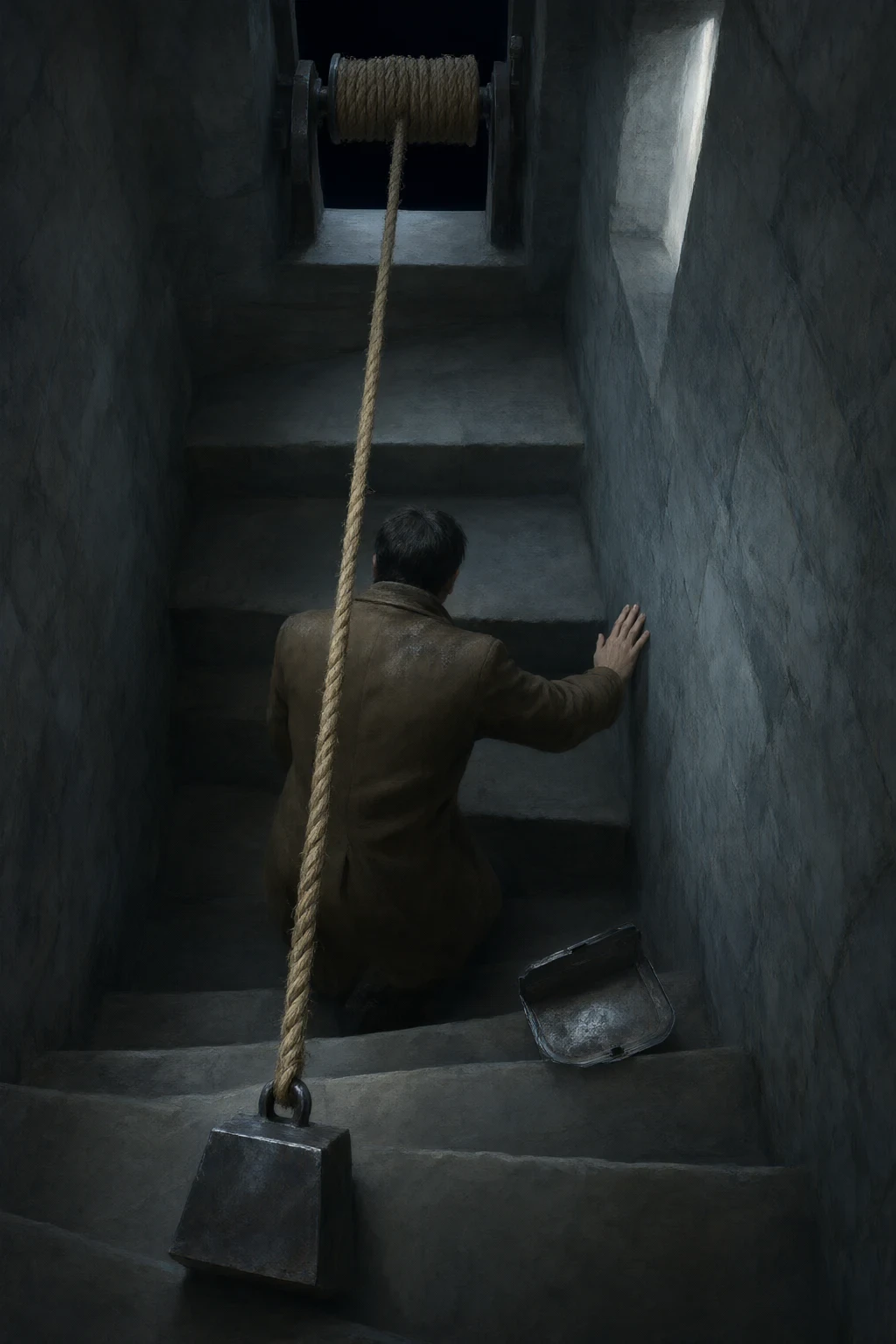
It is not a haunted tower and there is nothing in it at all, which Ludger understood about four o'clock in the morning, standing on the top stair with his hand on a wall that was warm. The Salt Tower at Salden is fifty-one steps and the last twenty are a spiral cut into the thickness of the wall, and the room at the top is a room for one person and a table. The hatch in its floor is racked, and the rack is a windlass on the roof with a four hundredweight of iron on the end of a hemp rope forty feet long, and the rope is the oldest object in the duchy and is inspected every year and was last inspected in 1801, and the last apprentice who went up it was nineteen and his name was Kaspar Halle and he was Margit's brother and he died in 1801, and the tower has been locked at the foot ever since, and the foot of the tower is forty feet from the Count's own house.
The upper chamber had a table in it and three caskets on the table, gold, silver and iron, exactly as the fourth term required, and a chair, and on the chair a folded blanket, and under the chair, on the floor, a tin box. He took the caskets down first, because the term said the caskets, and it was not until the fourth step that he understood why it was going to take two hours and forty minutes. A hundred and forty steps in the dark, with a windlass rope forty feet above you and a stone floor at the bottom of it, and nothing at all to be afraid of in any shape the world offers, until the arithmetic arrives on its own, uninvited, at about the second landing, and the arithmetic is a man who can add. The tin box was under the chair. She had written the date on the lid in the same hand as the list. Inside there was a sheet with four lines on it and a ring.
I have gone to Kaldbrunn and I shall be there until Michaelmas. Do not come before Michaelmas, and if you come before Michaelmas I will not see you, and I will not be unkind about it, I will simply not see you, because there is no arrangement in which I could hold your face and say the rest. You will be afraid tonight. You will be afraid because there is four hundredweight of iron over your head and a rope that is two hundred and forty feet from the last inspection, and there is nobody in that tower but you, and there has been nobody in that tower since 1801. That is the whole of what is in that tower. There is no devil on the hay and no woman under the bolster and no man on the gallows with a neck worth touching. There is a rope, and you have never once been told what a rope can do, and I have run out of ways of telling you that do not sound like a trick.
I could not be married to a man who had never been afraid of anything, because it would have been a marriage to a man who cannot be told a thing. You cannot tell a thing to a person who is not afraid. I have known that for two years and I have done everything a person can do about it except say it to you, and I did not say it because you would have said, yes, and gone inside. If you want to know where I am going, ask somebody who was in the yard, or ask the man at the mill, who will tell you without being asked, because that is what millers are. Yours, in the only way there is, M.
He was on his knees on the second landing at six minutes past four, which is a stone spiral and a bad place for knees, and he was not praying, because he had never done that, and there was nobody to pray to, and what was happening to him was not a vision and it was not a voice. It was arithmetic.
It was the four hundredweight of iron, and the hemp, and the length of the hemp, and the fact that he was the only person inside a cylinder and there was no second exit, and that the good hemp and the bad hemp were a number he did not know and would have to guess, and that guessing is what a body does at four in the morning on a stone stair. And it was the shape of his own head in his own hat, which he had worked out in the dark the way you work out a sound with your teeth, and it was a name, and the name was Kaspar Halle, and Ludger had met him twice, and the second time was at the wedding, four months before.
And then, in the interval between one number and the next, there was nothing in him at all. He waited. The fear did not go away when he counted to a hundred, and did not go away when he got up and went down four steps and came back, and he sat with his back against the cold wall and put his face in his hands and it was still there, patient, in the building with him, taking its time. It was, in the end, so uninteresting that he began to be irritated with it, and being irritated with it was the moment it was real, and after that it did not leave. He stayed on the stair for two hours. He did not go up and get the ring, which was in the tin box, and he carried the tin box down under his arm and left the ring in it.
The tower is a tower and the town of Salden is nine miles from the Wensahl and there are two roads out of Salden, and he came out of the gate at half past five with a box under his arm and no lamp, because he had never needed one. At the crossroads there is a milestone and a fingerpost, which still stands, and the fingerpost has two arms, and one arm says Kaldbrunn and the other says Wenlingen, and both of them are true, and the one that is useful to him is on the left.
He stood at the crossroads and he wanted two things, which had never happened to him before in twenty-five years, one after the other and then together: he wanted her, and he wanted to be told. And he understood, standing there, in the light coming up over the ploughland, that he had never in his life asked anybody a question, and that he was now going to have to ask one, and that the only person who could have answered the one he needed had gone away on purpose, and that this was the cost, and that she had told him the price herself, in four lines, in a room forty feet above a windlass, and had told him where to ask. He had not asked. That was the thing.
There was a carter coming up the Wenlingen road with an empty cart and a man on the cart who was eating, and Ludger could see him coming for four hundred yards, and there was a miller in Wenlingen who would have told him anything he asked for, and he had four hundred yards to think of a question, and the question he did not have was a question and not a subject, and four hundred yards were not long enough, because he had never once in his life begun a conversation with a question that was not an answer in disguise. The carter came up, and said good morning, and Ludger Weiss stood in the road with a tin box under his arm and a ring in it and asked him, in a perfectly ordinary voice, what time it was.
Then he took the road on the right, because it was wider, and it went south, and it did not go anywhere at all, and by the time the sun was properly up he had walked out of the duchy, and the fingerpost with two arms was behind him, and it took him until the second week of August to stop looking for one.