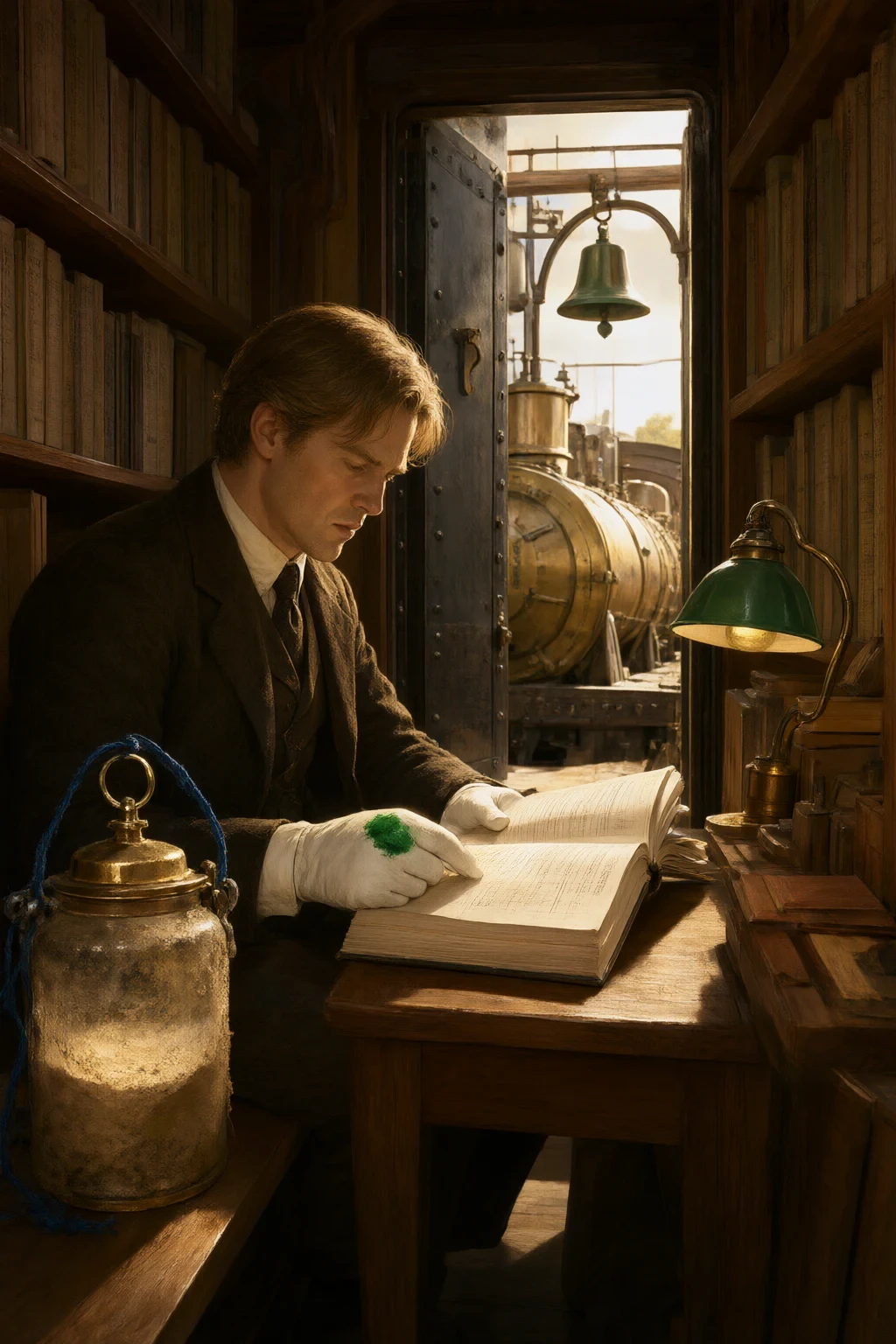
The Long Noon stood at Emberwhistle Halt for eleven hours and did not move, and in those eleven hours Sol Brannen counted every hour the engine had ever been given, and came up one hundred years short. The night stop was set at four. It ran to eleven because the Long Noon is a freight engine, and freight is nine hundred tons of hour-jar ballast, and ballast goes into the hour-pipe at Emberwhistle before it goes anywhere else, because Emberwhistle is the western head of the pipe, and the pipe is the reason there is a railway. That was the answer the halt staff gave him, and Sol wrote it in the day book, because a man doing a count who does not write down the answers he dislikes will shortly begin inventing answers he likes.
He counted at the desk in the Ledger Room for nine days and on the platform bench for the last two, because the room is always warmer than outside and always smells of ink and hot brass, and by the ninth day he had the strong impression that the room was making the argument for him. The room was one desk, one lamp with a green glass shade, and forty years of green-ink registers in oak shelves. The engine’s heartbeat came up through the floor as a slow tick, half a beat behind whatever he was writing, and he had stopped hearing the tick in his first year and had begun, somewhere in his eleventh, to write against it. The tick was one second and a fifth. He had measured it that first winter, with a watch and a bottle, in the interval between two stops. A year was three hundred and fifty-two thousand three hundred and twenty seconds, and a hundred years was eight hundred and seventy-six thousand hours. The engine had taken three million nine hundred and four thousand one hundred and sixteen hours into its fireboxes in forty years of running. It had spent three million twenty-eight thousand one hundred and sixteen of them. The difference was eight hundred and seventy-six thousand. He looked at the difference for some time. It was a beautiful number. It was a round number. Nothing in the working of a railway is round, because a railway is a machine that eats in ugly quantities, and a number that comes out round at the end of a subtraction of two ugly numbers has been put there by a hand.
On the seventh day he sent for Ferrite. He sent the request in the ordinary way, on a slip of Line paper, signed and dated, and the Captain came back inside two hours, which was faster than Sol had expected, because the Captain had been watching him from the walkway for six days and had opinions. The message said: BRING THE DRUM. NOT THE BOOK. BRING THE DRUM. The governor drum was a brass cylinder the size of a beer barrel, mounted on the forward firebox frame, and it was driven off the ballast valve through a train of gears that no one on the Line had oiled in eleven years because it did not need oil, because it did not need anything. It counted hours the way a tap counts water: mechanically, in the only terms it had, one notch per hour of fuel actually admitted to the fireboxes, whether or not a man with a green pen had entered it. It could not be talked to. It could not be persuaded. It was, in the strict sense the Line’s engineers used, the only honest instrument aboard, and the reason for the Captain’s message was that a man doing a count who finds a round number should go and get a thing that does not know what round means. Ferrite set it on the platform bench with the care of a man setting down a leg.
He was fifty-five, chief engineer, responsible for the engines and the gasbags, a braided beard with three fine copper wires run through it, singed at the ends where he had leaned over the firebox door too many times. He looked at Sol, and he did not ask what the count had found, and he waited. “Right. Listen,” he said. “The drum does not know your hand and it does not know mine. Forty years. I have had it geared down for the Kerr readout and nobody has touched the gearing.” “How many.” Ferrite read the dial the way a man reads a dial, with two fingers on the glass and his mouth slightly open, and then he said a number. “Three million, twenty-eight thousand, one hundred and sixteen. Confirm you heard that correctly.” Sol wrote it in the day book. “Heard it.” Ferrite turned the glass a quarter turn with a knuckle and showed the smaller scale, which was the fare side, hours taken. “Three million, nine hundred and four thousand, one hundred and sixteen. That is the intake. Confirm.” “Confirmed.” Ferrite took his hand off the glass. “Then your book is not wrong, Brannen, and I would have said so, and you would not have listened, and we have both wasted a day.” “No. We have not wasted a day.” “No,” Ferrite agreed, and picked up the drum, and set it down again. “We have not. Say the number.”
“Say which number.” “The one you are carrying about.” Sol looked at the drum, and at the sand, which at that hour was the colour of a struck match, and he said it. “Eight hundred and seventy-six thousand hours. One hundred years. Confirm you heard that correctly.” Ferrite did not confirm. He stood with his thumb on the drum for a while. “Right. Listen. That is my engine’s ballast, that figure. Every hour of it. Four hundred and six racks out of the yards, sand-crusted to the shoulder, blue twine on the handle, and if you have found a hundred years in there, then there is a hundred years of somebody in there, and I have been firing it for forty years.” “Yes.” “I did not say that to be cruel. I said it because it is the shape of the thing, and I would rather we looked at it together than you looked at it alone for another six days.” He shouldered the drum. “I will have the gear train out and counted tooth by tooth. It will take two days. It will agree with you.”
On the eighth day Septimus Vail came to the halt, which was a thing he did four times a year, and he did it in a white panama hat and sunglasses cut from smoked window glass, with a case of samples under one arm. Vail resold surplus hours to people who would rather not age, and the resold hours came out of the standing charge, and the standing charge was the largest single item in the Line’s book, and there was no clause anywhere in the Basin that stopped him. He had heard there was a count running. He had heard it from three people and had priced the information at two hours and thirty minutes, which he offered, and which Sol declined, and Vail wrote it on the back of his hand anyway. Then he said: “Eight hundred and seventy-six thousand hours, discounted for a single verified block, is a purchase I can make today. Ninety-eight hours on the barrel, and I will take the lot in ninety-second minutes, and I will take it in cash-out-of-a-jar, which is the only money that does not make noise. Fifty-one thousand hours at seventy-eight. I will take the lot. Ninety-eight is the price, and that is the price, and you do not have to decide before I have finished the sentence.” Sol said, “What happens to it.”
“What happens to everything, Ledger-keeper. It goes into a man in Sirocco who would like to be forty instead of sixty-eight, and it leaves you one problem smaller.” Vail tipped the hat. “Same again?” “If I sell it to him, it comes out of the same book.” “It comes out of the same book it came out of in the first place, or we would not be having this conversation under a copper roof in the middle of the night.” He set the case down. “You are confusing a moral question with a mathematical one, and there is a market for one of them.” “There is a market for one of them.” “Same again?” said Vail, to nobody, and went out to look at the gasbags.
The founding page was the eighth leaf of the first register, and Sol had read it perhaps nine times in eleven years, and he had read it as a formality, the way a man reads the ballast notation on a drawing he has no intention of changing. It was in a different ink. Everything after the third page was his predecessor’s hand, and his predecessor’s hand before that, and the first register had been kept by a man named Abel Sowerby, who had died on the Line in the eleventh year, and the first three pages were Sowerby’s, and they were brown-black where the green had not yet been mixed. Page eight read, in full: Taken this season, 876,000. Whereof fares 0. Standing 876,000. Carried. There was no entry under it. There was no expenditure against a hundred years. It sat in the intake column and nothing came out of it, and the running balance of the book after page eight was the running balance before page eight, as though the century had been taken in and had immediately, and without any accounting whatever, ceased to exist as a thing that could be spent. Sol read the marginal note three times and then went to get Ivo Tarrow. She was quiet for a while, and then she said: “But it is dischargeable, then. You put a name in a book and an hour comes off. Ivo did it.”
“Ivo put a name in a book that had a living man’s hours standing against it, and it came off that man’s account, and Ivo spent a year off the Line for the privilege. There is no name on page eight.” He closed the book. “If there were a name on it I would not have needed nine days.” “So what is it, then, if it is not a debt. You are calling it a charge with no payer. What do you call a thing with no payer.” “A fact,” Sol said. “Facts are worse. A debt has an end and a schedule. A fact is simply there, and it is true, and there is nothing anybody can do about it tonight or any other night.” “Who has ever read page eight.” He had the answer, because he had gone and got it on the sixth day, out of the register of accesses in the back of the first volume, which is kept for fire regulations and has never once been used for fire. “Five. Sowerby, his successor, a clerk from the assay office who left in the ninth year, a driver called Meighan who went to the eastern yards, and me. Three of them are dead. Meighan is alive, in Kellvetch, and he is seventy-eight, and he has not touched a register since the ninth year, and there is no living man on this railway who was ever told.” She looked at the book under his arm, and then at the hundred and forty tons of engine standing over her head on nine hundred tons of somebody’s century. “Then it is five people and a book,” she said. “It is five people and a book. In forty years. That is the number, Ferrous, that is the actual number. Take it to your coach.”
Ivo was at the far end of the platform, where the sand starts, in the last of the night, standing the way a man stands who has been standing a while. He was sixty-two, with a white left eyebrow burned to a stub at the tip, permanent and impossible to explain, and he had been a driver for nineteen years and a ticket-keeper for the rest, and there had been a name spoken into a register two years ago, once, and a year bought with it, and the whole Line still brought it up at least once a season. “I have a question about page eight.” “That is a terrible way to open a conversation.” “Do not open it. Answer it.” Ivo came and looked, and put his finger on the note, which said the years of the ground, in brown-black ink, in a hand that had not hurried. “They took it out of the clay,” he said. “Taken out of the clay how.” “You have not been to Kellvetch.” “I have been to Kellvetch.”
“You have been to the yards. You have walked the aisles. You have never once been down a working face.” He sat down on the bench, which took a great deal of his weight, and looked out at the ballast of his own engine. “The survey had three strata. First stratum, grey, ordinary. Second stratum, red, ordinary, good clay, the potteries took it for forty years. Third stratum, ochre, warm, and it was not clay. It came out of the face in blocks and it was heavy and it was dense as a stone and it was not anything anybody had a name for, so they called it the third stratum and they wrote the yield on the board every shift, and after nine days a man from the assay office went down and looked at it and came up and asked what year it was.” Sol said, “What year it was.” “What year it was,” said Ivo. “The third stratum was time. Not ground-up time. Whole time, laid down in ochre rock, older than the Basin, older than the water table, older than anything the Line has ever burned. It was the desert’s own, if the desert can be said to have one, and it was in the ground because time goes into the ground, and Kellvetch happened to be where it had gone.” “How much.”
“Eight hundred and seventy-six thousand hours, to the two hundred and eleventh foot.” Ivo held up his hands a hand’s width apart, and then closed them. “Then bedrock. Ordinary rock. That has never given anybody an hour in its life, and they could go no further, and the survey was closed, and that is the last entry ever made in the third stratum, and there is a stone over it at the pit head with the depth on it.” “How long did they take it?” “Four months,” Ivo said. “The first four months of the Line, in its second year, when there was no freight and no fares and no towns except the halt, because there was nothing to trade and nobody to trade with. The whole enterprise stood still and burned the third stratum until it was gone, and I was twenty-two and I shovelled it into the forward firebox with a barrow and my own hands, and my brother was on the other side of the boiler.” He stopped. Sol waited, because there was a well-known shape to this and it had been told before, in a bar in Sirocco, and it had a name at the end of it, and Ivo had never once supplied the name.
“They wrote the third stratum into the book as a standing charge,” Ivo said instead. “That is the trick. Not a lie on the page. The page is clean. You take nine hundred miles of desert out of the ground and you cannot sell it, so you call it a charge, and you carry it, and you bill it out across the districts, and every year after the first the districts pay it, and the districts pay it because the train comes, and the train comes because the districts pay it.” “So the Line was not built on stolen time. It was built on free time, and then it charged for it.” “That is a distinction with a use, and I have watched a great many men fail to make it.” Ivo stood, with effort, and brushed the seat of his trousers. “Every year of the nineteen I drove, I wanted a discharge out of that page. I am not going to get one. There is no name on that century. Nobody was born into it. You cannot put a true name into a book and cancel an hour of a thing that was never anybody’s to lose.”
He entered it on the ninth day. A Ledger-keeper may enter a finding. It is one of the four things a Ledger-keeper may do without a counter-signature, the other three being a stoppage, a correction, and a death, and there is no schedule in the Line’s own regulations that limits the size of a finding, which is either a piece of engineering or an admission. He entered it on the ninth page of the current register, in green ink, in his own hand, with the date and the page reference and the mechanical corroboration, and he wrote it in the flattest language the medium allowed, which was not flat, but was flat enough.
Finding. The standing charge of 876,000 hours carried at p.8 of the first register is the yield of the third stratum of the Kellvetch clay, 876,000 hours, worked out to the 211th foot in the Line’s second year. It is not a levy. It has no payer. It was never given by a person, and no person can be traced as having consented to it, and the Line has billed it annually to the districts of the Ochre Basin since the sixth year. Of the intake of 3,904,116 hours over forty years, 116,972, or three per cent, arises from fares actually sold and signed for. The balance arises from a charge with no payer. The book has carried it correctly at all times. The book has been honest. The book has been honest about a false thing, which is what honest means when the hand above it is not honest. — S. Brannen, Ledger-keeper, Long Noon. He read it four times. He could not make it smaller. He made it smaller by four words on the third reading and put them back on the fourth.
He could not make it false either, and he understood then, sitting in a lined-steel cabin with a green glass lamp and forty years in oak shelves, that this was the whole of what the Line’s one great machine had to offer him: a book that could not be made to lie, in a trade where a lie was the only thing anybody had ever needed from it. He had spent eleven years being proud of that. He acquired a sudden and specific dislike of the sentence the Ledger cannot lie, which he had himself written at the head of the day book in his twenty-ninth year, which was true, and which had never once occurred to be an argument. He took the book out to the platform because the platform was cooler, and because he wanted the sand on his boots. Nim Ferrous was on the bench with the Yard telesegram, because the Yard telesegram had come in at noon, and the halt has one bench and it is outside Ivo’s booth, and the courier sits where the bench is. She was thirteen, with a single copper braid down one side of her head tied off with blue twine, and she was not on the registry and had asked to be, twice, in writing, and had been told twice, in writing, that the answer would be given in the ordinary course.
She had the telesegram open on her knee. “Kellvetch says the racks reconcile to the register for every intake since the ninth year. Every handle tied, every twine sound, no jar unaccounted. It is signed by a packer and countersigned by a clerk and it took them three days to be sure.” “Good. Thank them.” “The third year is a different clerk’s hand. The third year is not countersigned, it is initialled, and the initials are Sowerby’s, and he is dead.” She looked up. “Do you want the discrepancy, or the reconciliation.” Sol considered it. “Neither,” he said. “Send it to Sowerby’s estate if there is one. It is thirty-seven years old. It is not going anywhere.” “Because it is old.” “Because it is old, and because I have read the third page of that register this week, and the third page is the beginning of the standing charge, and the whole century is standing on it, and a reconciliation out of Kellvetch will not make the century into a different number.” He said, “Three per cent of what the Line takes in is somebody signing a paper. The other ninety-seven is somebody being told.” Nim Ferrous sat with the telesegram on her knee for a moment. “And what do you do with the ninety-seven.” “Write it down. That is the whole of the job. It is the only job there has ever been.”
“There is a difference between writing it down and doing it.” “There is,” Sol said, “and I am forty years old, and I have never once refused to sell a ticket, and I have got a very long way further than that without once putting it in a book where a customer might see it.” Nim looked at the book under his arm, and he saw her look at it, and he took it out and opened it on the bench between them, in daylight, on the ninth page, and turned it so that the writing faced her. She read it. It took her a while, and she read it twice, because she was thirteen and had been on the Line two years and could count, and it took her the whole length of the second reading to get to the three per cent, and then she stopped, and sat back. “They do not know,” she said. “No.” “All of them.” “All of them. Since the sixth year.”
Marmalade came out from under the brake van with a piece of orange in her hand and one boot a full size too small, its cuff patched with cut tin, and she got up onto the bench and sat on Sol’s book. “Everybody in the bazaar thinks you found a ghost,” she said, in a confidential whisper, at volume. “I heard the cook’s boy saying you found a whole man under the engine, and I said my coach said it was a woman, so you do not know even that.” “Marmalade.” “It is a year old, is the thing it is not. I heard the flour man telling his brother, and the flour man was telling it wrong on purpose, because I am not supposed to be up here.” She put the orange down on the page. “You are going to tell everybody, though.” “No.” “You are going to tell everybody the thing you did not write, too, and the ones who read that will feel clever, and clever is not the same as told.” She kicked the small boot once against the frame of the bench. “You could at least charge them for reading it.”
At ten past four in the afternoon, when the sun does not so much rise as switch on but comes over the eastern rim of the Basin in one movement, like a lamp being touched, the booking opened at Emberwhistle Halt. The bell went first, rung by hand on the timber frame, green-edged and still, the size of a barrel, and it was rung by Ivo Tarrow because it had always been rung by Ivo Tarrow, once for a train arriving and once for a train about to leave, and the second time is the one people are listening for. There were nine passengers on the platform, and they came up one at a time, and Sol sold the tickets, which he had never done in his life and did badly, and he read the fare aloud, and he took the minutes, and he did not stop. Before each fare he read the page. He read the whole finding, all of it, at the pace of a man reading a tariff, to every customer, in a voice that had gone flat somewhere around the seventh reading, and after each one he asked whether they had heard it correctly, because that was what he asked, and because on the seventh, a woman with a child under a canvas awning said, out loud, “Ask me that again tomorrow and I will pay you double,” and he said, “Heard,” and took the minutes.
The ninth was a boy of about nineteen with a crate on his knees, and on the crate was an hour-jar with a loop of blue twine on the handle, sand-crusted to the shoulder, humming faintly, and he wanted to go as far as Kellvetch. He listened to the entire finding without moving, and then said: “Then it is my uncle’s fault, and he is dead, and I am the one carrying it.” “Your uncle built the pipe.” “Something like that.” Sol read the figure out. “Eight hundred and seventy-six thousand hours. Confirm you heard that correctly.” The boy nodded and paid forty-one minutes and got on with his crate. The bell went at five minutes to six, rung by hand, and the gasbags came off the mast one by one in descending order, and the Long Noon went east at the speed of a loaded dray, nine hundred miles of desert ahead of it, three per cent of its intake signed for by people who had been told and ninety-seven per cent billed to nobody, and the century in the ninth page of the register in green ink in a book that could not lie and had not once been asked the right question by anybody for forty years.
It could not be made smaller. He had tried, for two days, in a warm room that smelled of ink and hot brass, and it could not be made smaller, and the only thing left in the world to do with a number you cannot make smaller is to stop pretending that you do not know about it, and he had done that, and the Line had not stopped, and there was a woman at Sirocco who would sleep better tonight than she had slept the night before, and four thousand people in the Ochre Basin who would sleep exactly as well as they had slept the night before, and Sol Brannen took the next fare, and read the page, and asked.