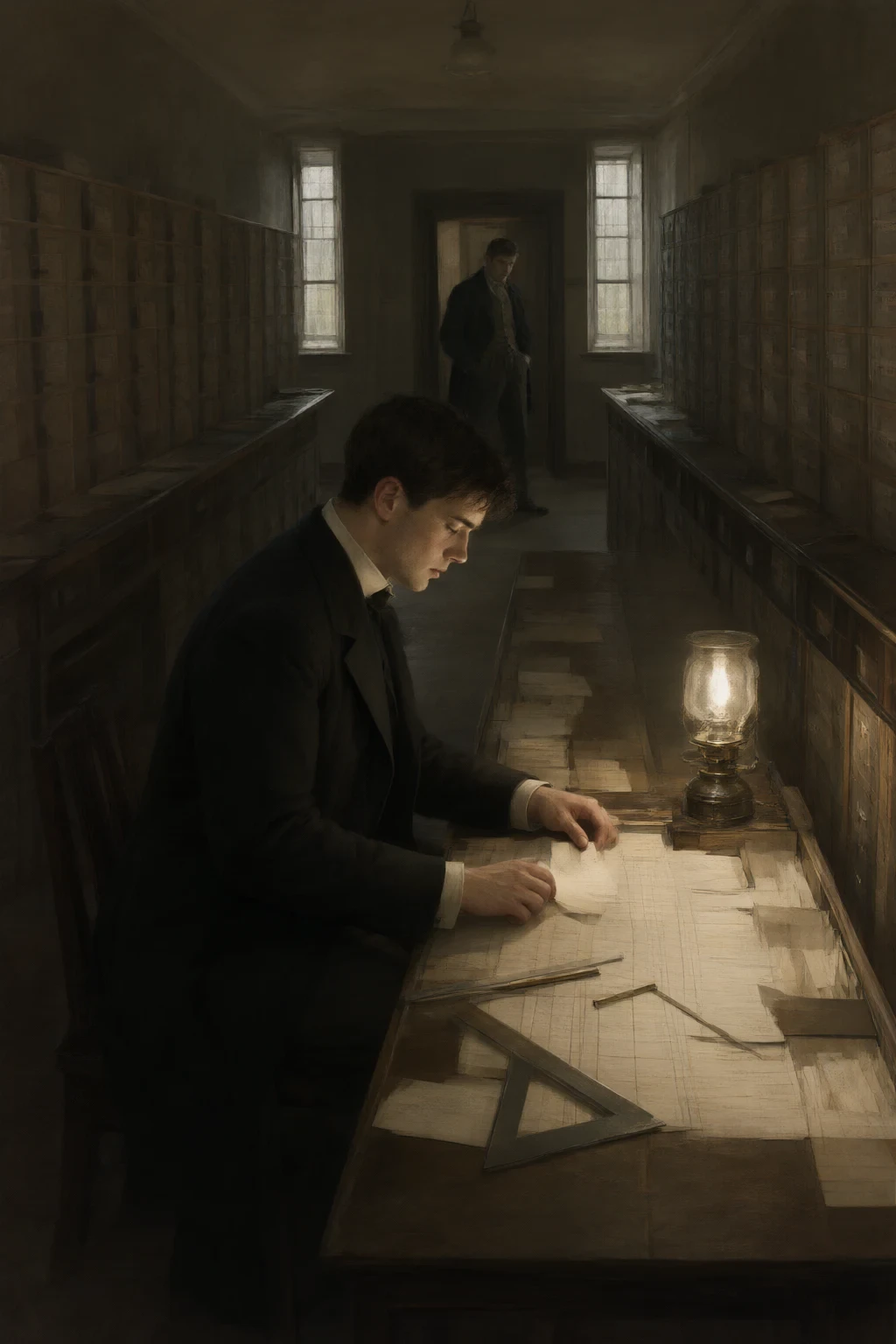
Cobb Tarn could recite any finding the Bureau had entered since the year he was twenty-two, in the exact words of the card, in the order the cards went into the drawers, and he did it while he walked, because there is no way to ask a registrar to stop. Nine hundred findings in eleven years. Eighty-two a year. He counted rather than read, and counting was the habit and reading was what the counting was supposed to serve, and the two had come apart somewhere around the fourth year and he had not noticed the join. The long room ran the length of the building with a window at each end and four hundred and thirty-two drawers down both sides, each holding about two hundred cards standing on their edges like the spines of very small books. All the same size, all the same colour, the numbers in at the foot and the hand always his. Drawer one was not like the others. Drawer one was in the register, not the long room, and it was a drawer in the sense that a man keeps a drawer in his head: a subsection, a small book of its own, and it had twenty-three cards in it, and it had twenty-three since before Cobb was born. Twenty-three households in two hundred years found sharp.
He could recite all twenty-three, forwards, including the ones where the house had burned down and the card had been kept anyway, because the name was the finding and the name does not burn. The eighteenth was the Marrow house. The nineteenth was Vantry. The twentieth was a house at Auld Sluice whose name had been spelled two ways in two centuries and had settled on the second. On the nineteenth card he stopped, in the middle of a word, the way he always did, because the recitation had reached a card he did not know. He had read that card eleven times. What Cobb Tarn had not done, in eleven years of reading the front of a card twice, was turn one over.
There were figures on the back of it, in pencil, in a testing hand, in a column. Not a note. Not a figure with a name against it. A column, forty-one entries long, running down the card from the top to below the stamp, every entry a decimal to two places, and every entry lower than the one above it. Cobb Tarn stood in the long room with the card in his hand for some time. Then he took out the other twenty-two, which he was entitled to do, because the registrar’s charter said the registrar might reopen and recount any entry in the register at any time and might not be asked for a reason, and the reason clause had been drafted in a year when Featherstone had a different opinion about itself. Twenty-one of the twenty-two had a column on the back. The twenty-third, which was the first, which was the card of 1802 with the illegible signature, had a mark on the back that was not figures at all. It was one word, in the same hand as the front, and it was the word the founding story is built on, and Cobb Tarn did not read it aloud in the long room and did not read it aloud anywhere for another thirty-one days.
So: twenty-one columns. He walked back down the long room with twenty-one cards against his chest and put them on his table in date order and sat down, and read the first one properly, which took him until the light went. The nineteenth, Vantry. The column beside it, as he would have told the Board and did not tell the Board: 0.52, 0.51, 0.50, 0.49, 0.48, 0.47, 0.46, 0.45, 0.44, 0.43, 0.42, 0.41, 0.40, 0.39, 0.38, 0.37, 0.36, 0.35, 0.34, 0.33, 0.32, 0.31, 0.30, 0.29, 0.28, 0.27, 0.26, 0.25, 0.24, 0.23, 0.22, 0.21, 0.20, 0.19, 0.18, 0.17, 0.16, 0.15, 0.14, 0.13, 0.12. The declared sensitivity of the household of Vantry was one tenth of an ounce. It had been one tenth since 1874 and it was one tenth on the card in the register and it would be one tenth when the register was read out in a hundred years, if the register was still being read out.
The last figure in the column was 0.12. The gap between the last figure and the declared figure was 0.02, and Cobb Tarn wrote that down, and then went to the eighteenth, the Marrow house, whose declared sensitivity was 0.30, and whose column ended at 0.32. Gap: 0.02. He did all twenty-one that night. He was there until the corridor gas was turned down at ten by the junior clerk, who came in, saw a registrar with twenty-one cards and forty-one rows on a sheet of foolscap, said nothing, because he was twenty-three and five months in the building, and went out and shut the door. The gap was 0.02 on twenty-one cards out of twenty-one.
The next thing Cobb Tarn did, and it was the only procedural act of the whole hundred days that was not open to anybody, was to go to the Board. The Board of Featherstone met in the front room on the first Monday and consisted of five people and a table, and the registrar was not a member of it and attended it by the quarter and asked it for nothing. He asked it for a hundred days. The charter gave it. The registrar might reopen and recount, and might not be asked for a reason, and might not be refused. The hundred days came out of that. He wrote one line on the request form, in the box marked purpose of the recount, and he wrote: to establish the number of presentations made against each sharp household in the register. The minute of the Board is two lines long. It is in the Board book, on the page opposite the sewing of the February returns, and it reads: RESOLVED: that the registrar be permitted to pursue his recount for one hundred days from this date, and that no assistance be rendered him, and that the results be reported at the sitting of the Board next following. No assistance was to be rendered him. He noted that going out, and thought at the time that the Board had probably meant it kindly, and thought it again much later and did not think it kindly then.
Aldis Prome was the chief tester and had been twenty-two years on the test floor and was the only man alive who could feel the pea on the first pass. Cobb Tarn went to him on the second day, because the register has a form in it, and the form is kept in a flat box in the strongroom anteroom press, and you cannot get at a form without a tester’s hand on the press. Prome’s hand was enormous and careful. He had a way of setting the heel of it flat on a mattress before he said anything at all about the mattress, which made everybody on the floor wait, and which one of the four tester-training manuals calls the posture of judgement and another calls the posture of a man about to be wrong. “Two in the afternoon,” Cobb said. “Two,” Prome said. “The figure is 0.10 and the verdict is that the household is at the end of its figure. The figure is 0.10.” “That is not what I came for.” “Then the figure was 0.10 and the verdict is that you came for something else, and the figure is 0.10.” Cobb Tarn waited. It was a technique and it had taken him a year to learn and it was the only technique that had ever worked on Prome. “What is on the back of the cards in drawer one,” he said.
Prome’s hand came up out of his pocket about two inches and stopped. “You are asking me about a certificate.” “I am asking you about the reverse of a card in the register.” “The reverse of a card in the register is not a document. The reverse of a card in the register is a space on which somebody has written.” “Yes.” “It is also the only part of the card that nobody has ever had to defend.” Prome put the hand back. “Forty-one figures on nineteen cards, and the rest shorter, and the first one is 1802, and you have not asked me about the first one.” “No.” “You will.”
The first fifty days were the paper. He had a table, a lamp, foolscap, and the right under the charter to open the register, and he was extremely good at this, because his whole training had been to extract one household from a pile and enter it correctly, and to do that nine hundred times is to have a machine in the head for the shape of a household. The sheet had forty-one rows down it and he wrote the figures across, one column per card, so the first row was the first presentation of all twenty-one households and the last row was the last. It came out like a staircase, and it came out like a staircase because a column of figures going down in steps of one hundredth will look like a staircase, and Cobb Tarn had spent four days in November refusing to rule a line through the columns before the last row. On the fortieth day he ruled one, and it went through twenty-one columns, and he went and found a rule and a set square and did it again with a magnification, because he wanted to be in the position of a man who could not be accused of making it easy. The decline was 0.01 at every presentation. On every card, at every row, without a single exception.
That was the first half of it, and the first half was ordinary. A person goes down by the same amount each time they are put under the reference pea, and 0.01 of an ounce is below the finest figure the trade can write on a bed foot, which is why nobody had ever looked at it. The trade writes tolerances to a tenth. A tester reads to a hundredth, because a tester reads with a body and a body does not stop at a tenth. Nobody had ever put a hundredth into a column and compared a hundredth across two hundred years, because there was no column, and there was no column because the backs of cards are not the fronts of cards. The second half was the gap. The gap was 0.02 on twenty-one cards, and the gap is the interesting number, because the gap is the only figure in the whole of it that somebody chose. On every one of the twenty-one cards, in the space under the last entry of the column, there was a second figure, and it was the same figure, and it was written out in words in the testing hand, and it read: the household is not to be reported until the figure is not less than 0.02 above the declared sensitivity of the household.
So what Cobb Tarn had found was not a pattern in children. Children are not regular. He had read enough of the register to know that a bed is not regular and a body is not regular and a house is not regular, and the whole of the trade is a long argument that none of them are. What he had found was a clearance. A declaration is not made on the last presentation. It is made on the last presentation plus two hundredths, so that no tester can ever be the man who turns a household over by declaring it blunt on a single pass, at a single sitting, in front of a mother. It is a safety clause. It is the most careful thing in the whole of the Bureau’s working papers, and it was written on purpose, by men who had been alive at a time when testers were being ruined by the verdicts they gave, and there are four names in the register of testers who lost the pea and were pensioned and never spoken of again and there are no photographs of any of them anywhere in the building, and the clause is the reason the four of them had a soft place to fall.
And the arithmetic of it was: a child declines 0.01 at a presentation; a clearance of 0.02 stands between the child and the declaration; therefore every household in the register, without exception, without regard to the child, the house, the county, the weather, the year, or the condition of the child on the day, is presented to the reference pea exactly forty-one times before it can be declared blunt. Forty-one. Twenty-one times out of twenty-one. Cobb Tarn read that sentence four times on the fiftieth day, in a room with the gas on, and then he went and did the other half.
The second fifty days were the beds. He went out into the trade, to four counties, on the strength of the register, and he went to the houses themselves, and he did the two things a registrar may do, which are to look, and to ask a question that has already been answered in a document. He did not ask anything else, because he had no standing to ask anything else. He went and looked at the feet of beds. Twenty-one households, twenty-one houses, and the figure was on the foot of every bed in every one of them in a testing hand, in pencil, never crossed out, and legible to whoever slept there next. That is the requirement. A figure on a bed foot is a promise about how wrong that bed may be, and a promise that cannot be read is not a promise, so the Bureau writes it large and the Bureau does not rub them out, and a man moving into a rented room in a great house at Auld Sluice reads the figure off the bed before he reads anything else in the room, and Cobb Tarn read them all and copied them all, and every one of them was a tenth and none of them was a hundredth. The hundredths were on the backs of cards in the register.
That was the second thing, and he had not expected to find it so plainly. The trade carries the promise in tenths. The Bureau keeps the truth in hundredths, on the reverse, in a hand, on a card that is not a document. There is a figure in Featherstone that everybody in Featherstone can read, and a figure underneath it, and the two figures are nineteen hundred and one numbers apart and nobody has ever been asked to reconcile them, because the top one is the promise and the promise is the thing that was sold. He asked his questions. He was permitted, in writing, in advance, to put a question whose answer was already on a document, and he wrote them all out first and then read them out, which is the only way anybody in Featherstone will answer anything. To the shop that had sold the Vantry beds: what figure was declared at the sale. The figure was 0.10, and Cobb Tarn already had it.
To a schoolmistress at Auld Sluice: which of the children of the house came to the school, and in which year, and did they keep coming. They kept coming. He had not expected that, and it took him a while to see why he had not expected it, and the reason was that he had assumed a house whose child had been declared blunt would be looking for a different arrangement. A house that has been certified is a house with a figure on everything, and a house with a figure on everything is a house that has done everything it is supposed to do, and the trade sells to it for another two hundred years. To a woman who had kept the gate at the Marrow house for twenty-two years: had any of the children gone away. Yes. The second one, in the winter, when there was a fever in the terrace, and the child was away at her aunt’s for eleven weeks. Cobb Tarn wrote eleven weeks down, and understood that eleven weeks was three presentations missed, and that the column on the eighteenth card was thirty-eight entries long and not forty-one, and that the gap at the end of it was 0.05 and not 0.02. Three presentations missed, and the clause waited for the three.
Not the household. The clause. The clause did not care that the child had a fever. It said not less than 0.02 above, and so on the forty-first presentation after the fever, when the number stood 0.05 above, the tester could not declare, and the column went on, and the number came down to 0.03, and then 0.02, and then the household was declared. The one other short card was the Auld Sluice one, at thirty-nine, and the reason for that was a winter: the towpath went under for a fortnight, and the great house at Auld Sluice is eleven miles down the valley, and it brings its own Sharp One to the Bureau on the Tuesday, because the Sharp One is brought to the Bureau and not the other way about, and the household did not come on two Tuesdays. The column was short by two. The gap at the end of it was 0.04. Cobb Tarn walked the eleven miles in February to a house where a man offered him tea, and was told about the flood in the particular way that people in a valley tell you about a flood, which is as an explanation of everything that has ever gone wrong in their lives. Twenty of the twenty-one were clean. The twenty-first was the fever and the flood, and was clean also, in the end, once you had the clause in your hand. That was the hundredth day.
Cobb Tarn had expected, in the ordinary course of a hundred days spent on a pattern, to find a reason. That is what a hundredth day is for. You take a thing that looks like a coincidence and you go and look for the man who did it; if there is a man you write his name, and if there is no man you write the date, and either way the hundredth day has an ending the first ninety-nine did not have. There was no man. There was a form. The certificate of certification is a single sheet of printed paper, revised in 1802, printed by a house in the county that has gone, and kept in a flat box in the anteroom press, and the clause is in the fourth paragraph. Cobb Tarn read it on the ninety-eighth day with the junior clerk holding the press open and the light on the floor, because there is no window in the anteroom. The clerk’s name was Fenn and he was twenty-three and he was Marguerite Fenn’s father, and he held a press open for a registrar and thought nothing further about it. The fourth paragraph, printed, and printed identically, and printed identically since 1802:
THAT the child designated for the sharpness of this household shall be exhibited to the standard of this Bureau at such intervals as the examiners shall appoint, until the figure of the child shall have declined to within two hundredths of an ounce of the declared sensitivity of the household, and not further; and that no finding shall be made against the household before that figure is reached. Two hundredths. In print. In 1802. And Cobb Tarn read it twice and understood, standing in a room with no window and a boy’s shoulder aching from a press, that nine people had sat down in 1802 and written the most humane sentence in the whole of the Bureau’s working papers, and that the sentence had spent every sharp child in four counties to the exact figure, for two hundred years, without one single one of them ever being named. He wanted to be told he was wrong. He had said so, out loud, to the junior clerk, who was twenty-three, and the clerk had said that if the registrar wished to be told he was wrong there was a great many of them who would have told him so, and had gone back to the press.
He did not write a report, and the reason is worth having, because it is the whole of the Bureau in one sentence. A finding is entered on the form. The form is a single sheet with eleven lines. The first is the household. The second is the address. The third through the ninth are beds, seven of them, with a declared figure, a true figure and a verdict. The tenth is the shop that sold them. The eleventh is the tester, and the registrar signs beneath it. There is no line for a clause in a printed form. He had found a clause in a printed form. He could not enter it. The Bureau has exactly one instrument for establishing that a thing is a thing, and the instrument has eleven lines, and what he had in his hand did not fit on any of them, and he tried it on each of the eleven over two evenings like a man trying a key. And rule ten, the one the Bureau teaches in the first year, on the floor, to every examiner: there is no neutral act. A tester who declares a bed out when it is in is a liar. A tester who declares a bed in when it is out is a criminal. There has never been a way to say nothing, and the requirement to finish is the hardest thing the trade asks of anybody. He was not a tester. He was a registrar, and he had spent eleven years proving that he was a man who finished, and it had never once occurred to him that finishing was the problem.
He entered it on the hundredth day anyway, and it is the only irregular entry in the register of Featherstone in two hundred years, and the reason he was able to enter it is dull, and is the whole of what happened. The first line of the form is the household. A household is a set of measurements. He had a set of measurements. He had one hundred days of them, in a fair hand, with the dates on, and the set of measurements had a name, and the name of a set of measurements is the name of the thing the measurements belong to. He wrote it in the box. He wrote the finding. He wrote the certificate, the clause, the figure, the column, the twenty-one cards, the two exceptions and their causes, and he wrote that the presentations were made to a child and the child was not a bed. He wrote it in eleven lines, because there were eleven lines. Then the clerk, who was twenty-three, and who had every right, and who did it because the rule is that a finding is read back before it is entered, said: “There is no house called that.” “There is a building called that,” Cobb Tarn said. “It wants a household.”
“It wants a name,” Cobb Tarn said, “and the name of the thing the measurements belong to is the name of the building, and you will enter it or I will stand here until you do, and it is seven minutes past four, and the Board sits on Monday.” The clerk entered it. Against the household of the Bureau of Featherstone, of the town of Featherstone, a finding: that a standard of the Bureau is a sentence of print of the year 1802, and that the sentence has been applied to twenty-one children, and that it declined each of them by one hundredth of an ounce and declared each of them blunt at two hundredths above the figure, and that no tester in two hundred years had any power to do otherwise. He signed it. He entered the date. He put the card in drawer one, at the back, and drawer one had twenty-four cards in it, and one of the twenty-four was not about a house. The registrar’s copy went into the register, and the copy is the one the register is made of: the Bureau of Featherstone is entered, in Cobb Tarn’s careful hand, as a household found sharp.
He did not go down to the cellar that night, and he thought about not going down for most of the year afterwards, and the reason was that there was nothing to look at. A dried pea in a glass case on a card, in a room with nine feet of air in every direction, does not change. There is no figure on the back of it. Nobody has ever turned it over, because it is in a case and the case is locked and the key hangs in the same room as the key to the press. He went up instead, at the end, because the light was still on in the long room and the corridor gas was not turned off until ten, and there was a bed on the floor of the testing hall with the ticking stripped, at the end of the rows, because the floor is swept every morning and the bed on the end row is always stripped and always waiting for the man who sleeps in it before the next man does.
Cobb Tarn did not sleep in it. He had never slept in one, and neither had his father, and neither, in all likelihood, had any registrar in the history of the Bureau, because the registrar is not on the floor and the floor is for the testers. The only man on the floor at eight in the morning was the chief tester, in his chair by the window with his hands in his pockets and a figure in his mouth. “0.10,” Prome said. “And the verdict is that you have entered something in the register, and the figure is 0.10, and I am not going to ask you what it is, because if I ask you then I have known about it for seven years, and I have known about it for seven years, and that is a thing I have not entered anywhere.” Cobb Tarn stood at the foot of the bed, where the figure was, in pencil, in a testing hand, and it was legible to whoever slept there next. “Ninety-nine cards,” he said. “Drawer one had twenty-three. You put figures on twenty-one of them.” “I put figures on twenty-one of them,” Prome said, “because on a day in some year or other somebody was going to be the registrar, and would be allowed to look, and would be the sort of man who looked.” The figure on the foot of the bed was 0.10, and Cobb Tarn had it in his hand in his own writing, and there was nothing further that a registrar could do with it.