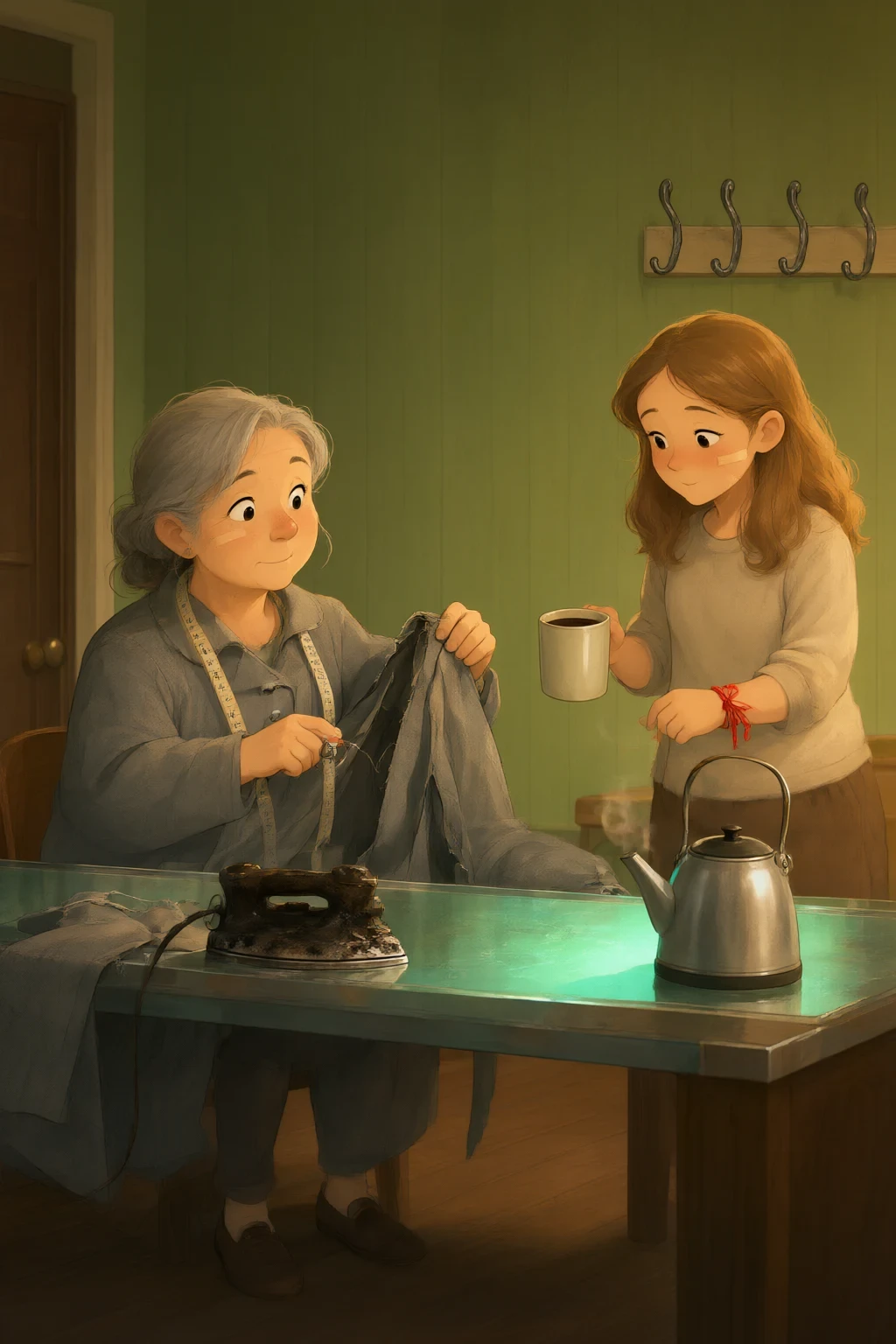
The Younger Brother’s coat lived on the second hook of the understudy bench, and for two seasons it had not been the right coat, and the only person in the building who knew that was the woman who had made it wrong on purpose. Hester Vaile kept the wardrobe in two rooms off the green room, and the second was a store the size of a pantry, with the smoothing iron on a hook by the door, burn-blackened down one side from forty years of a hot end left facing out.
“That is not a coat that has been worn,” she said. “That is a coat that has been slept in.” The coat was on the table. It was grey serge, lined with calico, and it was beautiful, and Hester had loved it before she was allowed to touch it. “You have taken it in,” said Nell Tarrant.
Nell was seventeen and the youngest of the corps and she was understudy for the Position of the Correspondent, who had four words in the second act. She had a length of bright red thread round her right wrist with no knot in it yet, and she was holding the shoulder seam in both hands, the way you hold something you have found.
“I have taken it in at the shoulder,” Hester said, “and I have let the sleeve out and down, because the shoulder is wrong and the sleeve is wrong, and I will tell you what is wrong with it if you will stop pulling on my seam.” “Why is it wrong?”
“Because it was cut for a man who is not a different shape from the man who wears it. That is the whole of the trouble and it has been the whole of the trouble for two seasons.” Hester put the thimble on. It was steel, riveted to her right thumb, and it made a small hard sound against the cloth. “The cloth is serge. It is not wool. Wool forgives you. Serge does not forgive you the way you are standing, and it has decided now, tonight, to tell the truth about it.”
The bench was two metres of bare board in the wings, stage left, in total dark behind the heavy drape, with eight hooks above it and a hot pipe running underneath the whole length of it. Eight people sat there in their coats in numbered order through every performance, and the only light they got was a twenty-metre crack of amber stage between the drapes, and the only thing any of them did in that light was watch.
Bram Sillet came off at the curtain and came to the second hook the way he came to it every night, which was without hurry, because he had done this nineteen hundred and five times. He had a permanent tan that came from greasepaint and never quite washed out, and two small strips of flesh-coloured tape on his cheekbones where the Younger Brother’s paint had been laid on and taken off so many thousands of times that the skin underneath gave up. He put his hand into the coat and shut it. The coat shut.
He stood very still in the dark, with the amber coming through the crack, and said nothing for so long that Nell, who was on the bench, counted to sixty and lost count. “It closes,” he said at last. “It closes,” said Hester. “It has closed since the spring.” “It has.”
They did not shout. It was the worst of it. They sat on the bench in their coats and asked how long, and who knew, and whether the book knew, and the answers were: two seasons, nobody, and no, because there are no garments in the book, the book is names and money. Corvin Ashby came out of the prompter’s box in the dark left of the stage with the hard blue bruise-shadow under his right eye that never went anywhere. He had the thin black notebook out and did not open it, because he found it by feel.
“Shoulder, in half an inch,” he said. “Sleeve, out three quarters and down one and a quarter. That is not cloth come in wrong from the wash. That is cloth that has been worked on purpose, and there is one pair of hands in this building that works on purpose, and it is not mine, and I do not know how to say that in a way you will like.”
“She is the wardrobe mistress,” said Corvin, “and the terms of a Position are the whole requirement, and a garment is a garment and not a Position, and I have just discovered that I do not know whose rule that was.” He looked at the clock. “Fifteen minutes. Everybody in the green room, and the kettle on, because it is two in the morning and there are eight of you and six chairs.”
The green room was low and panelled and had a permanent fog of greasepaint gone into the wallpaper so far it could not be scrubbed out. The kettle was just off the boil, the way it always was. Nell put out the mugs. The burn-blackened smoothing iron came in with Hester and went on the table still warm, and it ticked as it cooled.
Ilse Karrow came at twenty past two, in a coat over what she had been sleeping in, with the green lorgnette on its black cord round her neck and her right hand in a black kid-leather glove whose index finger had gone shiny from the pen. She apologised to the chair on the way past it. “Sorry. Chair is mine.” Nobody laughed.
“Now,” she said. “The book’s people do not know and the book does not have a column for cloth, and I want it said once, in front of everybody, so that nobody has to guess about it later. Hester, you altered a garment that belongs to a Position.” “Yes.”
“Then I am obliged to tell you what the terms are, because I only know them from the page.” She put her gloved hand flat on the teal cloth of the Season Book, quarter-bound with a gilt edge, open at the same page it was open at every day of the year. “A Position is not improved. A Position is not made more comfortable. A Position is performed as it is written, and the description is the whole of what the house has bought. I did not write that. I only write the seasons into the book.
But it is the rule and it is older than me.” “Then who did write it?” “The whole of it, over a hundred and forty years, by people who are dead and did not know they were writing it.” Ilse Karrow looked up from the page, and for once she did not sound like a column. “You have made a coat that fits. A coat that fits says out loud, in the front eight rows, that the man in the gilt letters is not the man in the coat.
And I am not permitted to have that said, and neither are you, and neither is the company, and we have all just spent an hour finding out that we cannot unhear it.”
Hester Vaile sat down at her own table and put the coat in front of her, and squared it, and smoothed it flat with both hands, and nobody in the room said anything at all. Then she took the smoothing iron off the table and hung it back on its hook by the door, because a woman does not work with a hot iron and a cold heart.
“I made this coat for the Younger Brother,” she said. “The Younger Brother is a Position. He is written on a page. The page says what shoulder he has. I have made a hundred and nine coats in this building and I have put my name on a call sheet once, in pencil, in a bad year, and somebody rubbed it out with a thumb because the call sheet does not take a woman’s name, it takes a Position and a number.”
She picked up her scissors. She did not use them. She put them down again and picked up the steel thimble on her right thumb instead. “So here is the whole of it. The cloth is the only place in this theatre where I have ever been allowed to speak, and I have been speaking in it for two seasons, and the sentence I have been saying is that somebody is in the building and is not being asked.”
They unstitched it at twenty-five past two, in the green room, in front of the whole company, which was all eight of the corps and the stage manager and the lamp-hand, who was fifteen and should not have been up and was. Hester went through the coat seam by seam and she did not hurry, and she said out loud what she was doing, because that is how a mender works and because she wanted it written down somewhere in the room.
“Shoulder seam. That is my row. Eleven stitches, taken out one at a time, going back the way they went in, which is the only way they can come out. Sleeve. That is my row. Under-arm. That is mine. Hem, half an inch, which I took up because he grew an inch in nineteen years and it is not the tailor’s fault that he grew.”
She kept every stitch. All of them went on to a card, and the card went into her pocket, and it was the only record of that work that had ever existed, and it was a record of a thing that was not allowed to exist. Bram Sillet held the coat up for her with both hands so she could get at the back of the shoulder, and he did it for two hours without once being asked, because nobody had thought to tell him he might not.
“He holds it at the shoulder,” he said, to nobody, in the flat precise way he had said everything for nineteen years. “He is not a strong man and he does not let on. He holds it up for two hours and does not put it down, and he will not say that he is tired, and he will not be thanked, because he is the Alternate of Record and the Alternate of Record is not a man in this building, he is a coat on a hook.” “Bram,” said Hester. “He is tired,” said Bram Sillet.
They finished it at four in the morning. The coat came off the second hook and it came apart on the green room table, and then it went back together, plain, and correct, and with every seam a seam and not a sentence. It was a serge coat cut to the measure of a man who does not exist, and it closed over nothing.
“No,” said Hester. “It will not shut on anybody. That is now the correct coat. I made it the right coat back out again in front of everybody, and it cost me the only sentence I have ever been allowed to say, and I would do it again tomorrow, and I would like to be asked to do it again, and I know perfectly well that I will not be.”
The company went to their floor and their corner and the green room went cold. Hester put the coat on its hook, second of eight, where it had always hung, and stood looking at it. Corvin came in with the call sheet for the next day, because there is always a next day.
“I cannot put your name on it,” he said. “Not because I will not. There is no line. The call sheet is a Position and a number, and you are neither, and if I wrote you on it in a hand of my own inventing, in a week somebody would ask whose hand that was, and then I would have to say.” “That is all right,” said Hester. “I know that. I have known it for forty years and I wanted to hear it said out loud in a room where I was not the only one hearing it.”
She took the steel thimble off her right thumb and set it on the table beside the smoothing iron, and she went out into the cold corridor with the ironing cloth over her arm. At half past six, Bram Sillet came to the second hook, and put the Younger Brother’s coat on over his greasepaint tan, and it did not close, and he did not do anything about it, and he went on.