The minute is in the harbour board’s book in a hand that writes small and keeps to the line, and it is dated the second of November, and it is four lines long. The wall is insured at midsummer by an office in the county town. The office has written for the name of the holder of each standard upon the ring ward, six standards, two hundred yards, and has written twice, in April and again in August, and the board’s secretary has answered both times with the name of this office, and the office has answered neither, and the policy fell due on the tenth of December. The board’s minute asks the lamp office to name the holder of the ninth lamp, being the standard at the bottom of Wharf Street, upon the corner, the lamp for which this office is the authority. It is the first time in sixty-six years that anybody outside this office has asked this office that question.
The back door of this office is off the quay and it is called the double door, because a person comes in by it and a person goes out by it, and the two are not the same door, though there is only one and there has only ever been one. A sentence is cut into the lintel and it is the only sentence in Ninehook cut into anything. It says: the holder is named and the lamp is read. It was cut in 1866 by a man who was paid two shillings and sixpence, and he cut the word holder twice, because the first one came out wrong and he did not like it. Under the sentence there is a slate on a ledge and a stick of chalk on a string. Every attendance at a double occupancy in this town is marked on the slate with a line, and the slate is wiped on the Monday. The marks on the lintel are not on the slate. There are marks on that lintel for forty years. They are in chalk and they are short and they are not in rows, and the man who chalks them is the constable of the night patrol, and he chalks one for every attendance, and this office has never asked him why he marks the lintel instead of the slate, and he has never offered, and the number on the lintel and the number of double occupancies in the register have never once been the same, and the office has never once counted either.
Hettie Rowntree prepared the answer in an afternoon, which is how she knew it was wrong. A question put in writing is answered in writing, and an answer in writing is the answer the register supports, and the register supports this: Lamp Nine, leased the ninth of October 1889, holder Perrin Oll, of the harbour wall, term for life, conditions: by handing-on of the ring at the standard. Hettie wrote it out fair, and she entered it in the day book under the day book’s printed heading for answers, and she read it back before she sealed it, because that is what she does. Lamp Nine. Wharf Street corner. Held by Perrin Oll, of the harbour wall, since the ninth of October 1889, the same having come to him by the handing-on of the ring. And then she sat with the pen above the line for a beat too long, which is a thing she has done for nineteen years and which has never once in nineteen years been about the pen. The register records and does not adjudicate. She has said that sentence out loud in this room perhaps two hundred times, to clerks and to glaziers and to a boy, and she has never once said it about a line she was writing herself.
The file went to a clerk called Bede Sallow, because the file wanted copying out for the board, and because the boy who took the file had been in the office six weeks and was given the easy work on purpose by a man who is kind in a way that is hard to distinguish from carelessness. He copied it out. Then he went and got the volume, which is what a person does. The last letting upon the ninth lamp is on the ninth of October 1889, and it is in the register in the ordinary hand of that year, which is a good hand, and the marginal particular is ruled, numbered, and filled, and it is the only marginal particular on that page filled in by a hand that is not a clerk’s. It reads: by handing-on of the ring at the standard. Witnessed: P. Oll, lamplighter, and the name of the clerk, and the name of the reader. Hettie Rowntree came and stood at the end of his desk and looked at the page he had open, and then at the page before it, and then at the page after it. “He did not read it,” said Bede Sallow. “He did not read it.” “Then the reading is not a reading. It is a handing-on written in the margin of a reading.”
“That is a very good distinction,” said Hettie Rowntree, “and you will not find it in any book in this room.” She went back to her desk. Bede Sallow sat with the volume open in front of him for another twenty minutes, and then he copied the file out properly, and he sealed it, and he took it down to the quay himself. The ring ward book is in the press with the ward books and it is the wettest book in the office. He got it out at a quarter to six because the light goes at six in December and he had been indoors since eight in the morning.
There is a form. It is printed on the last leaf of the day book, it was printed in 1861, and there are six copies in a card file in the press, because the day book is not a place for forms. It is headed, in full: Form of Question to a Lamp, with the fee. The fee is one shilling, and the shilling is entered in the day book on the left-hand side of the ruled line and the answer is entered on the right, and the two have been on opposite sides of the same line since 1861, and the office has never had a clerk who thought that was funny. A question may be put to a lamp at its standard, at the hour of lighting, in the presence of a clerk and a witness. The entry is read first, in full, from the volume, and the reading is that which makes a man a holder, and the clerk enters the time of the reading and the names of those present. The question is then put once. The answer is entered as it is given. A question may not be put as to what the lamp would wish, and the form says so in one line, and the one line is the only line on the form that is not about procedure.
In sixty-six years the form has been completed eleven times. The eleven are in the press with the answers, and the answers are short, and the questions are of the ordinary kind: what is the term of this lease; is this lamp discharged; is this man the holder; to whom is this lamp let. Nine of the eleven are on wards. One is on the second lamp on the quay and the answer is that the term is a life interest and the man is sixty-eight. One is on a lamp in the town that no longer stands, and the answer is that the lease was extinguished with the consent of the holder in 1879, which the register confirms, and which is the only one of the eleven the office has ever been satisfied by. Not one of the eleven is on the ninth lamp.
Bede Sallow asked for the form on the twenty-first of December, and Hettie Rowntree gave it to him, and he filled it in that afternoon at the desk in the cold part of the room with his coat on. The question he wrote was: what does the lease upon the ninth lamp say. The witness was Hettie Rowntree. The shilling came out of his own pocket, because a fee is a fee, and he entered one shilling in the left column, and the clerk’s name in the right, and the hour, and the standard, and the number of the lamp. “You may not ask it what it wants.” “I have not asked it what it wants.” “You have written the question well,” said Hettie Rowntree. “It is the question the form is for, and it is the only one anybody ever writes, and I will tell you something about it, and then I will not say anything else about it. In sixty-six years this office has put eleven questions to lamps and has never once put the other one, and the other one is the one everybody in this town is actually asking, and you did not write it, so you will be answered about the thing you did not ask, and it will be a long answer, and I have never seen one that was long and I have been in this room nineteen years.”
The reading is to be had at the office and not elsewhere, and the form says the reading is from the volume, and so the volume went out on a cart with a handcart boy because volume one weighs forty-one pounds and Bede Sallow did not want to carry it up Wharf Street in the dark in front of a witness. The corner at the bottom of Wharf Street is the busiest corner in Ninehook. On a December evening in the last week before Christmas there were a hundred and forty people on it, or near it, and the glass yard is forty yards up the point and three blowpipes were going in it and the light from the glory-hole lay across the wet stones in a long orange bar. The standard at Lamp Nine is an iron standard with a ring on it at the height of a man’s chest, and the ring has a hollow in it the shape of a grip and nothing else, and the hollow is worn the depth of a thumb. The wind was off the water and it was not a hard wind. It was the kind that comes in under a door.
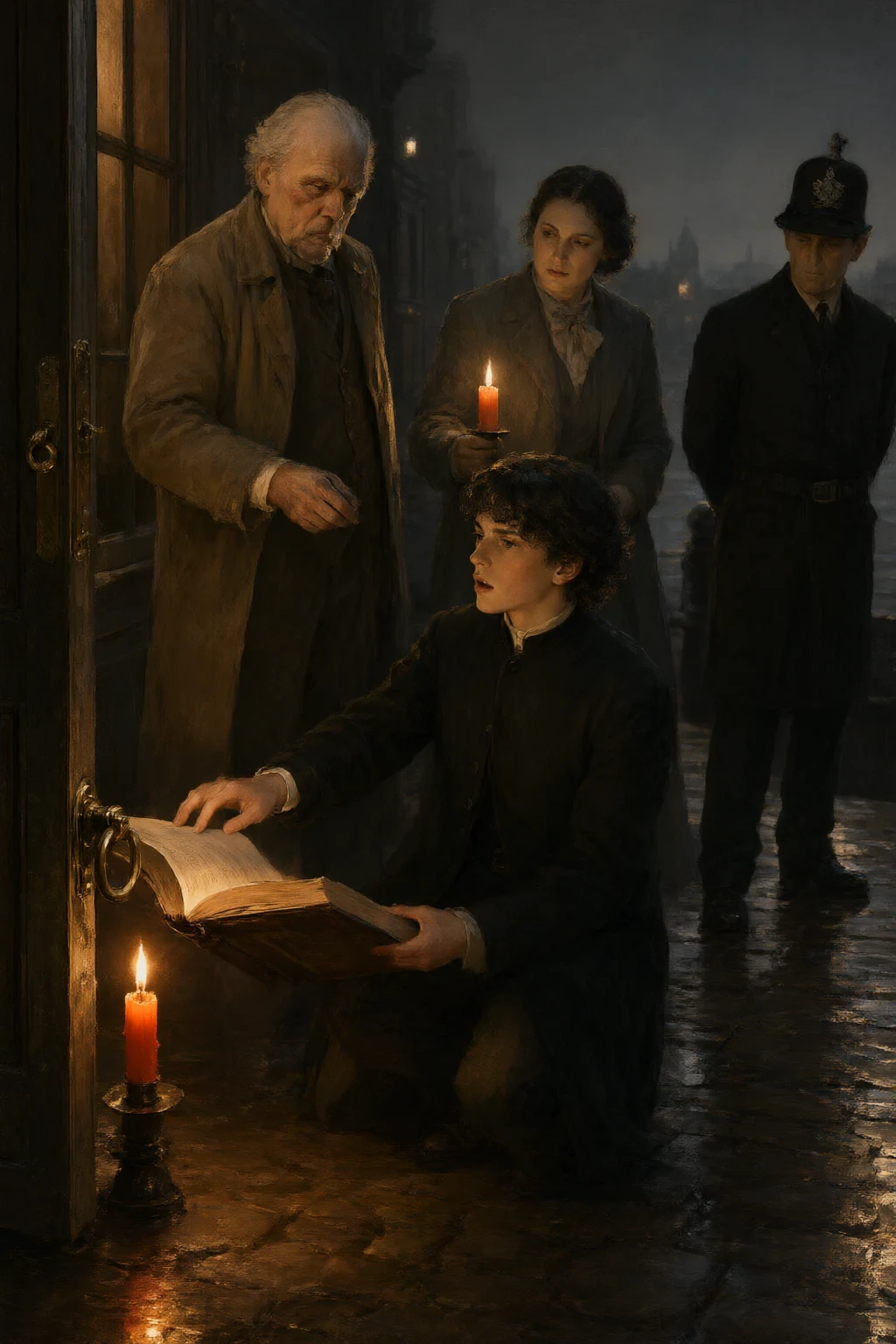
Bede Sallow put volume one on the wet pavement against the base of the standard, opened it on a stand he had borrowed from the office, and read the whole of the entry for the ninth lamp, from the leaf of 1841 to the leaf of the last letting, which is the ninth of October 1889, and it took him nine minutes and a bit over, and it is the longest entry in the register and he read all of it. He read it to Hettie Rowntree, who is the witness, and to a constable of the night patrol who had come because a lamp on the busiest corner in the town was standing open on the pavement with a boy reading out of it, and to an old man of seventy-eight who put his hand into the hollow of the ring as Bede Sallow began to read and who did not take it out again for the whole nine minutes, and who was Perrin Oll. At the end of it Bede Sallow put the question. The flame in the ninth lamp did not change. There was no wind in the chimney to speak of and the glass was whole and the wick was trimmed on the Thursday. It went on burning at exactly the size it had been burning at before he opened the volume, and it was the only thing on that corner that had not moved all evening.
What Bede Sallow wrote in the day book is this. He wrote it in one sitting with the door shut, and he wrote it as it came, and where he could not keep up he wrote that he could not keep up, and there are four such places. He was asked what the lease upon the ninth lamp says. The lease upon the ninth lamp says: Lamp Nine. Wharf Street corner, upon the quay. Leased the fourteenth of March 1841, at six bells. Let to the reader of this entry, and to no other, for so long as he be the man who is not already holding. The reading to be had at this office and not elsewhere. Provided always that the office shall set down in the register the name of the holder at the relief, and shall set the ring in the standard, and shall keep the lamp dark the fourteen days following, and shall open upon the fifteenth morning. And it is further provided, and this is the whole of the lease, that the light is not to be given to any man who has held this lamp before; and if two be found holding, the light is to stand upon the standard until the reading be had, and the light is to be given to the reader, and the entry is to be closed and the office shut the fourteen days.
That is the entry as it stands in the volume, and it was read out on the corner of Wharf Street at twenty minutes to six on the twenty-first of December by a clerk of this office, and he was asked nothing about it. [I could not keep up here. I take what I could hold of it. It was not said quickly and it did not stop.] The question that was put has been answered. The question that was not put is the name of the holder. Nobody has asked it in sixty-six years. It will be answered now, at length, and it will be answered to you and not to the office, because you are the reader and the office is not. [Here I wrote a full page and struck it out. What it came to is this.] The holder of the ninth lamp is not a man. The third column of the entry of 1841 does not contain a name, and the clerks of this office have entered one in every copy made since 1861 because a column that ought to hold a name and does not frightens a copyist, and the fright is why there is a name on it. The third column says: the reader of this entry.
The lease is therefore let, and has been let since the fourteenth of March 1841, to a person who is defined by an act and not by a birth. That person is the holder for as long as he is the man who is not already holding. The words are not a condition. They are the holder. There is no other person in this lease, and every name that has been entered in the third column of this lamp since 1841 is a clerk making a form agree with itself. A man who takes the ring having read the entry holds the lamp. A man who takes the ring having not read the entry holds a piece of brass on an iron standard and gets whatever the lease allows a man who has not read, which is very little, and which is why the ninth lamp has always been described in this town as a lamp that gives a quarter of the light and gives it to the wrong people.
A handing-on is not a reading. The ninth of October 1889 was not a reading. The man whose name is in that line held this lamp from the ninth of October 1889 until the day he died, in the sense that a man may sit in a house he is not paying for, and the light in the ring has belonged to nobody, and it has gone on burning at the fourth of the strength it should burn at for eighteen years, and this office has entered the word leased against the ninth lamp on every return it has made since, and the returns are correct, and they describe a holder who has not held it for eighteen years. The office has therefore not held this lamp since 1889. [I could not keep up here.] The office has kept a lamp with no holder, which is the fourth condition and not a fault, and has entered a name against it, which is a fault, and has made out its returns, which is a third thing, because a return asks who holds it and the answer is the reader and a return cannot ask who reads.
The fourth condition is the eleven minutes. A double occupancy is not a fault. The office has treated it as a fault for eighteen years and has written it as a fault and has sent a constable and has closed the door for a fortnight, and the office has been right about every step and wrong about the thing it was doing. Two are found holding when the light will not go to either of them, which happens when one of them has held the lamp before, or when the reading has not been had. Then the light stands upon the standard. It does not fall and it does not go out. It stands, the size it is, and this is the fifth condition, and a flame with no lease is an accident, and an accident is put out within the quarter hour by whoever gets there. The office has never once in eighteen years had a quarter hour expire on it, and it has never once understood why.
The light is given to the reader. That is the whole of the relief and it takes as long as the reading takes. The office has been printing eleven minutes at the foot of this form since 1861 because in 1861 a clerk attended one and wrote down what the clock said and the clock said eleven, and no clerk has ever measured it since, and the figure is not a finding. It is a figure. [I did not know what to do with this so I have left it as it is.] The name at the relief is to be set down in the register. The office has taken that name for eighteen years out of the report of the constable of the night patrol, and the office has eleven such reports, and every one of the eleven is the same report, and none of the eleven was written by the man who was there. The name in the register on a relief is the name of a man who read a report, and he read it, and so he is the reader, and so the report is a reading, and the arithmetic of this town is worse than anybody has believed.
And then, at the eleventh place, Bede Sallow stopped writing for a while, and then wrote this, and it is the only part of the answer that is not about a lease, and he has said that he was not sure afterwards whether it was part of the answer or whether it was the answer, and the office has not been able to decide either. The last entry in every register of this office is a word. It is not a name. It is the word this city uses for the next person, and it is written at the foot of the last leaf of each volume, and the office does not write it out in full upon a page, and there are four pages in this register where it is written out in full, and they are in the press under glass, and the other four leaves are blank.
I was not asked about the word. I am telling you because you are the reader and you have read it, and because a person who has read the register is a person the register has used, and you will want to know whether the word was written for you, and it was, and it was written for you when you were hired, which is a thing about this office and not about you, and I would not want a clerk of twenty-one to sit up a night with a question of that shape and no more than a candle in the room. I will not be asked what the ninth lamp wishes and I have not been asked. The holder is the reader. The reader is the man who is not already holding. At this hour, on the twenty-first of December, at the standard on the corner of Wharf Street, the reader is you, and the man who is not already holding is you, and there is a man in this city who has read the entry of 1841 nineteen times in a room at the top of this quay and has never once put his hand on the ring, and he is standing eleven feet from you and he signed the fee. There are two holders at the ninth lamp.
The flame did not change while any of that was being said, and the constable, whose name is Iven Pyle, stood on the corner with his hat off and looked at a lamp that was burning, and then looked at two men, and then at the volume standing open on the wet pavement, and then said the thing a constable says at the end of an evening. “Lamp Nine. Double occupancy, the twelfth. I will have the office closed the fourteenth day and the ring in the standard.” Nobody contradicted him. Pyle had been to this corner eleven times and had written the same report eleven times and had a great many reasons to think that the twelfth would be the same, and he took the lamp out of his coat, which was not police issue, and lit it at the base, and the ninth lamp lit at the size it always lights at, which is a quarter of what the eighth lamp on the wall is burning at, and a quarter of what it should be. Hettie Rowntree walked back to the office with the volume on a handcart and the rain coming in, and Bede Sallow came behind her with the form in a wet envelope, and neither of them said anything for the length of the quay.
Hettie Rowntree read the transcription at her desk at nine that night, because there is a rule that a day book entry made after the hour of lighting is read back before the clerk goes, and she read it exactly as it stands, including the brackets and the page the boy had struck out, and she did not paraphrase it, and Bede Sallow stood while she did it. The four places where the writer could not keep up are the four places in the answer where the person answering was faster than the person writing, and in three of the four the matter at issue was a date, and in the fourth it was the figure at the foot of the form. They did not argue about the answer. They argued for forty minutes about where it went.
A document entered in the day book is not a document. The day book is a day book, ruled in two columns, the money on the left and the matter on the right, bound at the end of the year, and open to anybody who asks to read it in the front room on a Tuesday. The register records lettings and surrenders and reliefs, and a line that says unlet and the date. An answer to a question is none of those things, and there is no column for it, and this office had no practice, because in sixty-six years it had never had one. So it went in the day book, and the whole of what the ninth lamp said is in a book in this office that any person may read for nothing on a Tuesday morning, and the office did not copy it into the register and will not, because the register is the register. And then Hettie Rowntree asked the question. She had wanted to ask it for six years, and she asked it in the ordinary way, with the day book shut. “What would close the ninth lamp.” Bede Sallow read the second condition and the fourth.
The holder consents to the flame going out. The holder is a reader. Any person who has read the entry is a reader, and this office cannot tell which of them is a reader, and cannot tell afterwards which of them it was, and cannot put a question that would find out. So the office has the power to close the ninth lamp this afternoon by asking the right person in the right words, and the power to do nothing at all, and no means of knowing which of the two it has done. “That is the answer I have been asking for,” said Hettie Rowntree. “For six years.” “Yes,” said Bede Sallow. “Then I should like to be left alone for a minute.”
The office was shut the next morning and stayed shut a fortnight, and the fire was let out on the second morning because a fire cannot be kept in a shut room, and the room went cold at the bottom first, which is the opposite of the way it goes when it is in use, and Hettie Rowntree and Bede Sallow and one clerk from the Wharf Street letting worked in the front room of the Custom House with the registers carried across in a handcart and the press locked. The ring was set in the standard on the twenty-first of December and the standard was left, and the ninth lamp was dark from the twenty-first to the fourth of January, and the corner at the bottom of Wharf Street was dark, and a hundred and forty people came down it in the fourteen days and said that the lamp was out, and the harbour board’s secretary wrote to the office about it, and the office was shut. Nobody went near the standard. That is not an instruction. It is a fact about fourteen days in a town where four hundred and eleven lamps stand and a man may put a hand into a ring at any hour of the night without breaking a law, and where a man who had read the entry in 1841 and had not held it was still the holder of the ninth lamp for as long as the reading had not been had again. The weather did what the weather does. The wind came round the corner of the office at four o’clock every afternoon and put its shoulder into the quay.
The office shut for a fortnight, and inside the shut fortnight it did a thing it had never done. A relief is only a relief if the man named in it held. That had been assumed for eighteen years, and the answer had stopped it being assumable, and so a rule in the register that nobody had ever had occasion to turn on the office turned on it. The name set down at a relief is the name of a reader, and a reader is a person to whom the entry has been read in the presence of a clerk, with the face of the signer witnessed, and two sets of initials in the margin. The twelfth relief names Perrin Oll, of the harbour wall, seventy-eight years of age. So on the twenty-eighth of December, in the front room of the Custom House, with the volume open on a deal table and a clerk holding the candle, Hettie Rowntree read the whole of the entry for the ninth lamp to Perrin Oll, from the leaf of 1841 to the leaf of 1889, and she read it as it stands, including the strike, and she watched his face, because that is the whole of what the margin asks for.
He is a very old man and it took a long time. He cannot read and did not pretend to. He answered the date, which was the only date he knew, by saying that the year was the year the second lamp on the quay was cracked, and when the candle guttered twice he said go on, go on, without being asked. Perrin Oll cannot write his name. His mark on a lease is a cross with a clerk’s initials beside it. Where the reader cannot write, the reader’s initial on a relief is made by the clerk at his direction and is marked as made at the direction of the reader, and there is a printed line on the form for that, and the line has been used four times in sixty-six years.
The consequence of the marginal entry is this. Perrin Oll is a reader of the entry of 1841. He was in the ring at the first attendance on the twenty-first of December, and he has held this lamp before, in 1889, and the fourth condition gives no light to a man who has held it before. So the brass ring at the bottom of Wharf Street will be in his hand for the rest of his life and will never once do anything at all. Nobody will tell him, because there is nobody in this office to tell it to, and he would have to be told it as a finding, and the finding is nine sheets, and the nine sheets are in a press. He was asked, at the end, what the nine minutes on the corner had been. He gave them as a round. He said the corner to the harbour office, the harbour office to the second standard, the second standard to the ninth, and he gave the state of the sea, which was a running swell from the south-west, and the hour, which was right to the bell. He was asked how long it had been. He said it had been the length of the round, and would not give it in minutes, and could not have said why not. And then he gave the sentence.
He said he had been getting at it for forty-one years, which is how long he walked the wall, and that he was one clause short, and Hettie Rowntree wrote it down as he said it, and it is in the day book, and it reads: I was on the ninth lamp in eighteen eighty-nine and I handed the ring on and I did not read it and I have never said so. And he stopped there, and the clerk waited, and the clerk was right to wait, because that was not the end of it, and the sentence does not end. The one clause short is a clause that must come after did not read it, and it must say what he is, and what he is is not a thing a man of seventy-eight can say in a room with a clerk and a candle in it. So he began it again, and got the same way. “Ring ward,” he said. “Ring ward. It is the corner, and I have been at it forty-one years, and I have the tide in my head and I have not the sentence, and you will want the sentence.” “Mr Oll. I have the sentence as far as it goes.” “Then you have the ring ward,” said Perrin Oll, “and I could not tell you the number of it, and it is the number I have said the last of, and there is a number for it and I have not it.”
The register was opened on the fourth of January and the relief was entered, because a relief is entered whether or not anybody can say what happened, and the entry for the twelfth double occupancy is the shortest in the volume, and it is this, and the hand is Bede Sallow’s, and he has read it back a good many times and has not altered it. Ninth lamp. Wharf Street corner. Double occupancy, the twelfth. The light stood upon the standard. The reading was had at the standard and not at the office, which is contrary to the second condition, and the clerk entered the contrary, because the contrary was what occurred. The name of the holder at the relief is set down: Perrin Oll, of the harbour wall, being the man in the ring at the first attendance and being seventy-eight years of age. Ring set in the standard. Office closed the fourteenth day. Lamp dark the twenty-first of December to the fourth of January inclusive. Eleven minutes. And on the line below it, which is the printed line at the foot of that form, which is the last line of a relief entry and has been the last line since 1861, and which is a rule with a figure already in it, a clerk has written a figure.
Eleven minutes is what the form says. What the form says is printed, and it was printed in 1861, and the reason it says eleven is not in the file, and the file contains a note that in 1861 a clerk wrote down what the clock said. The line below that line is the name of the clerk who entered the relief, and the day, and it is Bede Sallow, and the fourth of January, and the hand is steady. The answer to the harbour board went out on the eleventh of January, and it is two paragraphs, and the second of them is the whole of the difficulty. The holder of the ninth lamp, and of every standard upon the ring ward that is held under a lease of 1841, is the person who has read the entry and has not held the lamp before. This office is not able to name that person, and has no power to compel the reading of an entry and no power to prevent it. The board’s secretary wrote back in nine days. The letter asks for a name, in the terms of the schedule. The office wrote back that a name is not available. It is the shortest letter this office has sent in eleven years and it was read out twice before it went. The office in the county town then did what offices in the county town do, and wrote a policy on the ring ward in the name of this office, on the class, the class being a person who reads. The premium was eleven pounds and the term was a year.
The board’s minute of the ninth of January is four lines long and it is the best minute the board has written since the wall was built. It records that the ring ward is held by a body of persons of whom the number is not known and that this office is of opinion that it is a good number, and it directs that the policy be taken and the question not put again. Nobody put the question again. The men who walk that wall in February still say that the sixth and the seventh and the eighth are bad lamps. Bede Sallow closed the register on the fourth of January at four in the afternoon and shut the press, and the room was cold, and the office was open again, and in the weeks after that he went down the quay and stood at the corner of Wharf Street for a while without doing anything, because there is a lamp there and it is lit and a hundred and forty people cross it every hour of the evening. The light came back to the ring while he was standing there, at its usual size, which is a quarter of what it should be, and there was a hollow in the ring the shape of a grip and nothing else, and nobody came and put a hand in it, because it was the middle of January and the town was busy, and because the only man in Ninehook who had read that entry in 1841 and had not held it was seventy-eight years of age and had gone home at three, and the only boy who had read it out loud in an office in October had a round of two hundred and eleven lamps on the cliff path, four miles off, in the dark, with a taper-pole and a box of matches.