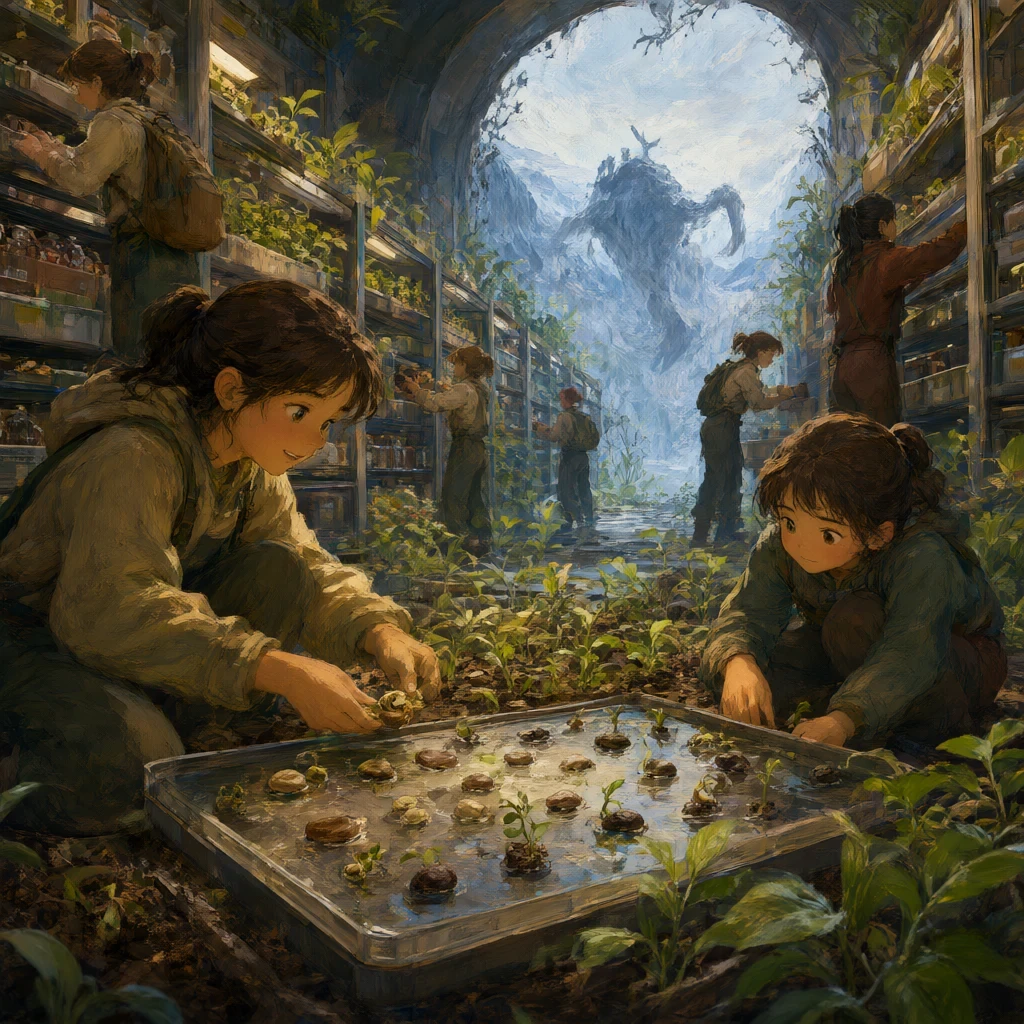
The Cold Larder sat on the high shoulder above River Vale, and the only door that mattered was the one with the four bolts and the chalk tally on the frame. Netta Bramble checked the tally every morning. Inside, the air was cold enough to sting, and dry enough that a paper packet left out for an hour would go crisp and brittle in your hand.
The shelves ran from the floor to the ceiling, and on them stood paper packets, glass stoppered jars, and brown tins sealed with wax, each one labelled in a different hand, each one a promise that something would come up. “All dead,” said Pim, from the doorway. He was eleven, farm-born, and never had got past the second bolt. “Dead things in boxes.”
“Prove it.” Netta set out twenty seeds on damp cloth in a flat tin and slid it onto the warm shelf under the pipes, where a lamp kept the box at a steady mild heat. “Twenty. We count what comes up, and we count it again in five days.” Her master, Keeper Odal, watched from the drying rack without turning around. “And what does the twenty tell you?”
“That we should not plant this one in the low field.”
“Wrong.” He came over and looked down at the cloth. “It tells you this packet gave you sixteen out of twenty on this shelf, in this week, at this heat. It does not tell you what the low field will give you in a wet spring. It is a hint. A small one. We do not gamble forty acres on twenty seeds.” “Then how many?” “That is the second question. Ask it after the flood.”
The flood came on the second week of the thaw, and it did not come from the river. It came from the Sedge Cut, the old diversion channel, whose timber wall had gone out with the ice on a Tuesday night.
By Wednesday morning, thirty feet of the lower flats lay under brown water and grey silt, and the water was still standing in the barley of the tenant farms, holding it flat, and drifting toward the terrace where the last wild plums of the valley grew in a line along an old wall.
The restoration crew came up the hill to the Cold Larder with mud to the knee and a list. Sixty acres to sow. The bank had one tin of Hollowfoot bean that gave sixteen in twenty, one jar of the old Sleet bean that gave nine in twenty, and a shelf of named beans nobody had grown in a generation. Pim read the list twice. “Sixty acres.”
“Sixty acres, and nothing in the ground under it,” said the crew foreman. “The silt is two feet deep in the low field. You cannot plough that. You would need seed dropped from a boat, and nobody has a seed boat, and that is the entire problem.” “Then we start small,” Netta said. “And we start where we can measure.”
The germination table became the centre of the valley for nine days. The crew brought in everything the flood had turned up: a biscuit tin from the flooded farmhouse, a tea chest of labelled beans from the schoolhouse cellar, a stoppered jar that had floated free of the seed merchant’s van and come to rest against a gate. The cold shelf filled with test tins.
The tea chest beans: zero out of twenty. Netta tried a second batch with the skins nicked and the cloth twice as wet, and got two. The biscuit tin: nothing, and when she opened it in front of everyone the seeds inside were swollen and grey and soft, and she wrote on the card what the smell was like.
“She was out of the kitchen for a day and a half,” Pim said quietly. “With the water at the step.” Odal nodded. “Drowned, or drowned and warm, or drowned and starved of air. A seed has to breathe even when it is waiting. Water on its own is not life. It is a small drowning.” Then they opened the 1911 packet.
It was the oldest thing in the room. The card said wild plum from the terrace, collected before the wall road, and the date was written in copperplate that had faded to brown. Pim made a face. “That is not going to do anything. That is older than my gran’s gran.”
Netta put twenty on damp cloth anyway, because that was the rule: you do not decide, you test. On the fourth day there was not one sprout. On the seventh there was not one sprout.
Pim was already at the door with his coat when Netta scraped the twenty seeds off the cloth, tipped them into a jar of wet sand, and set the jar on the cold floor of the store, where the stone kept it at a chill that took the whole week to work through.
“Wild plum will not start in a warm room,” she said. “It wants a winter first, a long one, and it wants the winter to be a little colder than comfortable. You can store a seed for years and it can sit there doing nothing at all, and that is not the same as being dead. It is asleep.” “You do not know that is what it is.” “No. That is why we test it again.”
On the fifteenth day she took the sand jar out and warmed the seeds back onto damp cloth, and four of the twenty had split their skins by morning, and by the fifth day there were fourteen. But she wrote the card carefully: FOURTEEN OF TWENTY, FIFTEEN DAYS COLD, TREATMENT INCOMPLETE.
“A plum wants months of cold, not a fortnight,” she said. “Fourteen is what this packet gave us in half a winter. The other six are still asleep, and asleep is not dead, and we do not write them off until the cold is finished. The six are not failures yet. They are simply not finished.”
“Sixty acres is not a seed problem, it is a choice problem,” Odal said. He laid the cards out on the table. “The bank has one packet that does well. One. It would be simple, and it would be the largest mistake anyone makes this year.” “Because sixteen in twenty is the best?”
“Because sixteen in twenty is the best this year, in a box, on a shelf. Beans in a field do not stand alone. They are attacked by things that like them, and by weather, and next year there may be a wetter August than this one. If every bean in this valley is descended from one tin, then a disease that finds that tin has found everything.”
He set a finger on the Sleet jar. “Nine in twenty is a poor packet. It is not a dead one.” So the foreman took the plan back down the hill, and the plan changed. The tenant farms that had lost the most got the Hollowfoot, which would feed the most mouths this autumn.
Between the strips they sowed the Sleet, and along the terrace wall Netta and Pim planted two rows of the plum that had been asleep since before either of their mothers was born, in soil they dug out of the silt with a borrowed horse. “The rows are forty acres of waste,” the foreman said.
“The rows are the next forty,” Netta said, and Pim snuck a look at her to see if she was joking, and she was not.
The silt was still soft in June when the first green came up through it in a ragged green seam a mile long. Netta walked the field with the field book and the foreman and could not stop smiling at the numbers.
The Hollowfoot strip was thick, the Sleet strip was thin and a day behind, and the plum rows were eight plants out of the fourteen that had been sown, with six spots still bare, because those six seeds were half-treated and lying in the silt still asleep, to be dug up and tried again next spring. Eight plants in a row is a small number.
It is also eight chances that in ten years somebody can come up here and take cuttings and find out whether the valley’s own plum survived at all. Pim came up the hill at the end of the month with the last card, the 1911 one, and set it on the desk.
“I put a line on it,” he said. “I know it is not my card. I put a line on it.” Netta read it. Dormant 1911. Stored cold, dry, dark. Fifteen days cold, incomplete. Fourteen germinated, sown June, eight up, six still dormant in the ground and to be retested. “Add the pear,” she said. Pim looked up. “There are no pears.”
“There are two, in the jar that floated out of the merchant’s van, and the merchant’s boy says they came off a tree that is still standing on the far bank.” She pushed the pencil toward him. “Anything that comes up here that we can put a number on is worth something to somebody in a hundred years. Write it down before you forget which tin it came out of.”
Outside, the river was back in its banks and the ploughs were working the dry ground above the flood line, and in the field below, a straight green seam was pushing up through two feet of grey silt, which is what a promise looks like when you put it underground and wait.