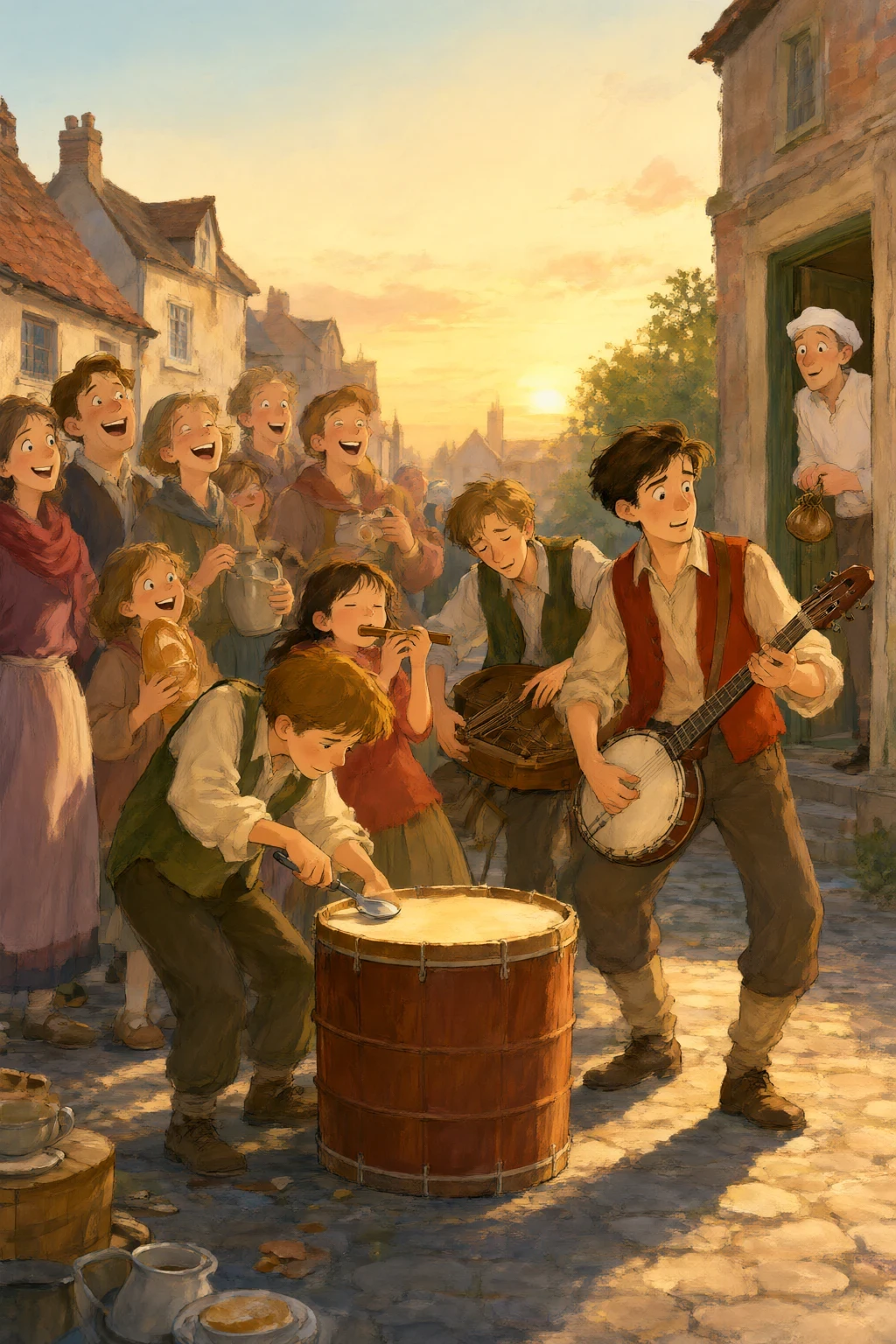
The town hired four musicians to make a debtor come out of his house. That was the whole job. The committee had tried letters. The committee had tried a lawyer, and the lawyer had cost more than the debt. Then Alderman Fenn, who had been in office eleven weeks and was tired of looking foolish, stood up in the guild hall and said that there was one thing nobody in this town could refuse, and it was sleep. They hired the worst band in the county.
Pim had the banjo, which was a long-necked thing with three strings that all worked and the fourth one that only worked if you looked at it. Ollie had the drum, which was a barrel, a rope and a spoon. Gus had the hurdy-gurdy, which he turned with his elbow and which produced one note, always the same note, and had produced that note for nineteen years. Dara had the fife, and Dara was the only one of the four who admitted out loud that they were bad at it. "I can play the same six notes," she said, "in the same order, and I can play them slowly." "Play them faster," said Alderman Fenn. "Then they are the same six notes, faster."
The debtor was a merchant called Master Quill who owed the town eleven pounds, and who had gone to bed in the daytime and bolted his front door and let the letters pile up on the step. The contract said: play outside his house until he comes out. Payable, forty silver, on payment. So they began at eight in the evening, opposite the house, and they played.
Ollie had found a rhythm by accident and it was not a rhythm, it was a length of rope and a barrel and a boy who did not know when to stop. Gus turned his elbow. Pim, out of what he described as pure spite, hit a ninth note on the banjo, the bad one, the one that only worked if you looked at it, and it worked, and then it went on working, which was a mistake. Two windows shut. A third window shut. "Nobody hates us yet," said Dara. "Nobody has heard the end yet," said Ollie.
On the second night a neighbour put her head out and shouted for them to stop, and Pim asked her, quite politely, what time Master Quill normally came out, and she said, "Never, you little horror," and shut the window.
On the fourth night the neighbour came out in her apron with a jug of water and two hard eggs and set them on the step and went back in without saying a word, and they played until two, and on the fifth night there were three eggs, and on the sixth night a woman from the far end of Lane Row brought a whole loaf and stood there until the end to make sure they ate it. "They're not frightened of him," said Gus, chewing. "They're frightened of us." "They are not frightened of us," said Dara. "They are waiting up."
On the ninth night Ollie's spoon went through the drumhead. They sat down in the road. The town was quiet in the way that a town gets when it is holding its ears shut. Pim said that if they stopped now they would have to give the money back and go home to their mothers, and Dara said that her two nights in the corner had not been the worst thing that ever happened to anybody, which made them all quiet again.
Then Dara stood up in the middle of the street and blew her six notes, very slowly, out into the dark, over and over, with nothing behind them, no drum, no elbow, no banjo. "Play with me," she said. "One note each. Ollie, you. Every time I stop, you hit it. That's all. That's the entire arrangement."
They played the whole of the fife tune on drum and banjo and hurdy-gurdy, one note each, boom, plonk, honk, and it was still not music. It was the worst performance in the history of performance. It was, however, a thing with a beat in it, and it was a sound that did not stop, and at half past six in the morning the sound was still there, going, the way water goes past a post. The front door of the house came down the street on its hinge.
Master Quill came out in his shirtsleeves holding eleven pounds in his hand and his nightcap on backwards and an expression nobody had ever seen on a face. "There," he said. "There. There. Take it. Take it and go and be somewhere else." Pim took the money. He counted it on the step, in the light, twice, because his whole training had been in being owed. "Forty silver for us," he said. "Eleven pounds for the town. The rest is for your own trouble, Master Quill, and we would take it if you offered, and you didn't."
"Keep it," said Master Quill, and went in, and shut the door, and from behind the door said, "and I am sorry about the letters, I kept meaning to open them." The band stood in the road with eleven pounds and forty silver in their hands and the sun coming up over the rooftops.
Nobody went back to bed. That was the strange part. It should have ended there, four tired musicians in a street at sunrise, and instead the whole of Lane Row came out and stood about, and the baker's boy said his father had been awake since four and cheerful, and an old man from the tannery said that he had not got up so early in nine years and his knees were better for it, and somebody produced a fiddle, and Gus turned his elbow next to the fiddle player out of pure friendliness.
By seven o'clock the town market committee had come down the road on foot to find out what all the noise was, and Alderman Fenn stood in front of the band and said, in the voice of a man revising a policy, "I understand this is now a permanent arrangement." Ollie looked at the two new drumheads, salvaged from the cooper's offcuts, and said, "I will want more money." "You will have more money," said Alderman Fenn.
They hire out now, all four of them, at four in the morning, mostly. The harbour, because the boats go out on the tide. The baker, because the baker was always asleep at four. The school, which has never once thanked them and which rings its bell on the dot. The alderman's own Tuesday, which the alderman insists was entirely accidental. The money is not much and the four of them share it evenly and Pim still loses the fourth string of the banjo about once a month and has never once replaced it.
What they have instead of music is a name. It got itself a name in the first month, from Pim, who said that any band can play and very few bands can do what we do, and what we do is get people up. So on Saturdays they take an open cart out to the middle of the market square, and they play, and it is still not good, and the square fills up anyway, and a man who bought apples on one side of the square goes and buys a hat on the other side and does not know the band was the reason.
Gus turns the elbow. Ollie hits the barrel. Dara blows the same six notes over the top, slowly, and the whole square is out in the sun in the middle of the day because none of them ever did learn how to play something quieter.