The last day of a season at the Thistlewire was not different from any other day until about four o’clock, and then it was different in eleven places at once, and all eleven of them were the same difference, which was that somebody had begun taking things off the walls. The gilt board came down first, at four, by two men on a ladder who had done it every September for thirty years and did it badly, in the rain, without speaking. Behind it the brick was the colour of weak tea, which is the colour of all the brick on Ardle Street, and the gas jets that had burned hard blue-white under the lettering went out one after another, and the front of the theatre was, for the first time since it was built, only a building. Then the programmes went, the ones still in the rack by the door, eleven hundred and forty of them for the run, gone soft at the corners from handling. Then the calendar off the poster board in the corridor. Then the brass rail on the stairs to the gallery, which was unscrewed rather than lifted, at the request of a stagehand who wanted the screw holes and not the rail. In the Subscription Office, at the same hour, Ilse Karrow took the Season Book out of the press-room cupboard for the last time in twenty-one years, and put it on the desk, and apologised to the desk, and did the Fridays early because the Friday after tomorrow was not a working day in a theatre that had closed. The stage was still to be done twice more. That was the part that had not changed and would not change: The Silver Pin, three acts, eight Positions, and a full house at eight, because the season ran to the last night and the last night had been sold in August to a man in the counting house who took a box on the Friday and had never once come in on a Wednesday.
The bench in the wings was the same bench it had been at the beginning of the run in September, and there were two metres of bare board and eight hooks and a hot pipe running underneath, and on the night of the last performance of a season the whole of the corps came and sat in numbered order, in their coats, as they had sat at two hundred performances. One sat at one. She had been on that hook for nineteen years and had never once given her age to anybody, and she had the Position of the Father and eight hundred and six performances of it, and she had brought a shawl. Two was a man of thirty-four who had broken the same finger on the same door in the second act and done it twice, because nobody is permitted to go on as a thing that is not described. Three was Maren Skell, thirty-one, who had the Position of the Widow and had asked to be released from it four hundred times and had been released from it four hundred times, and who had said in the green room that afternoon, to nobody in particular, that if the season was going to end anyway she would like it noted that she had been an excellent widow.
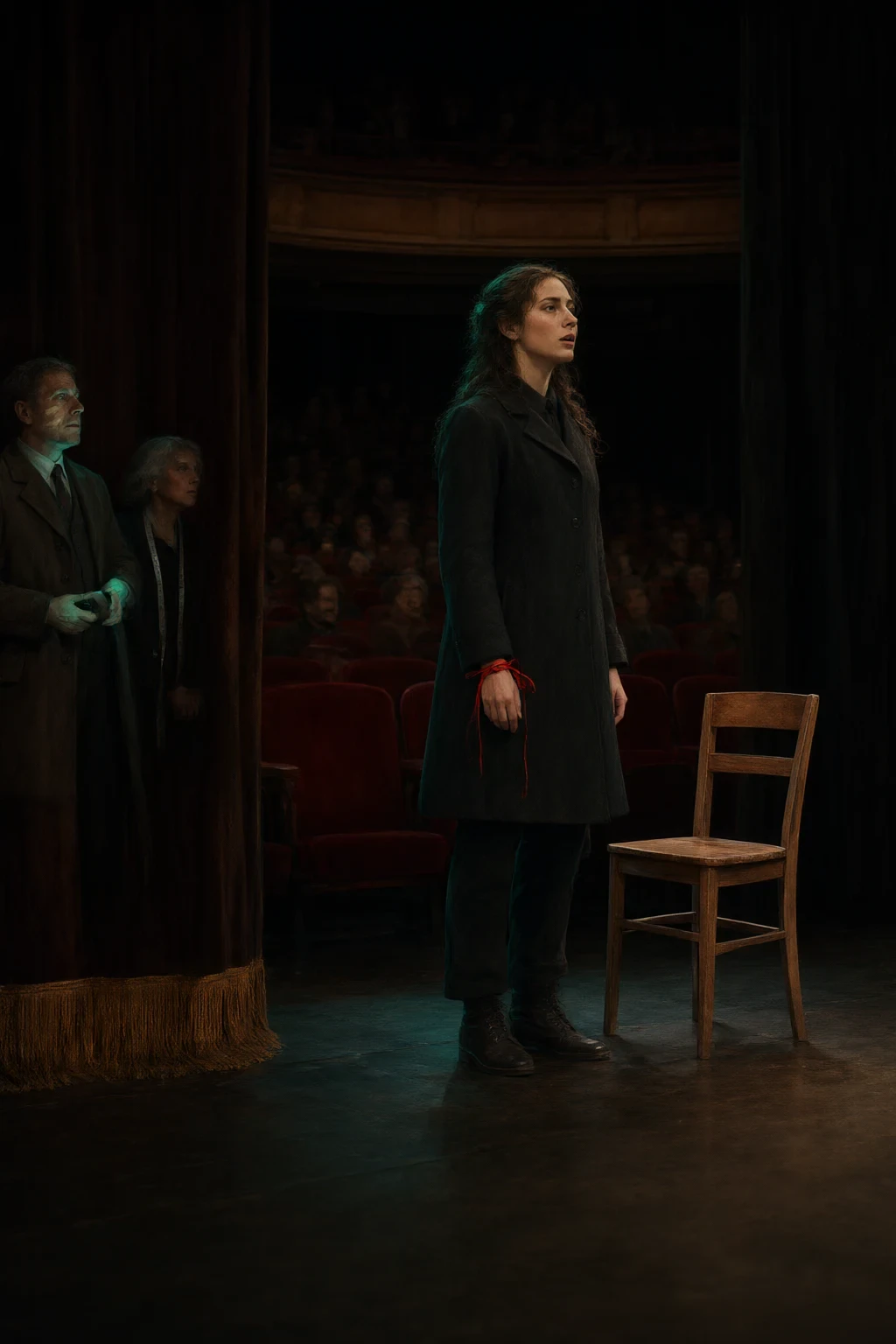
Four was Bram Sillet, forty-one, the Alternate of Record for the Younger Brother, two thousand and seventy-one consecutive performances, a permanent tan and two small strips of flesh-coloured tape on the cheekbones. Five and six were a marriage, and had been entered on the roll as one figure for eleven seasons because the roll had a column that took one and the pair had not troubled anybody about it. Seven was Tobias Hake, fifty-five, who had the Position of the Captain and eleven hundred and six performances of it and a hip that had been going since the third act of the ninth season and that he described, in the green room, as a colleague. Eight was Nell Tarrant, seventeen, the Correspondent, four words in the second act, never once given them, a length of bright red thread knotted round her right wrist with a single knot. “Seven,” said Tobias Hake, to the pipe, which was what he said it to. “Seven weeks. And the first one is gone, and the third one is gone, and the fifth is not going to hold out either, and I am going to have to be told what a refusal is, in a sentence, in words of one syllable, before I stand up in a house full of strangers.” “You have to stand up on the bench,” said Nell Tarrant. “In the wings. Not in the house.” “That is what I am asking for.”
The green room had six chairs for eight people and the argument about that had been settled by force some years ago, and Hester Vaile had come in with a tray of the coats on it, all eight, folded, in a stack, and had put the tray on the table where there was no room for it. Sixty-three years old, a steel thimble riveted to her right thumb, a tape measure round her neck gone soft and grey. She had been altering the leads’ garments to fit the understudies’ bodies for two seasons, quietly, and every alteration had been an act of love, and there was no clause in the whole of the machinery that permitted a single one of them. “I have taken out the two inches at the shoulder,” she said, “and the one at the underarm, and I have put them back in, and I have done it in the order I always do it, and I would like it written down that I did it in the order I always do it.” “Miss Vaile,” said Mr Sedley, from the doorway. He was the manager of the house and he had a hat in his hands and he had been the manager of the house for eleven years and had never in that time had occasion to do the one thing a manager is for.
“There is no procedure for tonight,” he said. “I have looked. I have had the manager of the Clarence on the wire until eleven and there is no procedure at the Clarence either, and our own board met this afternoon and could not tell me what to do, so I have come up here to ask.” He put the hat down. “I am not asking you to perform. I have no power to make anybody perform and I have not tried to make anybody perform and if I had tried I should have been told I had no power, which is why I did not try. I am asking whether anybody has an objection to my standing here.” Nobody objected, because there is no clause against his standing there, and because Mr Sedley was a decent man doing a decent thing, and because it is very hard to refuse a person who has come to ask permission. “Good,” said Mr Sedley. “Then I shall stand here, and I shall say nothing, and I shall be the last man in this building to find out anything, which is the position I have occupied since I came.” The difficulty was the giving of it. “A refusal has to be given,” said Corvin Ashby, standing at the end of the table with the call sheet in his hand and holding it away from his coat, because the ink of the last line was still wet. He had the hard blue bruise-shadow under his right eye that the prompter’s box had given him years ago, and he had not invented a word in six years, and the last of the forty he had invented was somewhere in the second act and he knew which line and not what it was. “Before the curtain. In this house. On this night. In this season. And it has to be every one of us, all eight, or it is not given at all.” “Given to whom?” said Tobias Hake. “That is the question I have been sitting on for an hour. Given to whom?”
“To the book,” said Corvin. “Nobody in this room has ever given anything to the book. The book is a shelf and a clerk and a set of columns and it does not hear things. But it is the only thing in the building that outranks the stage, and if the entry is to be struck at all it is struck there, and it cannot be struck by argument or by the board or by anybody in this room, so it is struck by the one thing the book does not have a form for.” “The form for a refusal,” said Bram Sillet. “The form for a refusal is a signature,” said Corvin Ashby. “That is all a refusal is. I have thought about it for four days and that is the whole of what I have, and it is not clever. The call sheet goes up at the half. I send it to the manager. Every member of the corps signs it. I have done it for eight years with a pen, at the counter, in front of two people, because that is the form of the thing and because the paper wants a hand on it.” “Eight years you have signed a call sheet,” said Tobias Hake, “and you have never once wondered what a signature is for.” “No,” said Corvin. “I have wondered every night for about six years.”
He put the sheet on the table, and the eight numbers were already on it in a column, one to eight, in pencil, because the paper did not have names on it and he had never had the authority to put them there. “We do not sign it,” said Maren Skell. “All eight of us, at the half, in this room, in front of each other. Eight numbers and eight blanks. I go up at the half with an unsigned sheet and the manager cannot refuse it and cannot send it back and cannot do anything at all with it, because there is nothing on it, and then we go to the bench and we do not go on.” “And if seven of us sign,” said Corvin, “it is a call sheet with a fault in it, and at the curtain we have seven Positions filled by bodies who were not asked and one Position filled by nobody, and the book will do the only thing it can do with a Position that nobody is holding, and that is not failure for us, that is failure for the other seven, and the other seven have wages.” Nobody said anything for a while. The kettle was just off the boil, as it was every hour of every day, and the wallpaper behind the mirror had the fog of greasepaint in it from a century ago. “Then it is eight or it is nothing,” said Nell Tarrant. “All right. All eight. Curtain? Curtain.”
Then Tobias Hake stood up off the chair, which took him a long time and which nobody helped him with, and put his hat on and went out to the stage door. Corvin Ashby did not stop him. That was the whole of his office for the night. He did not persuade anybody and he did not stop anybody, and he counted. Through the fanlight over the stage door you could see the top of a man’s hat and the lit rectangle of the street behind it, and Corvin stood in the corridor and counted, and the count was not in seconds, because seconds were not the unit that mattered. The unit was the back of a man standing in rain he had not agreed to. Eleven minutes. The rain went on at the other side of the glass. In the eleventh minute the man outside turned and looked up at the transom, and Corvin, who had been in the building eleven years and had never once in his life been on the other side of that door, took two steps back out of the light, and did not know what he was hiding from.
When Hake came back in he was wet through the shoulders of a coat that had cost more than a week of his wage. He hung it on the third hook with a care that was out of proportion to everything, and sat down, and said: “Eleven minutes.” “Eleven minutes,” Corvin said. “Thirty-one years,” said Tobias Hake. “I have been in this building thirty-one years and I have not once been in that street in the dark. It is not Ardle Street. It is not Ardle Street at all.” He looked at the table. “I want that entered somewhere. I am not asking for it to be entered. I am saying it in a room with six people in it, and in thirty-one years I have not found out that this room is not the wall.” Nobody wrote it anywhere. He had not asked for it to be written, and that was how the theatre worked: the cheapest things anybody in the corps had were the true things, and the true things were the ones nobody could prove. “Five and six,” said Maren Skell. “You are one figure on the roll. If we are eight signatures and one of them is two people, are we seven.” “You are one figure on the roll and one figure on the sheet and one column that takes one,” said Corvin Ashby. “The book will count what the book counts. That is the whole of what anybody in this room has ever been able to arrange.” “Right,” said Tobias Hake. “I am not going to be the man who makes it six.”
The house came in at a quarter to eight in weather that had been raining since the middle of the afternoon, and the queue at the box office had been longer than it had been all season, which is what the last night of anything does to a street. In the gallery, above the hot ash and the gas pipe, Amos Derwent sat along the catwalk with one burnt black eyebrow and a strip of oiled silk wound round his forearm like a bandage on nothing, and Corvin Ashby had come up the rope behind him and untied the end of it from the rail and given him the whole of the gallery, unsupervised, all the way to the top batten, which he had asked for for two years and had been refused for two years on the ground that somebody had to hold the rope. Nobody had to hold the rope tonight. “The fourth is amber,” said Amos, to the dark. “The fifth is green, and the gallery is red, and the first three are out because the book says the first three are out after the last scene, and the house is at half and I have not touched it and I am not going to, and I have two minutes, no more.”
Through the slot under the proscenium he could see all four hundred and twelve faces at once, and from up there they were not four hundred and twelve people. They were one field. A field of faces tipped at the same angle toward a light, and the light was the stage, and the stage was dark, and the field did not know that yet, because the half was still twenty-two minutes away and the curtain was still up. The corps came to the bench at the half, in their coats, in numbered order, and sat down on two metres of board over a hot pipe, and eight hooks stood empty above them, and one of the eight people on that bench had a length of red thread round her wrist with a single knot in it, which is what the corps wear who have decided not to go on, and there was one knot and never two. Maren Skell signed. The Widow, and a number. Tobias Hake signed, with the hip, at the table, on his own left leg, and put the pen down and said nothing about it, and that was how it was done.
The pair signed one between them, because the roll had a column that took one, and Amos Derwent, who was not one of the eight and had no number and no column and no place on the sheet, stood in the doorway and looked at it for a long time, and then went back up the rope, because the gallery was his and he had two minutes, no more. At the last, the two that mattered. Bram Sillet signed, four, and put the pen down, and said: “He signs in the third season of the run and he does not limp in the fourth, and he is not going to be told which of those was the play.” Nell Tarrant signed, eight, and the pen went through a blotter and made a mark on the copy underneath, and she did not apologise for it, and nobody mentioned it. Eight numbers and eight signatures on a form that said other things. Corvin Ashby read the sheet over once, folded it, put it inside his coat against his chest, and went to the counter to send it up, and did not put a single word in the prompt book that night, and did not have to.
The house lights came up at ten past eight. There is a thing that happens in a theatre at the half that no one outside a theatre has ever been told about, which is that when the lamps come up you are all looking at the same four hundred other people, and you are all looking at them as though you had not, and the light is not warm at that moment. It comes up the colour of weak tea, the way gaslight comes up on a wet pavement, and it comes up on four hundred and twelve faces that have all just arrived from rain, and every face in that house has the same expression, which is the expression of a person who has paid money and is about to be given something. The corps were on the bench in the wings and they saw the whole of it through a twenty-metre crack, and the crack was black, because the stage was black, and there was nothing on the stage, and there had never in twenty years been nothing on the stage. Mr Sedley came out and stood in the half-light in front of them in a hat he did not need to be wearing indoors. “The performance is a failure,” he said.
He said it clearly, and he said it to the house, and he was permitted to say it, because a failure is not a scandal. A failure is an ending. It was in the back of every ticket anybody in that room was holding, in the same print as everything else, and the ticket was the only part of the transaction anybody was permitted to hold. “The season is closed,” said Mr Sedley. “Every subscription is refunded in full at the counter as you leave. The counter is open now and it will stay open until it is closed. I am obliged to you for a very good season.” Then he took his hat off, which he had not planned to do, and stood there holding it, and the house waited, and the house did not understand, and the house would not go.
It went on like that for a long time, and nobody in the building had a procedure for it, and it was the ninety seconds that every member of the corps knew the length of in his bones, and the corps counted them, all eight, without speaking, and their counting differed by a second or two because they had counted them in different years. The house lights came up again, fully, and the stage came up with them, and at centre stage there was a plain deal chair, lit, on a bare floor, with nothing else on the stage at all. Not a person. A chair, with a thing in it that was not a body, and a light on it, and a chair is the last thing anybody has ever been able to pretend is a man. Nobody in the wings moved. It was the whole of what any of them had ever wanted, and it was standing in the middle of the stage under a hard amber lamp, and it was there because the machinery had no other answer and never had. Nell Tarrant stood up on the board, and put her hand on the hot pipe, and let go of it again. “No,” she said.
That was the whole of the refusal, in the wings, in the dark, at twenty past eight, to a chair. The book took it anyway, because eight numbers and eight signatures had gone up the counter at the half, and because the book is not a document that requires a person to say a word to it, and because the machinery of the theatre has no procedure for refusal, and never had, and the one act it could not account for was the only one it was built to be defeated by. The chair stayed for ninety seconds. Then the light went off it. Then the house lights went down. Then the stage went out from the front to the back in the order the lamps are supposed to be extinguished in, and the only person in the building who knew that order was fifteen and was not going to touch anything tonight, and the lamps went out anyway, in an order that was not his, one at a time, from the front of the house to the back.
The corps walked out in their coats. They came through the stage door and stood in the half-light at the front of the house, in a line, in numbered order, eight of them, and four hundred and twelve people looked at them, and nobody said anything, because nobody in the building is permitted to be told. A woman in the second row stood up and said, quite kindly, “Well. That was a poor show, wasn’t it.” “Yes,” said Nell Tarrant. “It was.” “You’ll want to wait for your money inside,” the woman said. “The girl at the counter has it in a tray. My husband says they give it in shillings now, not pounds, and it is a dreadful way to end a season, and I hope the season was a good one for the actors.” “Thank you,” said Maren Skell. They were not thanked for anything, and they were not booed, and they were not villains, and every person in that house went away believing what four hundred and twelve people in a wet street always believe when a building lets them down, which is that the people inside it had not bothered. A man in the back of the stalls leaned forward to Bram Sillet as he came down the aisle, and said, in the reasonable voice of a man asking a tradesman about a delay: “You have not told us, have you. What it was.”
And Bram Sillet stood still in a dark house full of people getting up out of velvet chairs, and had the truth ready, and had had it ready since the half, and it was nine words long, and he was not permitted to say it, though not by any clause or bylaw or rule. Nothing forbade him. There was no notice served on anybody and there was no fine and there was no black list and no memory of it, and the only thing that stopped the words was the arrangement itself, which had been made out of paper, and paper is very strong. “Sorry,” he said. “I could not say.” “That is as well,” said the man. “I should not think I could either, if I had been let.” He believed it. It was the most generous misunderstanding available in Verrow that night, and Bram Sillet stood in the aisle and let him have it, and went out. And that was the price, and it was a price nobody had been able to name in the fortnight before, because a refusal is not a speech. It is not a thing anybody is told. It is an act with no clause against it and no notice served, and it is remembered afterwards as incompetence, and the eight who did it would spend the rest of their lives being the people who ruined the Thistlewire, in a town where four houses had better boxes and two of them had names in their rolls. Nell Tarrant came back in last, and walked up onto the stage in the dark, and stood where the chair had been, and said four words to four hundred and twelve people who were getting up out of their chairs. “It was never sent,” she said. A man in the pit laughed, kindly, at whatever it was he thought it was.
The Subscription Office at three in the morning had the gas turned down to the lowest jet that would still burn, and the deal desk, and the barred window with the rain coming at it, and the brass grille, and the Season Book open at a page that had been left open for twenty-one years at the same place and was now going to be finished. Four hundred and twelve refunds, at the counter, in shillings, in a tray, in a clerk’s hand, in the order in which the money had been taken, because that is the order it had to be taken in. Eight wages struck in full for the season, in the Friday column, in the same ink, with the same two strokes. Mr Sedley did the sum out loud with a pencil, because he had asked to be allowed to do the sum out loud, and nobody stopped him, and it was the only thing anybody did in that office all night that anybody had thought of doing.
“Four hundred and twelve at eleven pounds is four thousand five hundred and thirty-two,” he said. “Half-price sales at the counter, six hundred and eleven. Refreshments through the concession, three hundred and forty. The sale of programmes, which is our own printing, ninety-eight. Total, five thousand five hundred and eighty-one pounds, and that is the best year the book has ever had, and it is eleven pounds short of what the front of house costs to run cold.” “And against it,” said Ilse Karrow. “Against it: the gas, one hundred and ninety a year. The coal for the basement, ninety. Nine wages, and mine, and the printer’s, and the two men in the lamp room, and the rent, and the insurance, and the interest on the money the building was built with. Seven thousand and a hundred and something.” He put the pencil down. “I have made a loss of one thousand six hundred pounds, and I have made it correctly, and I have had eleven months to make it correctly, and I have made it correctly because the man upstairs taught me how the sums go, and I could not tell you a single one of the figures I have just given your officer, because she has written every one of them in a book for twenty-one years and she has never once been wrong about a figure.”
“I have been wrong about one thing,” said Ilse Karrow. “Tonight. At about a quarter past three.” Mr Sedley said that he was sorry, and meant it, and that he had a train of thought which he was not going to finish. And then the last page, which is narrower than the others and carries no season and no names, and carries only a list, headed in terms without adjectives: TO BE FILLED. Ilse Karrow read the list she had signed herself, in September, in a hand that had not varied, for eleven years running, and struck the items out one at a time with a pen, because a list that is no longer to be filled is not left in a book for a clerk to find in a hundred years and wonder about. The house, filled as provided. The staff, filled as provided. The Positions, as set out in the Programme. And then she came to the first item, which is first because it is the oldest, and it is the one every officer has struck or failed to strike every year since the building was put up, and it was: The Theatre, Ardle Street, with the front and the box office and the gallery and the freehold.
And under the list, at the bottom of the last page, in the same small hand, in the same ink, the terms on which the list is filled. She had signed those terms in September without knowing she was signing anything, because nobody reads the terms on the first page of a book they have been reading for twenty-one years. TO BE FILLED by the persons on the roll of this book and by no other persons. And where the roll is discharged, the item is filled as provided. And the Theatre, being the first item, is filled by whoever is on the roll at the closing. “There,” said Ilse Karrow. Nobody in the room had heard the clause for a hundred and forty years because nobody had ever needed to read it, because a theatre has an owner and the owner is a man with a deed, and the deed is a different document from this one, and the book has been filled as provided for a hundred and forty years by a man who was in fact filling his own house, and neither of them ever once said so to the other. It is the most ordinary clause in the world. It is the clause under which a firm passes to its partners at a death, and it is the clause under which a workshop passes to the men in it at a Friday, and it has no ceremony attached to it whatever, and it cannot be argued with, and it does not require anybody to be a hero, or even to be present. It requires a roll to be discharged, and it requires somebody to be standing at the closing with a pen, which on the last night of a season at the Thistlewire was a woman of fifty-two in a black kid-leather glove with one index finger gone shiny with the pen.
Four hundred and twelve subscriptions refunded had discharged four hundred and twelve bodies from the roll of the house. A closed season had discharged the stage. What remained on the roll of the Season Book at the closing of the season, in a cold office at three in the morning, was the corps and the staff, and a boy who was paid a shilling and eightpence a week, and a wardrobe mistress of sixty-three, and a prompter with forty lines of his own invention in a black notebook, and a man who was being released on the terms already written into his own contract, and a girl of seventeen with four words and a red thread and no name. The building went to them at three in the morning on the last night of a season, and it took about eleven seconds, and there was no vote, and Mr Sedley stood in the doorway with his hat in his hands and said, “Is that all that is required?”, and Ilse Karrow said, “Yes. I am afraid that is all that is required. It is one line and it has been in the book since the year the building was put up.” “Then somebody should have told me,” said Mr Sedley. “Somebody did,” said Ilse Karrow. “It is the first line on the page. It is in the same print as everything else. You have never once had to read it, because a man with a deed does not read it.”
The call sheet for the last night of the season was written up at four, and it was a sheet like any other, and the Positions were on it in ink at the top, the eight of them, and Corvin Ashby wrote them out with the pen he used for the Positions, and then he came to the end of the sheet and the eight numbers at the foot of it, which were unsigned, which were a fault in a document, and which he could not enter up because there was nothing to enter. Hester Vaile took the thimble off her right thumb and put it on the table and put her hand flat beside it. “In that ink,” she said. “Whatever you are going to put, put it in that ink, and do not come to me afterwards and tell me the ink was a different ink, because I have spent thirty years being the only woman in this building whose name is on nothing, and tonight there is a sheet, and my name goes on it in the ink of the Positions, or I will take every coat off every hook in this building myself, and you may all go out in your shirts.” “Two and elevenpence,” said Nell Tarrant, from the doorway. “The wardrobe. It is two and elevenpence. It is in the roll.” “That is a wage,” said Hester Vaile. “That is not a name.”
“It is on the roll in the same book as the names,” said Nell, “and we own the book.” Nobody had said the word own before. It sat in the room for a moment in the gas-light at a quarter past four in the morning and nobody picked it up, and then Hester Vaile said, “Well, somebody had to,” and Corvin Ashby dipped the pen, and the eight names went onto the bottom of the last call sheet of the season in the ink of the Positions, and then he wrote the wardrobe in above the eight of them, because Hester Vaile had not left the room, and then he wrote the eight numbers underneath, because the numbers were the hooks, and the hooks are the benches, and the benches are what the eight of them had been for. Bram Sillet was released at twenty past four, on the terms already written into his own contract, which were that the Alternate of Record should be discharged at the close of a season at the officer’s hand, with the wages for that season paid in full. Ilse Karrow wrote: wages for the season, none, by the standing order of the Friday, and signed it, and did not pretend otherwise, and did not soften it, and gave it to him with the pen lying beside it, because a document is handed over and not explained.
“That is the whole of what you have to sign,” she said. “I am sorry about the other thing. There is no column for the other thing. I have looked.” “You looked,” said Bram Sillet. “I have looked on four Fridays and there is nothing, and I have been the officer for twenty-one years and there has never been a column for it, and that is not an oversight, that is the design, and I did not know it was the design until about two hours ago, and now you know it too, and I am sorry.” He signed it. He had never signed a document in nineteen years because his name was not printed anywhere and was not on any paper and could not go on any paper, and the pen went into the signature and the ink took, and the first time in nineteen years that a member of the corps wrote his own name on anything was on a release, at twenty past four in the morning, in a cold office in a cold city, in a hand nobody had ever seen.
Bram Sillet went out of the stage door at half past four in the morning, into Ardle Street, in the rain, and he had not been outdoors in daylight for nineteen years, and the river, on which all of Verrow was agreed, he had taken to be a rumour. The rain was not surprising. The rain was the one thing in Verrow he had never had any doubt about, and it was very good, and it was on his face and in his collar in about four seconds, and the pavement was the colour of weak tea, and the chestnut braziers at the corner were banked down to a red eye because there was nobody left to sell to, and the boards on the front of the theatre had been taken down at four o’clock, and behind them the brick was the same weak tea, and there was a ladder against the wall that a man had left in the rain. He stood in the middle of the street for some time without going anywhere in particular, because there was nothing he wanted to do and he had no habit of doing it. Then he heard it.
It was not a large sound. It was the sound a thing makes when it is a great deal larger than everything else and is not trying, and it came up the side of the street and went under the arches and went on, and there were barges on it, and the barges had no lamps that he could see, and the water was black and the sky over it was black and there was nothing at all in the way of light out there except a low thin line the colour of a bruise where the sky was thinner. Nobody was describing it. It was not on the board and it was not in the programme and it was not in the Season Book and it had no terms and it had nobody standing in it, and it did not have to be finished by the curtain, and it was the largest thing he had ever stood next to. Bram Sillet stood in the rain on Ardle Street and listened to the river for a long time, and did not go back in, and did not particularly mean to.
The building had to go into the dark, and somebody had to go in first, and the roll said the roll, and the roll at the closing was the corps and the staff and one boy, and the boy was the youngest thing on it, and the only person in the Thistlewire who had never once been in the building in daylight. Amos Derwent let himself in at the stage door at five in the morning with the key he had had since he was twelve, and the gas was out everywhere because the manager had shut the main, and the house was black from the lobby to the top batten, and there were four hundred and twelve empty velvet seats with the slow light coming up off the wet street through the fanlight and showing him, in one field, the backs of all of them. He had wanted, since he was eleven, to work the gallery by himself, unsupervised, all the way to the top batten. The terms on which it had been refused for two years were that somebody else held the other end of the rope.
Nobody held the rope. He went up it in the dark, five feet above a floor of hot ash and cold gas pipe, with the whole house underneath him and none of it lit, and the strip of oiled silk on his forearm was for nothing, as it had always been for nothing, and there was nothing to hold on to and nothing to look at and no one to tell him which was which. He got to the top of the gallery and put his hand out along the batten, which was cold, and which had no lamp on it and had never had a lamp on it, and was the highest thing in the Thistlewire that was not a name in a book, and he took his hand off it and went down the rope again in the dark and put the loop over the rail at the bottom, where it had always hung, where it had hung before he was born and where it would hang on Monday for whoever came in next. In the wings, on two metres of bare board, there were eight hooks and a hot pipe and no coats, and it was the most uncomfortable place in the theatre, and it was the only place in it where nobody was performing, and in the morning there was nothing at all on the board and the pipe had gone cold.