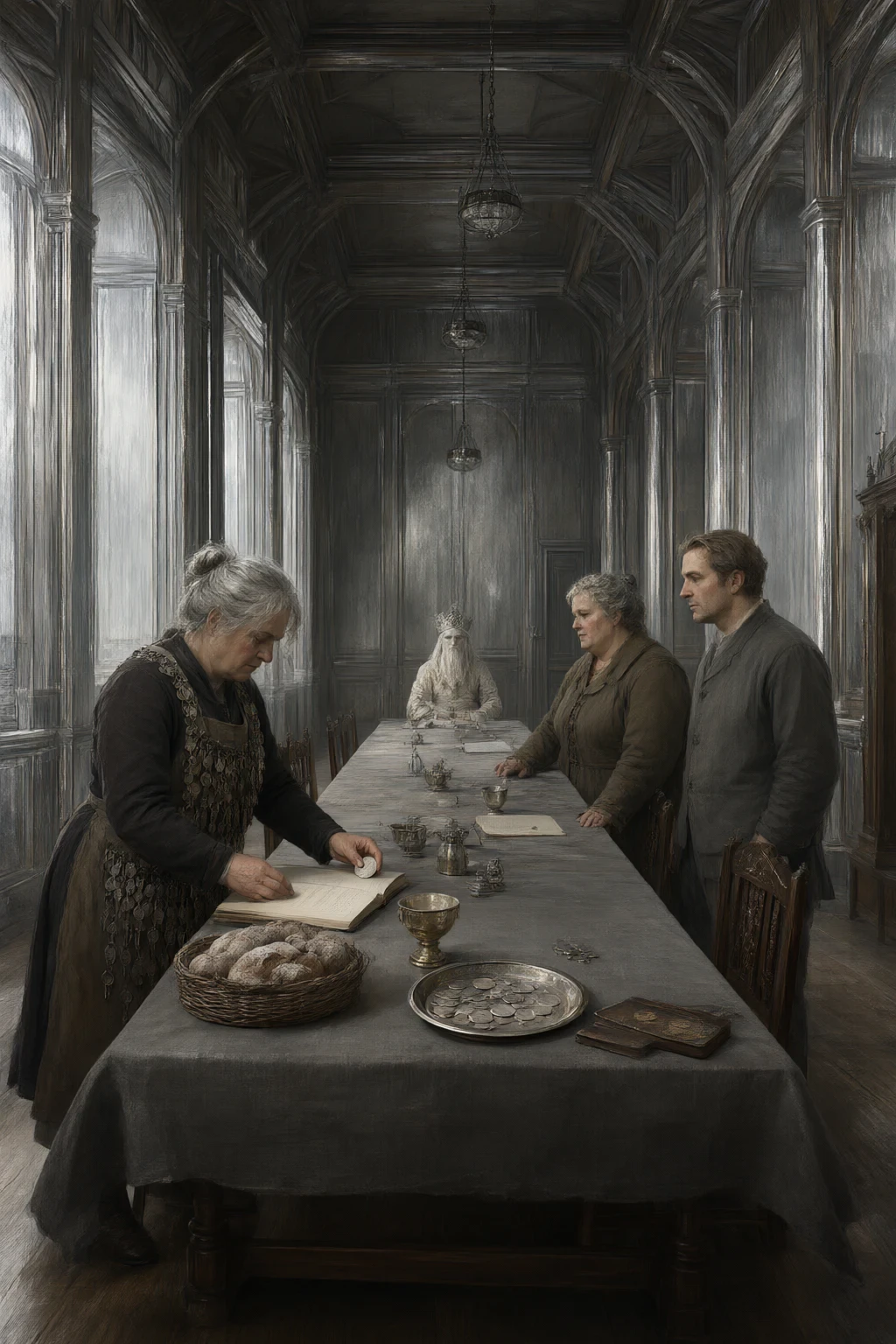
The notice came in on an awl, four lines of it, and only the last of the four mattered to Tallow Merrick. By order of the market at the Upper Gate, the season’s reckoning was this day and the next, and the accounts of the Court were to be shown entire, or failing entire, shown such as they are. She read it twice. Then she hung her chain back on its hook by the Vault door, a hundred small iron keys over her apron like a necklace, each cut from a different coin, all of them a size too small, and she counted them as she hung them, which four generations of this household have watched her do, and none of them has ever been rude about it. “Twenty-nine. Thirty. Thirty-one. There. Ninety-one to ninety-four, sharp. Very sharp. And you,” she said to the one on the end, the smallest, the one she keeps for nothing in particular, “you have no business hanging among the sharp ones. You are a soft key. You are a sentimental key. Get down.” She was still sorting when the auditors came up the stair, and they came up together, which told her something already.
The one in front was a heavy woman of about fifty with rain dried into the wool of a coat that had been good. She smelled of the market: mud, apples, honest rope. Behind her, quick and thin, a man in the Court’s own grey, carrying a folding rule and a wax tablet, who said, “Master of Accounts,” in the voice of a man who has never once had to say it twice. “Merkick,” said the woman. “Bettany Grale. Outside assessor, the gate market. I count things that leave.” “Tallow Merrick. Keeper of the Vault. I count things that stay.” “Thank you. Then we shall not get on at all, and I shall be able to go home.” From three steps down came Grist Bellweather with a lamp and a covered dish, saying that they had all eaten, and that if they had not, they would sit, and that there was broth, and that it was not good broth, it was broth. “Have you eaten? No. Sit. Sit, there is broth.” “It is the middle of the morning,” said the thin man. “It is the middle of everything,” said Grist. “Sit.”
They began with the Hall first, the Vault second, the Table last, because that is the order in which a true thing happens, and therefore the only order in which it can be counted. In the Hall of Telling there was the brass lamp, wagon-wheel wide, burning one clear steady flame, and beneath it the pale hard-edged disc of light on the plank floor, and nothing else in the room at all. The auditors stood in the dark at the edge of it the way everyone stands there, and Tallow stood in it, because the Keeper of the Vault signs every mint, and there had not been a mint since Tuesday. Bettany Grale looked at the disc, and at the brass tray on the deal table, and at the deal table, which was plain and had one crack in the third board from the window. “Eleven feet of it,” she said. “Twelve,” said the thin man. “Your own rule, assessor. Eleven and a half, with the overhang.” “Twelve,” Bettany agreed. “And a crack.” “The crack is not in the accounts.” “The crack is the reason I am here. I am here for the crack. Everything else in this building is because somebody put a coin in a tray, and the crack is because nobody has, for two hundred years.” They went down.
The Vault is cold in a way that has nothing to do with temperature. It is a domed room lined floor to ceiling with pigeonholes, and the lamps in it are low, and the shelves give back a faint chalky breath when the door opens, and the smell is cold metal and old paper, and the coins lie in velvet trays sorted by size, hundreds of thin silver discs in neat rows, each one worn to a smooth blank face with the ghost of a raised shape on it if you know how to look. Bettany Grale picked up a tray. She did not ask permission. She held it up to the low lamp and turned it. “This is the Court’s founding,” she said. “The Night the Hall Was Lit. Told in the Hall, four hundred and some years ago, in the words everybody uses.” “It is.” “It is the most beautiful story in this palace.” “It is the most beautiful story in four provinces,” said Tallow. “It has a fox in it. A real fox, allegedly, at the edge of the salt pans, which came out of the dark and did not run when the lamps were lit, and the whole Court agrees the fox understood.” “And what is this worth?”
Tallow took the tray from her, held it level, and set it back in its slot with the exact care of a woman putting a letter back in a drawer. “Four hundred and six, dull,” she said. “Very dull. Two hundred and eleven, dreadful. This one is two hundred and two and it is a good colour and a clean rim and I will not have it spoken of badly. It is worth nine, and it will spend as water, and it tastes of chalk, and if you set it on the rim it goes over like a leaf.” “That is the founding of the palace,” said the thin man. “Yes,” said Tallow. “That is the founding of the palace. We have it in four versions and thirty trays, and the best of them is worth nine.” Sennet Rull wrote on the tablet. He had a way of writing that made a small dry sound, three ticks to a line. “A court of this age, with a treasury of this size, and an entry rate of one true story told and overheard, mints on the order of a hundred a year in a good year,” he said. “A bad year,” said Tallow. “Name a bad year.”
“Seventy-one. Thirty-one. And the winter the mill flooded, of which there are two, and one of them is a lie, and I have never been able to decide which, and that is the most honest sentence I have spoken in this room in nine years.” “Four bad years in four hundred,” said Bettany, “and nobody in the market can name one. That is not a scandal, Merrick. That is a monopoly on failure.” “It is a well-kept ledger.” “It is a well-kept nothing,” said Bettany Grale, “and I say that kindly, because I have counted four hundred markets and every one of them is a nothing, and two of them are run by my own sister, and I have eaten at both.”
The Long Table is forty feet of dark oak under grey linen, laid for nine in a hall built around it, and it is always laid for nine even when the Court is down to four, which tonight it was, and the auditors had put it at six, and Tallow had not argued, which is how the auditors knew she was afraid. The sideboard held the whole of the Court’s provisions: chaff bread in a wicker, a pan of grey stew that had been grey since before any of them were born, salt, vinegar in a stoppered jar, and a ewer of water with a thing in it that was not ice, being chalk, which the palace has kept in the cold part of the north wall since before there was a Court. Grist put the bread on the table without being asked and stood back. The Queen was already seated at the far end, in the four feet of table a nine-hundred-year-old sovereign is entitled to by custom, and she had not been there when they came in, and nobody had seen her come in, which was normal, and which had not been normal about forty years ago.
She looked like a drawing of herself that somebody had left out in the frost. Pale, and light at the edges, the way a thing is light when it has been held up to a window too many times. Her crown was a circlet of hollow gold ringlets, like a circlet of split coins, and they had been split so long ago that the splits had gone smooth. Her hands lay on the grey linen, very still, and Tallow noticed, as she always did and had never once been able to say out loud, that the Queen’s fingertips had gone the colour of thin glass, and that a line of the ledger could be read straight through her hand. “Your Majesty,” said Bettany Grale, from the middle of the table, at a distance that was a courtesy and a measurement. “Assessor.” The Queen’s voice was a beautiful formal thing, put out like a coin onto a cloth. “You have come about the season, and the flour, and the thing that is not in the column, and I have been the thing that is not in the column so long that I no longer distinguish it from the furniture. I hope you will eat. There is a great deal of it and none of it is any good. It was. There was a point about the bread. It was.”
“Your Majesty,” said Tallow, “the entry for your supper is carried at one true thing, told and overheard, and paid nightly.” “Thank you, Merrick. I have been eating at this rate for ninety years and I do not recommend it.” Nobody laughed, because she had said it in the register of a physician and she had been right. Bettany Grale took out a stub of pencil and a card, and wrote, and said: “The Crown takes its supper nightly at a cost of one true thing told and overheard. Is the Crown able to say which true thing?” The room went the particular quiet that this room goes. “Your Majesty,” said Sennet Rull, “the assessor is asking what the Crown has been paying with.” “Then the Crown has been paying with the same thing it has always paid with,” said the Queen, “which is the Court’s own account of itself, in the Court’s own words, and which I have found, and this is a professional observation from a woman who has told more of them than anyone now living, I have found that it wears down. It wears down like a coin. And then it is a coin, and I eat with it, and it is. Well. It was something. I have lost the rest of it.”
Here is the arithmetic of supper, and it is very short, and it is the only thing this palace knows how to do. A meal is a debit. The bread, the salt, the stew, the water, the oil, the wick, the flour that was ground out of four hundred years of worn-out tales in a stone mill under the palace, the labour of five people and the keeping of a building: all of that is a debit, and it is entered every night, correctly, in the left-hand column, in the small neat hand of a woman who has kept the Court’s accounts for thirty-one years and who cannot stop. A payment is a credit. That is the whole system. A court that keeps no gold and no land and no army keeps a column of debits and a column of credits. The debits are everything that happens. The credits are the true things. A debit without a credit is not a theft. It is a court. It is a court being a court, which is to say a hole in the world with a lamp above it, and the lamp is warm, and the hole is honest, and the hole eats more than it earns, and the reason anybody stays is the lamp. For four hundred years the left column had been immaculate. For four hundred years the right column had been thin.
Tallow brought the ledger up to the Table and set it down, because a season’s reckoning is done at the Table, the Table being the only place in the world where anything worth anything changes hands, and an audit being nothing but a very slow changing of hands. She turned to the leaves she knew. “Ninety years of the Crown’s supper,” she said. “One thousand and forty-one meals. Nine hundred and ninety-nine of them identical: the standard rate, the standard charge. Debit column, one thousand and forty-one times, the whole of it, every night, entered. Bread, salt, stew, water, oil, wick, labour, the keeping of the room.” “Payment,” said Bettany Grale. “Payment,” said Tallow Merrick, and stopped. She had said it a great many times in her life. It is one word. It is four letters and a half, and it has never once been difficult. She turned the leaf. The right-hand column for the Crown’s supper, ninety years, was not blank. It had never been blank. It was filled, night after night, in a small neat hand, with a number. A tray number. A cross-reference. Night after night, for ninety years, to a tray in the second gallery: gold letter, third pigeonhole from the left, the low one. “It is entered,” she said, “every night, and it is good.”
The thin man was already writing. “Good. The Crown is solvent. The Crown has been solvent for ninety years, and the audit is a formality, and I can be at the second market by noon. I will say what an extraordinary set of books these are.” “Wait,” said Tallow. “Two words, Merrick.” “Wait. Hallow. Third pigeonhole from the left, the low one.” She did not go herself. She sent the thin man, because she could not leave the Table, the audit being at the Table, and because her hands had gone to the chain at her chest and were moving along the keys without counting them, which in thirty-one years had happened four times, and three of them had been at a funeral. Sennet Rull came back with the tray. He set it on the deal end of the Long Table, and Bettany Grale leaned over it with him, and Tallow stood at the end of the table with both hands on the back of a chair. The tray was not empty. It was a velvet tray of the second gallery, gold letter, and it was full. It was full of thin silver coins in neat rows, and the coins had the warm soft look that coins have when they have just been minted, and the raised shape on the face of every one of them was a lamp. Every one of them was a lamp.
“They are in date,” said Sennet Rull, after a while. “They are the founding. They are the Night the Hall Was Lit. Every night for ninety years, the Crown’s supper was paid with a coin out of this tray.” “Two hundred and two,” said Tallow Merrick. “Dull. Very dull.” “It has not been drawn on since the spring of the ninety-first year,” said Sennet Rull. “It is a full tray. I have counted them. It is full.” Outside the tall glass the wind came off the water and worked at the frost on the inside of it in the long slow way of a thing that has all winter. “Then there has been a further entry,” said Bettany Grale, and she had put her pencil down, which frightened Tallow more than anything else that happened that day. “Somebody has been signing it.” “Read the credit column.” Sennet Rull read the credit column. He read it in the dry ticking way, three ticks to a line, all the way down ninety years, and when he reached the bottom he went back up nine lines to the place where the pattern broke, because the pattern broke, and then he read that too. “The credit is entered in a hand that is not the hand of the Court,” he said. “It is a small hand, and a fast one, and it leans. It is entered every night, ninety years, without a single omission, and it is signed.” “And the signature is not a name of this Court,” said Bettany Grale. “Read it.” “Wenna Sallow,” said Sennet Rull.
Nobody in the room had heard it before. Tallow Merrick, who has read every line written in this palace since she was thirty years old, put her hand flat on the table to be sure of the floor. “Falling column,” she said. “Ninth of the third register. Thirty-one years back, or thereabouts. Name lost, cause unrecorded. And there are four since, and I have signed all four, and the Linen woman was Tuesday.” “Gone where?” said Bettany Grale. “Gone from the roll,” said Tallow. “That is all it says. It does not say died. This palace has never written the word dead in a register in nine hundred years, because a name is not struck from the roll for dying. It is struck for being unaccountable. And the Court of this palace has never in its life been able to account for anybody.” “Then she is not dead.” “Then she is not on the roll,” said Tallow, “and if she is not on the roll, she cannot have been paid, and if she cannot have been paid, the Crown has eaten ninety years of its supper for nothing, and if the Crown has eaten it for nothing, then there is no meal here. There is only the appearance of a meal. And the appearance of a meal is the cheapest thing in the world, and the Court is full of it.” “Then write it off,” said Bettany Grale. “Which line.”
“The credit. Ninety years, one thousand and forty-one nights, and there is no Wenna Sallow to present at the Table, so the payment is unproven, and unproven payment is no payment, and the Crown is in arrears, and arrears are a perfectly ordinary condition for a court of this age in a market of this size. I will sign that off in one line and we will all go and eat whatever the miller is offering.” “No,” said Tallow Merrick. “Merrick.” “I will not sign it off. Not that line. I will sign every other line in this book tonight, and I will sign the Crown in arrears, and I will sign the whole of the palace in arrears, and I will hand you a schedule of exactly how far in arrears, to the last crumb, in front of witnesses, because I have been waiting thirty-one years for somebody to ask me a question I can answer with a number.” Her voice did not go up. It went thinner, which in her is the same thing. “But I will not cross out a name.” “You cannot produce the name.” “I can produce the hand.”
The mill under the palace is low and stone and warm, and the millstones make a sound like distant surf that never quite stops, and there is one oil lamp hung low over the miller’s shoulder, so that everything below the hopper is in shadow and everything above it is in flour. Grist Bellweather had been grinding for four hours and had not heard them come down. He turned round with white brows and a scorched leather apron patched at the elbow and both thumbs hooked in his belt, and said, before anyone could ask, that they had all eaten, and that there was broth. Nobody sat. He said it again anyway, to the hopper, and turned back to his wall. The wall was the back of the mill, the one nobody had ever looked at, because there is nothing to look at. It was covered in chalk, not the miller’s accounts, which were on the slate by the door in the ordinary way, but in the way you cover a wall when you are copying something. Orders. In a small, fast, leaning hand. Oil, two gallons. Wicks, three, the long kind. Nails for the hopper, six. Salt against March. Flour, none, thank you. Rope, honest, one fathom, from the gate, and do not take theirs. Oil, two gallons. Wicks, three. Salt against March, and the March salt is the March salt.
Going back thirty years, at least. Going back to the corner where the plaster had been re-done and the chalk re-traced, and then traced again, later, by somebody copying a copy. “Who writes that?” said Sennet Rull. “I do,” said Grist Bellweather. “You write it.” “Every day for thirty years.” “Whose order is it?” And the miller stood with his back to the wall for a while, and the stones went on like surf, and then he said: “It comes down from the palace on Thursdays. Oil, and wicks, and whatever else the palace cannot go down to the gate for, because the palace does not go down to the gate. It comes to the mill door and it is set down on the step. There is never anybody there. There has never once been anybody there, not once in thirty years, and I have watched for it every Thursday.” He put his hand flat on the wall, the way a man does to a horse. “It came from a woman. That is her hand. And she wrote do not take theirs, and I have never taken theirs.”
It took the auditors until the second hour of the morning to be certain, and they were certain, because Bettany Grale believed in the hand more than in the name, and Sennet Rull had brought down the ninth of the third register, and Tallow had laid ninety years of the Crown’s supper open on the deal table beside the miller’s wall, and the two hands lay on the wood next to each other like a pair of dead leaves, and they were the same hand. It means a woman wrote, in a year no living person can now name, in a small fast leaning script: the Crown’s supper, one true thing, paid. And she came down to the mill on Thursdays with oil and wicks and honest rope, and she did not come in, and she set it on the step, and she went away up the lane before anybody could ask her anything. And then the Court, which cannot tell a true thing about itself, wrote her name in the only place it had left. In the right-hand column. In the margin. In the place where payment is entered. Ninety years running, in the hand of a woman who was owed, and never asked, and never once, in ninety years, thanked.
The auditors signed their findings at four in the morning at the Long Table, by candlelight, because the Hall lamp is not a clerk’s lamp and never has been. Sennet Rull put a coin of his own telling on the table and asked Grist for the broth, and Grist brought it, and the coin went across the rim and stayed gone. And then Bettany Grale took out her pencil and struck the line. “Ninety years of credit, struck,” she said, “on the ground that the credit cannot be produced. That is not cruelty. I want that written down somewhere. It is a rule. If I permit a name to stand in the credit column of this palace on the strength of a resemblance between two hands, then any person who ever owed this Court anything can be entered by me at dinner, and neither of us will ever know the difference. I am the only person in this room paid in money. I do not have the luxury of being moved by a wall.” “It is the rule,” said Tallow Merrick, “and you are right, and I would have written it as you have written it, and I have written worse.” “Yes,” said Bettany Grale. “I have read the ledger. So have you.” And the Queen, who had not spoken since the early hours and had not appeared to have been listening, said: “Assessor. Read it again.” “Your Majesty?”
“The credit. You have struck it. Read the name again. Aloud. In a room where it can be heard.” Bettany Grale sat down again, which she had not expected to do. “Your Majesty, it is a kitchen matter, and there is a great deal of it, and the numbers are not in dispute.” “Read it.” So Bettany Grale read it, at the Long Table, at four in the morning, to a Queen and a Keeper of the Vault and a Master of Accounts and a miller: Wenna Sallow. And nothing whatever happened. Nim Ollowan, who had been sitting on the end of the sideboard with her knees up, watching all of it, said into the silence, in a small voice nobody had been expecting: “Nothing minted.” “Nothing minted,” said Cresset Ombre. The Lampwright stood at the end of the long table with the brass lamp-stand fused into her right forearm and the skin inside her cuff gone brown as a crust, and she did not look at any of them. “That is correct,” she said. “The Hall is up there and we are not in it. A true thing said in a dining hall, to people who cannot contradict one another, is not a coin. It is a noise. Cresset has seen it a thousand times. This Court has been making that noise every night for ninety years, and calling it supper.” Nobody had an answer to that. The Queen, who had asked for it, looked down at her own hands, flat on the grey linen, and they were the colour of thin glass.
Tallow Merrick did not sleep. At six in the morning she went down to the Vault and took out the season’s ledger, and the season’s return, which is the thing the auditors take away with them: one sheet, signed, the whole of the palace in arrears to the market at the Upper Gate, to the last crumb, in a hand she was not ashamed of. And then she wrote, in the right-hand column, on a fresh page, at the top, in the small neat hand of the Keeper of the Vault, one line. She wrote it and she did not put a tray number against it, and she did not tick it, and she did not sort it, and she did not carry it up to the gallery, because there is no tray in this palace for a person. She wrote it in the margin instead, where a hand can be seen. The line said: one thousand and forty-one meals, and one true thing told and overheard, and the whole of it received by the Crown, and payment standing in the name of Wenna Sallow, of the ninth of the third register, whose name is fallen and whose hand is identified, and whose name is therefore not struck out, but not yet asked. It is not a balanced entry. It will never be a balanced entry. In eleven years, when Tallow Merrick is dead and the next Keeper comes up that stair and starts at pigeonhole one, there will be a line in the margin that does not add up, and somebody will have to decide about it.
In the morning, at the Long Table, which is cleared and mopped and laid for nine, the Queen came down alone and sat at the far end, and there was one crumb of chaff bread left in the wicker, and she did not eat it, because in the last hour she had begun to be able to see through her own fingers. She sat a while with her hands flat on the cloth. Then she said, out loud, to nobody: “Wenna Sallow.” And then: “Sallow. Sallow. I have known that. I have known that for. And then it was. Well. It was something.” And she was still saying it, twice, four times, like a woman trying a name in a dark hall, when the Lampwright came in to take the lamp down for cleaning, and stopped, and stood there, and did not say anything, which for the Lampwright was an entire speech.