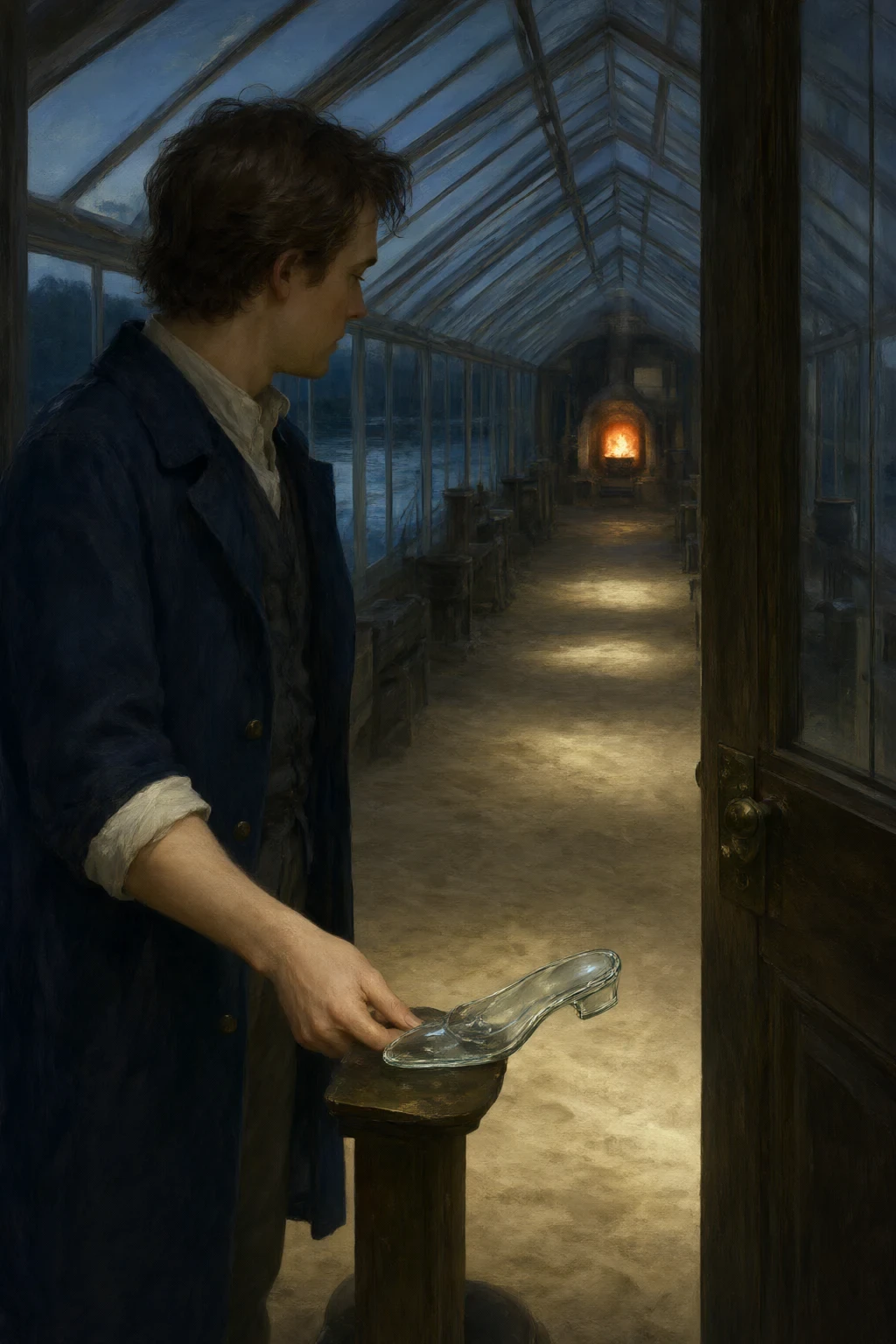
The cooling floor of the Sallow Bridge Glasshouse is ninety feet of sand, and every year it is dug out and carried to the tip and replaced with sand from Cold Ash, and on the morning of the third of October the man who digs it came to the far end and found that there was a board over a hole in it, and under the board there was a glass slipper, standing on its heel in the sand with the sole toward the door, and it was the colour of a bottle held up to a lamp, and it had the seam of the mould still on it and one flat spot on the sole where it struck the lead when it was struck from the sand. Amos Rill had come down from the Ledger Room on the Tuesday with a form, because forms do not wait for sand. The form was the disposal form, and it is a single printed sheet with four lines on it: the thing, the owner, the value, the place of disposal. The Cinder Ledger Room enters disposed matter in the column called disposed, and the column wants those four things, and where the fourth thing is concerned the column is a sentence and not a number, and the sentence is that the matter was carried to the Slag Bank.
He had the form on the bench when Ivo Sarn came out of the bottle end with his sleeve turned back and the pale crescent of an old burn white across the heel of his right hand, and he looked at the form, and then at the slipper in the sand, and then at the man on the bench. “Eleven hundred and holding,” said Ivo Sarn. “The floor is at nine hundred and forty and the sand is wet to the knee, and you are standing in it.” “I am standing on the boards.” “You are standing in it up to the boards.” He wiped his hand on his apron, which took the shine off the burn, which is what his apron is for. “What is the form.” “It is a disposal form. The floor is out and that has to go to the bank and the bank takes ash and things of a person’s, and the column wants a value, and I cannot enter a value for a thing with no owner in it, and it has had no owner in it since the year it was cast.” “How long.” “Thirty-one years.” Ivo Sarn looked at the slipper for a while. The furnace was making its noise at the bottle end, which is not a loud noise and is a noise you stop hearing in about a week.
“Nineteen seventy-four,” he said. “I closed it in March of nineteen seventy-four and I never sold it and I never entered it and I never struck it down. That is a slipper in a hole under a board and it has been that for thirty-one years and it is the only thing on this floor that is not sand.” He turned round. “The sand goes at eleven hundred. Take your form to the counter and come back at noon.” “I have to answer the four lines before noon.” “Then answer them wrong and I will tell the first clerk you are a fool,” said Ivo Sarn, “and the first clerk has been one for nineteen years and will take it as a compliment.”
Amos Rill took the form back to the Scale House and stood at the counter in the middle of the afternoon with it, and the beam-man was working and there was a queue of the Rope Walk out into the wet, and the thing he was thinking about was not the four lines. The thing he was thinking about was that he had wanted to pick the slipper up. He had wanted to pick it up the way you want to pick up anything that has been under a board for thirty-one years, and he had not, and the reason he had not was a rule he had read in the licensing schedule when he was seventeen and had thought at the time that it was a rule about shoes. A slipper worn past midnight is a claim presented. Whoever puts it on is honouring the claim and must answer it by the following dusk. Whoever picks it up and does not put it on has refused a claim, and refusal is entered against their own name, and refusal is worse than the debt. He had stood in the glasshouse with his hand out and had not picked it up, and there is a thing a clerk learns in his first year, which is that not doing a thing and not doing a thing are different, and only one of them is a decision. So the slipper could not be moved by anybody who did not intend to put it on. There were, as far as Amos Rill could tell standing there in the wet, eleven people in Emberwyke who had been in a position to do that.
The eleven were in the Ledger. Not in the Cinder Ledger volumes, which are a roll of hearths, and which have eleven thousand lines a night and a right-hand column and nothing else. They were in the Ledger Room, in a separate book on the shelf under the north window, a ruled book about two inches thick with a leather strap, and the book has one heading on the first page and no heading on any page after it, and the heading is: Presented: Sallow Bridge, slipper, one. Nobody knew who had started it. It was in a hand that had gone out of the building before Amos Rill came into it. The entries are one line each, and a line has a date, a name, and a mark, and the mark is one of two letters because there are only two things that can be done with a slipper in this city. W is worn past midnight, which is a claim presented and must be answered by the following dusk. R is refused, which is worse. He read the eleven.
March 1974, A. Sarn, W. August 1976, the re-roofers’ boy, W. February 1981, a glassblower’s apprentice, R. October 1983, a woman of the Coalquay, W. June 1988, the two girls on the Sallow Bridge steps, R R. February 1991, a renter of the Salt Hall, W. January 1994, R. November 1998, a boy of the Rope Walk, W. March 2001, a bargeman, R. October 2002, a woman with a stick, W. and, last, in the spring of this year, no name at all, R. The first of the eleven was a Sarn. It was written in the same week as the casting and it was entered by a clerk and not by the family, and Ivo Sarn, who has never in thirty-one years mentioned it to anybody including the boy standing in the shed, had been sixteen miles upriver that night and had come back on the Tuesday. A name, a date and a mark, eleven times, over thirty-one years, and not one word about the slipper itself. The column records the presenting and it does not record the thing presented, and there is a very good reason for that, which is that the column is a column of claims and a claim is a claim against a person, and a person is what the column is for. The last line was the one that stopped him. There was no name. There was a date in the spring, and the letter R, and then a space where the name is, and then, in a different ink, in a smaller hand than the clerk’s, the words: no roll.
He went to the eleven, which took nine days, and he went to them for the wrong reason and found the right one. The wrong reason was that a clerk who cannot complete a form will ask anybody. The right reason was that the column gave him eleven names and eleven dates and nothing else, and that the column was therefore not a record of a thing but a record of what a thing did to people, and that the only document that could carry the thing was the memory of people who had been standing near it. What the eleven sets of memory agreed on, and it is worth setting down exactly, because agreement like that is rare and it is never about the important thing.
The slipper is glass. Nine of the eleven said so without being asked and one said it was a bottle, which is a different thing, and one said nothing. It is cold. Everybody said cold. It is heavy; the woman who wore it in 1983 said it was like putting a wet stone on, and the bargeman who refused it in 2001 said he could not have carried it up the Coalquay steps and not because of his leg. It has a hard edge inside the heel where the seam is and the seam has not been taken off because nobody has ever taken it off. It does not smell. That surprised four people and one person said it smelled of the river and had always smelled of the river, and the woman with the stick in 2002 said it smelled of nothing, which is a different claim and is not a better one. What the eleven sets of memory did not agree on was whether it went on.
The re-roofers’ boy in 1976 put it on and it came off him in the yard and he put it on again twice and then left it on the anvil, and he remembered the sound it made on the anvil, and he remembered that it did not break. The apprentice in 1981 would not have it near his foot and was asked why and said it was not his, which is a reason and not the reason. The two girls on the steps in 1988 were asked separately, four days apart, by a clerk who did not tell them what the other had said, and one of them remembered a hat and the other remembered that it was not the right size for either of them, and the second of those is the more useful memory, because it is the more specific one. The woman with the stick in October 2002 put it on, and the boy of the Rope Walk in 1998 put it on, and both of them said the same thing, which is that it came off. Only the woman of the Coalquay said that it was still on her foot at one in the morning, and she said it as though it were a thing that ought to be obvious, and not as though it were the only one of the eleven that had ever been true.
The woman of the Coalquay in October 1983 is the only one of the eleven who is not dead, or gone, or unwilling to be found, and she was on the Rope Walk at the end of every night for twenty-nine years, and Amos Rill did not have to ask anybody where she was, and he did not go and ask her, and that is the part of this that he was not able to write in the form. One of the eleven came to the door, and it was the bargeman of March 2001, and he came because the boy went to the Coalquay twice, and he was fifty-eight years old and he had refused a claim once before, in a form, asked by a different clerk, and that clerk had written nothing down, and he had thought about that for a long time.
He remembered it in the mud. He remembered the Coalquay landing and the month and the tide and the reason: a woman he did not know had come out onto the landing with it and asked whether he would put it on, and he had said no, because he was on the water in an hour and a glass shoe is not a thing a man wears on a barge. “I said no out loud,” he said. “And that is when I found out what the no was. I did not know, when I said it, that the no was the thing that would be written down. I thought I had said an ordinary thing.” Then he gave the boy the part that was worth the walk, and he gave it without being asked for it, which Amos Rill wrote down afterwards in the terms it had been given in, because a clerk who improves a witness is a clerk who has made a witness.
The shoe had come off in about two steps, and it had landed sole up in the mud, and there had been sand in it. He had looked down at it and thought, in his own words, that it was a shoe with a foot in it made of sand, and that nobody does that on purpose, and that it was not bank sand, because bank sand is grey and this was pale and clean and it was the sand they ram into a mould, and it was still in there after nine years, and it had not shaken out when the shoe came off, and he had not picked it up afterwards, and he was not going to, because a man who picks a slipper up and does not put it on has refused it, and he had refused it once that morning and was not going to refuse it twice.
What he did instead was go to Cold Ash with a ledger and a boy’s arithmetic. The Sarn day book is a foolscap book ruled in six columns and it has been kept without a gap since the year the shed was built, and the entries are in the founder’s hand, and Ivo Sarn’s grandfather ruled the columns and Ivo Sarn’s father filled them and Ivo Sarn fills them. The columns are the day, the mould, the size, the pour, the closing, and the note. The fourteenth of March 1974 is one line and it is the longest line in the book. Slippers, twelve, sizes five to nine, closed from the seventh, poured 1,140 to 1,150, the fifth at 1,090 and the ninth at 1,120, which are the two ends of the shelf and the two hands, and the ninth is the note: the ninth is the note about a cracked chill which was mended and is not in the book again.
Sizes five to nine, twelve of them, and the day book gives the size of every one, and the size of the slipper in the hole is not five to nine in the sense of being one of the small ones. The boy measured it against the size stick in the pattern shop, which is a length of deal with twelve nails driven into it at the intervals the trade uses, and the slipper is ten and a quarter inches from the back seam to the toe, and the deal says eight, and a size eight is a grown woman’s shoe and not a child’s. The tale says the slipper was a child’s slipper. The tale says a great many things. The glass is ten and a quarter inches long and it weighs what it weighs, and the tale is not a document. Eleven of the twelve are in the sales book and the twelfth is not, and that is the whole of the identification, and it took him a morning.
The Sarn sales book is a day book with money in it, and it is kept in the office end of the shed, and it has never been copied, and nobody has ever had a reason to copy it. A slipper goes in as: size, pour, price, buyer, and where it went. Eleven lines carry the word slipper between March 1974 and the following spring. Two went to the chandler on the Coalquay in a pair. Four went to a renter of the Salt Hall in a lot of six. Three went to a glassblower’s widow at Sallow Bridge, one at a time, at three shillings and ninepence, which was the price of a size-five slipper in 1974. One went to a foundry hand in the Rope Walk, a size seven, for three shillings and elevenpence, and the buyer’s name is in the book and the man is dead. One went to the Sallow Bridge steps, to a woman with a hat, in 1975, size six, three shillings and fourpence, and the boy read that line three times and then read the column, and the column is the place of disposal, and the place of disposal says Slag Bank, November 1975, which means it was broken up, and the tale does not say that and the tale is not a document. The twelfth line does not exist. So there were twelve slipper moulds closed on the fourteenth of March 1974 and eleven sales and one unaccounted, and the unaccounted one is a size eight, and it is the only size eight in the twelve that is not in the sales book, because the other two size eights are in the lot of six that went to the Salt Hall renter in 1974 and are both entered at eleven shillings.
The price list is the last of the documents and it is the one that puts her name in. Amos Rill needed to know that the shoe on the Coalquay in 1983 was this shoe and not one of the two from the Salt Hall lot, and the only way to know that was money, because money is the one thing in this city that cannot be had twice in the same shape. The Sarn price list for 1983 is a printed card, and the glasshouse kept one of every year in a box by the office door, and the 1983 card says: slipper, size eight, four shillings and sixpence. The 1974 card says three shillings and ninepence for a size five, and four shillings and one penny for a size eight, and the list has gone up by fivepence in nine years, and the boy checked that, because a man who does not check a price list will find the wrong shoe. Then he went to the roll for the Coalquay for the month of October 1983, and the roll of a hearth is not a page of names, it is a line of figures ruled across the month, and every night the line has a square in it, and a square has two figures in it: the ash, and the person.
The Roll for the Coalquay, the eighteenth of October 1983, has a credit of four shillings and sixpence in the morning of the nineteenth. It is the only four shillings and sixpence in the Coalquay that year. He read the whole of 1983 in the Coalquay, which is a fortnight’s work, and there is one, and it is entered in the morning of the day after a presenting, and the Ledger Room enters a presenting in the morning of the day after it happens, because a claim must be answered by the following dusk and the clerk who records the answer wants the dusk to have passed before he writes. So: a woman of the Coalquay had a presenting on the eighteenth of October 1983; the claim was answered on the nineteenth; the answer was four shillings and sixpence; four shillings and sixpence was, in that year, in that city, one size-eight slipper of Sallow Bridge manufacture; the slipper in the hole is a size eight; the slipper in the hole is the only size eight of the twelfth of March 1974 that was never sold. The line above the square was a name.
Mared Holt's name was on the line, and Amos Rill read it, and then he sat on the end of the bench in the counting house with the roll open on his knees for a quarter of an hour. She had been twenty-one at the time. She was forty-two now, or thereabouts; nobody at the Coalquay knew and she had never said, and the Rope Walk had her down as thirty-nine in the run-book because the run-book was filled in by somebody else in a hurry. She had been a barrow-woman since she was seventeen. She had the longest clean board in the Rope Walk, which is a thing that takes twenty-nine years and a great deal of arithmetic, and there were not many people in Emberwyke who could have said where that discipline came from, and she was one of the very few who had ever been asked. He did not go to the Rope Walk. That was the whole of his reasoning and it took a quarter of an hour: the form wanted four things, and the four things were the thing, the owner, the value, and the place of disposal, and nothing in the four wanted a name.
The value was the difficulty and the value was the only reason any of this had ever happened. The struck figure of a mould is struck on the Sarn beam at the moment of closing, and it is the mass of the pack, the rammed sand in the finished mould, in pounds and ounces, and glass remembers the balance it was made at, which is not a figure of speech in this trade but is the reason a slipper cast against a weighing will sit on one foot and one foot only, and the foot is not a lucky foot and is not a small foot, and is the foot that balances to the figure that was struck when the mould was closed. A glass shoe is therefore a record of a number, in the same way that a slate is a record of a number, and the shoe is a better record, because the slate has to be carried about and the shoe is the number.
The Sarn house has struck a balance on the closing of a mould for four generations, and the reason is not a mystery and is not a superstition either. A slipper is the only thing this shed makes that a person wears against the skin of the foot, and a foot is a thing that has a balance, and the trade settled long ago that the balance of a foot should be the balance of a glass thing and not the balance of a leather thing, because leather takes a shape in a week and glass takes a shape in the world. So the founder strikes the pack, and the pack is the number, and the number is in the glass, and the shoe will sit on one foot in this city and on no other, and nobody in four generations has found out why, and nobody in four generations has wanted to, because a trade that could account for it would have to stop doing it.
Ivo Sarn struck that pack on the Sarn beam on the fourteenth of March 1974, at about a quarter past three in the afternoon, on the last mould of a run of twelve, with the furnace at eleven hundred and forty and holding, and there were two men on the bench and the other one was filling the chill at the fifth. He put three pounds four ounces of sand into the pack, and struck it, and wrote the mould and the size and the pour and the hour in the day book, and did not write the three pounds four ounces, and has not written one since. The reason he gives is the reason he has given for thirty-one years, which is that a number on a record is a promise, and he does not make promises, and there is a difference between a number a man has said and a number a man has written down, and only one of them can be used against him afterwards.
There was sand in the sole of the slipper when it went on the beam, and that was the bargeman’s gift, and it was the reason the number was the number and not something else. The figure is the mass of the pack, and the pack is still in the shoe, rammed, dry, and as true as the day it was put in. Ivo Sarn said so in the doorway before the boy had the pan loaded, in the voice he used for temperatures, and then he said that if anybody knocked that sand out of that sole the figure would be gone, and that he was not going to be asked to do this a second time. The pour is in the book. Five pounds eleven ounces of glass went into the size eight that is in the hole, and the Sarn trade table, which is the fourth page of the pattern book and has not been reprinted since 1902, gives the yield of a packed slipper mould as one in one hundred and seventy-five, sand to glass, and five pounds eleven ounces at one in one hundred and seventy-five is three pounds four ounces. The figure was three pounds four ounces. It was in the pattern book and it was in the pour in the day book and it had been in the shed, in arithmetic, since 1974, and the boy could have had it in an afternoon. What he could not do with it was get at it, because the shoe could not be moved by anyone who did not mean to put it on, and the only person in Emberwyke whom a size-eight Sallow Bridge slipper had ever fitted, according to eleven sets of memory and one roll, was a woman of fifty-two on the Rope Walk who had never once in twenty-nine years said how she came to be the way she was.
He asked her at the counter on the Friday, and he asked her in the wrong way first, and then he asked her in the right way, and the right way was a form. “The Ledger Room has a form for a thing of no account,” he said. “It wants the thing, the owner, the value, and the place. I can do three of the four. The value is the balance the mould was closed at, and the balance is not in the book, and the only balance that has it in it is the glass.” Mared Holt put her sack on the pan. It was forty-one pounds and it was a Thursday and it was the same as it had been on the two hundred and some nights before it. “Sorry,” she said. “I am sorry. I do not know what you are asking me.” “I am asking you to put it on,” said Amos Rill. The hall went on being a hall. “There is a rule about it,” she said. “There is a rule that says if you pick it up and do not put it on, that is a refusal, and a refusal is worse than the debt, and they put it against you for seven years.”
“There is a rule about it,” said Amos Rill, “and I am not asking you to pick it up. I am asking you to put it on, and to put it on is not a refusal, it is the opposite of a refusal, and it is the only lawful way that shoe will ever move again, and if you put it on, then it is yours to answer, and I can weigh it at nine o’clock and write the number in your form and the column closes and it goes to the bank tomorrow.” He put the form on the counter, which he had been told by two people in two buildings not to do. “I am not asking you about 1983. I have not got 1983 in this form.” “Sorry,” said Mared Holt. And then she apologised again, before the next sentence, because she apologises before every sentence she has ever said, including the word no, and she said: “Twenty-nine years I have carried in on time. Twenty-nine years. I have not missed one and I have not been late one, and there is a woman on the Coalquay who used to say that a barrow is a thing you can be honest with, and she is dead, and I cannot say the rest of it, and I have not been able to say the rest of it since the year before she died, and you did not ask me and I am going to put the shoe on.”
She put it on at half past eight on the Friday, behind the counter, with the doors shut, with the beam-man in the room because the room cannot be emptied, and she took it off again in ninety seconds and gave it back and said sorry once more. It came off her as it had come off the boy of the Rope Walk and off the woman with the stick, and the sole came away with a dry sound, and the flat spot on the sole did not go on her heel at all; it went on the outer edge and rode there, the way a thing rides when it is a hair too heavy on one side and the hair is not in the size. “It sits level,” said Amos Rill. “Do you understand what that means? It sat level. It has not sat level for anyone since the year it was cast.” “Sorry,” said Mared Holt, and put the sack on the barrow, and went out into the wet, and was on time on the Coalquay, and the Scale House weighed thirty-eight pounds and entered it, and the Rope Walk was in credit for the first time in a fortnight.
He weighed it at nine, on the Sarn beam, in the glasshouse, with Ivo Sarn in the room and the furnace banked at nine hundred and forty and the door open on the river, and the Sarn beam is a bronze yoke on a wooden column with six feet of throw and a stow of ducks that are the city’s ducks, and it is checked against the Scale House standard at the turn of each year, and the check for the spring of this year is one part in one thousand one hundred, which is better than a shop beam has any business being. Amos Rill put the slipper on the pan and put the ducks on the arm until the beam stood, and the glass was cold, and the mould seam was under his thumb, and the pointer came to rest at three pounds and four ounces. He read it twice. He had read it in the pattern book at one in one hundred and seventy-five from the pour in the day book, and the beam gave him three pounds and four ounces, and the two figures agreeing to the grain was the whole of the discovery, and it took four seconds, and it had taken him nine days. Ivo Sarn took the slipper off the pan and held it up in the doorway with the river behind it and looked at it for a while.
“That is the number,” he said. “That is the number.” “I struck it in March of 1974 and I have not said it out loud since, and I am not going to say it now, and you may put it in your form.” He set it down on the cooling floor in the sand, upright, the way it had stood under the board. “Understand what you are writing. A number in the margin of a form is not a record. It is an answer to a question you were asked once, by a boy, on a Friday, and I have never promised it to anybody, and the day book has a column for it four inches wide and I have not filled it in since my father died, and I am not going to start at fifty-two because a form wants four lines.” “If I write it in the form,” said Amos Rill, “then it is in a book.” “Then it is in a book,” said Ivo Sarn, “and I will have told you a number I did not have to tell you, and you are a clerk, and I am not going to be asked about it again for the rest of my life.” “That is the arrangement.” “That is the arrangement,” said Ivo Sarn, and went back to the bottle, and then, over his shoulder, in the voice he used for temperatures: “Nine hundred and forty. Do not stand in the sand.”
The form went up on the Tuesday. Thing: one slipper, glass, Sallow Bridge, size eight, cast the fourteenth of March 1974, mould seam on, one flat spot on the sole. Owner: none of record. Value: the balance struck at the closing of the mould, three pounds four ounces. Place of disposal: the Slag Bank, and the note under it, which the form does not provide for and which he wrote in the margin in the same hand as the rest: broken up, and the sand returned. Amos Rill entered it in the column called disposed, in the Ledger Room, with the date, and the column wanted a tonnage and a value and he wrote what the form said, and the tonnage is a stone and a half of glass and forty-one pounds of sand, and the sand goes back into the sand, and the glass does not. Then he made the total at the foot of the column for the week, which is a thing he has done every week since he was twenty years old, and the column had not had a value in it in eleven years.
The last thing in the book on the shelf under the north window was the strap, and the strap went across eleven lines, and the eleventh line had a date in the spring and the letter R and a space where a name is, and beside the space, in a smaller hand than the clerk’s, the words: no roll. He took the card out. It was a loose card, the size of a call ticket, and it had been in the book for four months and had been in his coat before that and had been in the disposed column of his own memory for two years, and the card said: slipper, refused, spring, no roll. Ottoline Vray was on the Sallow Bridge steps that evening because the steps are where she is, in a hat too large for her turned up twice at the brim, and she was carrying a bit of copper out of a sieve and putting it in her pocket, and when the boy came out of the door and stood there with a card in his hand she turned the hat up again, because somebody was looking at her. “Who is it for?” she said.
“It is a card,” said Amos Rill. “It is a card for a refusal. It is not in the book, because there is no roll for you, and a refusal is entered against a name, and there is nothing to enter it against, and that is the only reason in this city that nothing has ever happened to you.” She thought about that for longer than a child of nine usually thinks about anything. “Then what is the card for?” she said. “It is for me.” “And the shoe?” “The shoe has got a number on it now,” said Amos Rill, “and the shoe is going to the bank in a barrow on Thursday, and the bank will break it up, and the sand will go back into the sand.” “Then it is not for anybody,” said Ottoline Vray. And the boy on the steps of the Sallow Bridge Glasshouse, who was the second clerk of the Cinder Ledger Room and had a form in his coat and four lines on it and had answered all four, did not have an answer to that, and she turned the hat up again and went down to the water.