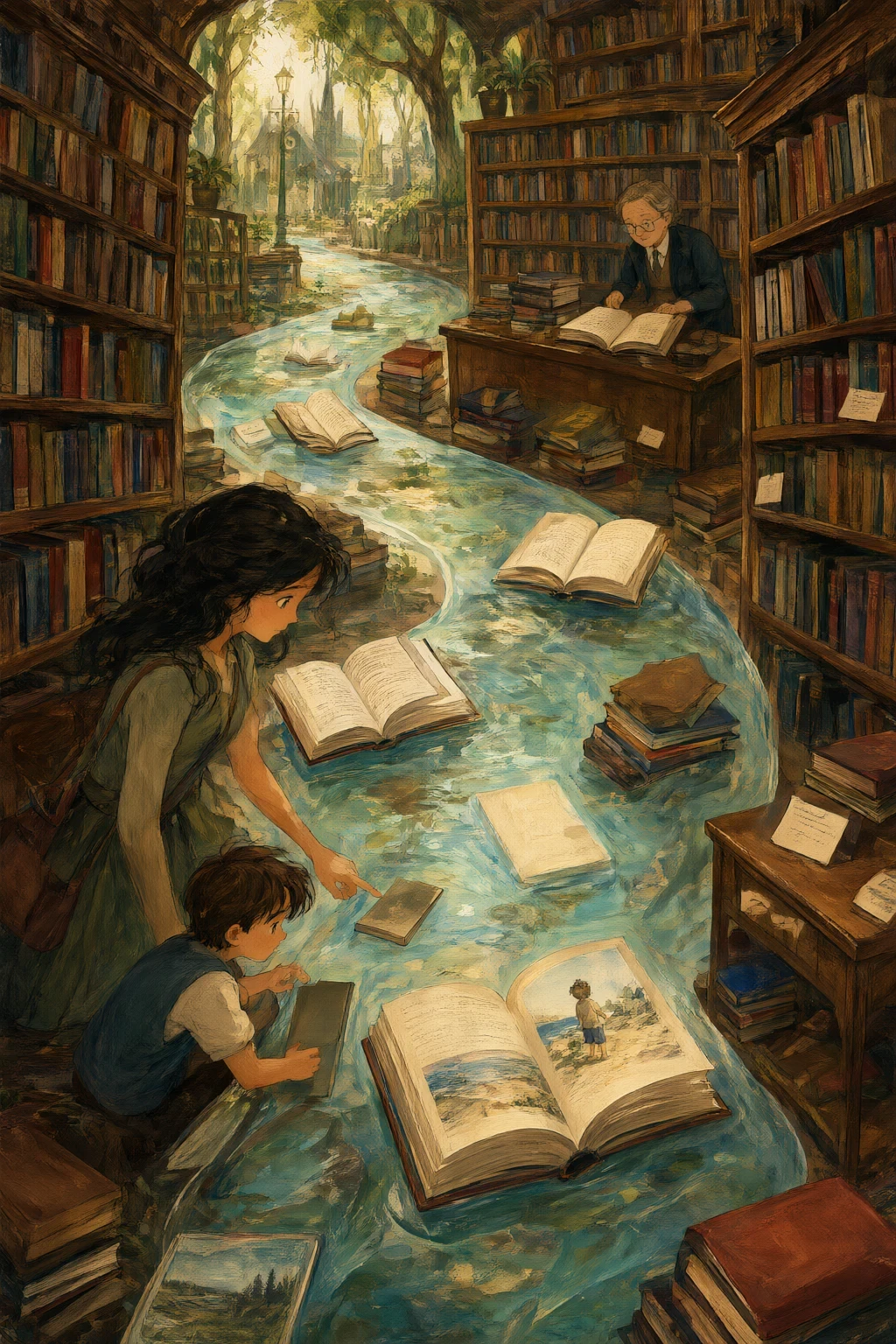
The River Orra did not knock on the library door. It sent a pebble inside. The pebble rolled across the reading room, passed between the tables, and stopped beneath the desk of Neri Bell, the youngest librarian on duty. It was wet, smooth, and shaped like a small gray fish. When Neri touched it, the library lights dimmed. A voice made of rain against windows said, “I would like a card.”
Neri looked around. The other children were reading. Outside, Orra flowed past the stone embankment, carrying leaves, fish scales, and a red thread from a child’s kite. “Is that you?” Neri whispered. The river answered by filling a fountain pen with blue ink.
Neri pulled out an application form. The first question asked for a legal name. She wrote Orra River. The second asked for a home address. The river filled in the entire valley. The third asked for a guardian. The ink made a small, patient mark that looked like a stone with two eyes. “Who can sign for you?” Neri asked. The rain tapped against the windows.
Neri had never thought much about legal personhood. She knew that children became adults at eighteen, that businesses had seals, and that anyone could borrow a book. She did not know how to borrow when the borrower was a river. The librarian in charge, Mrs. Vale, found her at the desk. “Is there a problem?”
Neri slid over the form. Mrs. Vale read it twice. Then she checked the old rules: no pets, no food, no wet books, and no borrower who could not be fined. “The river is not a pet,” Neri said. “The river is not a person either,” Mrs. Vale replied. “Not on the form.”
Outside, the water rose a finger against the embankment. A boy at the window pointed. The river had begun to repeat the word card in the rhythm of waves. Mrs. Vale folded the form. “Bring it to the town library board. But do not promise the river access.” Neri looked at the pebble. “Can a person be refused because the form is incomplete?” “They can appeal. That is different.” The words made Neri’s face hot. She knew the difference when it favored her.
The library board met on Thursday in the basement with the damp smell of old maps. Seven adults sat behind a long table. Neri carried the form. The River Orra had sent a second pebble, this one with a chip of green glass in its center. When Neri placed it on the table, the basement filled with the smell of rain. Mayor Pelloran said, “The river cannot read.”
“Books can be read aloud,” said Neri. “Water cannot enter a library.” “It already has.” A lawyer named Iven looked through the rules. “There is a category for schools, clubs, and organizations. The river could be represented by a watershed council.” “Which council?” Neri asked. Iven glanced at the papers. “The council that manages the water.” “So the manager would speak for the river?” “It would be the practical arrangement.”
Neri looked at the pebble. “That is not representation. That is a microphone with a government stamp.” The room became quiet. Some people shifted their chairs. A farmer named Tovan said, “The river is useful. It carries drinking water, irrigation, fish, and trade. It has rights to be protected.” “Those are uses,” Neri said. “They are not the same as its wishes.” Mrs. Vale raised a hand. “And what are the river’s wishes?”
The rain began again. It was soft, then heavier. Water slipped under the basement door and made a dark line across the floor map of the valley. Neri put her palm on the line. She saw not pictures, but pressures: a dam deciding where a fish went, a drain carrying factory perfume, a child’s laughter carried downstream without anyone asking. The vision ended. Neri’s hand was wet.
Orra said, “The stories in your building are mine until I say otherwise.” Several adults looked alarmed. A storyteller named Lio said, “A story becomes someone’s work when they write it down.” “Some stories came from my memory,” the river replied. “You kept the names. You left the river out.” Neri read the application again. At the bottom was a box marked BORROWER AGREES TO RETURN MATERIAL UNDAMAGED.
“The river wants its stories returned,” she said. “Not the words,” Lio said. “The words are the writer’s work.” “Then it can have the memories,” Neri said, “and the writers can keep their words.”
The board agreed to hold a trial. Orra would receive a temporary card, but only after a hearing on what the card could mean. Neri read the trial rules aloud. The river could not remove books, enter restricted rooms, or demand a person’s private letters. It could request stories that recorded water, floods, fish, or the river valley.
People who had used Orra’s memories without permission could answer questions about their work. A human advocate could speak for the river when the river could not speak into a microphone. Mayor Pelloran objected to the last part. “Who decides when the river cannot speak?” “The river decides with a group of people it chooses,” Neri said. “Choose? Rivers cannot choose.”
Orra’s voice rolled through the pipes. “I choose what enters my mouth. You should know the difference.” Neri had learned this in the library: a person’s silence can mean fear, respect, inability, or a choice not to speak. A river could speak in flood and drought, in temperature, in the sudden stillness after pollution. It was not less truthful because it did not use words.
A week later, the hearing filled the reading room. Neri sat beside the table. The River Orra appeared in a shallow basin brought by the children’s science club. Water trembled whenever someone lied. A fisherman said the river had ruined his nets. A woman who ran a mill said the river had supplied her family for three generations.
A girl named Iri brought a stone from the bank and placed it beside a poem about a fish. The poem was beautiful. The poem was wrong. It said Orra had “always been gentle.” Orra’s water turned the color of iron. “I flooded the lower field. I broke the bridge in 1984. I froze the pipes on Bridge Street. You must tell those things too.”
The fisherman said, “Water cannot be blamed for water.” “Then blame the people who poured the dye into me,” Orra replied. “But do not pretend I was innocent.” Neri wrote down every claim. She felt the old temptation to smooth the edges. The library board wanted a story with a hero and a problem. The river offered a thousand overlapping ones. She kept the overlap.
The trial card said that Orra could borrow from the local history room and request a review of stories about the valley. It could not take private letters or demand ownership of every image made beside the water. Its requests had to be answered within thirty days. A group of residents would serve as its temporary advocates, but any advocate could be removed by a public process.
Neri asked, “What happens if the board refuses a request?” Orra’s basin rippled. “Then I appeal.” “To whom?” “To the people who read the record.”
Neri began the review with Lio. His story “The Blue Door” used a memory Orra had shared: a child’s red kite caught in reeds, recovered by three sisters. He had changed the river into a road and the sisters into heroes. The river remembered the actual child. A boy named Tavi had lost the kite while trying to retrieve a trapped frog.
Lio defended the change. “A story has to be shaped.” “Shape it without saying the river was not there,” Neri said.
Lio rewrote the piece. He kept the sisters. He added Tavi, the frog, and the reeds. At the end, he wrote: The river carried the kite down until the boy found it. The river did not choose to return it. A human hand did. When Neri read the new version aloud, Orra’s basin went still.
Another book called the valley “empty before the settlers.” Orra provided a list of names: herons, foxes, sturgeon, reeds, and the people who had lived along the bank long before the town existed. The librarian could not erase every old book that had made an error. She could place notices beside them, invite corrections, and begin a shelf marked VOICES OF THE VALLEY—WITH PERMISSION.
Permission was not only a question of ownership. A story could be true and still cause harm if it turned a living being into scenery. Neri learned to ask not only, Who owns this story? but also, Who has the power to speak, and who bears the consequence when they are spoken for?
The board’s permanent decision came on a wet Tuesday. Orra received a library card with a blue wave at its edge. The card permitted access to the history room, a private listening room, and a place in the public archive. The river would have a seat on a new water-and-memory council. The council would include fishers, farmers, librarians, young people, and representatives invited by Orra itself.
Its first work would be reviewing the valley’s flood plan and the stories used in schools. Neri was not chosen as Orra’s permanent voice. The river chose Mrs. Vale, a hydrologist named Sefa, and a quiet girl named Pomi who had been recording water sounds since she was seven. Neri was chosen to keep the library record. She had learned that being useful did not mean being in charge.
On the first evening of the new council, someone asked Orra what it wanted the public to know. The rain began outside, but the reading room stayed dry. The water in the basin rose one clear inch.
“This is not a story about a river,” Orra said. “This is a place where a river and a town have to learn how to live. Sometimes the town will flood. Sometimes the river will carry away what the town built. Sometimes both will be changed. Do not ask me to be only kind or only dangerous. Ask what can be repaired, and who gets to help.”
Neri filed the hearing record. On the shelf, the old stories waited beside the new notices. The river had a card now, but it was not a magic ending. It was an opening with a signature line, a review date, and room for disagreement.