The register of the town carries four pounds a year against the nine acres of the third stand, and it has carried it since the fourteenth of October, 1864, and the roll of the third stand has no covenant of 1864 in it at all. Ivo Colm found that out in the second week of November, on the fourth sheet, in the column headed holding bound, and he did not go on to the fifth sheet, and he sat in the roll room above the tithe barn until the lamp wanted trimming and then he trimmed it and sat on. He had read that sheet in October and had read the pound a year of 1887 and had not gone further down the column, because a collation sets covenants against holdings, and a sum of money is not a covenant. The four pounds of 1864 was eleven lines below the pound of 1887 and in a different hand, and had been in that column for thirty-one years, and a clerk who looks for a fourth thing in a column of three finds it in November and not in October. He wrote the query in the margin of the fourth sheet in the smallest hand he has, which is the hand he uses for things he is not yet prepared to say out loud. Item. Fourth sheet. The register carries four pounds the year against the nine acres of the third stand, entered in the hand of 1864, and continued in eleven hands to this date. The roll of the third stand for the year 1864 is searched and contains no covenant. Where is the covenant, or who entered the charge, and on what authority.
The third stand is the third house in the row from the town end, and its holder was forty-seven years old and had held it twenty-two years, and his name was Tam Kelder, and he was the only one of the seven who could read. He was also the only one of the seven who counted the doorways he came through, which he did by lifting his left foot and setting it down again on the sill, and had done since he was a boy, and had never given a reason, and the row had a theory that the counting began in his sixteenth year and that the reason had to do with a night, and nobody had ever asked him, and asking him was the sort of thing that in Coldhay is not a question anybody asks twice. Ivo Colm asked him once, on the Monday, in the row, in the open, where there is no roof. The row of seven stands has no corridor. It is seven houses in a line with their backs to the town and their fronts to the nine-foot boundary wall, and there is eleven feet of grass between the wall and the front doors, and a man can stand in that eleven feet and see a hundred and forty yards in one direction and not see over the wall in the other. “The register says four pounds a year on your nine acres since 1864,” said Ivo Colm. “The roll says there was no covenant in your house in 1864. One of those two things is a mistake and I would like to know which.” “Ask the fifth.” “Why the fifth?” “Because you will ask the fifth anyway, and because the fifth has it in a book.”
There is no book in the fifth stand. There is a roll in the chapel press above the tithe barn, and there are the tithe barn’s own accounts, and there is the register, and there are the four hundred years of the boundary rolls, and there is a market book, a wool book, a quarry book, and a burial book, and there is not a book in the fifth stand and there is not a book in any of the seven, and the holders of the seven do not write, with the single exception of the third. That is the whole of what the town knows about the third stand’s books, and the town has known it for twenty-two years. The fifth stand has the charge of 1864 in the register in the fifth stand’s own hand, and the register is a book, and that is the book Tam Kelder sent Ivo Colm to, and it took the clerk a fortnight to see that the two sentences he had been given on the Monday had been about two different books.
Halla Dree asked the same question in four houses in one year, and had had four different answers, and had stopped counting which of the four she was in, which is the only part of it she admitted to. Her question was this. On the eleventh of March, 1894, in a house in this row, a covenant was made between the holder of the fifth stand and the holder of the second stand, and the term given under it was that the fifth stand’s north-end strip and byre should be the second stand’s for the term of one year, and the holder of the second stand was asked to complete it and did not, and the holder of the second stand is Halla Dree.
She had asked the fifth, and the fifth had said that a covenant binds the speaker’s holding in the house where it is made, and that if it was made in the fifth stand then it is our strip and our byre that are in question, and would not say which house, and said that a house does not say. She had asked the fourth, and the fourth had said that he did not know and that nobody knew, and that a thing nobody knows about cannot be asked about at the market. She had asked the first stand, and the first stand had said that he has been asked the same question seven times and has answered never, and that he will not be asked an eighth, and had said it kindly. And she had asked the seventh, and the seventh had said that she had been asking the wrong question for a year and had better ask it in a room, and had not said which room, and had gone back to his fire. So she had four answers, and the four answers were all true, and they were all true about different houses.
She came to the third stand’s door on the sixteenth of November at four in the afternoon, with the light behind her and her back to her own wall, which is a thing she does, and which is a thing a person does who has spent a long time in rooms where the door is the only way out. “In which house was it made,” said Halla Dree. “The eleventh of March, 1894. I have asked four men and I have four houses, and I am asking you because you are the only one of the seven who writes.” Tam Kelder stood in his doorway with the door open behind him and the kitchen behind that, and the hearthstone in the ash, and the row behind him with the light on it, and he did not answer for a while, and Halla Dree waited, because her habit is to ask her questions in the exact words she was asked and to wait for the exact answer, and a woman who waits for an exact answer in a doorway in the row is a woman who will wait there until it is dark. “If I tell you,” said Tam Kelder, “I will have said a word under a roof with a witness in it.” “You will have said a word in a doorway.”
“There is a roof over the door. There is a roof over this house. You are standing under it and you are awake and you are not the other party, which makes you a witness, and I am the holder of this house, and a word I speak binds my nine acres in this house for a year from today. That is what you would be asking me for, and you would be asking me for it on a Monday, in the open, where there is no roof, and if I said it in the open it would be worth nothing, and if I said it under the roof it would cost me a year of my ground, and you did not think about that, and I have thought about nothing else for four years.” “I thought about it,” said Halla Dree. “I thought about it in the second house, and the fourth, and the sixth, and the fifth, and you are the fifth house I have asked and the only one who has told me the price.”
The words went into the row and the row did what the row does, which is to keep them. What the row knew by the twentieth of November was this. That the third stand’s holder had a book. That Halla Dree wanted the house of a covenant of 1894 out of it. That Ivo Colm had found four pounds a year on the third stand’s nine acres with no covenant behind it. That the third stand’s holder had said, in eleven feet of open grass, with the wall nine feet high on one side of it and no roof anywhere above it, a sentence that was true, and that the sentence had cost him nothing, and that it had also told the whole row that there was a book. The row is seven houses and eleven feet of grass and a wall, and there is no other way to walk up it, and everybody in it walks up it every day, and there is no arrangement of a person’s day in Coldhay by which a book stays a book for a month.
Tam Kelder brought it on the twenty-first, wrapped in a piece of sacking, and he gave it to Ivo Colm in the roll room and not in his own house, and Ivo Colm understood that before it was explained to him, and had known it since the seventeenth of November, and had said nothing, and had read the four lines of 1902 approximately nine hundred and forty times. The roll room is one chamber over the tithe barn with one window facing north and a press of four hundred years along the north wall and a desk with a brass arm and a green-black ink and a blotter that has been blotted with the same cloth since 1871. There is no hearth in the roll room. There is no hearth in the tithe barn either, and no hearth in the office of the wool yard, and there are four rooms in Coldhay with no hearth in them, and they are the four rooms in which nothing that anybody says binds anybody, and every person in Coldhay who has ever been in trouble has known that within a year of arriving.
A house in Coldhay is a house with a hearth in it. The hearth is the thing that makes the house. Not the door, and not the walls, and not the name over the door, and not the willingness of the person inside it. The hearth. Seven hearths in this row and no more, and the other forty-one houses in Coldhay are houses to live in and are not houses in the sense that the law uses, and this is not a distinction anybody makes at a market. So the book was read in the roll room, and read as a book, which is a thing that is read and not a thing that is said.
It is smaller than a man expects. That is the first thing about it. It is half a sheet of paper folded twice and bound with a tape of linen through a hole in the corner of each leaf, and the tape is black with the grease of a hand, and the leaves are ruled in a hand that was not a clerk’s hand and is not now. The rule on the inside of the front cover is in the same hand and reads: the day, and the house, and what was said, and the witness, and where the witness’s hands were. Nothing else. No notes. No opinions. No sums. The first leaf is dated the fourteenth of October, 1864, and the last dated the third of November, 1890, and between them there are two hundred and nine leaves written on and eighty-one left blank, and the four years from 1890 to 1895 are blank at the end, and the reason is not entered, and Tam Kelder did not offer one.
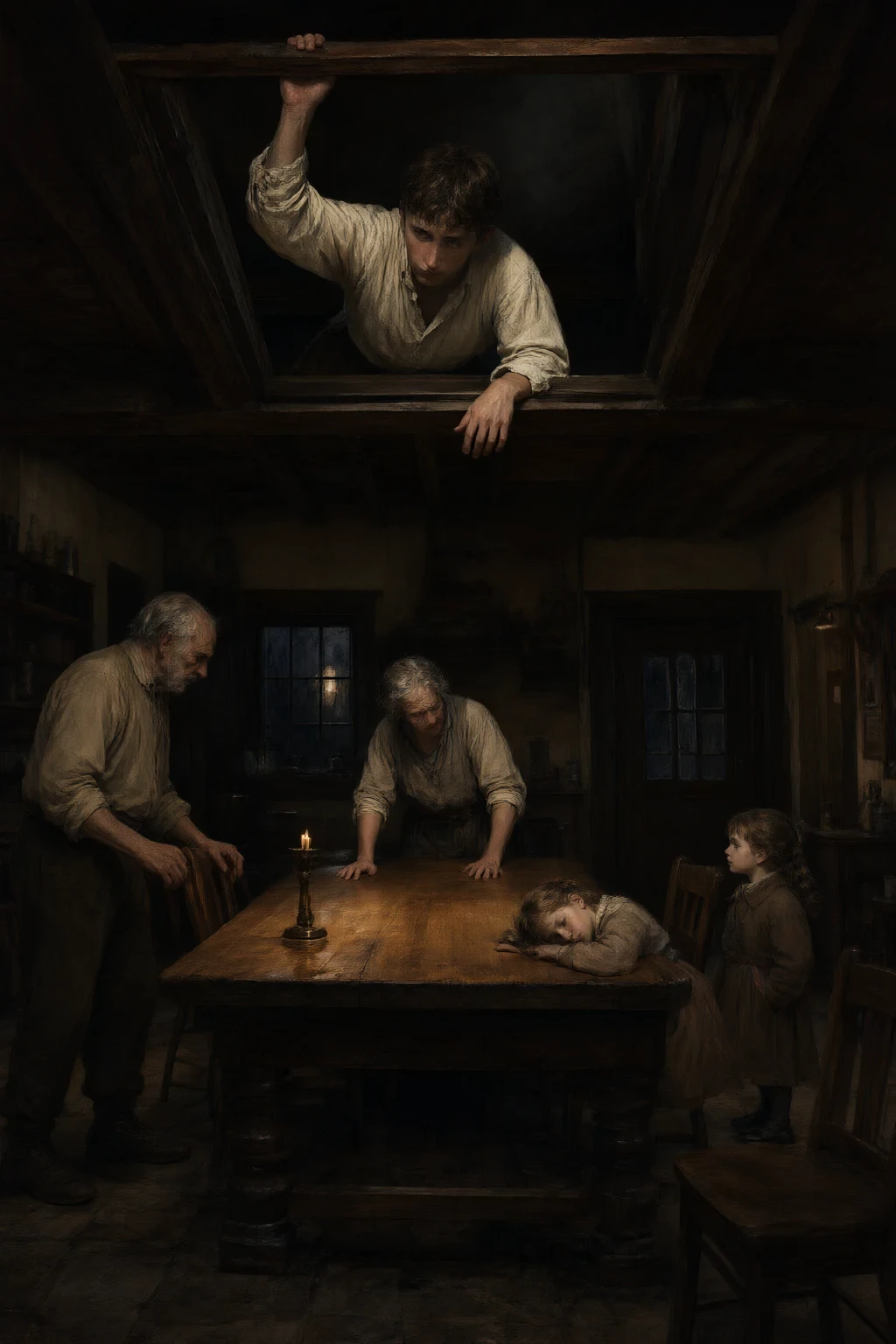
“It begins on a night in October 1864,” he said. “I was sixteen. I had been in the third stand since I was eleven. The whole row was awake and the six of them were in this house, in this room, from the hour of the supper until about two, and they were doing what they do, and I was in the loft with the hatch open, and I am the only one of the seven who can read, which is not a thing anybody taught me and is a thing I found out about on that night.” “You were sixteen.” “I was sixteen and I could read and there were six men in a room who could not, and one of them said, in a voice I would know again, put that down, and I put it down.”
Halla Dree’s leaf is the third from the end that is written on, and the hand on it is older than the hand on the 1890 leaf by about nine years, which is a thing you can see and cannot measure. Item. The eleventh day of March, 1894. In the fifth stand, the holder of the fifth stand gave a term, which was, that the north-end strip and the byre of the fifth stand should be the second stand’s for the term of one year. The holder of the second stand was asked to complete it and did not. Witness, the woman of the seventh stand, both hands on the table. Halla Dree read it twice, and she was a woman who asks questions in the exact words she was asked and waits for exact answers, and she asked none, and she sat down on the end of the desk with the edge of her hand on the leaf, and did not touch the ink. “The fifth stand,” she said. “The fifth stand.” “The chair in my own kitchen has nothing to do with it, and I have been sitting on the edge of my own bed for four weeks trying to make it have something to do with it. I am not a fool about the law. I am a fool about rooms.” “That is the same question,” said Ivo Colm. “It is the same question.”
“A term can be withdrawn by the person it was given to, and only by that person, and only in the same room, alone, unprompted, and out loud. A withdrawal asked for, hinted at, or obtained in company is not a withdrawal. You have been asking four men for a house, and the house is a term of your own withdrawal, and you cannot ask.” Halla Dree looked at the leaf for some time. “Then I cannot ask you for the house either,” she said. “That is what you said on the sixteenth.” “That is what I said on the sixteenth.” “And on the twenty-first you gave it to me in a room with no hearth in it, which is the only way it could be given.” “That is the only way it could be given,” said Tam Kelder, “and I have known that for four years, and I have not done it, and you can put that in your own book if you keep one.”
The 1864 leaf is the first leaf, and it is the only leaf in the book that is written on both sides, and the other side is where the rule is repeated because the first leaf had no room on the front. Item. The fourteenth day of October, 1864. In the third stand, the holder of the third stand gave a term, which was, that the foundling kept in the back room of this house should be the third stand’s, and that four pounds the year should be the fifth stand’s for the term of one year, and that the fifth stand should have nothing further to do with her. The holder of the fifth stand accepted. The foundling consented. Witness, the woman of the sixth stand, both hands on the table. Three voices in one paragraph, and the third of them was a child of seven years who was asleep at the other end of the same house with the door open. The fifth stand is the Ottery house, and a girl of nine sleeps in its back room four nights a week under a covenant made in another house. The foundling of 1864 was found in the Fosse way cut in 1861 and was gone from this row by 1871, and the roll has nothing further about her, and the register has nothing, and there is no glass in a house she is not in.
Ivo Colm read it and then put his hand flat on the blotter, which is a thing he does instead of swearing, and then took his hand off it again. “There is no covenant of 1864 in this roll,” he said. “There is no covenant of 1864 in this roll,” said Tam Kelder. “The register has four pounds a year against nine acres of this stand from the fourteenth of October, 1864, and it is in eleven hands, and the first of the eleven is the fifth stand’s hand, and the fifth stand entered a charge for a covenant that does not exist.” “Yes.” “Who wrote this leaf, Tam.” “I wrote this leaf.” “You were sixteen.” “I was sixteen and I was in the loft with the hatch open and I was awake, which nobody in that room knew, and I was the only one of the seven who could write, and the fifth stand’s holder said the words of her part, and the third stand’s holder said the words of his, and then both of them turned round and looked up at the hatch, because they wanted it in a book, and one of them said, put her name to it. And I put her name to it.” “The child was asleep.”
“The child was asleep from the hour of the supper. She was asleep on the flags at the end of that room with her coat over her and her head on her arm, and I had gone down the ladder twice to look at her, because she had been crying and then had not been crying, and the second time I went down she was asleep, and I went up again and I wrote her consent, because they were both standing there waiting, and I was sixteen, and I could not think of any other way the sentence was going to end with everybody in it.”
Nobody said anything for some time. The press stood along the north wall with four hundred years in it and the lamp made a small weather of the gold on the spines, and the blotter had a mark on it where a hand had been. “Then there was no covenant,” said Ivo Colm. “There was no covenant.” “Nothing said by a sleeping person binds anybody. Nothing said to a sleeping person is a covenant. And the terms of a covenant are the terms that have been given and accepted, and the consent of the child was a term, and it was not given, and it could not have been given, and the covenant of 1864 was not made and could not have been made.” “That is what the book says,” said Tam Kelder. “The book says it was made. The book is wrong. I have known it was wrong every day since the fifteenth of October, 1864, and I did not know that I knew it, and I have never used the book, and I have never told anybody, and I have had four pounds a year on my nine acres since that week and I have never once asked why it was there.”
Here is the cold part, and it came out of the rubric sheet, which is a printed sheet of the year 1871 with the ten rules on it in the order and wording of the year 1871, and it has a table of contents to it and a list of the felonies and a note on the glass, and Ivo Colm keeps it on the desk under the blotter and has read it more often than he has read the 1902 hand. Rule eight is that a foundling holds nothing and is owed by everybody, and that a gift to a foundling is the only gift in Coldhay that cannot become a covenant, because there is nothing to encumber. “If the covenant of 1864 had been made,” said Ivo Colm, “it still could not have been a covenant.” “No.” “Not a defective one. Not an incomplete one. A covenant cannot exist, because the thing it was doing was giving, and a gift to a foundling cannot become a covenant, there being nothing in her to encumber. Rule eight. The fifth stand’s holder knew that. She sat in that room in 1864 and she knew it as well as you do, and she entered four pounds a year on the register for thirty-one years, and she did not take one penny of it.” “She kept it,” said Tam Kelder. “It is in a box in the fifth stand under the bed and it is four pounds a year for thirty-one years, and it is in a japanned tin, and nobody has ever opened it, and I have seen it because I have been in that room, and I have not told anybody, and that is the second thing I have not told anybody in thirty-one years.”
The other half of the business took eleven weeks and it is the part that is done in the roll room and not in the row. A private book is not a record. Ivo Colm said so on the twenty-fourth of November and he said it three times in the same afternoon, to two men and once to the window, and he was right, and the reason he was right is on the fly leaf of the quire in the hand of 1902, which says that the roll is not the account, that the account of a house is the glass of that house, and that the roll is but the copy, and the copy is good until the glass is read. The book is not the copy either. The book is a third thing, and it is a thing kept by a man in a coat lining, and its value is not in doubt and its authority is nothing whatever. A record is only as good as the hand that kept it, and the hand that kept this one was sixteen. So the book could not be used to strike the charge, and could not be used to make the covenant, and could not be entered, and could not be produced at the quarter court, and nobody in the chapel had ever heard of it and nobody in the chapel was going to. What it could do was tell a clerk where to go and what to look for, and that is a thing a private book is very good at, because a private book is made out of what one person saw with his own eyes, and there are not many of those in Coldhay and they are not written down anywhere else.
The glass of the third stand is a pane of the door and it is not old. The third stand was built in 1761 and the door was replaced in 1849, and the pane is a common pane out of a glazier’s cart, and the house has kept it the way the fourth stand keeps its door, which is the way every house that has kept a glass for any length of time keeps it, without knowing that it was keeping anything. Whoever goes out with a hand on the latch wipes the pane at the height of their own face with the heel of that hand, once, and not twice, on the way out. The reading of a glass is done in the house, in the presence of two holders, and the clerk reads and nobody speaks, and the reason nobody speaks is that the reading of a record in a house with a hearth in it is a performance of the record, and the performance of a record is the making of it again, and a man in Coldhay who cannot see the difference between a record and a covenant is a man who will find out about it in front of witnesses.
So the third stand’s kitchen on the ninth of December had Ivo Colm in it with a lamp and a sheet of foolscap, and the holder of the third stand, and the holder of the fourth stand, who had been asked and had come, and Halla Dree, who was not a holder and had no standing and was asked to stand in the doorway because a doorway in a house in Coldhay is part of the house, and stayed there for an hour and forty minutes. Nobody spoke. Ivo Colm read the pane in silence, and wrote as he read, and his hand was the hand of 1896 and it was writing down a thing said in October 1864, and the two things were a hundred and thirty-one years and three months apart and the ink was the same ink.
The glass of the third stand holds what was said in the third stand, and what was said in the third stand on the fourteenth of October, 1864 was this, in the order in which it was said, and the glass does not put things in order of importance, it puts them in the order they were said, which is the one respect in which it is exactly like a man. The holder of the third stand, speaking: the whole of the term, the foundling and the four pounds and the fifth stand having nothing further to do with her, and it was said in a low voice, and a chair was moved twice. The holder of the fifth stand, speaking: accepted. The woman of the sixth stand, who was the witness, and who is eighty-one years old, and who has never been asked about any of it: she said nothing. There is nothing on the glass for her. She was a witness and a witness is a person awake, of an age to know, and not a party, and a witness is not obliged to say anything at all, and hers was the two hands on the table that Tam Kelder wrote down because he could see them from the hatch. And then the holder of the third stand said, put her name to it. And then there is nothing for thirty-one years.
The glass is not silent about a child. That is the point of it and it is the reason the law trusts a glass above a roll. A glass reads back what has been said in that house, and a sleeping child is in that house, and everything said in that house while she slept is in the glass, including a man saying put her name to it, and including the woman of the fifth stand saying that the child would say yes in the morning. That last sentence is on the glass, and it is the last thing on the glass for the year 1864, and Ivo Colm copied it out in full, and then he read on to the next sentence on the pane, which is a matter of a boundary stone and is of the second of March, 1878, and between the two there is nothing whatever, and the nothing is the whole of the finding.
The entry went in on the fourteenth of January. Item. Third stand. The register carries four pounds the year against nine acres, entered in the hand of 1864 and continued in eleven hands. There is no covenant. The charge is struck in the sum of one hundred and twenty-four pounds, and the register is to carry no sum against the third stand in respect of the year 1864 or any year following, the same being an entry of money and not an entry of law. The one pound the year entered in 1887 for the use of the back room of the fifth stand is not touched and is not questioned, being a licence and not a covenant, and being a thing that none of the ten rules on the sheet of 1871 has anything to say about. Then Ivo Colm wrote the line he had thought about for seven weeks, and it is the only line in four hundred years of the roll that is in the first person, and it is the only one anybody has ever had to think about for seven weeks.
Item. I would note to the clerk that comes after me that the account of this matter was not in the roll, and that I have put it in, and that the glass is the account and the roll is the copy, and that if the copy and the glass ever differ again the glass governs and not the copy, and that I have said so here because in November I had a sheet in my hand that said the reverse about a hand in 1878, and did not know it, and the man who wrote 1878 was in his chair for eight years and was not a thief, and I was in mine for thirty-one and nearly was.
The fifth stand’s holder came on the fifteenth with the japanned tin. She put it on the table in the roll room, which is a room with no hearth in it, so that nothing she said in it would bind her, which everybody in that room understood and nobody mentioned, and she opened the tin, and there was thirty-one years of four pounds a year in it in sovereigns and half sovereigns and a great many sixpences, and it came to one hundred and twenty-four pounds, and she counted it onto the table in four goes and it took a long time, and nobody helped her, because a person who counts a sum like that out on a table in front of witnesses is paying, and there was nothing to pay. Then she said: I will take it back. Which is not a discharge, because a discharge is the lender saying I take less, out loud, in the lender’s own house, in front of a witness, and it is done about four times in a century, and the three people at that table stopped, and then each of them understood that there was no covenant, and that the tin was not a debt, and that the words had been said in a room with no hearth in them, and that they were therefore nothing at all, which was the intention. And the fifth stand’s holder took the tin back and put the lid on and said, that is the first time in thirty-one years anybody has let me say a sentence of more than three words in a room with a clerk in it, and she went out, and the door does not lock, and it does not lock anywhere in this row.
The book went back into the coat lining on the eighteenth of January, and the lining had to be let out at the shoulder for the second time that winter, and the stitch is not the twelfth, it is the first of a new row, because a man who has been carrying a thing for thirty-one years and has put it down and picked it up again does not go back to the middle of a row of stitching, he starts a new one. Halla Dree was in the row on the twentieth, and she had not asked Tam Kelder a single question about the 1864 leaf, and everybody in the row had expected her to, and she said afterwards that she did not need to, because a woman who asks questions in the exact words she was asked and waits for the exact answer had been given an exact answer by a man in a room with no hearth in it, in front of a clerk, and had not needed it twice.
The girl of eleven was at the third stall post in the tithe barn yard on the fifth of February, with her hat turned up twice, and she had heard the whole of the 1864 business from a carter who had heard it from a man who had been in the row, and she had one question about it, and she asked it of Ivo Colm in the open, where nothing binds anybody, which is the only place in Coldhay where an eleven-year-old can ask a real question and get a real answer. “There was a girl asleep,” she said. “In the book. It says she consented. Who was it for?” “It was for the third stand.” “It was for the woman of the sixth stand,” said Ivo Colm. “It was four pounds a year and the finding of a tin under a bed, and all of it was for the woman of the sixth stand, and the woman of the sixth stand is eighty-one years old and has never been asked about it, and I am not going to ask her, because she was a witness, and a witness is not obliged to say anything at all.” Wren Sallow turned her hat up a third time, which she does when an adult looks at her, and Ivo Colm looked at his boots, and the girl thought about it for as long as it takes to count eleven.
“Then who was the girl asleep for?” she said. And Ivo Colm quoted the previous entry exactly, and waited, and it did not finish itself, and there was nobody else in the tithe barn yard to finish it, and the north light came off the barn wall and went along the setts and the market was over and the row was shut and the wall between the row and the pasture was nine feet high and could not be seen over and could not be heard over, and Tam Kelder came across the grass that evening with his coat buttoned to the neck, and he counted the doorways he came through, and there were two, and he had not counted two before.